Executive Overview
In the typically predictable realm of enterprise software, companies reaching massive scale are expected to slow down. Gravity catches up with everyone. Revenue run-rates cross milestones, law-of-large-numbers deceleration sets in, and growth curves flatten out.
Databricks has officially rewritten the rulebook.
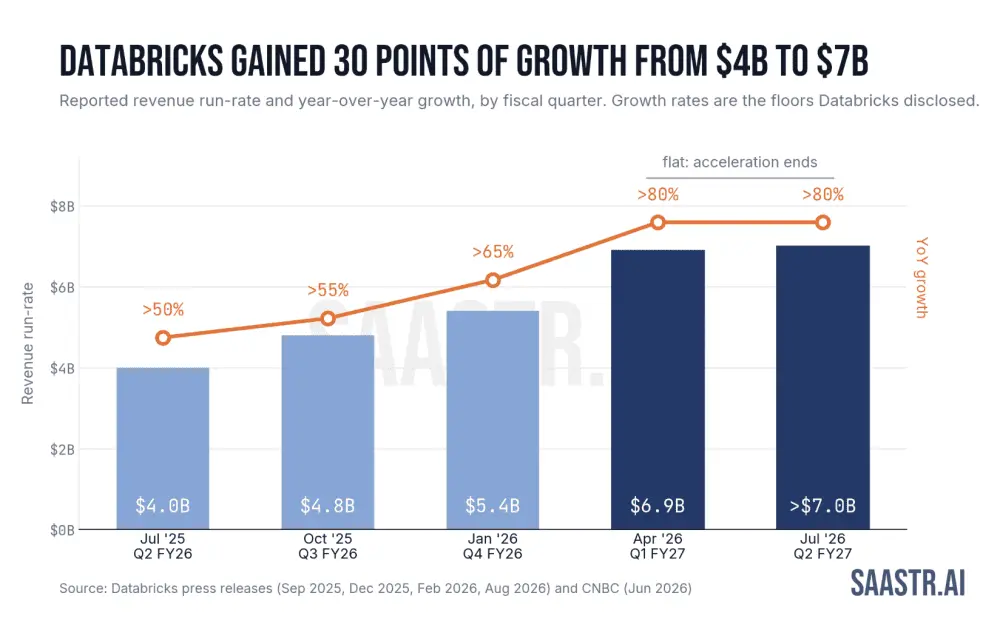
The data, analytics, and AI infrastructure giant announced that it crossed a staggering $7 billion revenue run-rate in Q2, growing at an astonishing 80% year-over-year. Simultaneously, the company closed a mammoth $5 billion strategic funding round led by Coatue, valuing the private enterprise at an eye-watering $190 billion. While the headline valuation will dominate mainstream financial news, the truly unprecedented story lies beneath the surface: Databricks has managed to actively reaccelerate its growth curve at a multi-billion-dollar scale, defying decades of SaaS financial precedent.
This deep dive unpacks the six structural pillars defining Databricks’ current trajectory—from its market-share victory over Snowflake and the margin-compressing realities of agentic AI, to a disciplined valuation multiple and a deliberate strategy to stay private while executing high-velocity M&A, such as the acquisition of ElectricSQL.
Detailed Chronology: The Road to $7 Billion and a $190 Billion Valuation
To understand the magnitude of Databricks’ current position, one must map the velocity of its recent ascent. The past four quarters have witnessed an acceleration curve that industry veterans call virtually unprecedented for B2B software of this size.
The Acceleration Arc
Four quarters ago, Databricks was operating at a respectable—yet standard for elite tech—50% growth rate on a $4 billion run-rate. Over the subsequent year, rather than tapering off into the 30% or 40% brackets, the company’s year-over-year growth climbed steadily, peaking at over 80%.
While the most recent quarter held flat at 80% rather than climbing higher, this represents a completed, highly aggressive growth arc. Growing at 80% when your baseline is $7 billion means adding billions in absolute new revenue annually—a feat unmatched across the enterprise software landscape.
The Snowflake Shift
The competitive dynamics of the data infrastructure market have experienced a definitive tectonic shift. Both Databricks and its primary rival, Snowflake, close their fiscal years on January 31, allowing for direct quarter-by-quarter comparison.
According to product revenue tracking and self-reported run-rates, Databricks surpassed Snowflake in the October 2025 quarter and has steadily widened the gap ever since.
- The Methodology Nuance: Financial purists note that this comparison is not entirely apples-to-apples. Snowflake’s figures represent audited GAAP revenue, whereas Databricks operates as a private company utilizing self-reported run-rates.
- Snowflake’s Continued Health: It is vital to note that Snowflake is far from troubled. Demonstrating robust health with 34% product revenue growth, a 126% net revenue retention rate, and a raised full-year guide of $5.84 billion, Snowflake continues to add roughly $1.8 billion in net new product revenue annually.
However, Databricks won the overarching company-level race by aggressively expanding into adjacent AI infrastructure categories—such as Lakebase, Genie, Agent Bricks, and the Unity AI Gateway—that Snowflake historically has not sold. Lakebase alone surpassed a $100 million run-rate this quarter from a standing start, cementing Databricks’ dominance in the AI data stack.
Supporting Context & Metrics: Agents, Margins, and Expansion Loops
A closer inspection of Databricks’ financial and operational mechanics reveals how the business model is adapting to the dawn of agentic artificial intelligence.
Agents Drive the Revenue and Eat the Margin
At the Data + AI Summit, Databricks CEO Ali Ghodsi offered a candid look into the operational friction caused by modern AI. Gross margins are feeling pressure because autonomous software agents generate exponentially more queries than human users ever could.
"It’s the consumption-based business model, agentic AI coming. The agents are generating way more queries." — Ali Ghodsi, CEO of Databricks
For consumption-priced infrastructure vendors like Databricks, this translates to massive revenue capture alongside gross margin compression. Agents hit database accounts an order of magnitude more frequently than human analysts.
For software leaders watching this trend, the lesson is clear: if your pricing model is tied to consumption or value extraction, your infrastructure must survive a world where automated agents bombard your system 50 times for every single interaction a human used to initiate. Per-seat SaaS vendors bundling AI into flat pricing tiers face an even harsher margin reality.
Land-and-Expand Dominance
Databricks’ growth is not coming from a frantic land grab of new logos; it is fueled by astronomical expansion within its existing enterprise footprint.
With over 70% of the Fortune 500 already utilizing its platform, the company’s explosive revenue leaps are driven by accounts graduating into higher-tier brackets—notably the elite cohort of customers generating eight figures ($10 million+) annually, a group now numbering well over one hundred logos.
The Valuation Multiple Discipline
Perhaps the most fascinating metric of the latest $5 billion round is the discipline of the valuation multiple. Across three major funding events, the market’s pricing of Databricks has remained remarkably anchored:
- September 2025: Valuation above $100 billion on a $4 billion run-rate (~25x multiple).
- February 2026: Valuation at $134 billion on a $5.4 billion run-rate (~25x multiple).
- Today: Valuation at $190 billion on a $7 billion+ run-rate (~27x multiple).
While the company’s valuation has surged by 90% over eleven months, the multiple has barely moved. The market is not inflating a speculative bubble; it is consistently paying 25 to 27 times run-rate for a business whose revenue is physically materializing on the balance sheet.
Official Statements & Strategic Moves
Databricks’ leadership is pairing financial muscle with aggressive, targeted technological expansion. On the exact day of the funding and revenue announcements, Databricks completed the acquisition of ElectricSQL, the team behind PGlite, which saw its weekly downloads skyrocket from 1 million to 13 million over the past year. This integration is explicitly designed to accelerate Lakebase read-and-write speeds for agentic AI workloads.
The IPO Stance: Why Stay Private?
Addressing market speculation regarding an imminent Initial Public Offering (IPO), Ali Ghodsi poured cold water on public market timelines during a recent interview with CNBC:
"We’re not just a company that wants to stay in the private [market] forever, but right now I just think there would be too much distraction in the public market."
With positive adjusted free cash flow over the trailing twelve months, a war chest bolstered by a $5 billion private raise, and a private valuation that would instantly rank it among the elite tiers of public software companies, Databricks has no pressing structural need to list. Remaining private insulates the company from the myopic quarterly earnings pressures of Wall Street, allowing management to absorb the operational margins of agentic AI consumption without public hand-wringing every ninety days.
Future Outlook & Industry Takeaways
The Databricks narrative of 2026 serves as a case study for the entire enterprise technology ecosystem. As the industry transitions from human-driven cloud analytics to agent-driven autonomous execution, several strategic lessons emerge:
- Consumption Models Win the AI Era: While fixed-seat software models struggle to monetize heavy AI utility, consumption-based data infrastructure captures the sheer volume of agentic queries—even if it requires careful navigation of margin compression.
- Scale Does Not Equal Stagnation: Companies that successfully platform-shift into emerging architectural paradigms (such as Lakehouse, Lakebase, and AI governance layers) can defy traditional SaaS gravity and reaccelerate growth even past the multi-billion-dollar threshold.
- Private Capital Abundance: For elite-tier tech assets, the public markets no longer hold a monopoly on massive liquidity or acquisition currency. Private syndicates are increasingly capable of funding multi-billion-dollar rounds that keep hyper-growth companies private longer, granting them the strategic runway to build without public market interference.
Databricks has set a new benchmark for what is possible in B2B software. As the $7 billion run-rate paves the way toward the next decade of data and AI convergence, the industry will be watching closely to see how competitors adapt to a landscape now decisively shaped by agentic consumption.