Executive Overview
For the past several years, enterprise software executives and venture capitalists have clung to a comforting narrative: artificial intelligence is merely another layer of icing on the traditional SaaS cake. According to this dogma, AI would act as a powerful feature enhancement—a marginal utility driver that incumbents could easily integrate, charge an extra ten dollars a month for, and ride into the next decade of compound growth.
That argument has officially broken.
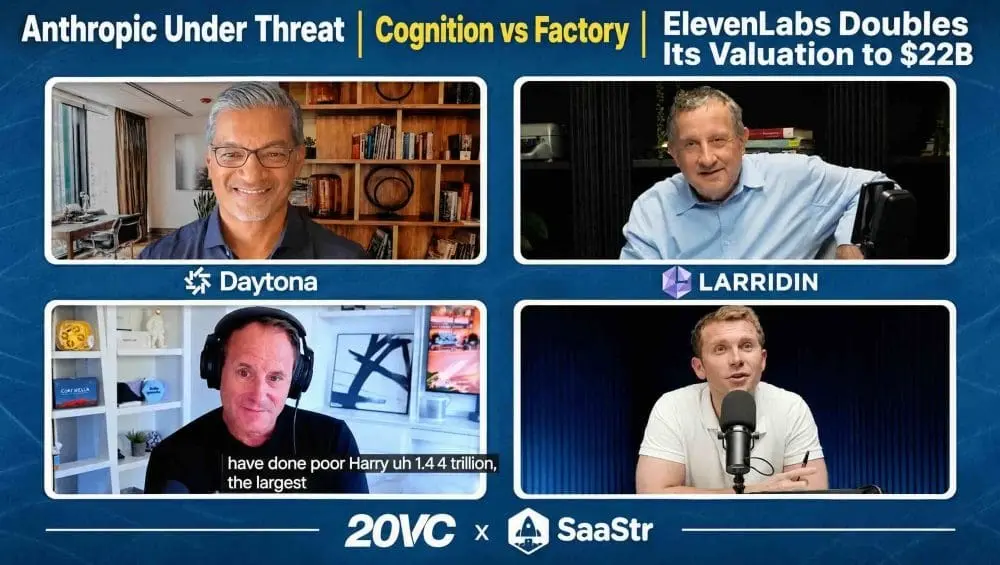
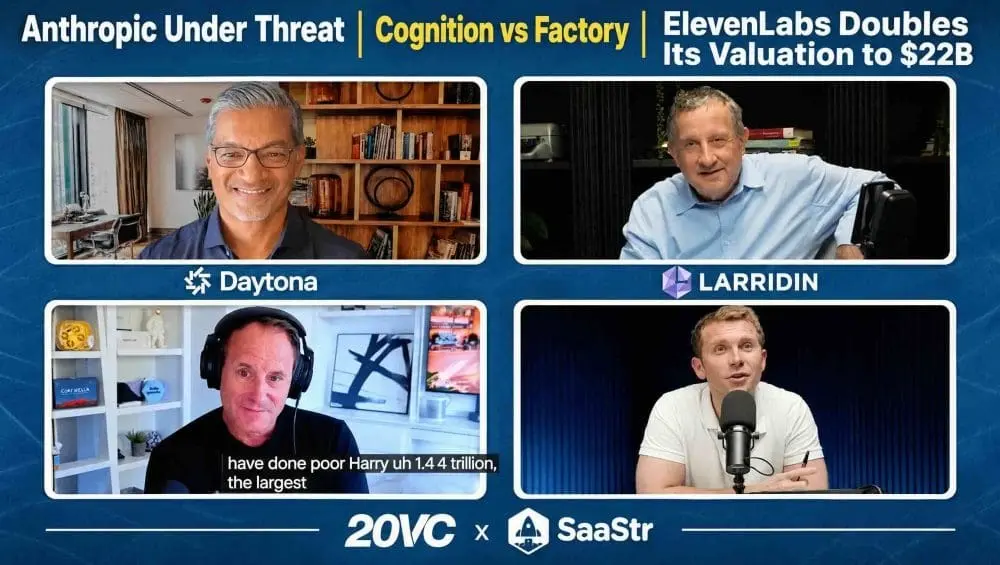
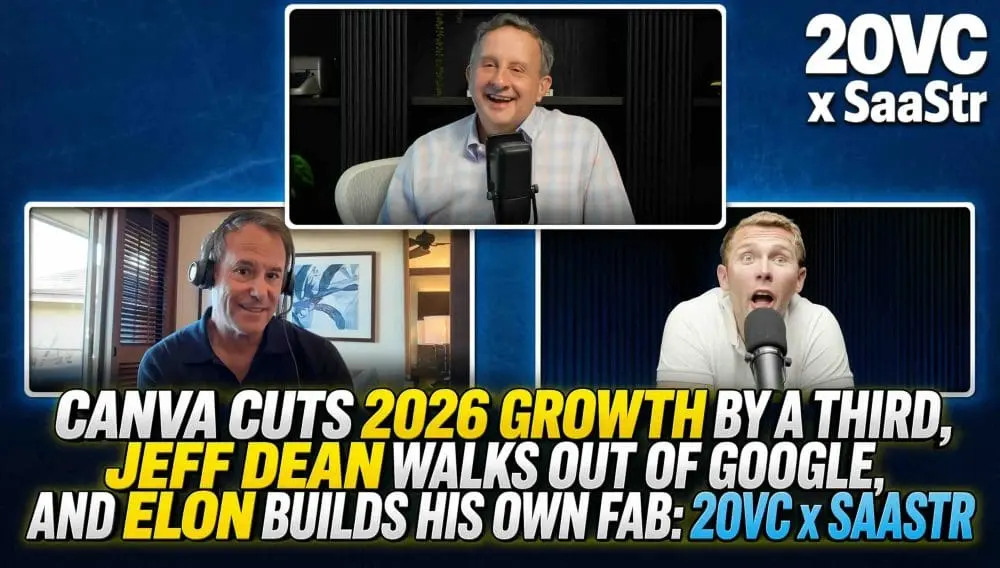
In a recent, highly charged joint session of 20VC x SaaStr, host Harry Stebbings sat down with industry heavyweights Jason Lemkin and Rory O’Driscoll to dissect a series of tectonic shifts rippling through the technology landscape. The consensus was stark: the line between "feature" and "obsolescence" has been crossed. From Canva slashing its 2026 growth projections by a third due to exploding frontier model serving costs, to the quiet death of the "no-code" software layer, and the explosive rise of agentic workflows bypassing traditional user interfaces entirely, the software ecosystem is undergoing its most violent restructuring since the advent of cloud computing.
At the same time, the macroeconomic backdrop is fracturing into two distinct realities. Infrastructure providers and picks-and-shovels players like Datadog, Cloudflare, and Palantir are raking in record margins by riding the largest hardware buildout in human history. Meanwhile, application-layer incumbents who hesitated, dragged their feet, or failed to fundamentally re-architect their products in 2023 and 2024 are paying a brutal bill in 2026 and 2027.
This deep-dive investigation explores the anatomy of this market bifurcation, examining why the traditional SaaS playbook is effectively dead, how a new breed of compensation structures and executive control demands are reshaping corporate governance, and what the death of the "feature argument" means for the next decade of venture capital.
Detailed Chronology: The Week the Paradigm Broke
The market didn’t shift overnight, but a series of cascading events in mid-2026 forced even the most entrenched skeptics to acknowledge the new reality.
1. Canva’s Growth Warning and the Economics of Prosumer AI
The shockwaves began when Canva, which entered 2026 humming along at a 30% GAAP revenue growth rate on roughly $3 billion in revenue, abruptly disclosed that it would likely finish the year closer to 20%. The culprit isn’t a sudden loss of creative market share, but rather the crushing cost of compute. Subsidizing frontier model calls across a massive prosumer base is an extraordinarily expensive endeavor.
As Rory O’Driscoll pointed out, the gross margin compression is merely a second-order symptom. The existential question is whether a drop from 30% to 20% growth is a transitional speed bump or a trajectory hurtling straight toward 10%. With Adobe trading at three to four times revenue while growing at 12%, Figma public at $1.4B growing at 40%, and Canva private at approximately $3.6B growing at 20%, the entire creative software stack is facing a brutal existential audit.
2. The Agentic Bypass: When UIs Become Invisible
Perhaps the most alarming development for software incumbents is not that users are churning to competitors, but that they are disappearing entirely from software consideration sets.
Jason Lemkin shared that when SaaStr built its internal ad server and creative generation network entirely on autonomous agents, it never once occurred to the system to route a task through Canva or Notion. The agents simply didn’t need them. This mirrors the core fear articulated by Uber’s leadership: the ultimate disaggregation of the user interface. When a consumer tells ChatGPT, "I want a flyer," or "I want a car," and the underlying agent instantly routes the task to the cheapest, most efficient provider behind the curtain, standalone consumer and prosumer tools are stripped of their brand equity.
Consequently, the golden era of "no-code"—platforms that allowed humans to bypass engineering resources to build databases, spreadsheets, and design layouts—is rapidly drawing to a close. If a business process can be executed natively inside an LLM interface, the standalone application layer faces an uphill battle for survival.
3. Brain Drain at Google and the Compute Bottleneck
While applications struggle with agentic disaggregation, Big Tech is wrestling with internal resource allocation. The departure of Jeff Dean from Google after 27 years, alongside three top-tier researchers, coupled with Demis Hassabis shifting into a chairman role, sent shockwaves through the market, temporarily erasing billions in market capitalization.
The exit wasn’t about money; it was about compute. When a tech titan allocates compute to Cloud, it immediately converts into 30% operating margins by servicing external clients like Anthropic. When compute goes to Gemini, it yields consumer revenue and coding models. But when compute is funneled into long-tail moonshots like drug discovery or materials science—projects that sit third or fourth in line—top-tier scientific talent will inevitably pack their bags and launch venture-backed labs where capital and compute are freely available.
Supporting Context & Metrics: A Bifurcated Market
The broader market is currently playing out two entirely different movies simultaneously. On one side are the infrastructure beneficiaries; on the other are the application-layer companies facing an existential reckoning.
The Infrastructure Boom vs. The Application Squeeze
Companies like Datadog, Cloudflare, Palo Alto Networks, and Twilio didn’t have to fundamentally reinvent their business models to survive the AI wave. They sell critical infrastructure directly into the largest hardware and data center buildout in modern history. Trading at healthy multiples with strong operating margins, these firms enjoy the luxury of simply selling more to a market with an insatiable appetite for compute and security.
In stark contrast, application companies like Canva, Airtable, and HubSpot are caught in a crossfire. HubSpot, for instance, is no longer just fighting off the legacy threat of enterprise giants like Salesforce; it is facing a burgeoning lower tier of AI-native SMB competitors—such as Monaco, Lightfield, and Aurasell—that are scaling at velocities previously unseen in the CRM category.
The Rise of the Three-Tier Compensation Model
Labor markets within tech have similarly fractured. The old binary division between "normal employees" and "AI engineers" has given way to a tri-part compensation structure:
- Regular Employees: Standard salary and equity bands.
- Core AI Talent: The specialized engineering class whose compensation packages were aggressively inflated over the past three years.
- The "God-Tier" Superstars: A tiny cadre of one to five ultra-elite researchers or operators commanding multi-million-dollar cash packages and equity grants ten times larger than traditional norms.
While these packages put intense internal strain on corporate culture, companies cannot execute aggressive pivots—such as Palantir’s legendary turnaround—without them. However, as Rory O’Driscoll cautioned, early employees who secured $1 million in Anthropic stock in 2023 sitting on generational windfalls have fundamentally distorted hiring market expectations.
Official Statements & Industry Perspectives
The discourse on 20VC x SaaStr yielded biting insights from tech’s most vocal operators and investors:
-
On the Death of Non-Founder Leadership:
"Any investment I’ve made that is not run by a founder is going to be a zero in this age. Whether they’re at $20 million or $200 million, they’re all going to be zeros." — Jason Lemkin
-
On Trimming Portfolios vs. Holding Winners:
"Most of the time you won’t regret trimming. But on the few that you regret trimming, it turns out to be most of the value." — Rory O’Driscoll
-
On the Disaggregation of UI:
"What is the President of Uber’s single biggest fear? The disaggregation of UI, where you say ‘I want a car’ and ChatGPT routes you to Lyft or Uber based on price." — Harry Stebbings
Future Outlook: The Next Twelve Months
As the industry looks ahead toward 2027, several structural realities will dictate the winners and losers of the next technological cycle:
- Reckoning with Private Valuations: The era of hiding behind stale private market marks is over. Venture capitalists and institutional LPs can no longer justify holding assets at inflated historical valuations when fundamental growth rates are decelerating. Expect a wave of forced markdowns across legacy SaaS and no-code portfolios.
- The Governance and Control Pendulum: With Elon Musk’s staggering $16.8 billion first installment on Terrafab and Revolut’s proposed compensation packages pushing CEO ownership toward 30% to 40%, founder control is becoming the price of admission. Being a public company CEO has become punishingly difficult; giving visionary founders absolute operational control is increasingly viewed by investors as a necessary evil to keep ambitious companies out of the hands of bureaucratic caretakers.
- The Non-AI Safe Havens: As demonstrated by platforms like Whatnot raising capital at a $20 billion valuation on the back of massive live-commerce gross merchandise value (GMV), businesses anchored in deep, universal human behaviors—commerce, physical interaction, and financial services—will continue to command massive premiums precisely because they exist outside the blast radius of LLM disruption.
Conclusion
The notion that artificial intelligence can be neatly tucked away as a product feature has been thoroughly dismantled. Incumbents who used 2023 and 2024 to hesitate are now settling their accounts in a market that rewards radical transformation and punishes passive adaptation. For founders, investors, and enterprise leaders alike, the message is unequivocal: adapt to the agentic reality, or watch your entire product category dissolve into someone else’s background prompt.