On the surface, the online landscape for content marketing education appears homogeneous. Most available programs offer a familiar formula: a series of pre-recorded video modules covering foundational search engine optimization (SEO) best practices, high-level copywriting frameworks, and generalized distribution strategies, usually wrapped up with a few standardized action items or downloadable worksheets.
However, beneath this veneer of uniformity lies a stark divergence in quality, efficacy, and ROI. The content marketing courses that genuinely accelerate career trajectories and generate measurable revenue differ vastly from mediocre alternatives. These top-tier programs are distinguished by critical variables: the proven, real-world track record of the instructors, the availability of active feedback loops, and—most importantly—the recency of the advice. In an era profoundly reshaped by generative artificial intelligence and shifting algorithmic behaviors, obsolete strategies can render a brand invisible overnight.
To cut through the noise, this report establishes a rigorous evaluation matrix designed to help entrepreneurs, marketers, and career-driven professionals select the absolute best content marketing course for their specific goals. By examining eight of the most prominent educational offerings on the market against strict criteria—ranging from instructor credibility to community support—we provide a definitive guide for maximizing your educational investment.
Detailed Chronology & Evolution of Content Marketing Education
To understand why modern courses vary so dramatically, one must examine how content marketing education has evolved over the past decade.
The Early 2010s (The Blogging Boom): Education in this era was largely self-taught through blogs and basic whitepapers. Content marketing meant writing long-form keyword-stuffed articles, and courses focused almost exclusively on basic on-page SEO and guest blogging.
The Mid-2010s (The Rise of Structured Academies): Major software providers and SaaS platforms began standardizing education. Free certification courses from companies like HubSpot emerged, allowing marketers to validate foundational skills. However, these programs remained entirely theoretical and self-paced.
The Late 2010s to 2020 (The Playbook Era): Industry leaders launched specialized programs focusing on conversions rather than just traffic. Advanced SEO frameworks (such as those by Ahrefs and Backlinko) dominated the market, moving the needle from vanity metrics to lead generation.
The Post-2022 AI & Social Era (The Modern Landscape): The explosive rise of AI content generation, coupled with the saturation of traditional search channels, fundamentally broke old-school educational playbooks. Modern content marketing courses can no longer survive on blogging alone. Today’s effective curriculum must integrate personal branding, multi-channel distribution across platforms like X and LinkedIn, email copywriting, and direct response sales frameworks.
Content Marketing Course Evaluation Criteria
To evaluate the marketplace objectively, we measure each program against six distinct factors:
Factor
Why it Matters
Instructor Credibility
Has the instructor actively used content marketing to scale and sustain a profitable business? Do they possess verifiable statistics and real-world case studies?
Content Formats Covered
In the modern digital ecosystem, relying solely on blog posts is insufficient. Programs must address personal branding, social media, email acquisition, and video.
Advice Recency
Generative AI and algorithmic shifts have rewritten the rules. Is the curriculum tailored to current market trends, or is it recycling outdated 2020 tactics?
Feedback & Individual Support
Are students left to navigate pre-recorded videos alone, or is there direct, personalized support available when execution stalls?
Community Integration
Does the platform provide an active peer network for troubleshooting, collaboration, and networking?
Pricing Model
Is the financial structure a one-time fee, a freemium model, or an ongoing membership?
Comprehensive Evaluation of the Top 8 Content Marketing Programs
1. Copyblogger Academy
Overview: A hybrid course and community platform operated by two seven-figure entrepreneurs, Tim Stoddart and Charles Miller, who have built substantial businesses entirely through organic content.
Instructor Credibility: Exceptional. Tim Stoddart has founded multiple seven-figure companies, including Copyblogger and digital marketing agency Quantum Leads. Charles Miller has amassed over 220,000 followers on X and 100,000 on LinkedIn, helping dozens of high-net-worth entrepreneurs build authoritative personal brands.
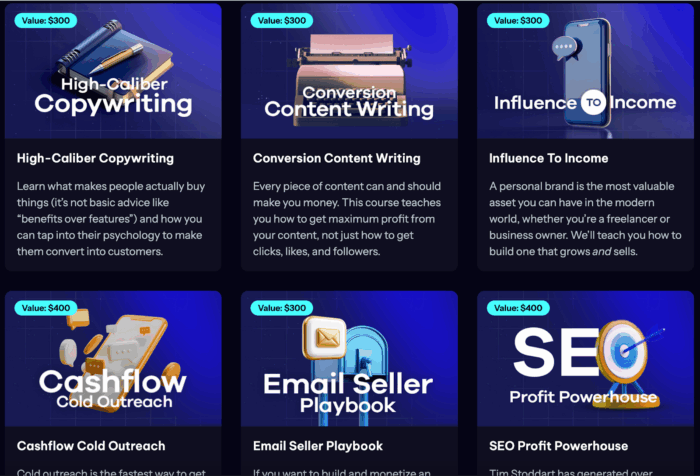
Course Content: The curriculum features six hyper-specific modules covering copywriting, SEO content, email copywriting, and personal branding. Crucially, the instructors are active operators testing tactics in real-time.
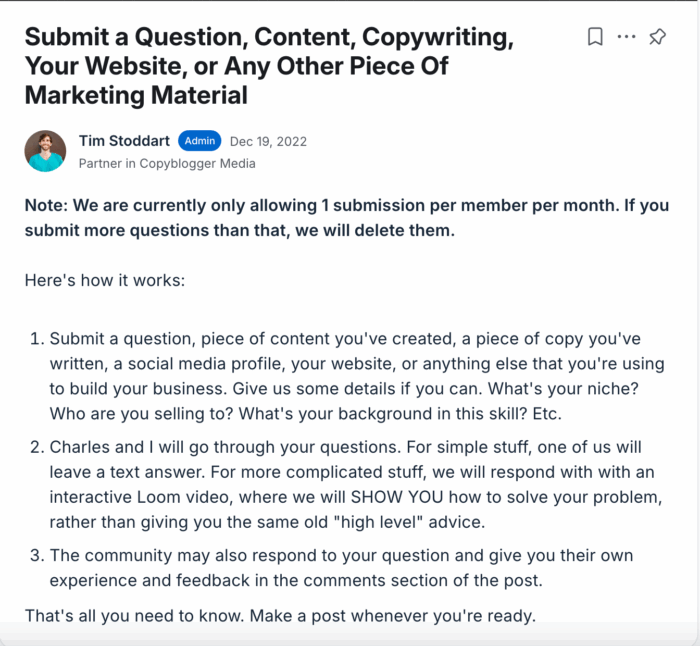
Community & Support: Unmatched among traditional courses. Members gain access to a dedicated feedback tab where they can submit work directly to the founders, monthly mini-courses, and a collaborative peer network.
Pricing: $1 trial followed by a monthly membership structure.
2. HubSpot Content Marketing Course
Overview: A completely free, 8.5-hour certification program featuring 14 lessons, 54 videos, and 11 quizzes.
Instructor Credibility: High. Taught primarily by Justin Champion (HubSpot’s Global Head of Surround Sound Growth), alongside industry veterans like Andy Crestodina.
Course Content: Focuses heavily on traditional inbound marketing, blogging, guest blogging, and video strategy. However, it completely omits critical modern revenue drivers like email marketing, personal branding, and AI adaptation strategies.
Community & Support: None. It is a strictly self-paced, pre-recorded curriculum with no feedback mechanisms or networking groups.
Pricing: Free.
3. Grow and Convert’s "Customers From Content"
Overview: A specialized program created by Benji Hyam and Devesh Khanal, founders of the Grow and Convert agency, focused specifically on generating conversions rather than empty traffic.
Instructor Credibility: Exceptional. Their methodologies are backed by a documented track record of driving ROI for over 40 B2B and B2C brands, including Leadfeeder and Patreon.
Course Content: Broken into five granular modules covering keyword research, conversion-focused writing, distribution, and attribution modeling. The curriculum evolves continuously alongside the founders’ agency experiments.
Community & Support: Excellent. Hosted inside a private discussion forum where founders actively answer questions, complemented by monthly Zoom calls.
Pricing: $699 one-time payment or six monthly installments of $135.
4. Superpath
Overview: Founded by Jimmy Daly (formerly of Animalz), Superpath functions less like a traditional course and more like a graduate-level professional network for in-house content marketers.
Instructor Credibility: Stellar. While led by Daly, the intellectual capital is drawn from content leaders at elite SaaS brands like Shopify, HubSpot, Intercom, and Clearscope.
Course Content: Offers advanced "mini-courses," teardowns, templates, and strategic workshops, though it leans heavily toward long-form blog content for B2B and SaaS businesses.
Community & Support: Industry-leading. Features active Slack channels, AMAs, peer reviews, and job boards.
Pricing: Free tier available; Pro memberships start at $50/month.
5. Ahrefs’ "Blogging for Beginners" (Blogging for Business)
Overview: A free, 5-hour video course hosted on YouTube, taught by Ahrefs CMO Tim Soulo.
Instructor Credibility: World-class. Soulo has played a pivotal role in scaling Ahrefs’ organic search footprint to millions of monthly visitors.
Course Content: A tactical, step-by-step playbook exclusively dedicated to building, ranking, and monetizing a blog. However, because it was recorded in 2020, it lacks modern strategies regarding AI integration and search landscape evolution.
Community & Support: None outside of public YouTube comment sections.
Pricing: Free.
6. Semrush Academy Content Marketing Courses
Overview: Curated learning paths featuring industry heavyweights, notably including courses by Brian Dean (founder of Backlinko).
Instructor Credibility: Impeccable. Brian Dean is globally recognized as a premier SEO and link-building authority.
Course Content: Deep dives into advanced content campaigns, SEO optimization, and traffic generation. Like Ahrefs, the primary drawback is recency, with foundational materials largely rooted in 2022 frameworks.
Community & Support: Non-existent; structured as self-study video modules.
Pricing: Free.
7. CXL Content Marketing Course
Overview: A concise, one-hour strategic program taught by Derek Gleason, SEO and Content Lead at Shopify.
Instructor Credibility: High. Gleason oversees massive content libraries at Shopify and brings enterprise-level experience managing accounts for major brands like Twitter.
Course Content: Excellent for understanding high-level content research and distribution strategy, though it avoids tactical copywriting tutorials.
Community & Support: Self-paced with no direct instructor interaction or peer community.
Pricing: $299 for a single-course purchase, or via CXL subscription tiers.
8. Udemy: Content Marketing Masterclass by Brad Merrill
Overview: A broad, 3.5-hour masterclass designed to touch upon every conceivable pillar of digital marketing.
Instructor Credibility: Moderate. Taught by media entrepreneur Brad Merrill, whose broad entrepreneurial background spans multiple digital properties.
Course Content: Broad instruction covering storytelling, the AIDA framework, SEO, and email marketing. Because of its broad scope, it lacks the deep, laser-focused execution found in specialized programs.
Community & Support: Limited to Udemy’s standard Q&A interface.
Pricing: $109.99 (or included via Udemy subscription).
Supporting Context & Metrics
When selecting a program, professionals must weigh theoretical knowledge against practical execution speed. According to industry surveys, over 70% of marketers who enroll in self-paced, free video courses fail to complete them due to a lack of accountability and actionable feedback loops.
Programs that integrate community accountability and direct mentorship—such as Copyblogger Academy and Grow and Convert—demonstrate significantly higher completion and revenue-generation rates among students. Conversely, free corporate-backed academies (HubSpot, Ahrefs, Semrush) serve exceptionally well as foundational primers but require supplemental education to address modern AI search dynamics and multi-channel social distribution.
Official Statements & Industry Perspective
Industry leaders increasingly emphasize that content marketing education must adapt to structural changes in how audiences consume information.
"The playbook of publishing 3,000-word SEO articles and waiting for Google to send free traffic is fundamentally broken," notes Tim Stoddart, co-founder of Copyblogger Academy. "Modern content creators must master direct-response copywriting, build defensible personal brands on social platforms, and leverage AI as an amplifier rather than a crutch. If a course isn’t teaching you how to survive and thrive in today’s hybrid social-search ecosystem, it’s already obsolete."
Future Outlook
The trajectory of content marketing education points toward hyper-specialization and community-led growth. As automated tools democratize the production of baseline text, the value of content has shifted away from mere volume and toward unique perspective, direct audience ownership, and distribution mastery.
Courses that rely purely on static, pre-recorded video lectures without community feedback or real-time updates will continue to lose market share to dynamic, membership-based ecosystems. For professionals looking to future-proof their careers and businesses, investing in interactive communities helmed by active, practicing operators will remain the gold standard for educational ROI.