Executive Overview
In a significant policy enforcement action targeting the stealth monetization of consumer Internet of Things (IoT) hardware, LG Electronics USA has announced plans to purge smart TV applications that silently convert user devices into residential proxy nodes. The decisive move follows alarming cybersecurity research demonstrating that more than four out of every ten applications available in LG’s webOS app store contained embedded Software Development Kits (SDKs) designed to reroute external internet traffic through household connections.
Smart televisions have evolved from simple display units into complex, networked computing platforms. However, as hardware margins tighten, developers and third-party monetization brokers have increasingly targeted these always-on devices. By embedding residential proxy SDKs into benign software—ranging from basic games to screensavers—app creators have monetized their user bases by leasing domestic internet bandwidth to third-party clients.
Following revelations published by cybersecurity research firm Spur, LG Electronics confirmed it is actively reviewing its software library and working with application developers to strip out proxy functionalities. Apps that fail to comply with these platform guidelines face immediate suspension. The development highlights a growing industry-wide challenge: balancing ecosystem open-market dynamics with consumer privacy, network security, and meaningful user consent in the smart home era.
Detailed Chronology
  [ Early July ] --------------------------------------------------------> [ Mid July ] -----------------------------------------------------> [ July 22 ]
  Spur releases report: 42%+ of LG webOS apps                             LG opens app store review;                                             Bright Data issues formal
  & 25%+ of Samsung Tizen apps contain                                     SVP John Taylor announces                                              statement defending opt-in
  residential proxy SDKs.                                                 suspension policy for proxy SDKs.                                      model & PwC audit status.
1. The Initial Discovery
In early July, threat intelligence firm Spur published a landmark study analyzing the distribution of residential proxy SDKs within smart TV application stores. The findings revealed systemic integration of proxy harvesting code across both LG’s webOS and Samsung’s Tizen operating systems.
2. Industry Outreach and Inquiries
Journalists and security researchers, led by KrebsOnSecurity, submitted inquiries to key hardware vendors and proxy providers. The research demonstrated that consumer hardware was being quietly converted into commercial routing infrastructure, often without clear operational context provided to the device owners.
3. Executive Confirmation
Responding to the findings, LG Electronics USA issued an official policy stance. Senior Vice President John Taylor announced that operating an always-on residential proxy network is fundamentally incompatible with the intended functionality of LG smart TVs. The company immediately initiated a platform-wide review to audit developer-submitted binaries.
4. Platform Audit and Enforcement
LG notified developer networks that residential proxy features must be excised from all current webOS application builds. Concurrently, the platform updated its review standards for future submissions to flag and block embedded residential proxy SDKs during automated and manual ingestion pipelines.
5. Vendor Counter-Response
On July 22, Bright Data—identified as the primary proxy provider operating within these app stores—issued an updated statement defending its business model. The company highlighted its opt-in mechanisms, independent security audits, and strict Know Your Customer (KYC) compliance frameworks, while acknowledging the ongoing shift in platform policies.
Supporting Context & Metrics
The Mechanics of Residential Proxy SDKs
Residential proxies act as intermediaries that route web traffic through real consumer devices assigned genuine residential IP addresses by Internet Service Providers (ISPs). Unlike data center IP addresses, which are easily identified and blocked by anti-bot protections, residential IPs carry high trust scores. Consequently, residential proxy networks are highly sought after by commercial entities for data scraping, ad verification, market research, and localized price intelligence.
To build these networks, commercial proxy providers offer software developers monetary compensation to integrate SDKs into free or low-cost apps. When a user installs the application, the embedded SDK registers the host device as an active node within the proxy provider’s grid.
+---------------------------------------------------------------------------------------------------+
|                                  RESIDENTIAL PROXY ARCHITECTURE                                   |
|                                                                                                   |
|  [ Third-Party Client ]  --->  [ Proxy Provider ]  --->  [ Smart TV (webOS) ]  --->  [ Target Web ] |
|  (Rents IP Bandwidth)          (Bright Data, etc.)       (User Household IP)          (Data Scraping)|
+---------------------------------------------------------------------------------------------------+
Prevalence Across Smart TV Ecosystems
Spur’s telemetry revealed that the practice had reached systemic proportions across major consumer electronics platforms:
| Platform / Operating System | Platform Share of Apps Containing Proxy SDKs | Top Proxy Provider Identified | Typical App Categories Affected |
|---|---|---|---|
| LG webOS | 42% + | Bright Data | Casual Games (e.g., Pac-Man), Utilities, Screensavers |
| Samsung Tizen OS | 25% + | Bright Data | Utility Apps, Clocks, Media Tools |
The sheer density of proxy code in these marketplaces stems from the resource-constrained nature of smart TV app development. Independent developers frequently turn to SDK monetization to cover infrastructure costs without resorting to traditional, intrusive display advertising that degrades the lean-back viewing experience.
Monetization vs. Transparency: The Consent Gap
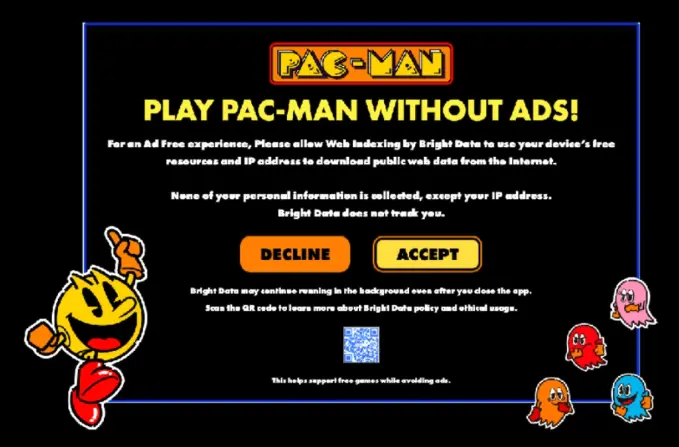
In many instances, applications offer users a choice: view traditional banner ads, pay a subscription fee, or opt to "share idle internet resources" in exchange for ad-free usage. For example, a popular Pac-Man title analyzed on the webOS platform explicitly prompted users to choose between ad-supported play or allowing the television to function as a network node.
+---------------------------------------------------------------------------+
|                          TYPICAL USER OPTION SCREEN                       |
+---------------------------------------------------------------------------+
| Select Your Experience:                                                   |
|                                                                           |
| [ Option A ] View continuous banner ads during gameplay.                   |
|                                                                           |
| [ Option B ] Play ad-free by sharing idle device bandwidth and            |
|              system resources with network partners.                      |
+---------------------------------------------------------------------------+
While proxy operators argue that these dialogs constitute informed consent, security analysts point out critical operational flaws in the model:
- Non-Technical User Base: Smart TV users generally do not view their televisions as full-fledged computers capable of acting as public network relays.
- Secondary Consent Vulnerabilities: Consent is frequently granted by household members who do not own the network subscription or lack the technical authority to authorize traffic relaying—such as minors or guests.
- Network Deprecation Risks: Operating a proxy node subjects a household’s public IP address to potential blacklisting by fraud detection systems, disrupting online banking, streaming services, or gaming platforms connected to the same local network.
- Lateral Movement Concerns: Unchecked network traffic passing through an IoT device creates potential attack surfaces if local isolation protocols fail, allowing abusive actors to probe adjacent devices on the local Wi-Fi network.
Official Statements
LG Electronics USA
Addressing the implications of Spur’s research, LG Senior Vice President John Taylor clearly stated the company’s platform stance:

"A residential proxy network is not an intended use for LG smart TVs, and LG Electronics is working with developers to remove the residential proxy option from their apps on the webOS platform. If this option is not removed, these apps will be suspended."
Taylor emphasized that the enforcement action is part of a broader structural overhaul of LG’s app ingestion ecosystem:
"As part of our ongoing efforts to enhance platform quality and the user experience, LG will continue to strengthen our evaluation process for developer-submitted apps, including those that incorporate residential proxy SDKs. Our review of those apps is well underway now."
Cybersecurity Researchers
Trevor Sutter, representing threat intelligence firm Spur, challenged the validity of current consent mechanisms used by proxy providers operating on consumer IoT hardware:
"A one-time consent prompt buried in a TV app is not a substitute for meaningful transparency, ongoing control, and platform oversight. The risk is amplified when consent comes from individuals within the household who use the device but shouldn’t give consent, such as minors."
Proxy Network Operators
In response to the report, Bright Data, identified as the dominant residential proxy framework active on the webOS and Tizen stores, defended its compliance standards and business practices:
"Every peer opts in through a dedicated screen and receives value in return; every customer is vetted, and our practices have now undergone a second independent audit by PwC. We remain committed to an open, transparent internet where legitimate businesses, researchers, and institutions can responsibly access data that lives in the public domain."
Bright Data and similar providers maintain that robust Know Your Customer (KYC) onboarding processes, combined with strict client vetting, prevent malicious actors from utilizing their commercial proxy infrastructure for cyberattacks or illicit network intrusions.
Future Outlook
Ecosystem Governance and Competitor Response
LG’s aggressive stance against residential proxy SDKs places immediate pressure on competing Smart TV manufacturers—most notably Samsung. With over 25 percent of audited Tizen OS applications incorporating similar SDK components, industry observers expect Samsung and other platform operators (including Android TV/Google TV and Roku) to face demands for heightened app store vetting procedures.
As hardware markets continue to homogenize, app store governance is rapidly becoming a key competitive differentiator for consumer privacy. Platform providers that fail to enforce strict boundaries around bandwidth usage risk alienating consumers and exposing their networks to reputational degradation.
Regulatory and Standards Pressure
The proliferation of stealth proxy SDKs in home appliances arrives amid expanding global regulatory frameworks aimed at IoT security. Legislative efforts—such as the European Union’s Cyber Resilience Act and the U.S. Federal Communications Commission’s Cyber Trust Mark program—are placing explicit obligations on manufacturers to secure connected hardware throughout its operational lifecycle. Bandwidth harvesting without explicit, clear, and durable administrative consent directly conflicts with the core tenets of these emerging cybersecurity baselines.
Systemic Monetization Creep Across Hardware Lines
The controversy surrounding webOS proxy SDKs underscores a broader industry struggle: hardware manufacturers and developers attempting to wring ongoing service revenue from static consumer purchases.
This tension was further highlighted when independent tech outlet Gamers Nexus revealed that select high-end LG LCD monitors automatically push promotional third-party software—specifically paid McAfee antivirus subscriptions—to host PCs via display drivers delivered through standard Windows Update channels without user prompts.
+-----------------------------------------------------------------------------------+
|                        CROSS-SECTION OF HARDWARE MONETIZATION                     |
+-----------------------------------------------------------------------------------+
| Product Division  | Distribution Channel     | Monetization Vector                |
+-------------------+--------------------------+------------------------------------+
| LG Smart TVs      | webOS App Store          | Residential Proxy SDKs (Bandwidth) |
| LG LCD Displays   | Windows Update Drivers   | Auto-Installed Antivirus Promos    |
+-----------------------------------------------------------------------------------+
As manufacturers navigate the boundary between platform monetization and device security, LG’s purge of residential proxy SDKs sets an important precedent. Moving forward, the industry must establish clear standards defining acceptable monetization methods—ensuring that consumer smart devices remain viewing portals rather than stealth routing hubs for global web traffic.