Executive Overview
For decades, the software engineering industry has chased a singular holy grail: eliminating the infamous excuse, "It works on my machine." To achieve this, organizations have increasingly turned to standardized developer environments. By packaging approved runtimes, strict dependency trees, and essential toolchains into isolated containers, virtual machines (VMs), or cloud-hosted workspaces, modern engineering teams expect every developer to start from an identical foundation.
The theoretical and practical benefits of this approach are substantial. Standardized environments drastically reduce developer onboarding times from weeks to mere minutes, minimize insidious dependency conflicts, and make local setups reproducible across broad teams. Yet, a persistent and frustrating reality remains: software engineers using the exact same environment definition file can still experience wildly different build times, cryptic test failures, erratic network behavior, and mysterious access errors. Furthermore, local results frequently diverge from Continuous Integration (CI) pipelines and production deployments, even when all environments proudly share the exact same container image.
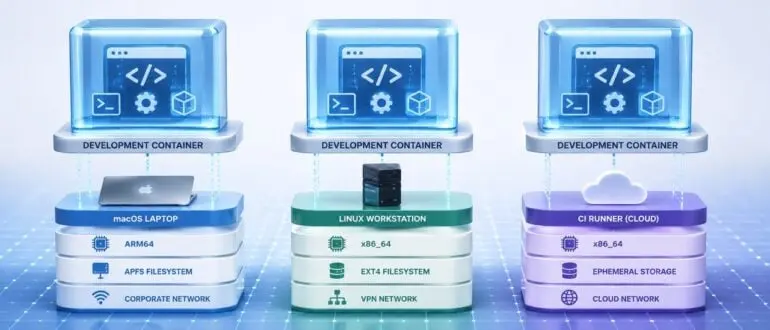
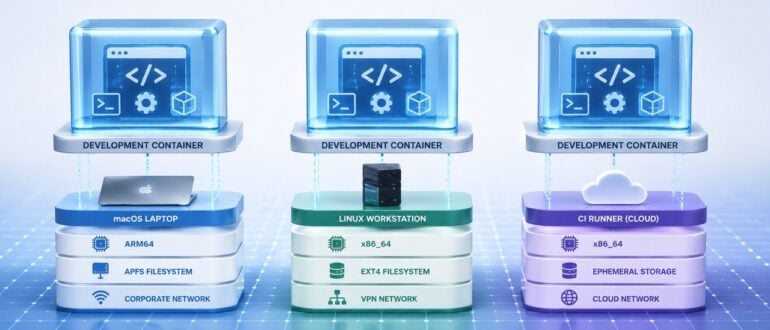
This technical paradox highlights a fundamental misunderstanding in modern infrastructure management. A container or cloud workspace only defines a isolated slice of the total development ecosystem. The host systems, underlying hardware architectures, virtualization layers, persistent state caches, network boundaries, and external APIs continue to profoundly influence how software is built, tested, and executed. Achieving true reproducibility is a far broader and more complex engineering challenge than simply standardizing a Dockerfile or a Development Container Specification.
To bridge this gap, engineering leaders must shift their strategies. Instead of relying blindly on static "golden images," organizations must establish rigorous, continuously tested developer-environment contracts, synchronize local workflows with CI execution planes, and treat environment maintenance as an active, ongoing engineering discipline.
Detailed Chronology: The Evolution and Limits of Isolation
To understand why modern development environments still fracture, it is helpful to examine the historical progression of software workspace standardization and the recurring bottlenecks that have accompanied each technological leap.
Phase 1: The Era of Manual Configuration (Pre-2010s)
In the early days of software engineering, development environments were entirely manual and bespoke. Developers provisioned physical or virtual machines by hand, installing programming language runtimes, compiling databases, and fetching libraries globally.
- The Problem: Workspace drift was rampant. A developer joining a team might spend two weeks wrestling with missing header files, mismatched system library versions (like
glibc), and conflicting Python or Ruby runtimes. The phrase "It works on my machine" was an everyday accepted reality because virtually no two machines were configured identically.
Phase 2: The Containerization Revolution (Mid-2010s)
The rise of Docker and containerization promised to encapsulate the application and its dependencies into a single, immutable artifact. By abstracting the operating system user space, containers allowed developers to run applications identically across macOS, Linux, and Windows hosts.
- The Problem: While containers solved OS-level discrepancies inside the runtime, they exposed new boundaries. Developers on macOS and Windows had to run heavy virtualization layers (like Docker Desktop’s Linux VMs), introducing file-system synchronization overhead, performance penalties, and subtle behavioral mismatches between the host operating system and the containerized Linux kernel.
Phase 3: Cloud Workspaces and Remote Development (2020s–Present)
To eliminate local resource constraints and host operating system friction, the industry migrated toward cloud-native development environments, such as GitHub Codespaces, Gitpod, and remote SSH-based dev containers. These environments shift the heavy lifting entirely to remote virtual machines provisioned with predefined CPU, memory, and storage allocations.
- The Problem: While cloud workspaces ensure uniform compute and memory footprints for developers using the same instance types, they introduce a heavy reliance on continuous, low-latency network connectivity. Furthermore, they decouple the developer from physical peripherals, local security certificates, corporate VPNs, and internal network proxies, creating an entirely new class of environment-specific connectivity failures.
Supporting Context & Metrics: Where Standardization Breaks Down
Standardizing what runs inside a container or cloud workspace improves consistency, but it cannot completely insulate software from the underlying infrastructure.
+-----------------------------------------------------------------+
|                        EXTERNAL SERVICES                        |
|       (Cloud APIs, Package Registries, Identity Providers)      |
+-----------------------------------------------------------------+
                                 |
                                 v
+-----------------------------------------------------------------+
|                        HOST ENVIRONMENT                         |
|     (Hardware Architecture, CPU/RAM, VPN, Host Filesystem)      |
+-----------------------------------------------------------------+
                                 |
                                 v
+-----------------------------------------------------------------+
|                       CONTAINER / WORKSPACE                     |
|            (OS Image, Language Runtimes, Toolchains)            |
+-----------------------------------------------------------------+
1. Host System Differences Leak Into the Container
Even when developers share a pristine, immutable container image, the host machine bleeds through necessary integrations such as bind mounts, port forwarding, credential helpers, web browsers, and VPN clients.
Filesystem behavior is a primary culprit. Linux filesystems are natively case-sensitive, whereas default macOS filesystems (APFS) are case-preserving but case-insensitive. A code repository containing both Config.js and config.js will compile and run seamlessly on a Linux host or a Linux-based CI runner, but it will trigger baffling overwrite conflicts or missing-file errors when synchronized from a Mac machine via Docker volume mounts.
File synchronization limitations further exacerbate this issue. Docker’s synchronized file-sharing mechanisms struggle with massive file counts, intricate symbolic links, and deep directory trees. Consequently, large enterprise codebases often behave sluggishly or throw unpredictable I/O errors across different host configurations, despite the container definition remaining completely untouched.
2. The Danger of "Drift" and Frozen Standardization
A shared environment definition is only as good as its maintenance lifecycle. Teams frequently fall into one of two dangerous traps:
- Unpinned Dependencies: An environment configuration that relies on an image tagged
latest, an unpinned feature flag, or an installation script that fetches the absolute newest package from the internet will inevitably produce a subtly different environment every single time it is rebuilt. - Frozen Stagnation: Conversely, teams terrified of breaking changes often delay rebuilding their shared images for months. Over time, those images continue running with deprecated packages, expired security certificates, or obsolete tooling. Standardization then achieves the exact opposite of its intent: it efficiently distributes an outdated, insecure environment across the entire engineering organization.
Furthermore, persistent state—such as local package caches, persistent volumes, and accumulated editor extensions—survives far longer than expected. Two workspaces built from the exact same configuration file will gradually diverge over time simply because one has accumulated weeks of cached build artifacts while the other was provisioned fresh this morning.
3. Local Development vs. CI: Separate Realities
Many engineering organizations maintain two distinct configuration worlds: one for local developer workspaces and another for CI pipelines. Though they may look deceptively similar, they are typically built from different definitions, maintained by entirely separate platform or infrastructure teams, and updated on completely asynchronous schedules.
A developer routinely runs tests inside a long-lived, warm container packed with cached dependencies and broad network access. Conversely, a CI job executes on a freshly provisioned, ephemeral runner featuring a clean filesystem, preinstalled tools that may not match local versions, and heavily restricted network permissions.
This structural asymmetry causes continuous friction. A local build frequently succeeds simply because an undeclared, legacy dependency already exists in the developer’s local cache. The exact same commit then fails instantly in CI because the clean runner lacks that hidden dependency.
Official Industry Insights and Directives
Industry standards bodies and major platform providers have increasingly documented the systemic limits of container-level isolation.
- The Reproducible Builds Project: Open-source authorities emphasize that true reproducibility requires looking far beyond simple container images. Factors such as compiler versions, hardware architecture assumptions, build paths, system locales, and time zones can fundamentally alter build outputs. The project’s guidelines repeatedly highlight that environment configuration is an intricate, multi-layered puzzle where minor environmental variables introduce non-determinism into binary artifacts.
- GitHub Codespaces Documentation: Enterprise platform guidelines note that cloud-hosted development containers run inside isolated virtual machines with distinct machine types. While resource allocations can be standardized, developers must configure explicit networking layers to handle private corporate registries, internal DNS entries, and on-premises services. A container definition cannot inherently solve network topology and routing variations.
- Docker Desktop Engineering Guidelines: Official documentation stresses that running Linux-based containers on macOS or Windows requires complex translation across virtualization and file-sharing boundaries. Performance variations and filesystem quirks are documented operational realities that engineering teams must design around, rather than assume away.
Future Outlook: Building a Contract, Not a "Golden Image"
As software architectures grow increasingly complex and distributed, attempting to cram every conceivable tool, library, and utility into a massive "golden image" is no longer viable. Bloated images expand security attack surfaces, slow down provisioning times, and obscure what the environment actually guarantees.
Instead, progressive engineering organizations are moving toward an explicit developer-environment contract. Rather than treating the environment as a static artifact, teams must define a formal agreement covering:
- Guaranteed Runtime Versions: Explicitly pinned language runtimes, compiler versions, and core system utilities.
- Resource Boundaries: Minimum memory, CPU, and storage baselines required to successfully compile and test the software.
- Network and Service Dependencies: Clear definitions of required external APIs, mock services, and database emulators.
- State Management Policies: Automated protocols for clearing stale caches and enforcing clean rebuild schedules.
Operationalizing Continuous Validation
To ensure this contract holds true, automation must continuously test the environment itself. Engineering teams should implement automated pipelines that spin up a clean environment from scratch, pull the latest code, build the application, and execute the core test suite on a scheduled basis.
Organizations must also track meaningful environment metrics to gauge success:
- Setup and provisioning success rates.
- Average workspace rebuild times.
- The frequency of CI failures that cannot be reproduced locally.
- The volume of environment-related internal support tickets.
By treating environment standardization as an ongoing, highly observable engineering practice rather than a one-time provisioning checklist, organizations can finally bridge the gap between local workspaces, CI pipelines, and production deployments—ensuring software behaves predictably across the entire software delivery lifecycle.