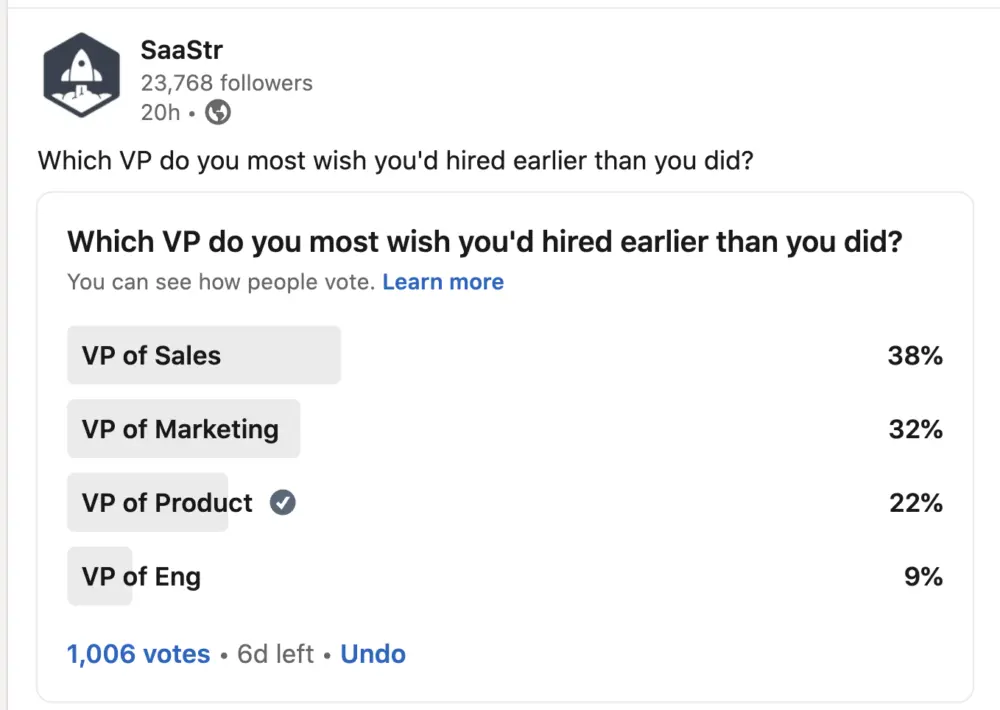
Executive Overview
In the high-stakes, fast-paced world of B2B Software-as-a-Service (SaaS), early-stage founders operate in a perpetual state of controlled chaos. Between the fragile milestones of securing seed funding, chasing product-market fit, and trying to close that next critical enterprise logo, founders wear a dozen hats simultaneously. They are the chief product officers, the lead enterprise account executives, the head of customer success, and the chief recruiter all rolled into one.
However, as a startup scales past the crucial threshold of $1 million to $2 million in Annual Recurring Revenue (ARR) and pushes toward $5 million, $10 million, and beyond, a dangerous operational bottleneck emerges. While almost every technical and non-technical founder universally acknowledges the eventual need for a Vice President of Sales, a pervasive and destructive myth persists regarding the rest of the executive suite. Founders frequently convince themselves that roles such as VP of Marketing, VP of Product, VP of Engineering, and VP of Customer Success can be deferred, bypassed entirely, or indefinitely managed by junior individual contributors and overextended founder-CEOs.
This article investigates a foundational thesis derived from veteran SaaS scaling insights: The moment a B2B SaaS company hits initial traction—typically hovering around $1.5M in ARR where revenue transitions from sporadic repetition to a reliable, repeating motion—the organization is immediately ready for a "VP of Everything."
Waiting too long to install seasoned executive leadership across all core functions is not a prudent conservation of capital; it is a self-imposed growth ceiling. When founders claim they do not need these executive leaders, the root cause is almost always a lack of prior experience working with truly world-class executive talent. Once a founder experiences the transformative impact of a high-caliber VP, the paradigm shifts permanently: the better the people you hire, the less you have to figure out entirely on your own.
Detailed Chronology: The Evolutionary Stages of Startup Leadership
To understand why scaling past $1M ARR breaks traditional founder-led operations, we must examine the chronological evolution of a B2B SaaS startup’s organizational maturity.
Phase 1: Pre-Revenue to $1M ARR (The Founder-Led Hustle)
In the earliest days of a startup, execution velocity is everything. There are no playbooks, no historical data, and no predictable pipelines.
- The Dynamic: The founding team must be deeply hands-on. Survival depends on raw grit, direct customer discovery, and rapid iteration of the core code and value proposition.
- The Leadership Style: Dictatorial, highly reactive, and intensely creative. The CEO is intimately involved in every line of code, every marketing email, and every sales demo. At this stage, specialized VPs are not only unnecessary; they are actively harmful. An expensive executive accustomed to established processes will flounder in an environment where the product definition changes week by week.
Phase 2: $1M to $2M ARR (The Initial Traction Threshold)
This is the inflection point where the company transitions from finding what works to systematically repeating what works. Initial traction has been secured. The value proposition resonates with a defined buyer persona, and churn rates stabilize to acceptable levels.
- The Dynamic: The complexity of the business begins to outpace the cognitive bandwidth of the founders. Customer acquisition requires more than personal founder networks. Codebases require architectural scaling, security audits, and dedicated product roadmaps.
- The Critical Mistake: This is precisely where founders make their most costly strategic error. Recognizing that sales is the primary engine of near-term survival, they hire a VP of Sales while keeping marketing, product, and customer success under their own direct, personal oversight or managed by junior generalists.
Phase 3: $2M to $10M ARR and Beyond (The Scaling Imperative)
As the business pushes from $2M toward double-digit millions in ARR, the operational friction multiplies exponentially. A process that worked for closing ten customers breaks entirely when attempting to close one thousand customers.
- The Dynamic: Scale demands specialization. A founder cannot effectively mentor junior marketers, architect enterprise-grade security protocols, design intricate customer success retention funnels, and manage enterprise deal cycles simultaneously without burning out or stalling growth velocity.
- The Solution: Bringing in seasoned VPs who have navigated this exact growth curve before. Far from being a financial drain, elite executive hires at the $2M ARR mark are inherently accretive—they generate more value, efficiency, and revenue than they consume in compensation.
Supporting Context & Metrics: The Anatomy of Executive Value
Why do founders hesitate? The primary deterrents are cash flow anxiety, past trauma from mismanaged executive hires, and the psychological difficulty of relinquishing control. However, data and operational history across the B2B SaaS ecosystem paint a clear picture of why these fears must be overcome.
The Sales Exception Fallacy
In the B2B landscape, founders easily grasp the necessity of a VP of Sales because sales is universally understood as an external, transactional combat sport. Even if founders have never sold a software product in their lives, they recognize their own limitations when sales velocity slows down. They realize they cannot personally hop on every discovery call or negotiate every multi-year enterprise contract once the pipeline expands.

Yet, this logic applies equally to every other pillar of a SaaS enterprise:
- VP of Engineering/Product: Without a dedicated technical leader, technical debt accumulates silently, deployment cycles slow down, and product-market fit begins to drift as customer demands outpace the core architecture.
- VP of Marketing: Relying on junior growth hackers or content coordinators leaves the company without a strategic narrative, predictable lead generation engines, or brand positioning capable of commanding enterprise pricing.
- VP of Customer Success: In a SaaS business, growth is a leaky bucket without proactive retention and expansion strategies. A junior support manager cannot design the customer journey maps, net retention rate (NRR) expansion plays, and executive sponsorship programs required to drive multi-million-dollar valuations.
The Mathematics of Accretive Hiring
A common misconception among early-stage founders is that executive salaries ($200k–$300k+ base plus equity) represent an unsustainable overhead cost at $2M ARR. However, this view misinterprets the financial mechanics of an elite executive.
- The Multiplier Effect: A great VP does not simply perform tasks; they build systems, hire high-performing teams, and eliminate the catastrophic mistakes that founders make due to lack of domain expertise.
- Time Reclamation: When a founder hands over functional ownership to a proven VP, those hundreds of hours per month are redirected toward strategic fundraising, visionary product expansion, and key enterprise partnerships.
- The "In Arrears" Advantage: As industry veteran and SaaS investor Jason Lemkin famously notes: "The better the folks you hire, the less you have to figure it out yourself. You still have to figure it out yourself ultimately. Just you can do it more in arrears with better VPs and managers." Elite executives bring established playbooks from companies that have walked the path before, saving the startup years of painful trial and error.
Official Perspectives & Industry Insights
The philosophy surrounding early executive hiring has been a subject of intense debate among venture capitalists, SaaS operators, and founders for over a decade. While lean methodologies advocate for keeping headcount restricted for as long as possible, empirical evidence from top-performing B2B SaaS companies suggests a different playbook.
Industry veterans emphasize that the quality of the hire matters more than the timing. Bringing in a mediocre or misaligned executive simply because the revenue milestone has been reached is worse than having no executive at all. A toxic or incompetent VP of Sales or Marketing can completely disrupt an early-stage culture and burn through precious runway.
However, the core takeaway from leading SaaS scaling authorities remains unequivocal: If a founder genuinely believes that their company does not need any VPs beyond sales, it is almost invariably because they have never had the privilege of working alongside a truly exceptional one.
When a founder experiences the profound relief of handing a department to an executive who takes total ownership, anticipates problems before they manifest, and executes at a world-class level, skepticism vanishes. The friction dissolves, and the trajectory of the company bends sharply upward.
Future Outlook: Navigating the Next Era of SaaS Growth
As the B2B SaaS ecosystem matures in an increasingly competitive macroeconomic climate, the margin for error for early-stage startups is shrinking. Investors no longer reward "growth at all costs" fueled by undisciplined burn; instead, they demand capital efficiency, strong net retention, predictable unit economics, and operational excellence from day one.
For founders navigating the critical window between $1M and $20M ARR, the implications are clear:
- Embrace Delegation Early: Recognize that holding onto functional ownership past the $2M ARR mark is an ego-driven bottleneck rather than a financial strategy.
- Upgrade Talent Standards: Stop settling for junior managers to run critical business functions. Invest in battle-tested executives who have scaled companies from $2M to $20M ARR previously.
- Redefine the Role of the CEO: As the organization builds out its executive suite, the CEO’s role shifts gracefully from an operational firefighter to a visionary orchestrator, culture keeper, and chief strategist.
Ultimately, building a generational B2B SaaS company is a team sport. The transition from a founder-dependent hustle to an institutionally sound enterprise requires structural maturity. By acknowledging that initial traction demands a full suite of executive leadership—and by having the courage to hire world-class talent to run them—founders can shatter their growth ceilings and build enduring, high-valuation market leaders.