Executive Overview
In the contemporary digital economy, the velocity of information often dictates competitive survival. Organizations can no longer rely on the sluggish mechanics of traditional, scheduled batch-processing jobs to drive business decisions. As soon as an operational transaction is committed to a database, its relative analytical value begins to decay. To counteract this, modern data architectures require instant visibility into operational changes, routing fresh data seamlessly into cloud warehouses, machine learning models, and microservices.
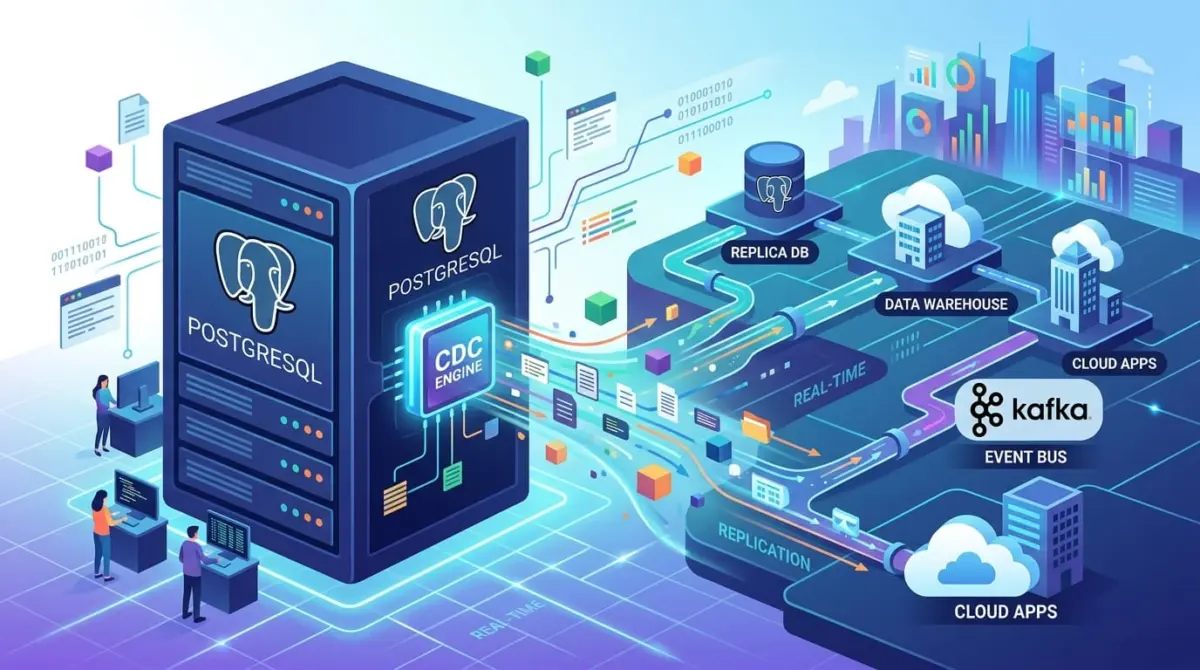
At the center of this paradigm shift is Change Data Capture (CDC)—specifically optimized for PostgreSQL, one of the world’s most popular open-source relational databases. According to a landmark industry prediction by Gartner, approximately 60% of enterprise data integration platforms will incorporate native CDC capabilities, highlighting its critical transition from a niche engineering luxury to a fundamental infrastructural necessity.
This comprehensive report examines the leading PostgreSQL CDC solutions on the market, analyzing their unique architectures, operational trade-offs, and ideal use cases. Furthermore, it explores the technical mechanics of Write-Ahead Log (WAL) replication, the shifting economics of enterprise data pipelines, and the strategic roadmap for organizations aiming to future-proof their real-time data estates.
The Shift to Real-Time: A Detailed Chronology of Data Integration
To understand why PostgreSQL CDC has become the undisputed standard for data movement, it is instructive to look at how enterprise data integration has evolved over the past two decades.
Phase 1: The Era of Scheduled Batch ETL (Early 2000s–2010s)
For years, the Extract, Transform, Load (ETL) paradigm was dominated by cron-driven scripts and heavyweight enterprise service bus (ESB) architectures. Organizations ran nightly or hourly batch jobs to pull data from production operational databases (OLTP) into analytical data warehouses (OLAP).
- The Bottleneck: This approach imposed immense strain on production databases during execution windows, frequently causing application slowdowns. More importantly, it meant business intelligence dashboards operated on data that was anywhere from hours to a full day old.
Phase 2: The Rise of Query-Based Polling (Mid-2010s)
As business demands shifted toward fresher insights, engineering teams attempted to bridge the gap by writing custom polling scripts that queried tables for newly inserted or updated rows (often relying on updated_at timestamps).
- The Bottleneck: Polling introduced severe concurrency and locking issues. Scanning large production tables repeatedly consumed precious CPU cycles and disk I/O, frequently missing deleted records entirely and missing micro-updates occurring within the polling interval.
Phase 3: The WAL-Based CDC Revolution (Present Day)
Modern architecture bypasses tables entirely, shifting attention to the database transaction log—known in PostgreSQL as the Write-Ahead Log (WAL). By parsing the WAL, CDC engines intercept inserts, updates, and deletes at the byte level the exact moment they are written to disk.
- The Impact: This non-invasive observation method reduces production database overhead to near-zero, eliminates the need for complex table scans, and provides sub-second replication latency. It forms the backbone of modern event-driven architectures, real-time fraud detection systems, and hyper-personalized AI engines.
Supporting Context & Metrics: Why WAL-Based CDC Wins
The structural advantages of WAL-based CDC over legacy integration methods are underpinned by distinct technical and financial efficiencies:
- Eradicating Database Load: Polling strategies create high-frequency, resource-intensive read operations that directly compete with live user traffic. WAL reading, conversely, is sequential and passive, operating asynchronously from the core transactional engine.
- Capturing Deletes: Timestamp-based polling fails to capture deleted records unless soft-deletes are strictly enforced in application code. Because the PostgreSQL WAL records every raw tuple modification, CDC tools capture deletions with absolute fidelity.
- Powering AI and Machine Learning: Modern predictive models—ranging from real-time recommendation engines to fraud detection classifiers—suffer severe performance degradation when fed stale data. Continuous feature store updates via CDC ensure models evaluate fresh, highly relevant signals.
- Minimizing Replication Lag: In mission-critical environments, data that is even a few minutes old can trigger false alarms or lead to flawed automated decisions. Advanced CDC frameworks reduce lag to milliseconds, maintaining absolute synchronization between transactional systems and downstream analytical engines.
The 8 Best Postgres CDC Tools and Software for Real-Time Replication
Selecting the right CDC tool requires careful evaluation of your organization’s internal engineering capacity, infrastructure budget, data volume, and destination ecosystem. Below is an exhaustive breakdown of the top eight PostgreSQL CDC solutions available today.
+------------------------+----------------------------------+----------------------------------+
| Tool                   | Core Architecture                | Ideal Use Case                   |
+------------------------+----------------------------------+----------------------------------+
| 1. Artie               | WAL Streaming / Managed          | High-volume cloud data loading   |
| 2. Debezium            | Kafka Connect / Open Source      | Custom event-driven ecosystems   |
| 3. Airbyte             | Logical Replication / Extensible | Multi-destination standardizing  |
| 4. Estuary Flow        | Streaming-First / In-Flight ETL  | Real-time predictive pipelines   |
| 5. Striim              | Enterprise-Grade / Heterogeneous | Zero-downtime digital transforms |
| 6. Fivetran            | Fully Managed / SaaS             | "Set-and-forget" data operations |
| 7. AWS DMS             | Native AWS Integration           | Migrations into AWS ecosystems   |
| 8. PeerDB              | Postgres-to-Warehouse Optimized  | Low-latency BI dashboards        |
+------------------------+----------------------------------+----------------------------------+
1. Artie
Artie is engineered specifically to simplify low-latency PostgreSQL replication by abstracting away the heavy operational overhead typically associated with pipeline maintenance.
- Mechanism: It utilizes native Write-Ahead Log (WAL) streaming to capture inserts, updates, and deletes, keeping data warehousing platforms meticulously synchronized with production environments.
- Key Advantage: By automating schema evolution and checkpointing, Artie prevents pipeline breakage when production table structures change. This makes it an exceptional choice for high-volume engineering environments where database resource preservation is paramount.
2. Debezium
Debezium stands as the open-source industry standard for organizations prioritizing deep architectural control and event-driven design.
- Mechanism: Integrating seamlessly with Apache Kafka and Kafka Connect, Debezium translates database transaction logs into a continuous stream of JSON or Avro events consumable by downstream microservices.
- Key Advantage: Operating as a lightweight, distributed observer, it reads the PostgreSQL WAL with minimal performance penalties. It is the premier option for enterprise teams maintaining custom big-data ecosystems on self-hosted infrastructure.
3. Airbyte
Airbyte leverages an expansive connector library combined with modern logical replication frameworks to deliver versatile data integration.
- Mechanism: By utilizing PostgreSQL’s native logical replication features, Airbyte achieves accurate incremental data synchronization while maintaining a minimal resource footprint on primary databases.
- Key Advantage: It strikes an optimal balance between open-source flexibility and out-of-the-box utility, making it a favorite for organizations standardizing analytics workflows across complex, multi-cloud setups.
4. Estuary Flow
Estuary Flow treats data movement as a continuous stream rather than a collection of discrete batch processes, putting real-time architecture at the core of its design.
- Mechanism: Flow manages high-throughput replication across operational databases and cloud messaging systems using a streaming-first engine.
- Key Advantage: It uniquely supports in-flight data transformations. Engineering teams can filter, clean, and reformat data while it is being replicated, ensuring high-quality inputs arrive at downstream predictive analytics models.
5. Striim
Striim is a robust, enterprise-grade platform built expressly for mission-critical IT environments where downtime is unacceptable.
- Mechanism: It fuses real-time streaming ingestion with continuous in-memory processing, allowing organizations to synchronize PostgreSQL data while concurrently running complex analytical calculations.
- Key Advantage: Striim excels in heterogeneous enterprise environments, effortlessly bridging legacy infrastructure with modern cloud messaging fabrics during large-scale digital transformations.
6. Fivetran
Fivetran is synonymous with the "set-and-forget" operational philosophy, offering a fully managed SaaS service that automates the entire data pipeline lifecycle.
- Mechanism: It handles connector configuration, automated schema drift detection, and continuous health monitoring for PostgreSQL pipelines entirely out-of-the-box.
- Key Advantage: By outsourcing infrastructure management to a dedicated provider, engineering teams can focus entirely on utilizing data rather than debugging broken replication jobs.
7. AWS Database Migration Service (AWS DMS)
For organizations deeply embedded in the Amazon Web Services ecosystem, AWS DMS serves as the natural, deeply integrated choice.
- Mechanism: It supports continuous, ongoing replication, ensuring zero data loss during migrations to targets such as Amazon Redshift, Amazon Aurora, or Amazon S3.
- Key Advantage: Because it is native to AWS, it inherits robust cloud security controls, IAM integration, and VPC networking, making large-scale hybrid-cloud migrations seamless and secure.
8. PeerDB
PeerDB is a specialized, modern solution built explicitly to solve one problem: high-performance PostgreSQL-to-warehouse replication.
- Mechanism: By hyper-focusing on a single architectural pathway, PeerDB bypasses the bloat of multi-purpose integration tools, drastically cutting down replication lag.
- Key Advantage: It is ideal for Business Intelligence (BI) teams demanding sub-second dashboard refreshes without the administrative burden of managing complex, general-purpose streaming infrastructures.
Official Statements & Industry Perspectives
Industry leaders and market analysts have increasingly highlighted the urgency of moving away from batch processes in favor of streaming paradigms.
According to enterprise architecture research notes published by Gartner, “The expectation for real-time analytics is no longer restricted to specialized financial applications; it is becoming a horizontal requirement across retail, logistics, healthcare, and SaaS.” Furthermore, Gartner’s projection that 60% of enterprise integration platforms will feature native CDC capabilities underscores that continuous data capture is rapidly becoming a baseline expectation for IT infrastructure.
Database reliability engineers and data architects frequently emphasize that choosing a CDC tool is ultimately a balancing act between operational control and maintenance velocity. While open-source tools like Debezium provide infinite customization and zero licensing costs, they demand significant internal engineering hours to maintain. Conversely, fully managed platforms like Fivetran and Artie reduce maintenance overhead at the expense of higher direct software costs and less granular infrastructure tuning.
What to Look for in a Postgres CDC Platform
Before committing to a specific PostgreSQL CDC solution, technology leaders must evaluate several core evaluation criteria:
- Schema Evolution Handling: Production databases change constantly. Look for tools that automatically handle schema drift (e.g., column additions, data type modifications, and table renames) without crashing the replication pipeline.
- Resource Footprint: Ensure the tool reads from the WAL efficiently without overwhelming database memory, CPU, or generating excessive disk bloat via unconsumed replication slots.
- Failure Recovery & Exactly-Once Semantics: In the event of a network partition or destination outage, the CDC tool must gracefully resume from the exact checkpoint without duplicating data or creating gaps.
- Target Compatibility: Verify that the platform natively supports your target destinations—whether they are cloud data warehouses (Snowflake, BigQuery, Redshift), streaming platforms (Kafka, Kinesis), or operational vector databases for AI applications.
Future Outlook
As enterprise applications become increasingly event-driven and AI-dependent, the demand for real-time data integration will only accelerate. The boundary between operational databases and analytical data stores will continue to blur, driven by ultra-low-latency synchronization mechanisms.
PostgreSQL, with its robust extension ecosystem, thriving open-source community, and reliable WAL architecture, will remain at the epicenter of this transformation. Organizations that invest early in modern, resilient postgres cdc tools will unlock unprecedented agility, empowering them to react to market changes, customer behaviors, and operational anomalies instantly. In the modern business arena, real-time data flow is no longer a technical luxury—it is the baseline of modern operational excellence.