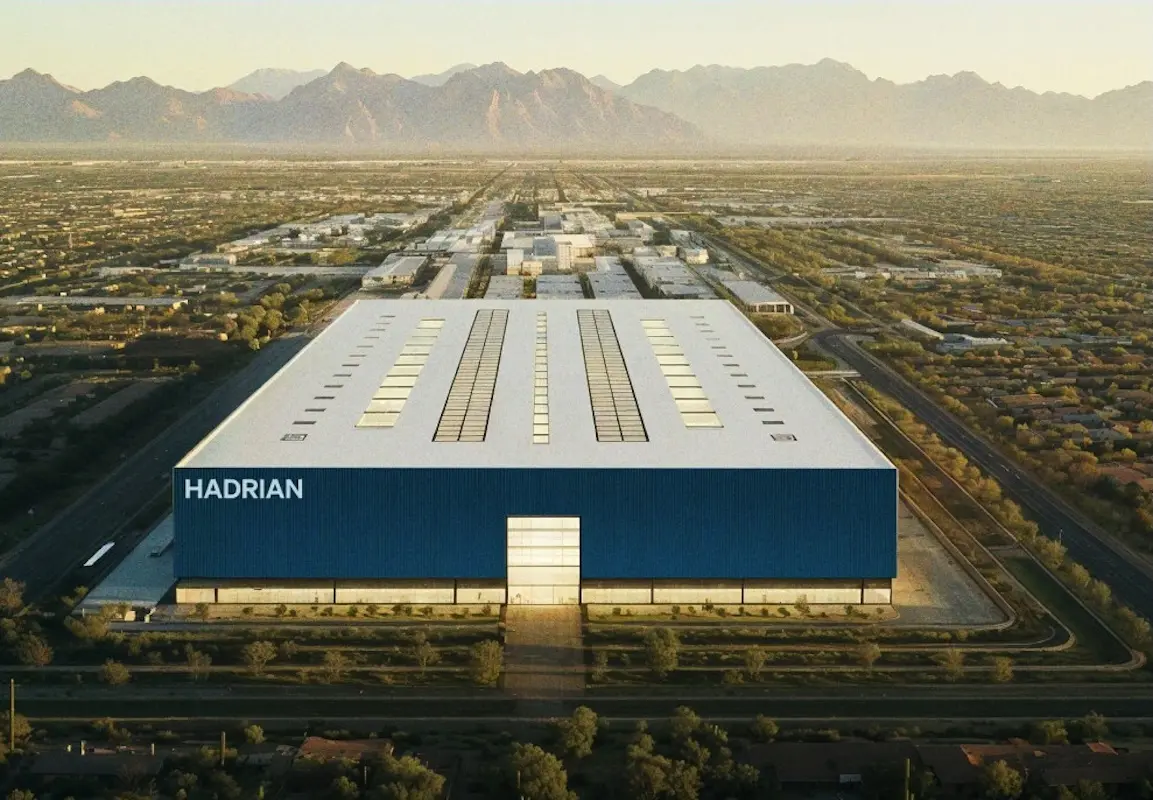
Published: August 6, 2026
Dateline: SAN FRANCISCO & MESA, ARIZONA
Category: Defense Technology / Industrial Automation / Venture Capital
Executive Overview
In a milestone transaction that underscores the shifting priorities of modern venture capital and national security, defense tech startup Hadrian announced on Thursday that it has successfully secured a massive $1.37 billion Series D funding round. The financing values the rapidly expanding automated manufacturing company at an impressive $7.87 billion.
This latest influx of capital arrives on the heels of a $260 million Series C round led by Founders Fund and Lux Capital roughly a year ago. According to PitchBook estimates, Hadrian’s cumulative lifetime fundraising now sits at approximately $2 billion, vaulting the firm into the upper echelons of the world’s most valuable private deep-tech and industrial startups.
Unlike many contemporary defense tech startups that focus on software algorithms, counter-drone systems, autonomous aerial vehicles, or artificial intelligence targeting solutions, Hadrian has staked its claim on a foundational, unglamorous bottleneck: the physical supply chain. The company is not building weapons; rather, it is building the hyper-automated factories required to mass-produce critical hardware components for the military-industrial complex. By deploying advanced robotics, precision machinery, and proprietary software, Hadrian aims to solve America’s most acute industrial vulnerability—the erosion of domestic manufacturing capacity for defense hardware.
The Series D round features a veritable "who’s who" of institutional finance and venture capital. Lead investors include WCM Investment Management, Washington Harbour Partners, Valor Equity Partners, 137 Ventures, and Baillie Gifford. They are joined by a broad coalition of participating firms, including 1789 Capital, Morgan Stanley Wealth Management, funds managed by Apollo and T. Rowe Price, alongside tech-focused heavyweights such as CapitalG, Andreessen Horowitz, Founders Fund, Lux Capital, and Altimeter.
Detailed Chronology & Growth Trajectory
Hadrian’s meteoric rise reflects a broader structural realignment within the United States economy, where national security concerns have converged with a bipartisan push for industrial reshoring. Founded with the mission to revitalize America’s manufacturing base, the company has methodically moved from concept to large-scale execution over the past several years.
The Foundation and Early Scaling
When Hadrian first emerged from stealth, the venture capital community was initially skeptical of capital-intensive hardware plays, preferring software-as-a-service (SaaS) and asset-light business models. However, geopolitical friction and persistent supply chain bottlenecks exposed severe vulnerabilities in Western defense procurement. Traditional aerospace and defense prime contractors were struggling with aging workforces, antiquated machinery, and multi-year backlogs.
Hadrian identified a critical gap: precision machining. Modern military hardware—ranging from jet engines to nuclear submarines—requires thousands of uniquely milled metal components built to exact tolerances. Hadrian’s thesis was that software-defined, highly automated factories could compress production timelines from months to days while drastically reducing error rates.
The Series C Turning Point
Approximately one year prior to its current announcement, Hadrian closed a $260 million Series C round co-led by Founders Fund and Lux Capital. This capital injection served as a critical inflection point, enabling the company to expand its footprint beyond initial pilot facilities. During this phase, Hadrian integrated full-product manufacturing capabilities, moving past raw component production to deliver more complex assemblies. This period also marked the opening of its strategic site in Arizona—a precursor to the sprawling new infrastructure projects that would soon follow.
The Mesa, Arizona Expansion & Alabama Submarine Initiative
Hadrian’s infrastructure ambitions went into hyperdrive earlier this year. In March, the company officially opened a massive advanced manufacturing facility in Alabama, specifically designed to supply critical parts for the U.S. Navy’s Columbia-class and Virginia-class nuclear submarine programs. That strategic endeavor was structured as a high-stakes public-private partnership valued at an estimated $2.4 billion.
Building upon its Alabama footprint and existing Arizona operations, Hadrian is now channeling its newly acquired $1.37 billion Series D capital into the realization of its third major facility in Mesa, Arizona (as well as expanding its broader national network). This facility is designed to serve as a blueprint for the future of American defense manufacturing: lights-out, highly automated, and deeply integrated with the digital threads required by the Department of Defense.
Supporting Context & Strategic Metrics
To understand the significance of Hadrian’s $7.87 billion valuation, one must examine the broader macroeconomic and geopolitical backdrop governing defense technology investments in the mid-2020s.
The Industrial Base Deficit
For decades, the United States outsourced significant portions of its manufacturing ecosystem to overseas markets in pursuit of cost optimization. While this strategy benefited consumer goods and commercial electronics, it proved catastrophic for national security resilience.

- The Tier-2 and Tier-3 Supplier Crisis: While major prime contractors like Lockheed Martin, Northrop Grumman, General Dynamics, and Raytheon manage overall weapon system assembly, they rely on a fragile network of thousands of small, specialized machine shops (Tier-2 and Tier-3 suppliers). Many of these smaller shops are family-owned businesses facing generational succession crises, lacking the capital to invest in modern automation or AI-driven quality control.
- Production Backlogs: The U.S. military faces severe delivery delays across major platforms, from munitions replenishment (depleted by foreign aid and strategic stockpiling) to naval shipbuilding. The U.S. Navy’s submarine industrial base, in particular, has struggled to meet required delivery cadences, making companies like Hadrian critical to national survival.
Financial Engineering and Capital Influx
The composition of Hadrian’s Series D cap table reveals a fascinating evolution in tech investing. While traditional venture capital firms like Founders Fund, Lux Capital, and Andreessen Horowitz laid the early groundwork, the Series D brought in massive institutional asset managers—including Baillie Gifford, T. Rowe Price, Apollo, and Morgan Stanley Wealth Management.
This shift indicates that Hadrian is transitioning from an early-stage venture experiment into a mature, capital-intensive industrial titan capable of generating predictable, long-term cash flows backed by multi-year government procurement contracts.
Official Statements & Industry Reactions
While specific direct quotes from individual executives within the funding announcement remain measured, the collective weight of the participating investor syndicate points to a unified thesis: software alone cannot protect a nation; physical output matters.
In previous statements surrounding its facility expansions, Hadrian leadership emphasized that America’s geopolitical deterrence relies entirely on its industrial velocity.
"We are not building a tech company in the traditional sense; we are building the industrial engine required to secure the free world," an early company manifesto noted. "If you cannot manufacture the hardware at scale, innovation on a whiteboard is meaningless."
Investors echoed this sentiment. By backing Hadrian with $1.37 billion in a single tranche, firms like Valor Equity Partners and Washington Harbour Partners are betting that the modernization of the defense supply chain is not merely a patriotic endeavor, but one of the largest market opportunities of the decade. The transformation of factories from manual, union- and labor-constrained environments into software-orchestrated automation hubs represents a trillion-dollar total addressable market (TAM).
Furthermore, defense analysts have pointed out that Hadrian’s model aligns perfectly with the Pentagon’s recent initiatives—such as the Department of Defense’s focus on manufacturing resilience and supply chain redundancy. By partnering directly with naval shipbuilders and aerospace primes, Hadrian has embedded itself deeply into the procurement pipelines of the federal government, ensuring high switching costs and long-term revenue visibility.
Future Outlook: The Horizon for Hadrian
With $2 billion in total capital raised and a valuation approaching $8 billion, Hadrian faces both monumental opportunities and unique operational challenges.
1. Scaling Execution in Mesa and Beyond
The immediate priority for Hadrian will be the rapid construction and operationalization of its planned third facility in Mesa, Arizona. Scaling high-precision, automated manufacturing is notoriously difficult. Unlike software, which can be deployed instantly via the cloud, physical factories require complex supply chains, precise environmental controls, heavy regulatory compliance, and rigorous quality assurance standards (such as AS9100 aerospace certifications).
2. Workforce Transformation and Automation
Hadrian’s ultimate promise is that automation can offset the severe labor shortages plaguing the manufacturing sector. However, operating these advanced facilities requires a new breed of technicians—individuals trained in robotics maintenance, software orchestration, and advanced metallurgy. The company will need to invest heavily in training and educational partnerships within the communities where it operates, such as Mesa and its Alabama hub.
3. Broadening Beyond Naval Defense
While Hadrian has made major inroads supporting Columbia- and Virginia-class submarine production, the broader defense apparatus spans land, air, space, and cyber infrastructure. Over the coming years, expect Hadrian to expand its manufacturing footprint into hypersonic missile components, satellite structures, tactical ground vehicle parts, and next-generation aviation platforms.
4. The Long-Term Path to Public Markets
Given the caliber of institutional investors participating in the Series D—ranging from mutual fund giants to elite wealth management firms—industry observers are already speculating about an eventual Initial Public Offering (IPO). While Hadrian management has remained tight-lipped regarding public market timelines, a company commanding a nearly $8 billion valuation with deep government-backed revenue streams is a prime candidate for public listing once market conditions stabilize.
Conclusion
Hadrian’s $1.37 billion Series D funding round marks a defining moment in the modern history of defense technology and American industrial policy. By bypassing the software hype cycle and directly attacking the physical bottlenecks of military hardware production, Hadrian has positioned itself as an indispensable pillar of national security. As geopolitical tensions persist and the demand for domestic manufacturing sovereignty reaches an all-time high, Hadrian’s network of automated factories stands ready to reforge the arsenal of democracy for the 21st century.