Executive Overview
In a sweeping move that underscores the rapid acceleration of corporate reliance on artificial intelligence, TikTok USDS JV—the specialized entity managing TikTok’s critical U.S. operations—is officially shutting down its regional office in Nashville, Tennessee. Set to take effect on October 5, the closure will result in the elimination of 250 jobs, impacting a vital cohort of the platform’s domestic content moderation workforce.
Employees affected by the sudden decision received abrupt notification via email on a Wednesday morning, quickly followed by the revocation of corporate access. For many workers, the realization set in as they found themselves digitally locked out of their company-issued devices, accompanied by notices detailing upcoming severance packages.
While corporate leadership frames the restructuring as a necessary measure to streamline operations and position the company for sustainable long-term growth, the timing and execution of the layoffs have cast a spotlight on the evolving nature of digital trust and safety. The closure of the Nashville hub is not merely a localized real estate decision; it represents a profound philosophical shift in how one of the world’s most influential social media platforms manages the delicate balance between automated technology and human oversight.
Serving a massive domestic audience of more than 200 million active users in the United States, TikTok relies heavily on robust content moderation to maintain compliance, protect user safety, and navigate a complex and increasingly hostile regulatory landscape. By dismantling a physical hub dedicated to human moderation, TikTok USDS signals an institutional pivot toward automated systems—a transition that raises pressing questions about the future of labor in the tech sector, the psychological toll on human moderators, and the ultimate efficacy of AI-driven content governance.
Detailed Chronology of the Nashville Office Closure
The unraveling of TikTok USDS’s Nashville operations unfolded with startling swiftness, catching the local workforce and industry observers largely by surprise.
The Wednesday Morning Notification
The first indication of the impending corporate earthquake arrived in employee inboxes on a Wednesday morning. According to copies of the internal correspondence reviewed by The New York Times, workers stationed at the Nashville facility were informed that the office would be permanently shuttered. The decision, communicated with corporate finality, bypassed protracted local consultations or phased transitions.
Instead, the communication outlined immediate operational changes. Multiple employees, speaking on the condition of anonymity due to fear of jeopardizing their severance agreements, reported that their digital credentials were systematically revoked shortly after the email landed. Workers attempting to log into their enterprise laptops, communication channels, and project management tools found themselves blocked, replaced by automated prompts indicating that their employment terms had ended and directing them toward human resources for severance arrangements.
The October 5 Deadline
The corporate timeline leaves impacted workers with a brief window to navigate their sudden unemployment. While the digital lockouts and termination notices were dispatched in early August, the physical doors of the Nashville office will remain officially open until October 5. This grace period serves administrative and wind-down purposes rather than active operational continuity, as the moderation teams based out of the facility have effectively been sidelined.
The abruptness of the shutdown mirrors a broader trend across the technology sector, where major platforms increasingly favor swift, decisive workforce reductions over extended transition periods. For the 250 employees in Nashville—many of whom relocated to Tennessee or built specialized careers around digital trust and safety—the October 5 deadline marks the abrupt close of a turbulent chapter in the platform’s operational history.

Supporting Context & Metrics: The Human-AI Equilibrium
To fully understand the weight of the Nashville layoffs, one must examine the operational mechanics of TikTok’s content moderation apparatus. The platform operates at a staggering scale, processing billions of data points, videos, comments, and live streams daily for its 200 million-plus U.S. users. Managing this digital ecosystem requires a sophisticated blend of algorithmic filtering and human nuance.
Insights from the Inaugural Platform Security Reports
Just one month prior to the announcement of the Nashville office closure, TikTok USDS published its inaugural platform security and community guidelines reports. These transparent disclosures shed rare light on the immense volume of material evaluated by the platform’s moderation infrastructure, outlining the tireless work undertaken to shield users from potentially harmful, misleading, or inappropriate content.
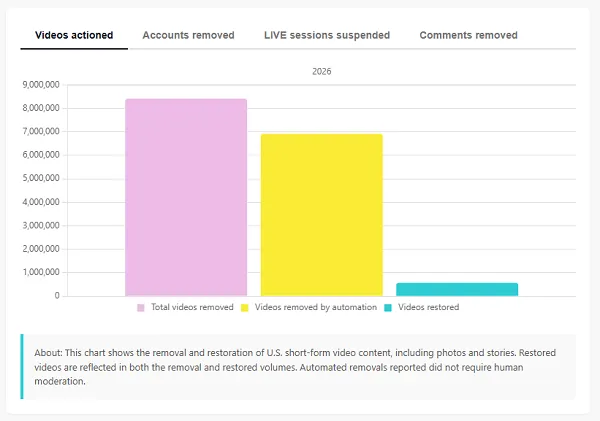
Data extracted from the transparency reports revealed that between January 22 and March 31, TikTok USDS removed more than 8.4 million videos from the platform in the United States alone. These figures illustrate the relentless daily pressure placed on the moderation infrastructure, where millions of pieces of content must be assessed, triaged, and adjudicated within narrow timeframes to prevent viral spread.
The Automated vs. Human Divide
A deeper dive into the removal statistics exposes the shifting balance of power between machines and humans within TikTok’s moderation hierarchy:
- Automated Detection: Approximately 82% of the 8.4 million removed videos were flagged and excised through automated detection systems. These algorithms scan video frames, analyze audio tracks, parse textual overlays, and cross-reference known violation patterns at lightning speed.
- Human Oversight: The remaining 18% of removals, alongside appeals, edge cases, and complex contextual evaluations, fell to human moderators. These professionals are tasked with interpreting nuance, cultural context, satire, and local idioms—areas where traditional algorithms historically falter.
The heavy reliance on automated detection—handling more than four-fifths of the platform’s cleanup efforts—provides a critical window into TikTok USDS’s strategic calculus. With continuous, rapid advancements in artificial intelligence, machine learning, and computer vision, corporate leadership appears increasingly confident in handing the reins over to automated systems.
The Nashville office, which housed a localized team of human moderators, became redundant in an era where advanced large language models and neural networks can process complex audio-visual data with unprecedented accuracy and minimal latency.
Official Statements and Corporate Ambiguities
As the news reverberated across the tech industry, media outlets and labor advocates sought clarity from TikTok USDS regarding the long-term implications of the restructuring. The responses from corporate channels, however, have been notable for their brevity and calculated ambiguity.
The Corporate Rationale
In an official statement provided to The New York Times, TikTok USDS articulated the official reasoning behind the Nashville facility’s closure. The company framed the decision as a calculated administrative pivot designed to:
- Streamline domestic operations
- Eliminate architectural redundancies
- Better align internal teams for sustainable, long-term growth in a competitive digital landscape
By consolidating operations and leaning into technological efficiencies, TikTok USDS aims to construct a leaner organizational framework.

Unanswered Questions Regarding Moderation Capacity
Despite the corporate explanations, critical questions remain glaringly unaddressed. TikTok USDS declined to share specific details regarding how the Nashville closure will impact its overarching moderation efforts. Furthermore, leadership steadfastly refused to comment on whether the labor capacity lost through the termination of 250 employees would be replaced—either through new hires in alternative geographic regions, third-party outsourcing contractors, or expanded software capabilities.
This corporate reticence has fueled speculation among industry analysts and digital rights advocates. If 250 human jobs are being erased without a corresponding increase in human headcount elsewhere, the burden of moderation is shifting almost entirely onto silicon and code. While automation offers unmatched speed and scalability, critics argue it lacks the empathy, contextual understanding, and ethical accountability required to judge sensitive human expression fairly.
Future Outlook: The Evolution of Trust and Safety
The closure of the Nashville moderation hub and the layoff of 250 workers mark a watershed moment for TikTok USDS and the broader social media landscape. As the industry careens deeper into the artificial intelligence boom, several key trends and challenges loom on the horizon.
The Rise of AI-First Moderation
The Nashville layoffs are emblematic of a broader structural evolution across Silicon Valley. Companies that once hired tens of thousands of human contractors to review graphic, disturbing, or sensitive content are aggressively pivoting toward automated moderation. By leveraging generative AI and sophisticated machine learning models, platforms can drastically reduce operational expenditures associated with physical offices, healthcare benefits, and psychological support services for human moderators.
However, relying on AI for content governance is not without peril. Automated systems remain vulnerable to bias, false positives, and an inability to grasp subtle cultural nuances. When algorithms make mistakes on a platform with 200 million U.S. users, the consequences can range from accidental censorship of marginalized voices to the failure to catch sophisticated harms.
Navigating Regulatory Scrutiny
TikTok USDS operates under intense regulatory scrutiny in the United States, where lawmakers closely monitor its data practices, content algorithms, and corporate governance. As the platform transitions toward an increasingly automated moderation model, it must prove to regulators, creators, and users that its systems remain robust, fair, and transparent. The publication of transparency reports is a step in the right direction, but maintaining public trust will require continuous accountability—especially as the human safety net within the company is systematically dismantled.
The Human Cost of Technological Progress
Ultimately, the story of the Nashville office closure is a human one. Behind the abstract corporate metrics of operational efficiency and algorithmic scalability lie 250 professionals whose livelihoods have been upended by the relentless march of technological progress. As platforms race to automate their operations, the digital economy faces a reckoning regarding the value of human labor in maintaining the digital public square.
When the doors of the Nashville office close for the final time on October 5, they will not just mark the end of a physical workspace; they will symbolize a definitive crossing into a new era where machines watch over the digital world, leaving human judgment increasingly sidelined.