







Executive Overview
The corporate conversation surrounding artificial intelligence has officially moved past the novelty of conversational text generators. For enterprise leaders, the holy grail of digital transformation is no longer a slightly smarter chatbot that can draft an email or summarize a PDF. Instead, the strategic horizon is now dominated by agentic AI—autonomous software agents engineered to execute complex, multi-step business tasks end-to-end across disparate departments, workflows, data lakes, and legacy IT systems.
However, translating the promise of agentic AI into production-grade reality requires a fundamental shift in how organizations conceptualize infrastructure. According to extensive research and thousands of workload experiments recently conducted by Intel, agentic AI is not merely an inference problem; it is a profound systems engineering challenge.
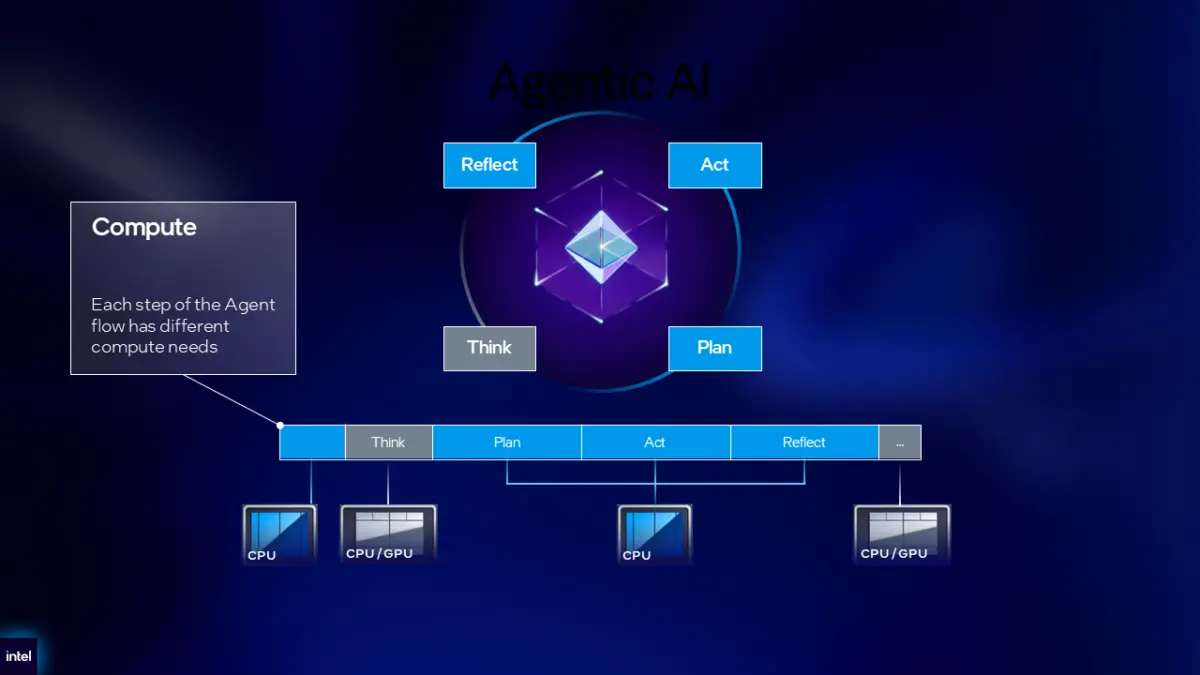
Successfully deploying agentic AI at scale demands a robust platform built upon proper CPU capacity, resilient data access, policy-aware tool utilization, deep observability, sophisticated memory management, and the architectural agility to predictably plan and scale agent fleets. To help enterprise leaders navigate this paradigm shift, Intel has distilled its empirical findings into five foundational lessons. This report explores the architectural realities, performance metrics, sizing strategies, and scaling principles necessary to transition agentic AI from experimental pilots to core enterprise infrastructure.
Detailed Chronology: The Evolution from LLM Inference to Systems Orchestration
To appreciate the current state of enterprise agentic AI, one must examine the chronological evolution of AI workloads over the past several years.
Phase 1: The Era of Static Inference (2022–2024)
In the initial wake of generative AI’s mainstream explosion, the technology industry focused almost exclusively on Large Language Model (LLM) inference. Organizations treated AI models as monolithic oracles. A user submitted a prompt, the model computed token probabilities, and a static response was returned. Performance metrics during this era were narrow, focusing heavily on tokens-per-second, GPU memory bandwidth, and raw parameter counts. Infrastructure teams built data centers optimized to feed GPUs with massive datasets, treating the compute node as an isolated island dedicated to raw mathematical calculation.
Phase 2: The Emergence of Tool-Using Assistants (2024–2025)
As organizations sought higher utility, developers began connecting LLMs to external tools via application programming interfaces (APIs). Models learned to invoke calculators, search engines, and internal databases. While this expanded capabilities, it exposed severe architectural bottlenecks. Inference engines were suddenly tasked with managing conversational state, parsing tool outputs, and recovering from runtime errors. Enterprises quickly realized that simply throwing more GPU power at a model did not solve latency spikes caused by slow database queries, poor memory handling, or inefficient network hops between tools.
Phase 3: The Agentic Workflow Revolution (2026 and Beyond)
Today, the industry has crossed a critical threshold into true agentic AI. Modern software agents are goal-driven automated enterprise workflow processes. They do not merely answer a prompt; they analyze a business objective, architect a multi-step execution plan, call disparate enterprise tools, read and interpret results, handle exceptions, and dynamically retry when failures occur.
Intel’s recent research marks a pivotal milestone in this third phase. By conducting thousands of rigorous agentic AI workload experiments, Intel sought to look past the marketing hype and dissect the hidden mechanics of agent execution. The overarching discovery is definitive: an agent is only as good as the systems architecture that supports it. Because agents operate across people, data, systems, and strict governance policies, enterprise value depends entirely on end-to-end task orchestration, latency management, telemetry, and scalable infrastructure.
Supporting Context & Metrics: Decoding Agentic Performance
To gain deep, unbiased insight into agentic AI workload performance, Intel undertook a comprehensive empirical study. Recognizing that standard benchmarking tools were insufficient for evaluating multi-step autonomous behavior, Intel extended Terminal-Bench, an open-source benchmarking harness specifically designed for evaluating AI agents with advanced profiling, telemetry, and replay capabilities.
Methodological Rigor: Removing LLM Variability
One of the greatest challenges in evaluating AI agents is run-to-run variance introduced by the underlying LLM. A model might generate a slightly different response or reasoning path in consecutive runs, making it difficult to isolate whether performance bottlenecks stem from the infrastructure or stochastic model behavior.
To solve this, Intel’s benchmark extension utilized a deterministic record-replay mechanism for LLM responses. During the initial phase, LLM outputs were recorded once and subsequently replayed identically across thousands of subsequent runs. This ingenious methodology effectively decoupled agent performance from LLM variability, establishing a reliable, repeatable baseline for comparative systems analysis.
Furthermore, Intel curated an intentionally broad task mix for Terminal-Bench to reflect the chaotic reality of modern enterprise environments. The test suite encompassed:
- Software compilation and automated testing
- Complex database operations and Boolean logic
- Data interpretation, ray tracing, and compression
- Linear algebra and video transcoding
- Intensive machine learning training routines
Defining "What Good Looks Like"
Traditional AI metrics evaluate the model in a vacuum (e.g., benchmark scores on standardized academic tests). However, platform and operations teams operating fleets of agents require an entirely different observational framework. Intel’s research establishes that enterprise operators must track six vital metrics to understand system health:
- Task Completion Latency (P50 and P95): Measuring how long end-to-end workflows take to execute, ensuring that systems do not silently bottleneck.
- Agent Fleet Density: Quantifying how many concurrent agents a given compute instance can sustain without degrading performance.
- End-User Experience Quality: Evaluating the responsiveness and reliability of the final output delivered to the human operator.
- Cost Scaling Dynamics: Tracking how operational expenditures scale linearly versus exponentially as active agent counts multiply.
- Error Recovery and Retry Rates: Measuring how efficiently agents detect failures, adjust their execution plans, and successfully self-correct.
- Resource Saturation Thresholds: Identifying the exact tipping points where CPU, memory, and I/O subsystems saturate under heavy agentic concurrency.
Together, these six metrics answer the fundamental questions keeping enterprise IT operators awake at night: Is the system performing as expected? How many agents can the infrastructure sustain? How should we scale to support growing enterprise adoption?
Official Statements and Architectural Frameworks
Intel’s extensive experimentation yielded three core dimensions for deploying agentic AI safely and efficiently in enterprise environments. These pillars serve as an actionable playbook for architects, system administrators, and technology executives.
Dimension 1: Plan in Terms of Agent Density, Not Raw Agent Count
When sizing infrastructure for traditional applications, IT leaders often look at raw user counts or static virtual machine allocations. For agentic AI, this approach fails. Intel’s primary sizing rule introduces the concept of agent density, measured as the number of agents per vCPU.

Agent density acts as the leading signal for system saturation. For example, empirical testing demonstrates that running 10 active agents on an 8-vCPU system yields behavioral and performance characteristics remarkably similar to running 20 agents on a 16-vCPU system, provided the density remains constant. This gives enterprise architects a portable, predictable metric to compare capacity across diverse instance sizes, cloud environments, and processor generations.
Crucially, the optimal density depends heavily on the specific business use case:
- Interactive Copilots and Assistants: User-facing applications require low agent density. Because human users are waiting in real-time, response time is paramount, and latency spikes cannot be tolerated.
- Batch Workloads and IT Automation: Asynchronous background tasks—such as automated code refactoring, regression testing, or ticket triaging—can easily run at much higher density, maximizing compute efficiency and lowering the total cost of ownership (TCO).
The Observability Paradox: Moving Beyond Average CPU Utilization
One of the most profound operational insights from Intel’s research centers on performance monitoring. Average compute (CPU) utilization is a notoriously weak primary performance monitoring signal for agentic workloads.
Agents exhibit a inherently "bursty" execution pattern. They alternate between periods of waiting (e.g., waiting for an LLM response or an external API call) and short, violent bursts of compute-intensive work (e.g., processing large datasets, compiling code, or parsing complex logs). Because of this rhythm, average CPU utilization can look perfectly healthy on a dashboard, masking the underlying reality that these compute bursts are creating internal queues and severely degrading the user experience.
To solve this, Intel recommends a new observability model: Alert on P95 task latency first, then confirm the issue by inspecting sustained task duration. P95 latency acts as an early warning radar, signaling when workflows are beginning to wait in queues long before average task duration metrics register any meaningful degradation.
Dimension 2: Scale Out by Default
When enterprise demand increases, infrastructure architects face a classic dilemma: scale up (add more cores and memory to a single monolithic system) or scale out (add more independent systems to a cluster).
Intel’s testing data provides a clear directive: Scale out by default.
This recommendation aligns directly with the nature of agentic workflows. Enterprise agents are typically semi-independent and characterized by modest per-agent compute bursts. Scaling out improves overall system performance, guarantees high availability, lowers overall infrastructure costs, and makes it drastically easier to preserve the target agents-per-vCPU ratio as the enterprise platform grows.
Organizations should reserve scaling up for highly specific edge cases—such as instances where individual agents require massive parallel compute, shared state limits partitioning, memory locality is critical to performance, or restrictive software licensing constraints apply.
Dimension 3: Grounded Business Implications and Target Personas
Technology without business value is an expensive science project. Intel’s research highlights that organizations achieving production-grade success with agentic AI are not chasing fleeting technological novelties. Instead, they are taking a pragmatic approach: wrapping automation layers around existing workflows that already possess codified rules and measurable service-level agreements (SLAs).
Prime candidates for early enterprise agentic deployment include:
- Software Engineering: Automated code creation, refactoring, and extensive regression test farms.
- IT Operations: Automated IT support ticket triaging, root-cause analysis, and incident remediation.
- Business Intelligence: Comprehensive market analysis and automated financial data gathering.
- Cybersecurity: Continuous security review, vulnerability scanning, and automated compliance auditing.
The ideal enterprise persona for driving agentic AI is not the experimental hacker chasing the latest model release. Rather, it is the accountable enterprise leader—the Chief Information Officer, Chief Technology Officer, or VP of Engineering—who must relentlessly improve cycle times, boost operational productivity, strictly enforce corporate governance policies, and scale technology adoption while keeping a watchful eye on the bottom line.
Future Outlook: The Road Ahead for Enterprise AI
As we look toward the remainder of the decade, the trajectory of enterprise computing will be indelibly shaped by the maturation of agentic AI. The organizations that successfully navigate this transition will be those that view AI not as an isolated software library, but as a holistic systems architecture challenge.
Intel’s empirical workload experiments provide a vital roadmap. By recognizing that agents are workflow automation engines requiring robust CPU capacity, specialized observability frameworks, and deliberate density-based scaling, enterprises can finally bridge the chasm between experimental proofs-of-concept and resilient production environments.
The future belongs to organizations that build on solid foundations. By prioritizing P95 task latency monitoring, scaling out agent fleets by default, and anchoring automation to well-defined business processes, enterprise leaders can unlock unprecedented levels of productivity. Agentic AI’s ultimate value will not be measured by how eloquently a model can chat, but by how reliably autonomous software agents can execute real work across teams, systems, data, and processes—moving enterprises confidently and securely into a new era of digital transformation.