Executive Overview
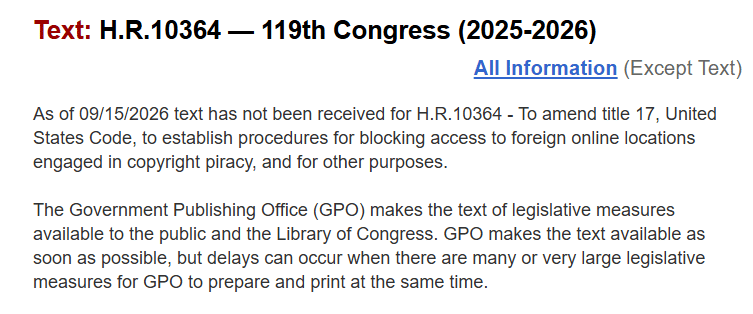
U.S. Representative Darrell Issa has officially introduced a new legislative proposal into the House of Representatives aimed squarely at curbing digital piracy by blocking foreign copyright-infringing websites within the United States. Filed under Congressional record H.R. 10364, the measure is broadly intended to establish formal judicial procedures enabling rightsholders to choke off access to offshore online locations operating outside domestic jurisdictions. While formal text remains unpublished on Congress.gov pending processing by the Government Publishing Office (GPO), early drafts and prior stakeholder negotiations indicate the bill envisions forcing both traditional Internet Service Providers (ISPs) and major Domain Name System (DNS) resolvers to implement technical blocks.
The introduction of H.R. 10364 marks a major milestone in a multi-year, highly contentious political battle over website blocking—a policy tool that has remained largely taboo in American legislative circles since the catastrophic collapse of the Stop Online Piracy Act (SOPA) and the PROTECT IP Act (PIPA) in 2012.
However, the path forward for Rep. Issa’s bill is far from clear. As a retiring member of Congress serving out the final months of his legislative term, Issa faces a tight window to advance the proposal through a deeply divided House. Furthermore, H.R. 10364 enters a crowded legislative ecosystem characterized by internal competition from alternative bipartisan measures, ongoing negotiations toward a unified "four corners" consensus, and swift, fierce opposition from digital rights advocates and public interest groups who warn of catastrophic collateral damage to free expression, global internet architecture, and innocent small businesses.
Detailed Chronology: From SOPA’s Ashes to H.R. 10364
The Post-SOPA Landscape and the Rebirth of Site Blocking
For over a decade, mandatory website blocking at the network level was viewed as a legislative third rail in Washington, D.C. The overwhelming public backlash, massive internet blackouts, and tech-industry mobilization that ultimately derailed SOPA and PIPA in January 2012 successfully pushed ISP-level filtering off the table for years. During this interim, American copyright industries relied primarily on Digital Millennium Copyright Act (DMCA) takedown notices, voluntary payment-processor agreements, and search-engine demotions to combat digital piracy.
The political calculus began to shift dramatically in January 2025, when Representative Zoe Lofgren introduced the Foreign Anti-Digital Piracy Act (FADPA). FADPA signaled a renewed appetite among certain lawmakers to re-examine foreign site blocking, provided it included narrow definitions and safeguards. This initial legislative spark set off a cascade of competing proposals. By the summer of 2025, a bipartisan coalition of Senators unveiled the Block BEARD Act draft, pushing yet another framework for combating offshore copyright infringement.

Issa’s Long-Term Crafting of the American Copyright Protection Act (ACPA)
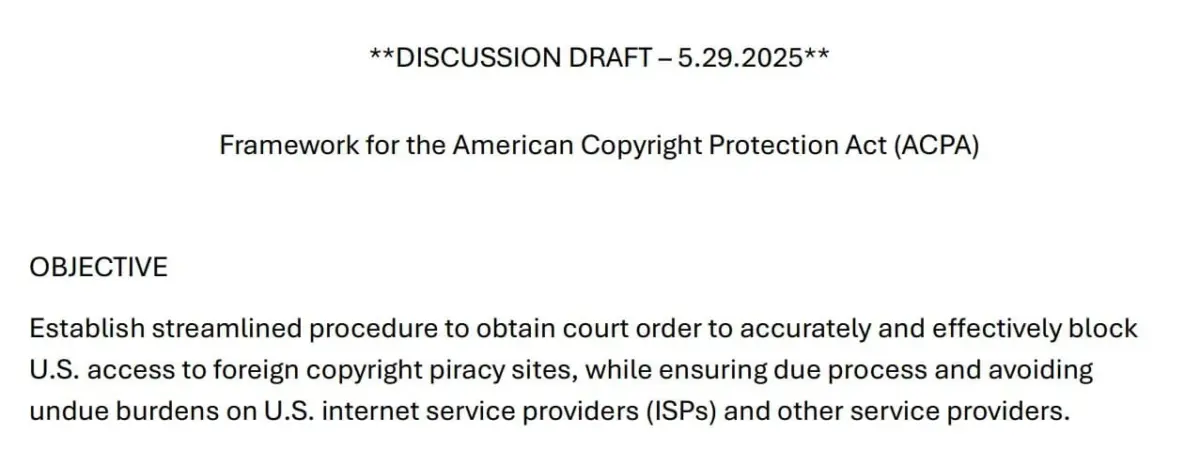
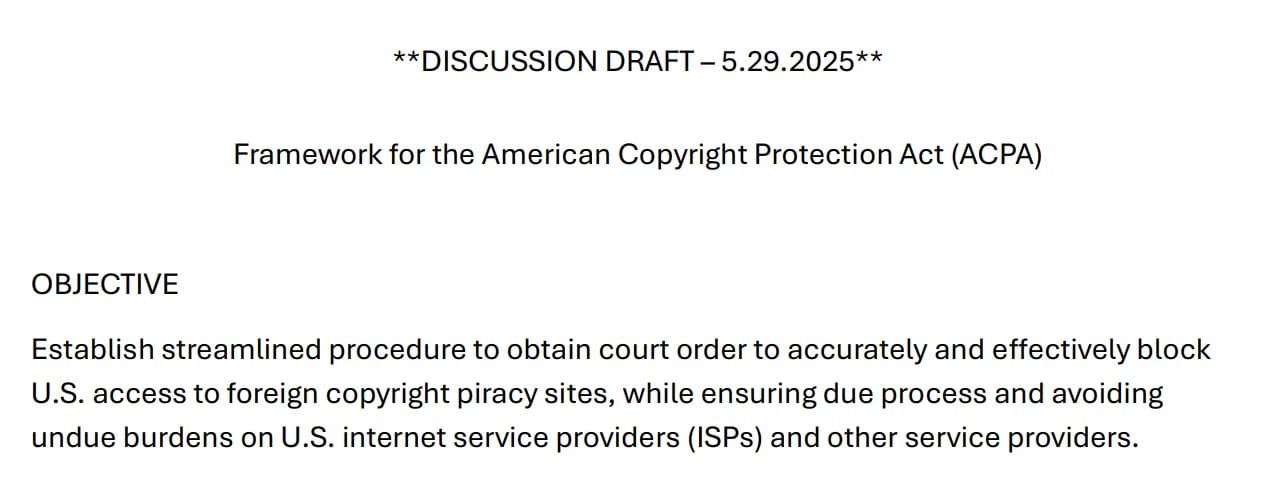
Concurrently, Representative Darrell Issa—acting in his capacity as Chair of the House Intellectual Property Subcommittee—was spearheading a parallel legislative initiative. Over the subsequent months, Issa cultivated stakeholder feedback, circulated working drafts, and refined what was commonly referred to during discussions as the American Copyright Protection Act (ACPA).
Although industry insiders and lobbyists had reviewed various iterations of the ACPA text over the past year, formal introduction was delayed. On June 30, 2025, Issa indicated to The Capitol Forum that his explicit intention was to introduce the anti-piracy bill before lawmakers departed for a scheduled district work period. That timeline slipped, leaving observers uncertain whether the text would ever see the floor before the close of the legislative session.
That uncertainty ended with the official filing of H.R. 10364, described in congressional ledgers as a bill "to establish procedures for blocking access to foreign online locations engaged in copyright piracy, and for other purposes." While the bill currently lacks an explicit short title in official congressional logs, it is widely understood by policy analysts to be the formal iteration of the ACPA framework.
Legislative Architecture: What Do Early Drafts and Precedents Reveal?
The Absence of Official Text and the 2025 Discussion Draft
As of publication, the Government Publishing Office has not yet published the finalized text of H.R. 10364, and Representative Issa’s congressional office has not yet issued an official press release or provided comment upon requests from investigative outlets like TorrentFreak. Consequently, analysts must evaluate the bill through the lens of the previously reviewed 2025 ACPA discussion drafts, which provide the most reliable roadmap to the mechanics of Issa’s proposal.
Key Operational Mechanisms of the Proposed Framework
Based on these earlier iterations, the proposed blocking framework relies on several distinct structural pillars designed to streamline litigation while purportedly establishing safeguards against abuse:
- Dual-Target Enforcement: The mechanism empowers copyright holders to secure targeted court orders compelling both traditional Internet Service Providers (ISPs) and foundational DNS resolvers to block consumer access to designated foreign pirate portals.
- Specialized Judicial Oversight: Unlike general district court filings, the early ACPA drafts stipulated that the Judicial Conference of the United States would maintain a curated roster of designated judges specifically assigned to hear all site-blocking cases, fostering judicial expertise and consistency.
- Centralized Registry: The U.S. Copyright Office would be tasked with maintaining and publishing a centralized, publicly accessible directory of active site-blocking orders.
- Anti-Overblocking and Compensation Provisions: In an effort to differentiate his bill from broader, unmitigated blocking models, Issa’s early draft included a high-stakes punitive safeguard. Under this provision, any innocent third party whose legitimate website, platform, or digital infrastructure was mistakenly blocked due to a rightsholder’s error or overzealous enforcement could legally claim up to $250,000 in statutory compensation.
Whether these specific accountability measures survived the final drafting process prior to the bill’s formal introduction remains unknown, awaiting the release of the official text.
Supporting Context & Metrics: The Legislative Turf War
A Crowded Congressional Arena: Three Competing Tracks
Representative Issa’s introduction of H.R. 10364 does not occur in a vacuum; rather, it introduces acute friction into an already crowded legislative landscape featuring multiple concurrent site-blocking efforts.
- The Bicameral Consensus Effort: Earlier this year, reports indicated that Senator Thom Tillis and Rep. Zoe Lofgren were actively working to merge the FADPA and Block BEARD initiatives into a single, unified bicameral bill targeting both ISPs and large-scale DNS resolvers.
- The "Four Corners" Negotiations: Rep. Lofgren subsequently confirmed she was engaged in complex negotiations regarding a "four corners agreement" alongside Rep. Issa, as well as Senators Marsha Blackburn, Chris Coons, Adam Schiff, and Thom Tillis.
Washington insiders have long debated whether these various proposals represent coordinated efforts or siloed, competing legislative tracks. If H.R. 10364 is intended to serve as the foundational House vehicle for a broader consensus package, prominent co-sponsors—such as Rep. Lofgren—would theoretically appear on the bill. If Lofgren’s name and other bipartisan partners are absent, it suggests the House may be advancing two distinct blocking bills, with the Senate’s anticipated vehicle serving as a third competing alternative.
The Clock is Ticking: Issa’s Impending Retirement
Compounding the legislative complexity is the political reality of Rep. Issa’s career trajectory. Issa is currently serving the final months of his term and is retiring at the end of this congressional cycle. This leaves a vanishingly narrow window of opportunity to guide a major, highly contentious intellectual property overhaul through committee markup, floor debates, and bicameral reconciliation before the legislative session expires.
Official Statements and Stakeholder Reactions
Digital Rights Advocates Sound the Alarm
Even in the absence of published text, civil liberties organizations and public interest advocates have mobilized swiftly against the introduction of H.R. 10364, warning of severe collateral damage to the open internet.
Leading the charge is Public Knowledge, which released a sharp critique immediately following the bill’s introduction. The organization warned that the legislation effectively deputizes broadband providers to act as private copyright police.
"More importantly, applying blocking orders to global DNS resolvers causes global blocks," warned Meredith Rose, Senior Policy Counsel at Public Knowledge. "This means that one court can cut off access to a website globally, based on a single individual’s filing and an expedited procedure."
Rose further emphasized the disproportionate threat posed to non-infringing digital entities:
"Small businesses and nonprofits face the greatest risks for site blocking but have the fewest protections. In Europe, we’ve seen overblocking bring down digital infrastructure for hotels, car mechanics, retail shops, telehealth programs, and even a nunnery."
Critics argue that even if statutory compensation mechanisms are included to penalize erroneous blocks, small enterprises lacking dedicated legal counsel cannot easily absorb the prolonged operational downtime or reputational damage inflicted by erroneous global DNS-level filtering.
Silence from Major Copyright Holders and Studios
In sharp contrast to the vocal opposition from civil society, major rightsholder organizations and industry trade groups have maintained a measured silence. The Motion Picture Association (MPA)—which notably honored Rep. Issa with its prestigious Industry Champion Award earlier this year in recognition of his sustained anti-piracy advocacy—did not immediately issue a public statement celebrating the bill’s introduction. Requests for comment sent to major entertainment industry coalitions were unanswered at the time of publication.
Future Outlook: What Lies Ahead for H.R. 10364?
The introduction of H.R. 10364 represents a critical test of political will, industry lobbying power, and digital rights defense in the United States Congress. Over the coming weeks, as the Government Publishing Office finally releases the complete statutory text, policy analysts, technical experts, and legal scholars will meticulously parse the language to determine:
- Whether the robust anti-overblocking and $250,000 compensation provisions from the 2025 ACPA discussion drafts survived intact.
- Whether H.R. 10364 stands alone as an independent House bill or has been integrated into the broader "four corners" bipartisan negotiations led by Rep. Lofgren and Senate counterparts.
- Whether the procedural hurdles of a retiring sponsor and a crowded legislative calendar will stall the bill in committee, or if copyright industries can marshal enough momentum to push site-blocking legislation further than it has traveled at any point since 2012.
As this is a breaking legislative story, further updates, expert analyses, and textual breakdowns will follow as soon as official documentation becomes publicly available.