While the United States lacks a centralized, statutory site-blocking framework comparable to those found in the United Kingdom or parts of the European Union, federal courts are increasingly serving as the battleground for aggressive civil enforcement. A landmark federal lawsuit recently adjudicated in Florida illustrates this shift dramatically.
Initiated by Mexican media giant TelevisaUnivision (TU), the case has yielded what may be the most expansive, dynamic, and forward-looking digital piracy injunction ever issued by a U.S. court. By obtaining an order that not only targets current pirate IPTV networks but also anticipates future domains, unlaunched services, and unproduced intellectual property, TU has charted a radical new course for copyright enforcement. This comprehensive investigative report breaks down the anatomy of the lawsuit, the unprecedented legal mechanisms at play, the compliance footprint of targeted digital intermediaries, and the long-term implications for the future of digital piracy and enforcement in America.
Executive Overview
In June, Mexican broadcaster TelevisaUnivision filed a federal lawsuit in the U.S. District Court for the Southern District of Florida, targeting a sprawling ecosystem of unauthorized Internet Protocol Television (IPTV) providers. The original defendants included services such as Thunder TV, Sunset TV, Pop TV, Kaelus TV, and Tele Latino, alongside their anonymous or pseudonymous operators.
The broadcaster’s primary impetus was high-stakes contract compliance. TU holds the exclusive broadcasting rights for the FIFA World Cup across 16 Latin American territories. However, its licensing agreement with FIFA mandates rigorous geofencing to prevent the Mexican broadcast signal from bleeding into the United States. The proliferation of pirate IPTV services streaming these feeds directly threatened to breach this agreement, exposing the broadcaster to catastrophic financial penalties, including the potential termination and forfeiture of hundreds of millions of dollars in rights payments.
To mitigate this immediate existential threat, TU petitioned U.S. District Judge Kathleen Williams for an emergency temporary restraining order (TRO). What began as a targeted measure to protect a single broadcast window quickly mutated into a sprawling legal instrument. By July 24, Judge Williams converted the TRO into a preliminary injunction characterized by several extraordinary legal innovations:

- Dynamic, Self-Expanding Scope: TU’s legal counsel was granted the unilateral power to add new targets—including unlaunched services, entirely new piracy brands, and freshly registered domains—by filing a simple sworn declaration, bypassing the need for prior judicial approval.
- Futuristic Intellectual Property Protections: The injunction explicitly extends protection beyond TU’s current catalog and World Cup rights, covering any copyrighted works or broadcasts the company may produce, license, or acquire in the future.
- Massive Intermediary Compliance: The order binds a vast array of global Internet infrastructure providers—ranging from domain registrars and content delivery networks (CDNs) like Cloudflare to major financial processors and social platforms—demanding immediate domain suspensions, data handovers, and account freezes.
With no defendants or intermediaries stepping forward to challenge the order in court, the injunction has effectively weaponized U.S. jurisdiction against pirate networks worldwide, raising profound questions about due process, judicial oversight, and the limits of extraterritorial copyright enforcement.
Detailed Chronology of the Legal Proceedings
The swift and aggressive trajectory of TelevisaUnivision v. IPTV Operators demonstrates the potency of emergency federal civil litigation when deployed against offshore and pseudonymous digital actors.
Phase 1: The Emergency Filing and Initial TRO (Early June)
The legal saga commenced in early June when TelevisaUnivision formally filed its complaint in Florida federal court. Naming a handful of prominent IPTV providers and their allegedly hidden operators, TU laid out the immediate commercial dangers posed by unauthorized streaming. Emphasizing the severe risk of breaching its multi-million-dollar FIFA licensing agreement, TU moved swiftly for emergency relief.
On June 5—just one day after the initial paperwork was submitted—Judge Kathleen Williams granted a Temporary Restraining Order. Handed down without hearing testimony from the defendants, the TRO instantly prohibited the named parties from infringing upon TU’s copyrighted telenovelas, broadcasts, and trademarks. Crucially, the order also reached third-party entities operating "in active concert" with the primary targets, ordering ISPs, hosting providers, CDNs, domain registries, app stores, and payment processors to disable listed domains and IP addresses.
Phase 2: Rapid Expansion and First Supplementations
Recognizing the fluid and elusive nature of digital piracy networks—which routinely spawn mirror sites and rebrand under new names—TU’s legal team immediately began utilizing the self-expanding mechanics baked into the court’s orders.

- June 12: TU filed its first formal supplementation, appending new IP addresses and domains to the court-mandated block list.
- July 10: A second major supplementation added an entirely new tier of notorious streaming and aggregation brands that were never named as original defendants in the June complaint. This wave brought prominent piracy hubs such as XuperTV, Tarjeta Roja, Pirlo TV, Roja Directa, RBTV, Strikeout, and StudioMax directly under the judicial crosshairs.
Phase 3: The Preliminary Injunction (July 24)
On July 24, Judge Williams formalized the temporary measures by issuing a preliminary injunction. By this stage, the scope of the case had expanded exponentially beyond the original June complaint. The resulting injunction cemented a dynamic enforcement framework that gave TU sweeping powers to continuously prune the digital landscape of unauthorized content for the foreseeable future.
Notably, throughout this entire progression, neither the primary IPTV operators nor the vast majority of the implicated technical intermediaries appeared in court to mount a defense or object to the proceedings. Consequently, the broad injunction remains fully enforceable as the litigation continues toward a final judgment.
Supporting Context & Metrics: The Intermediary Landscape
While the injunction formally binds a comprehensive roster of global entities, its practical efficacy has depended heavily on geographic jurisdiction and the specific operational models of the targeted intermediaries.
Domain Registrars and the "ClientHold" Status
To evaluate the real-world impact of the court order, digital rights researchers conducted extensive WHOIS audits on the targeted web properties. Out of 474 domains queried across the litigation schedules:
- 203 domains were slapped with a
clientHoldstatus, indicating that their respective domain registrars had actively suspended resolution. - 1 domain was suspended directly at the registry level.
- The remaining domains remained active, untouched by the registrar actions mandated in the U.S. order.
This disparity highlights the limitations of extraterritorial enforcement. U.S.-facing registrars—most notably Namecheap and GoDaddy—complied almost universally, placing holds on virtually every flagged domain under their management. Conversely, domains linked to foreign registries and registrars—such as Russia’s REGTIME-SU and the Dutch firm Registrar.eu—remained completely operational, having failed to suspend a single listed domain.

An analysis of the timing revealed that over 90% of the successful domain suspensions occurred in direct correlation with the legal milestones: clustering tightly around the June 5 restraining order and the July 24 preliminary injunction.
Cloudflare’s Tailored Compliance and Data Hand-Overs
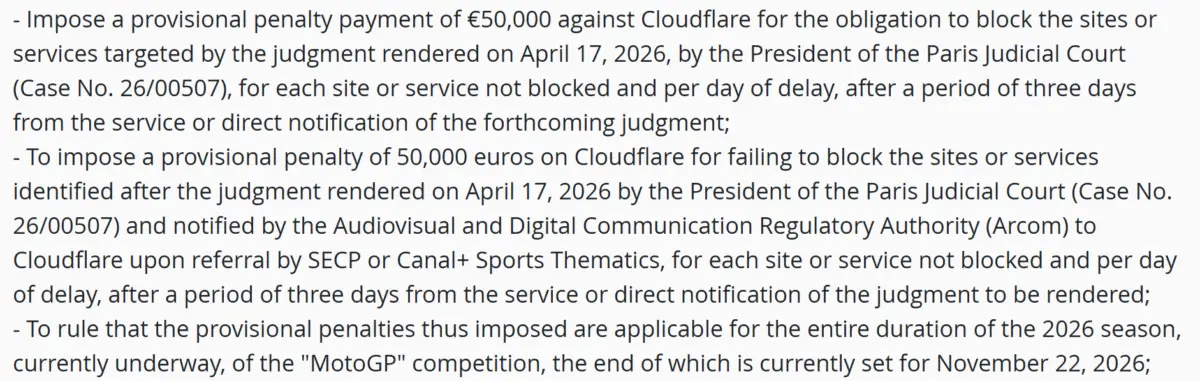
Among all technical intermediaries, content delivery network titan Cloudflare found itself subject to the most exhaustive and individualized scrutiny. Several pages of the injunction are dedicated exclusively to Cloudflare’s obligations:
- Immediate Disruption: Cloudflare was ordered to disable its CDN, reverse-proxy, and DNS services for a comprehensive list of targeted domains within a strict 24-hour window.
- Forensic Disclosures: The company was compelled to surrender origin-server IP addresses, DNS history records, account holder legal names, billing and payment details, and 14 days of detailed request logs for every flagged property.
- Account Association Checks: Cloudflare was further tasked with cross-referencing its user database to identify any secondary accounts sharing billing names or email addresses with flagged entities, effectively unmasking operators attempting to shield themselves behind clean proxy accounts.
Despite these heavy investigative burdens, Cloudflare successfully negotiated important legal guardrails. The company is only required to surrender data it already possesses, bears no ongoing affirmative duty to monitor user content, and its compliance does not constitute an admission of legal liability—mirroring the "no-fault" intermediary frameworks standard in European intellectual property enforcement.
Voluntarily Dismissed Infrastructure Providers
Interestingly, early in the proceedings, TU’s complaint named several prominent hosting and infrastructure companies—including Enzu, Dash Networks, DigitalOcean, and HostGator—as formal defendants. However, once these entities engaged with the legal reality of the TRO and adjusted their services, TU voluntarily dismissed them from the lawsuit within a fortnight, streamlining the litigation to focus entirely on the elusive content operators and compliant infrastructure gatekeepers.
Official Statements and Legal Philosophy
The legal architecture constructed in TelevisaUnivision v. IPTV Operators represents a significant evolutionary leap in U.S. intellectual property litigation. Historically, American copyright holders seeking site-blocking or intermediary disruption were required to navigate cumbersome legal hurdles for every distinct domain, application, or service discovered.

By contrast, the preliminary injunction issued by Judge Williams embraces a "dynamic" model long championed by rightsholders in foreign jurisdictions like the UK and Spain, while pushing the boundaries even further into speculative territory.
The Mechanism of Self-Expansion
The most legally controversial clause within Judge Williams’ order authorizes TU’s legal counsel to unilaterally expand the scope of the injunction:
"Plaintiffs may supplement Schedule A by filing a verified declaration identifying additional infringing services, IP addresses, domains, applications, or platforms, which supplementation shall take effect immediately upon filing and service."
This shifts the traditional burden of judicial review. Rather than requiring rightsholders to return to court to prove that a newly discovered mirror site or rebranded IPTV service meets the legal threshold for infringement, the court has essentially outsourced the determination of infringement to the plaintiff’s legal team. Once a sworn declaration is filed, the full weight of the injunction—and the obligation of intermediaries to block the property—activates instantly.
The "Futuristic" Scope of Protection
Equally striking is the temporal elasticity built into the injunction. By defining its targets not merely as the named defendants, but as "any comparable system" whether "currently in existence or developed in the future," the court has issued an anticipatory injunction.

This formulation covers pirate services that have not yet launched, operating under brand names that remain uninvented, hosted on domain names that have yet to be registered. As long as TelevisaUnivision asserts that a newly surfaced platform transmits its copyrighted or licensed material, the infrastructure supporting it is legally bound to self-destruct upon notice. Similarly, protecting future copyrights—works that TU has not yet produced, acquired, or licensed at the time of the judge’s signature—breaks new ground in U.S. jurisprudence regarding the limits of injunctive relief.
Future Outlook and Industry Implications
The ramifications of the TelevisaUnivision preliminary injunction extend far beyond the immediate fate of Thunder TV, Tele Latino, or XuperTV. This case serves as a masterclass and a potential blueprint for major media conglomerates, sports leagues, and copyright holders seeking to combat digital piracy within the American legal system.
1. Proliferation of Dynamic Injunctions in the U.S.
For years, U.S. rightsholders watched enviously as European and Asian counterparts utilized dynamic site-blocking injunctions to instantly neutralize live-streaming piracy during major sporting events. While U.S. courts have occasionally issued broad third-party orders, the TU case pushes this precedent to its logical extreme. If appellate courts uphold this self-expanding mechanism, rightsholders across the entertainment and sports sectors are virtually guaranteed to adopt this litigation playbook, seeking similar "blanket" injunctions in future copyright disputes.
2. The Global Intermediary Split
The execution metrics analyzed by researchers reveal a stark reality: U.S.-based intermediaries (such as Cloudflare, GoDaddy, and Namecheap) will continue to bear the brunt of domestic anti-piracy enforcement because they are subject to the direct coercive power of American federal courts. However, the survival of domains hosted behind foreign registrars in Russia, Iran, and parts of Europe underscores the persistent limits of unilateral national court orders in a borderless digital ecosystem. As rightsholders grow more aggressive, expect increased legal pressure on international cooperation and ICANN policies to bridge these jurisdictional gaps.
3. Due Process and Transparency Concerns
The most urgent questions arising from this litigation center on constitutional due process and judicial oversight. By allowing private attorneys to expand injunctions via sworn declarations without prior judicial vetting, the court has effectively minimized judicial oversight during the enforcement phase. Furthermore, the opacity surrounding these administrative supplementations raises concerns regarding over-blocking—the accidental suppression of legitimate, non-infringing websites that share IP space or infrastructure with targeted pirate services.

As civil liberties groups and technical experts begin to scrutinize the long-term viability of self-expanding judicial orders, TelevisaUnivision v. IPTV Operators will undoubtedly be cited both as a revolutionary triumph for modern intellectual property protection and as a cautionary tale regarding the erosion of traditional judicial oversight in the digital age.