Executive Overview
In the shadowy corridors of modern digital communication, encrypted messaging apps have long served as a double-edged sword. While platforms like Telegram champion privacy, decentralization, and unrestricted global connectivity, they have inevitably become a haven for illicit operations. Among these, digital media piracy has found a remarkably resilient, highly organized home.
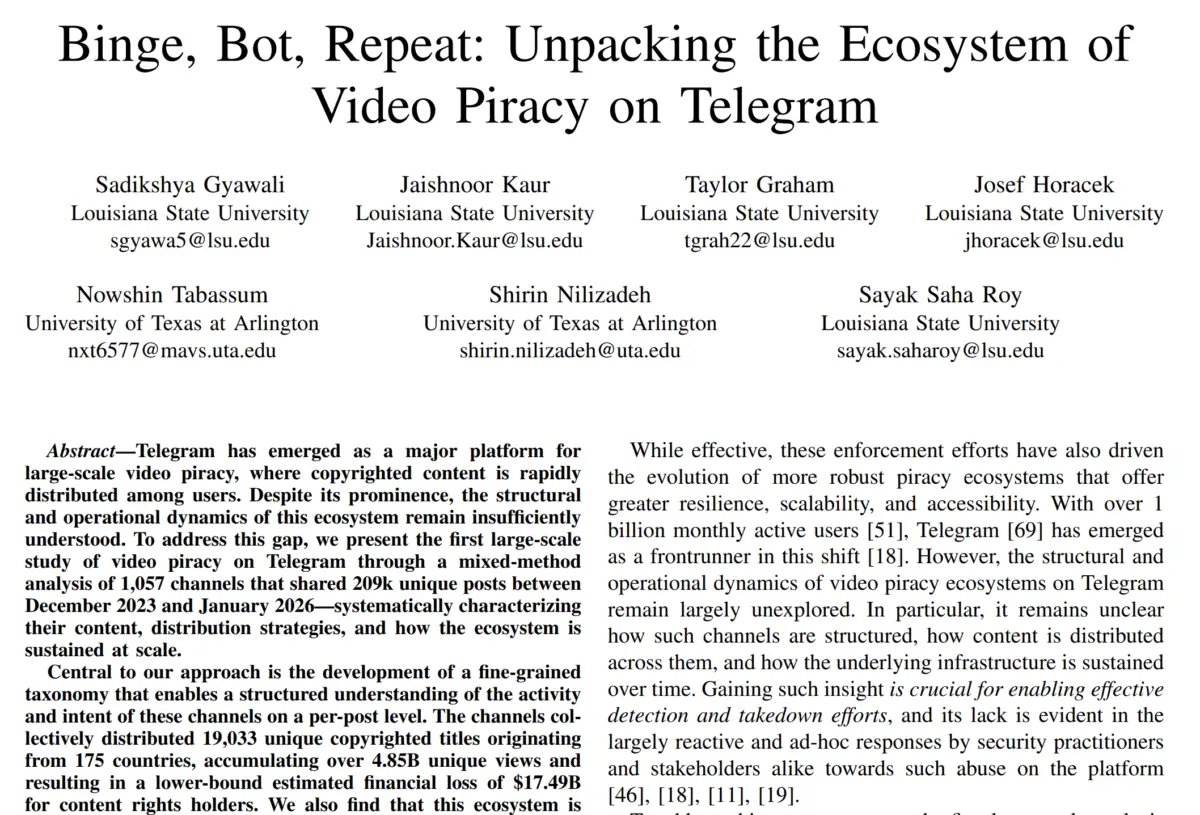
While the general phenomenon of piracy on Telegram has long been an open secret within cybersecurity circles, its actual scale, operational mechanics, and economic toll have remained largely unmapped—until now. A groundbreaking academic paper titled “Binge, Bot, Repeat: Unpacking the Ecosystem of Video Piracy on Telegram,” authored by researchers from Louisiana State University (LSU) and the University of Texas at Arlington (UTA), provides the first large-scale, empirical analysis of video piracy on the platform.
Examining more than 1,000 interconnected channels and over 200,000 posts, the study reveals that Telegram is no longer a peripheral fringe for file-sharers; it is an industrial-grade distribution network. Driven by automated bots and engineered for maximum resilience against takedowns, the platform’s piracy ecosystem commands billions of views, threatens major rightsholders with billions of dollars in theoretical losses, and mimics the professional supply chains of legitimate streaming services.
To counter this, the research team went beyond passive observation. They engineered “Anti-RIP,” a real-time, AI-powered channel-hunting framework designed to root out and neutralize new piracy hubs before they scale. By open-sourcing their findings and code, the academics have thrown down the gauntlet, sparking a high-stakes, AI-driven game of cat-and-mouse between digital rights enforcers and underground content syndicates.
Detailed Chronology: Unpacking the Research and Discovery
The journey to mapping Telegram’s piracy underworld represents a massive logistical and technological undertaking. To grasp the mechanics of how content flows through the messaging app, the researchers orchestrated a meticulously timed study spanning from December 2023 to January 2026.

Phase 1: Data Harvesting and Model Training (Late 2023 – Early 2026)
During the primary data-collection phase, the research team from LSU and UTA targeted an initial corpus of 1,057 distinct Telegram channels identified as hotbeds for media sharing. Together, these channels accounted for roughly 209,000 individual posts.
Because manual classification of hundreds of thousands of media posts is practically impossible, the researchers deployed a locally hosted Large Language Model (LLM). This AI system was tasked with parsing the text, metadata, and visual assets of each post, categorizing them, and identifying unique media titles. Through this automated text-mining and classification effort, the model successfully cataloged 19,033 unique pirated titles, comprising 14,632 movies and 4,401 television shows originating from 3,941 distinct production companies.
Phase 2: Building the Defense – The Birth of Anti-RIP (Early 2026)
Recognizing that cataloging historical data only tells half the story, the research team sought to build a proactive solution. Between February 3 and April 10, 2026, they developed and deployed Anti-RIP, an automated AI framework designed to hunt down illicit channels before they could establish a foothold.
Instead of passively waiting for piracy links to surface in search results—many of which are intentionally obscured—Anti-RIP actively generated candidate Telegram handles. It probed these handles systematically to identify connections to known piracy communities. In a single sweep across this two-month window, the tool scanned an astonishing 249,133 newly created Telegram channels.
Phase 3: The Takedown Campaign and Industry Response (Spring 2026)
Armed with real-time detection capabilities, Anti-RIP flagged 802 active piracy channels (with a median age of less than five days), alongside 299 secondary connected channels and 108 automated bots.

Rather than dumping raw links onto enforcement agencies, the researchers packaged their findings into comprehensive "evidence reports." Each dossier detailed a channel’s specific function within the network—whether it operated as a primary host, a secondary redirect, or a monetization hub. These detailed intelligence packages were dispatched directly to Telegram’s abuse department and 17 major United States rightsholders.
The strategy bore fruit swiftly. Over a tightly monitored 61-day period, the intelligence feeds facilitated the outright removal or inaccessibility of 524 previously unknown piracy channels and 71 bots, alongside the targeted deletion of thousands of individual infringing posts by Telegram administrators.
Supporting Context & Metrics: The Scale of the Underground Economy
The empirical data uncovered by the LSU and UTA researchers shatters the illusion that Telegram piracy is a small-scale, peer-to-peer hobby. The metrics paint a picture of a massive, highly structured corporate shadow-industry.
Staggering Engagement: 4.85 Billion Views
Across 983 active channels identified by the study, posts containing pirated video content amassed a cumulative 4.85 billion views. While a single post frequently contained multiple titles or collection links, the sheer volume of user engagement underscores how deeply ingrained Telegram has become as a media consumption alternative.
Most Targeted Rightsholders
The ecosystem heavily mirrors traditional streaming preferences, with anime holding a dominant market share.
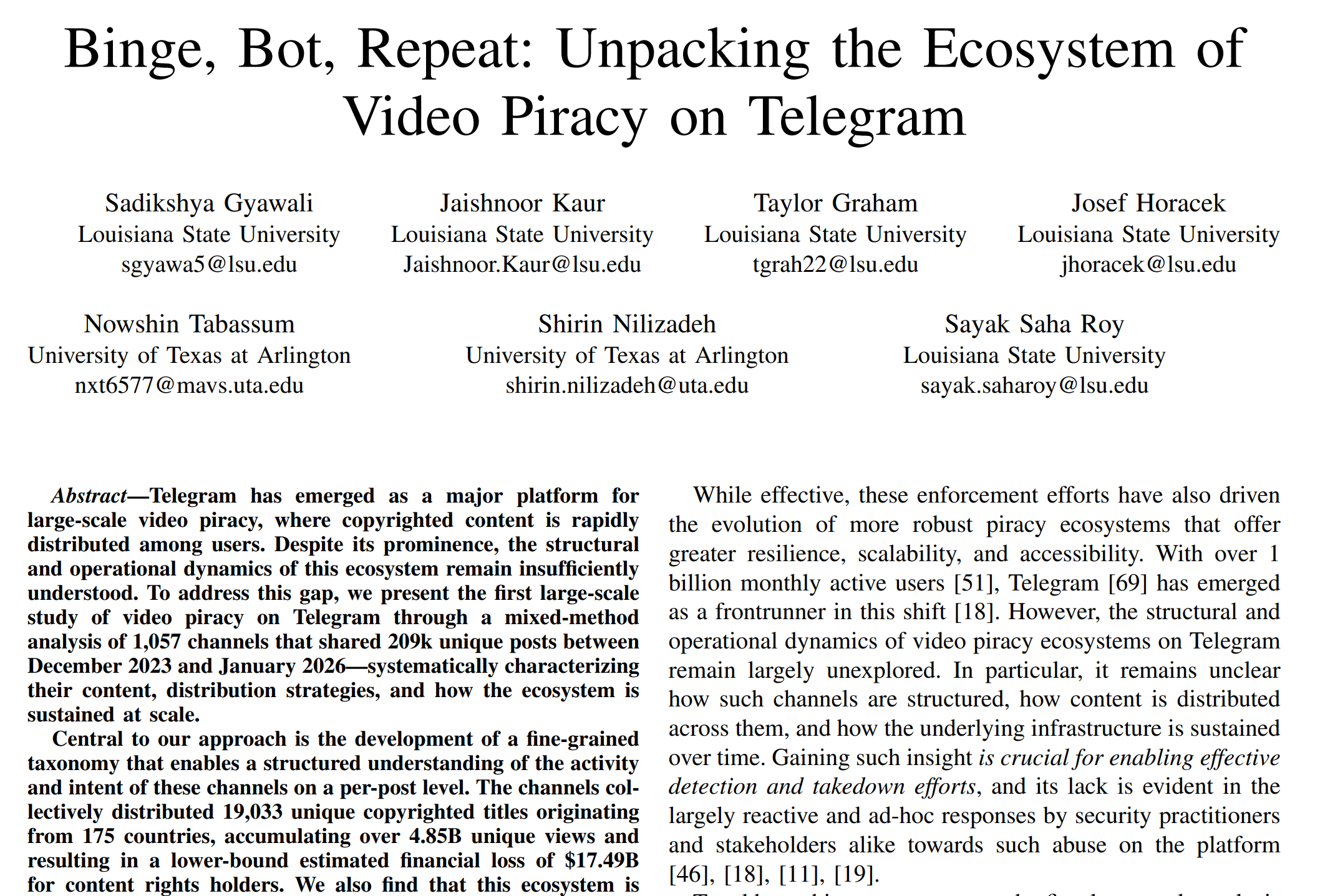
- Toei Company (Japan): Topping the charts as the most heavily targeted rightsholder, Toei Company accounted for 17% of all pirated titles identified in the study. As the home of global powerhouses like One Piece and Dragon Ball, its content remains a primary draw for underground traffic.
- Netflix: Capturing the second spot, Netflix content accounted for 15% of the unique titles circulating through the network.
- Warner Bros.: Rounding out the top three, Warner Bros. properties represented 12.4% of the cataloged material.
+-------------------------------------------------------+
|                TOP PIRATED RIGHTSHOLDERS              |
+-------------------------------------------------------+
| 1. Toei Company (Japan)  [One Piece, Dragon Ball] 17% |
| 2. Netflix                                        15% |
| 3. Warner Bros.                                 12.4% |
+-------------------------------------------------------+
Economic Impact: The $17.49 Billion Calculation
To quantify the financial damage, the researchers calculated a conservative economic loss model. Assuming that just 1% of the staggering 4.85 billion post-views translated directly into lost sales—benchmarked against the cheapest legal subscription or purchase option available—they estimated total global rightsholder losses at $17.49 billion.
Geographically, content originating from the United States bore the brunt of this estimated loss at $8.17 billion, followed closely by Japanese intellectual property at $3.72 billion. To maintain methodological integrity, the researchers deliberately capped lost sales calculations at a single subscription cost when multiple titles from the same streaming ecosystem were bundled into a single user post.
Architectural Resilience: Built to Survive
One of the paper’s most vital technical revelations is that Telegram piracy does not rely on single points of failure. Roughly 94% of the mapped piracy channels were systematically interconnected, forming web-like syndicates.
Furthermore, these networks are deliberately engineered to evade keyword searches and automated moderation:
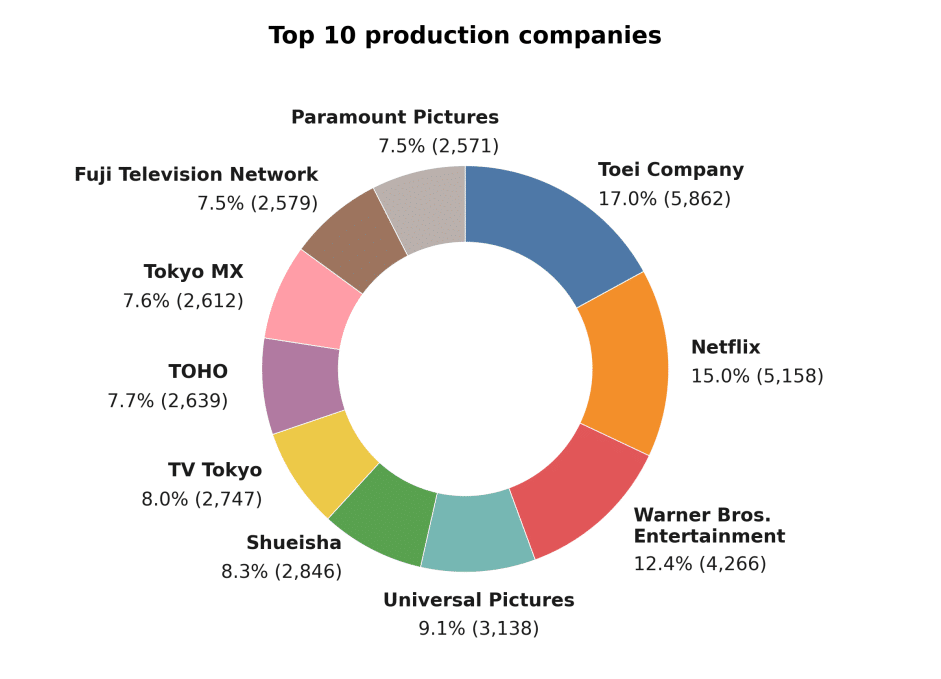
- Intermediary Chains: Users are rarely dropped directly into a content library. Instead, they are funneled through complex chains of intermediary channels, gateway bots, and backup accounts that handle discovery, access control, and monetization.
- External Hosting Offloading: Interestingly, direct file uploads, torrents, and magnet links were virtually nonexistent within the study’s scope (only nine torrent links were discovered). Instead, Telegram channels acted purely as signposts, directing users to third-party cloud-storage and video-hosting platforms such as TeraBox, Terashare, and GoFile.
- Ecosystem Tooling: Beyond media files, certain channels functioned as resource hubs, distributing compromised login credentials for premium platforms (Netflix, Hulu, Disney+, Crunchyroll) alongside customized VPN tutorials designed to bypass geographical blocks and ISP-level censorship.
Official Statements and Industry Feedback
The bridging of academic research and corporate intellectual property enforcement yielded a rare glimpse into how major entertainment studios handle automated intelligence reports.
When the LSU and UTA research team dispatched their structured Anti-RIP evidence reports to 17 major U.S. rightsholders, the response was overwhelmingly engaged:
- High Engagement Rate: 14 out of the 17 studios formally acknowledged receipt of the reports and integrated the intelligence into their enforcement pipelines.
- The Value of Context: Four major studios explicitly noted that the AI-generated contextual labels—which categorized channels by their exact operational role (hosting, redirecting, or monetizing)—drastically improved their ability to assess, triage, and prioritize takedown notices.
Despite this operational success, the researchers maintain complete transparency regarding the limitations of their AI tool. During rigorous validation testing, when two human coders reviewed a random sample of 1,000 posts flagged by the system, it was discovered that Anti-RIP produced a minuscule false-positive rate, wrongly flagging 4 legitimate posts as piracy. While the core detection model demonstrated a 98% accuracy rate in controlled laboratory testing, the real-world error rate across unpredictable, evolving slang and media formats remains an ongoing engineering challenge.
Future Outlook: The AI-Driven Cat-and-Mouse Game
As the academic paper “Binge, Bot, Repeat” makes its way through preprint channels before formal peer review, its release marks a definitive turning point in the governance of encrypted messaging applications.
By open-sourcing the Anti-RIP framework and releasing their comprehensive dataset publicly on GitHub, the researchers have democratized advanced digital forensics. Rightsholders and platform administrators now possess a tested, AI-driven blueprint to identify and dismantle underground distribution networks before they achieve viral scale.
However, technology is rarely a one-way street. Industry experts and security analysts universally predict that underground syndicates will inevitably adopt generative AI models of their own. Pirates are expected to leverage automated script rotation, dynamic channel generation, and obfuscated natural language processing to bypass AI-based filters like Anti-RIP.
Ultimately, Telegram faces mounting pressure from global regulators and intellectual property holders to tighten its platform governance. As AI becomes both the weapon of choice for automated piracy networks and the primary shield for content creators, the digital landscape is hurtling toward an unprecedented era of automated, algorithm-versus-algorithm warfare.