






Executive Overview
For nearly two millennia, the carbonized remains of the Herculaneum scrolls have sat locked in their fragile, charred, and seemingly impenetrable cylindrical tombs. Buried and calcified by the catastrophic eruption of Mount Vesuvius in 79 CE—the same cataclysm that entombed Pompeii—these ancient papyri represent one of the greatest linguistic treasures of the classical world. Contained within them are lost philosophical treatises, historical accounts, and poetic works written by ancient minds, preserved in a state that rendered them entirely unreadable without destroying the physical artifacts.
For generations, attempting to physically unroll these brittle scrolls meant turning them into black dust. However, a revolutionary convergence of high-resolution 3D X-ray imaging, neutron research, adaptive software algorithms, and artificial intelligence is fundamentally rewriting the boundaries of what is possible in classical archaeology.
In a breakthrough published in PLoS ONE (DOI: 10.1371/journal.pone.0353485), a multidisciplinary team of researchers has demonstrated how modern experimental physics can solve the greatest hurdle facing the international Vesuvius Challenge: low contrast. By artificially carbonizing test scrolls to replicate the exact material degradation of the original Herculaneum artifacts and analyzing them at the National Institute of Standards and Technology’s (NIST) Center for Neutron Research, scientists have illuminated hidden text with unprecedented clarity.
Furthermore, the team—featuring physicists and materials scientists such as Jake LaManna and Michael Cyrus Daugherty alongside co-author Seiler—has adapted software originally designed to inspect lithium-ion batteries to digitally unwrap complex "jelly roll" configurations. Most significantly, their findings point toward a game-changing tactical shift for future archaeological excavations and analysis: screening papyri for trace elements of lead in the ink. This simple yet profound methodological pivot could slash the time required to read hundreds of currently unreadable ancient texts, bridging a 2,000-year gap between antiquity and the digital age.
Detailed Chronology: From Vesuvius to the Digital Frontier
The story of the Herculaneum scrolls is as much a tale of modern technological persistence as it is of ancient destruction. When Mount Vesuvius erupted in 79 CE, it buried the seaside Roman town of Herculaneum under a pyroclastic surge of searing ash, rock, and gas. Unlike Pompeii, which was buried under relatively loose ash and pumice, Herculaneum was sealed beneath a dense, concrete-like layer of volcanic mud that reached depths of up to 20 meters. The extreme heat flash-carbonized organic materials—including a massive private library of papyrus scrolls stored in a luxury villa, often identified as the Villa of the Papyri.
Rediscovered in the mid-18th century during well-digging operations, the library yielded hundreds of carbonized scrolls. Early attempts to unroll them were catastrophic. Using mechanical contraptions designed by Padre Antonio Piaggio, many scrolls were pulverized or permanently ruined, leading scholars to lock the remaining intact cylinders away in European libraries, viewing them as permanently lost to history.
The Turning Point: The Vesuvius Challenge
The modern renaissance of Herculaneum scroll research truly ignited in October 2023, when the Vesuvius Challenge made its inaugural announcement, deciphering the very first readable letters trapped inside an unopened scroll using advanced machine learning models.
Building on this momentum, the international research community crossed a monumental threshold in early 2024 when a trio of brilliant minds captured the global $700,000 grand prize for producing fully readable, continuous blocks of ancient Greek text from within an un-unrolled artifact.
The timeline of breakthroughs rapidly accelerated thereafter:
- Late 2024: Researchers successfully generated the first high-definition X-ray tomographic images of the internal structure of scroll PHerc. 172, housed securely within the Bodleian Libraries at the University of Oxford.
- Early 2025: Scroll PHerc. 1667 was successfully read in its entirety. Scholars discovered that the text was a profound philosophical treatise focusing on ethics, human happiness, and moral progress, shedding new light on the Epicurean tradition.
- 2026 (PLoS ONE Study): The publication of Seiler, LaManna, Daugherty, and colleagues’ methodology provided a definitive physical and software framework to optimize and speed up the digital unwrapping process.
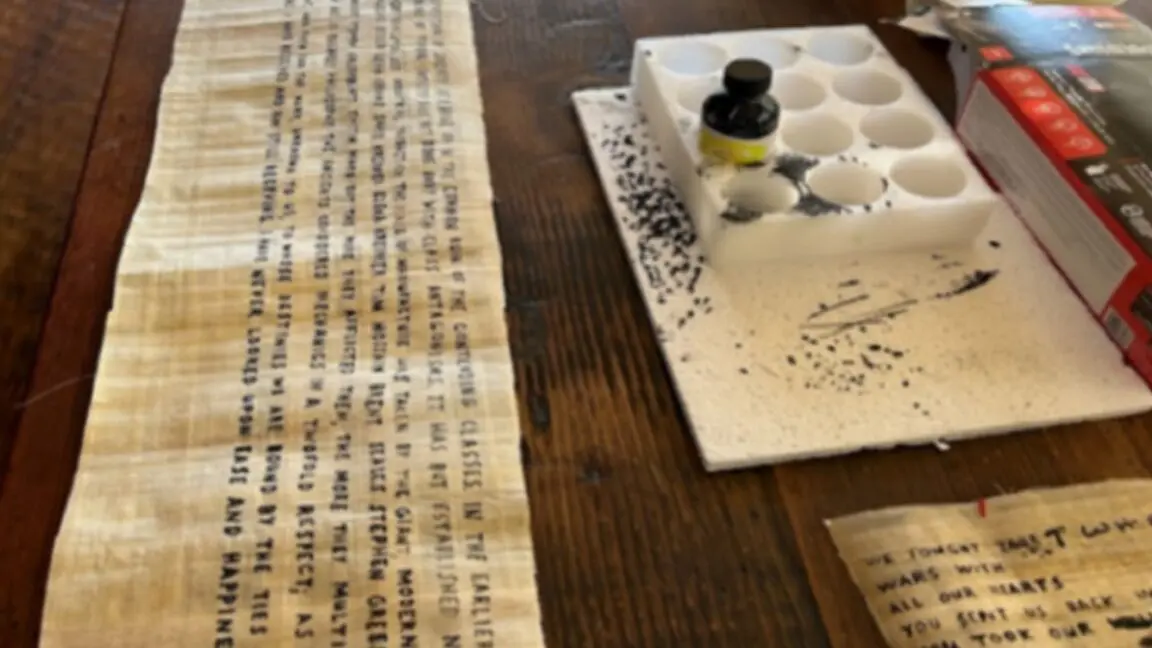
In the latest breakthrough, the research team created physical facsimiles by carbonizing test scrolls in high-temperature furnaces to mimic the precise chemical and physical structure of the original Herculaneum documents. Co-author and physicist Jake LaManna then took these surrogate models to NIST’s Center for Neutron Research in Maryland, subjecting them to advanced 3D X-ray scans.
The results were astonishing. "The letters lit up like a Christmas tree," Seiler noted, emphasizing the sheer predictive power of modern imaging physics.
To solve the puzzle of digital flattening—transforming a warped, crushed cylinder into a flat, readable 2D surface—co-author Michael Cyrus Daugherty adapted a specialized software program. Originally written to non-destructively inspect the internal structure and coil formations of lithium-ion "jelly roll" batteries, Daugherty’s code was successfully repurposed to digitally unwrap the model scrolls layer by layer, exposing the hidden script.
Supporting Context & Metrics: Overcoming the Carbon-on-Carbon Dilemma
To understand why this new research is so vital to the ongoing success of the Vesuvius Challenge, one must examine the fundamental physical challenge of reading the scrolls: contrast.
Most ancient Mediterranean writing utilized carbon-based black inks made from soot or charcoal binders applied to papyrus sheets, which were also organic, carbon-based materials. Over nearly two millennia of carbonization inside a volcanic tomb, the ink and the papyrus converged into nearly identical densities. When viewed through conventional X-ray micro-tomography, the contrast between the written characters and the background sheet is virtually nonexistent. Traditional machine learning models have had to spend thousands of hours training neural networks to detect microscopic texture variations, surface cracks, and faint fiber displacements left behind by the stylus.
This is where the interdisciplinary team’s discovery of elemental composition changes everything.
The Lead Ink Hypothesis
While many Herculaneum scrolls utilized standard carbon ink, historical analyses have occasionally detected trace metals, particularly lead, intentionally or accidentally mixed into writing fluids in the Greco-Roman world. Lead has a drastically higher atomic number and density than carbon, making it opaque to X-rays and neutron beams.
"With lead in the ink, you would get a huge friggin’ signature, so you really need to be looking for scrolls with lead in them," Seiler explained. "They’re having problems reading a lot of them because of the low contrast of carbon ink on carbon paper. We’re relatively certain that if they start searching for lead, or they let us search for lead, it will help this whole process."
The team points out that advanced analytical tools do not require massive synchrotron facilities for initial triage. Even a portable, handheld X-ray fluorescence (XRF) spectrometer is entirely sufficient to scan unopened scrolls, detect trace elemental signatures, and identify which specific artifacts in library collections hold high concentrations of metal-bearing inks. This transforms the selection process from a blind lottery into a targeted, data-driven operation.
Official Statements and Interdisciplinary Perspectives
The success of the 2026 study underscores a broader paradigm shift in twenty-first-century scholarship: the blurring lines between classical humanities and hard-core experimental sciences.
Reflecting on the eclectic nature of the collaborative effort, Seiler expressed deep admiration for the journey required to reach this milestone:
"Honestly, getting here is, for me, just as unique as our research. I mean, inorganic chemistry, papyrus, X-ray tomography, AI—it’s really quite an eclectic group of scientists and methodology to get to the point that, yes, if there’s lead in those scrolls, you guys will be able to read the images much better. I’ll give you 10-to-1 odds. We’d like it to be our team, but if some other team is going to take this idea—which is OK—we don’t care."
This spirit of open-source science mirrors the ethos of the Vesuvius Challenge itself, where global computer scientists, classicists, and students collaborate publicly on GitHub and Discord servers to crack codes that have remained silent since the Roman Empire.
Physicist Jake LaManna echoed the sentiment of wonder when describing the moment the NIST scans illuminated the hidden text:
"It’s amazing what you can get electrons to do."
By bridging neutron research facilities with industrial battery diagnostics software, the team has demonstrated that solutions to ancient historical mysteries often lie hidden within unrelated modern engineering sectors.
Future Outlook: Accelerating the Discovery of Lost Classical Texts
The implications of this research extend far beyond academic curiosity. Hundreds of unopened Herculaneum scrolls remain housed in institutions like the Naples National Archaeological Museum and the Bodleian Libraries at Oxford. Many of these have been set aside because preliminary low-resolution scans suggested they were too degraded, distorted, or low-contrast to yield results using current AI models.
With the new protocols established by Seiler, LaManna, Daugherty, and their colleagues, the workflow for future historical recovery is poised for radical acceleration:
- Non-Destructive Elemental Triage: Libraries and research consortia can deploy handheld XRF scanners to rapidly screen unopened scrolls for lead-based inks.
- Targeted High-Resolution Scanning: Artifacts flagged with promising elemental signatures can be prioritized for high-intensity neutron and synchrotron X-ray imaging at facilities like NIST.
- Advanced Digital Unwrapping: Software adapted from industrial engineering—such as battery CT-scan analysis algorithms—will automate the complex task of flattening multi-layered, warped papyrus sheets without human error.
- AI-Assisted Transcription: Machine learning models, already trained to recognize Greek and Latin letterforms from prior Vesuvius Challenge datasets, can translate the high-contrast digital slices into readable text at unprecedented speeds.
As this coalition of inorganic chemists, physicists, software engineers, and classical philologists continues to break down barriers, humanity stands on the precipice of a monumental intellectual recovery. Works of philosophy, science, and literature written by thinkers who walked the streets of Rome and Greece two thousand years ago are finally stepping out of the shadows. Thanks to the ingenuity of modern science, the lost library of Herculaneum is finally opening its doors.