EXECUTIVE SUMMARY
The global software development ecosystem is facing an unprecedented and intensifying security crisis, driven largely by state-sponsored threat actors weaponizing the very foundations of modern programming: open source software (OSS) libraries. A landmark security report published by Amazon has officially linked a coordinated series of high-profile open source supply chain compromises to a prolific North Korean threat group. Operating under various monikers—including Sapphire Sleet, Stardust Chollima, BlueNoroff, CageyChameleon, Alluring Pisces, Famous Chollima, and UNC1069—this state-backed nexus has systematically targeted popular repositories like npm to execute devastating, multi-stage cyberattacks.
For years, nation-state cyber operations have evolved from traditional espionage and localized data exfiltration into sophisticated, financially motivated campaigns. For the Democratic People’s Republic of Korea (DPRK), these digital assaults represent a vital asymmetric strategy designed to bypass crushing international sanctions, alleviate domestic resource shortages, and generate hard currency. By targeting developers and software supply chains, these threat actors can achieve maximum leverage with minimum effort. Compromising a single widely used open-source package grants malicious actors instantaneous, backdoor access to thousands of downstream enterprise networks, cloud environments, and critical infrastructure pipelines globally.
This investigative report explores the mechanics of these supply chain campaigns, analyzing specific high-profile compromises—such as the attacks on the axios, debug, and chalk packages—and detailing the alarming convergence of social engineering, multi-stage encryption, and generative artificial intelligence. As cybercriminals and state-sponsored groups scale their operations using modern automation tools, the software development community must fundamentally rethink its approach to trust, dependency management, and workstation security.
The Economics of Asymmetric Warfare: North Korea’s Cyber Strategy
To fully understand the current wave of software supply chain attacks, security analysts must view them through a geopolitical lens. Academic and threat intelligence research—such as recent studies from Pusan National University—highlights that North Korea’s offensive cyber operations are no longer peripheral anomalies; they are a central pillar of the regime’s asymmetric national strategy and survival logic.
Facing chronic resource shortages, severe diplomatic isolation, and decades of sustained international economic sanctions, the Pyongyang regime has increasingly relied on cybercrime, corporate espionage, and digital disruption to sustain its fragile economy and fund its strategic weapons programs. Rather than engaging in costly conventional force projection, the regime weaponizes lines of code. This form of asymmetric power allows a heavily sanctioned nation to project global influence, bypass financial blockades, and siphon billions of dollars in cryptocurrency and intellectual property.
The tactical pivot toward software supply chains is a natural extension of this economic mandate. Traditionally, state-sponsored hackers targeted organizations individually via spear-phishing or perimeter network breaches. While effective, these campaigns are resource-intensive and require sustained effort for every target breached. In contrast, software supply chain attacks offer exponential efficiency. By compromising a popular open-source package or infiltrating the developer accounts of trusted maintainers, a single malicious payload can be distributed automatically to thousands of enterprise applications and cloud environments worldwide within minutes.
CJ Moses, Chief Information Security Officer of Amazon Integrated Security, emphasized this multiplier effect in the company’s recent threat briefing. "When an attacker compromises a widely used open source package, every organization that depends on that package is potentially affected," Moses wrote, noting that Amazon has observed a dramatic escalation in both the volume and sophistication of software supply chain attacks driven by DPRK-linked entities.
Chronology of Compromise: Mapping the Campaign Against npm
The scale and coordination of North Korean open source targeting have become starkly apparent through a series of escalating incidents throughout recent years. Threat intelligence firms, cloud security providers, and major platform maintainers have pieced together a alarming timeline of targeted package injections, social engineering campaigns, and developer credential thefts.
The Evolution of Package Injections
Historically, North Korean groups focused primarily on fake job interview schemes—such as the infamous "Contagious Interview" campaign tracked by Socket—where developers were tricked into downloading malicious code disguised as technical tests or coding assessments. However, recent campaigns reveal a much more direct, systemic assault on core package repositories.
In March 2025, security researchers identified a North Korean group successfully compromising a typo-squatted crypto package on the npm repository. While the footprint of this initial compromise was relatively small, threat intelligence analysts quickly recognized it as a dry run—a testing ground designed to refine their operational tradecraft for larger, more impactful targets.
The ambitions of the threat group escalated dramatically later that year:
- March 2025 (
axios): The group executed a supply chain attack againstaxios, a ubiquitous JavaScript promise-based HTTP client downloaded approximately 100 million times every week. Becauseaxiosis foundational to countless web applications and backend services, the breach sent shockwaves through the enterprise security community. - September 2025 (
debugandchalk): The threat actors shifted their focus to other foundational utility packages, specificallydebugandchalk. Cloud security firm Wiz later reported that approximately 1 in 10 cloud environments were directly impacted by these compromises within a harrowing two-hour exposure window.
This string of attacks marks the first time that global threat intelligence researchers have definitively linked the axios, debug, chalk, and typo-crypto compromises to a single, unified North Korean threat cluster, variously tracked by Microsoft as Sapphire Sleet and by Google’s Threat Intelligence Group as UNC1069.
Anatomy of an Open Source Supply Chain Attack
The methodology employed in these campaigns is chillingly consistent, relying on psychological manipulation and the erosion of trust rather than brute-force software exploitation:
- Targeting the Maintainer: The threat actors leverage sophisticated social engineering techniques, posing as recruiters, project investors, or fellow developers to establish rapport with legitimate open-source package maintainers.
- Account Takeover and Collaboration: Once trust is established—or through direct credential theft via developer workstation malware—the actors gain unauthorized access to maintainer accounts or publish tokens.
- Malicious Code Injection: The attackers publish a seemingly benign software update that quietly integrates malicious code alongside standard functionality.
- Automated Propagation: Because organizations and development pipelines are configured to automatically pull in the latest minor or patch versions of open-source dependencies, the malicious payload is ingested seamlessly into enterprise codebases.
Evolving Tradecraft: AI, Evasion, and the Trust Deficit
What makes these modern DPRK-linked attacks particularly dangerous is the rapid evolution of attacker tradecraft. Threat groups are no longer relying on crude scripts or easily detectable backdoors; instead, they are deploying advanced evasion techniques that challenge even the most robust security operations centers.
Splitting Workflows and Long-Game Persistence
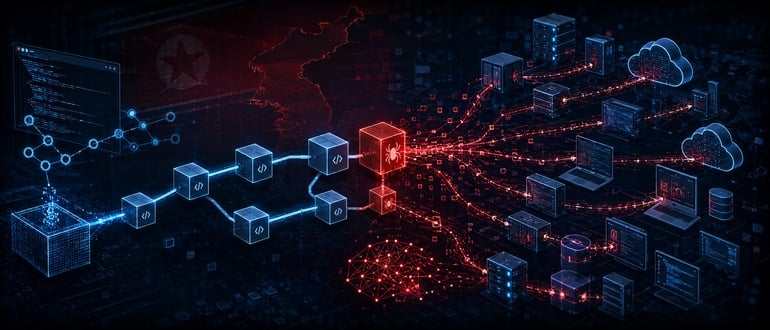
Modern threat actors frequently split a single malicious workflow across multiple seemingly unrelated ordinary packages. By fragmenting the payload, individual packages appear entirely benign during automated security scans. The malicious behavior only triggers when these components are inadvertently reassembled in a specific sequence within a downstream application.
Furthermore, these groups demonstrate immense patience. Threat actors will create, publish, and actively maintain genuinely useful, high-quality open-source packages for months—sometimes over a year—to build trust and reputation within the developer community. Only after the package has achieved widespread adoption and integration do they introduce the malicious payload.
Cryptographic Obfuscation and Sandbox Evasion
Moving beyond simple string obfuscation, multi-stage payloads now utilize strong cryptographic techniques to hide their true intent until execution time. Additionally, sophisticated malware strains are now engineered with anti-analysis capabilities: payloads refuse to launch if they detect they are operating inside a secure sandbox or virtualized analysis environment, effectively blinding researchers attempting to inspect their behavior.
The Generative AI Threat Multiplier
Perhaps the most transformative shift in the cyber threat landscape is the integration of generative artificial intelligence by bad actors. Generative AI has dramatically lowered the barrier to entry for cybercrime while vastly expanding the sophistication of attacks.
As Amazon’s research team highlighted in their threat report: "Generative AI is changing what attackers can produce and what defenders can rely on. Historically, many malicious packages were caught because they looked wrong, with broken language, thin documentation, obvious copy-paste, or a telltale function reused across samples. Generative AI erases many of those signals."
Bad actors now use LLMs to generate pristine code, write professional documentation, craft convincing social engineering pitches without grammatical errors, and scale their campaigns across multiple repositories simultaneously. This artificial polish makes malicious packages nearly indistinguishable from legitimate open-source contributions.
The Developer Workstation as Ground Zero
Traditionally, enterprise security strategies focused heavily on perimeter defense, endpoint protection for corporate laptops, and cloud workload monitoring. However, modern nation-state campaigns have redefined the attack surface, placing software developers and their workstations directly in the crosshairs.
As researchers from Wiz noted in recent threat analyses, software engineers represent the ultimate high-value target for sophisticated threat actors. Developers hold privileged cloud credentials, npm publish tokens, and direct, unmitigated access to proprietary source code repositories. Furthermore, their daily workflows inherently require them to download, install, and execute third-party code and open-source packages directly on their local workstations.
The proliferation of AI-powered coding assistants and integrated development environment (IDE) extensions has accelerated this risk vector at machine speed. As AI tools expand the pool of individuals writing and deploying software, more developers are inadvertently pulling external packages, extensions, and automated scripts onto local workstations that maintain direct, authorized pathways into corporate cloud environments and CI/CD deployment pipelines.
Open repositories like npm, PyPI, and GitHub are uniquely vulnerable because they are built on a foundational ethos of community trust, automated updates, and open collaboration. Threat actors are effectively exploiting the open-source community’s greatest strength—its collaborative spirit—turning it into a systemic vector for global espionage and financial theft.
Comprehensive Metrics and Impact Scope
To understand the macro-level impact of these campaigns, industry telemetry paints a sobering picture of scale:
- 100 Million: Weekly downloads of the
axiosJavaScript library, representing the massive potential blast radius of a single supply chain compromise. - 1 in 10: The proportion of cloud environments estimated by Wiz to have been directly impacted by the
debugandchalkpackage compromises within a critical two-hour exposure window. - 11 Accounts per Month: The average number of malicious or loader-distributing accounts banned by GitHub in 2025 alone for ties to DPRK-linked state threat groups.
- Multiple Vectors: The convergence of social engineering, typo-squatting, account takeovers, and AI-generated documentation into unified, multi-stage operational pipelines.
Future Outlook and Strategic Defenses
As state-sponsored threat groups like Sapphire Sleet and Famous Chollima continue to refine their open-source supply chain tactics, the cybersecurity industry must transition from reactive patching to proactive, Zero-Trust supply chain governance. Relying solely on community vigilance and manual code reviews is no longer viable in an era where adversaries use generative AI and sophisticated cryptographic evasion.
Security leaders recommend a multi-layered defense strategy for enterprise development teams:
- Strict Dependency Pinning and Auditing: Organizations must move away from automatic, floating dependency updates. Every imported open-source package should be explicitly pinned, version-locked, and subjected to rigorous cryptographic verification and Software Bill of Materials (SBOM) generation.
- Developer Workstation Hardening: Recognizing that developer endpoints are the new perimeter, organizations must deploy specialized endpoint detection, secure containerized development environments, and strict monitoring of API tokens, SSH keys, and npm publish credentials.
- Behavioral Analysis Over Signature Matching: Security tooling must evolve to detect anomalous behavioral patterns during runtime and installation, rather than relying on static signatures that can be easily randomized by generative AI.
- Enhanced Maintainer Verification: Repository maintainers and platform operators must implement multi-factor authentication (MFA), hardware-token enforcement (FIDO2/WebAuthn), and anomaly detection for account activity to prevent unauthorized package takeovers.
Ultimately, the weaponization of open source by North Korean state actors is a watershed moment for the software industry. Protecting the global digital economy will require unprecedented collaboration between cloud providers, repository maintainers, enterprise security teams, and open-source communities to restore trust in the code we all rely upon.