Executive Overview
The rapid ascension of artificial intelligence (AI), machine learning (ML), and high-performance computing (HPC) has fundamentally rewritten the operational parameters of the modern data center. As organizations scramble to deploy dense clusters of specialized graphics processing units (GPUs) and AI accelerators, a profound physical constraint has emerged: heat.
Historically, data center rack densities hovered comfortably between 5 and 10 kilowatts (kW), a thermal load that traditional computer room air conditioning (CRAC) and air-handling units could manage with relative ease. Today, however, next-generation AI and HPC servers are driving individual rack densities to 30 kW, 50 kW, 60 kW, and beyond. At these thresholds, conventional air cooling is hitting a hard brick wall. Air is an inherently poor thermal conductor; moving enough of it to combat extreme heat demands immense volumes of electrical power, sprawling infrastructure, deafening acoustic profiles, and vast physical space.
To circumvent these cascading inefficiencies, the data center industry is undergoing a historic architectural pivot toward liquid cooling. Far from being a fleeting novelty, liquid cooling harnesses the superior thermal capacity of liquids—such as water or engineered dielectric fluids—to capture heat efficiently at or near the source.
As detailed by technology expert Brien Posey, adopting liquid cooling is no longer just an optional engineering upgrade for edge use cases; it is becoming an absolute operational imperative. However, liquid cooling is not a monolithic technology. Instead, it represents a diverse toolkit spanning Rear-Door Heat Exchangers (RDHx), Direct-to-Chip cold plates, and full-scale Immersion systems. Navigating this spectrum requires data center operators to balance performance targets, energy goals, facility limitations, and long-term total cost of ownership (TCO).
Detailed Chronology: The Evolution from Air to Liquid
The transition from air-cooled data halls to advanced liquid thermal architectures did not happen overnight. It is the culmination of decades of exponential hardware scaling colliding with the laws of thermodynamics.
- The Air-Cooled Era (Late 20th Century to Early 2010s): For decades, standard enterprise servers relied on ambient air circulation. Cool air was drawn through the front of the chassis across CPUs and memory banks, with exhaust fans blowing heated air into hot aisles. While effective for low-density computing, this methodology relied entirely on the specific heat capacity of air—a medium that requires massive volumetric flow rates to shift meaningful thermal loads.
- The High-Performance Computing (HPC) Vanguard (Mid-2010s): Early adopters in supercomputing and cryptocurrency mining began experimenting with bespoke liquid cooling configurations, drawing inspiration from high-end gaming PCs. These pioneers recognized that closed-loop water blocks and dielectric fluid baths could keep overclocked silicon operating stably under punishing workloads.
- The AI Gold Rush and the Density Crisis (2020–Present): The commercial explosion of generative AI models shifted GPU deployments from boutique science projects to mainstream enterprise operations. Modern AI training clusters introduced unprecedented power densities per rack. Traditional air-moving systems could no longer keep pace without creating catastrophic temperature hot spots, forcing mainstream colocation providers and hyper-scalers to rapidly embrace liquid cooling as standard infrastructure.
Supporting Context & Metrics: Why Air Cooling is Failing
To understand why data centers are abandoning air, one must examine the fundamental physical limitations of airflow management at scale.
The Thermodynamics of Air vs. Liquid
Air possesses a remarkably low volumetric heat capacity. To remove thermal energy from a densely packed server rack, mechanical engineers must move exponential volumes of air. This necessitates larger fans, wider ducting paths, and immense energy expenditures.
Furthermore, as fan counts multiply to combat local hot spots, a parasitic power drain occurs: a significant percentage of the facility’s total power usage effectiveness (PUE) is funneled exclusively into running fans rather than powering compute loads. This dynamic also creates severe acoustic challenges, turning data halls into high-decibel environments.
Liquid, by contrast, transfers thermal energy exponentially better than air. Water and engineered coolants can carry thousands of times more heat per unit volume. By capturing heat close to the point of generation—often directly on the silicon die—liquid systems eliminate the need to flood the entire data hall with chilled air.
Unlocking Thermal Efficiencies and Heat Reuse
One of the most transformative economic advantages of liquid cooling is its ability to operate at much warmer coolant temperatures than traditional air-cooled systems. Because liquids can absorb heat efficiently without requiring sub-zero chilling, facilities can reduce their reliance on energy-intensive mechanical chillers and compressors.
Moreover, this shift unlocks the potential for industrial heat reuse. Warm-water loops exiting the data center can be captured and repurposed to heat adjacent office buildings, municipal water networks, or industrial processes, fundamentally transforming data centers from energy sinks into localized thermal assets.
Official Industry Analysis: The Three Pillars of Liquid Cooling
Liquid cooling is best understood as a spectrum of technologies, each tailored to distinct structural requirements, capital expenditure (CapEx) budgets, and thermal loads. Industry practitioners generally categorize these solutions into three primary methodologies.
1. Rear-Door Heat Exchanger (RDHx) Cooling
For facilities looking to modernize legacy infrastructure without ripping out existing server chassis, Rear-Door Heat Exchangers offer an accessible entry point.
- Mechanism: An RDHx replaces the standard back door of a server rack with a liquid-cooled coil system. Air enters the server from the cold aisle, passes over internal components (CPUs, GPUs, and memory), and exits out the back. Instead of discharging this hot air directly into the room, it passes through the liquid-cooled coils of the rear door. Heat is transferred from the air to the circulating liquid, drastically lowering the exhaust temperature.
- Active vs. Passive Designs: Passive RDHx units rely entirely on the servers’ internal fans to push air through the door coils, making them simple and reliable for moderate densities. Active RDHx units incorporate built-in fans within the door itself, allowing them to pull air through dense coils and handle significantly higher thermal loads with consistent performance.
- Use Cases: RDHx is ideal for brownfield sites and incremental upgrades. It is minimally disruptive to existing IT hardware and carries a relatively low risk profile compared to systems that route liquid directly over sensitive electronics.
2. Direct-to-Chip Cooling
Direct-to-chip cooling represents a more aggressive thermal intervention, delivering liquid straight to the hottest components inside the server chassis.
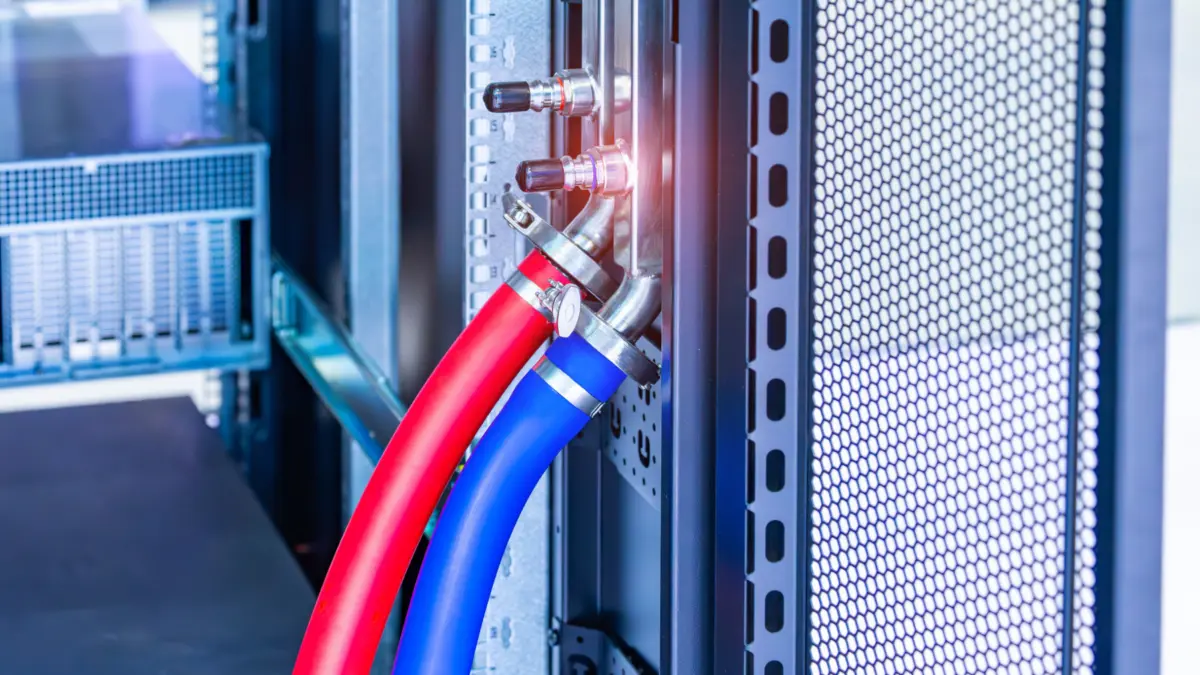
- Mechanism: Specially engineered metal blocks, known as cold plates, are mounted directly in physical contact with high-heat components like CPUs and GPUs. Coolant is fed into the rack via facility connections, entering a distribution manifold that routes liquid to individual servers through quick-disconnect fittings. The coolant absorbs heat directly from the chip’s surface before returning to a Coolant Distribution Unit (CDU), which isolates the IT loop from the facility water system while regulating pressure and temperature.
- Use Cases: Direct-to-chip is uniquely suited for AI training clusters, GPU-dense environments, and HPC workloads. While fans may still be retained to cool lower-draw components like power supplies and networking gear, direct-to-chip systems capture 70% to 90% of the total rack heat load at the source.
3. Immersion Cooling
Immersion cooling represents a complete paradigm shift, moving away from closed-loop piping to entirely submerge server hardware within a fluid bath.
- The Dielectric Advantage: Servers are submerged in specially formulated dielectric liquids that do not conduct electricity, allowing electronic components to operate safely while fully immersed.
- Single-Phase vs. Two-Phase Immersion:
- Single-phase immersion relies on a circulating dielectric fluid bath. Pumps continuously push warm fluid through an external heat exchanger, transferring heat to facility water loops without causing the fluid to boil.
- Two-phase immersion utilizes a fluid engineered to boil at very low temperatures. Heat from the chips causes the liquid to vaporize into a steam. When this vapor contacts a condenser cooling plate suspended above the tank, it liquefies and drips back down into the bath, utilizing latent heat of vaporization to achieve extreme thermal transfer efficiency.
- Use Cases: Immersion cooling delivers uniform temperatures, eliminates acoustic noise, and enables maximum possible rack densities. However, it requires an entirely new operational framework, specialized hardware compatibility, and careful fluid management.
Future Outlook: The Road Ahead for Data Center Infrastructure
The transition to liquid cooling marks a permanent maturation point for the digital infrastructure industry. As artificial intelligence models scale toward hundreds of billions of parameters, the physical density of compute clusters will only continue to accelerate.
Data center operators can no longer treat cooling as an afterthought or a secondary utility; it is now a core determinant of compute performance, financial viability, and environmental sustainability. Whether retrofitting legacy data halls with Rear-Door Heat Exchangers, deploying targeted Direct-to-Chip cold plates for dense GPU arrays, or engineering greenfield sites around full-scale Immersion systems, the industry is irrevocably shifting toward liquid-centric architectures.
Ultimately, choosing the right cooling strategy requires a holistic evaluation of performance targets, energy efficiency goals, facility spatial limitations, and total cost of ownership. As the thermal pressures of the AI era mount, those who successfully master the spectrum of liquid cooling solutions will dictate the future velocity of global technological innovation.