Executive Overview
For decades, the motion picture industry has relied on a delicate, often frustrating compromise when it comes to high-intensity lighting. To replicate the sheer brilliance of natural sunlight or punch through heavy diffusion, cinematographers have historically turned to Hydrargyrum Medium-arc Iodide (HMI) fixtures. While powerful, traditional HMIs are notorious for their operational inefficiencies: they require massive ballasts, consume immense amounts of power, emit extreme heat, require strike-up and cool-down periods, and offer zero color tunability beyond physical gel filters.
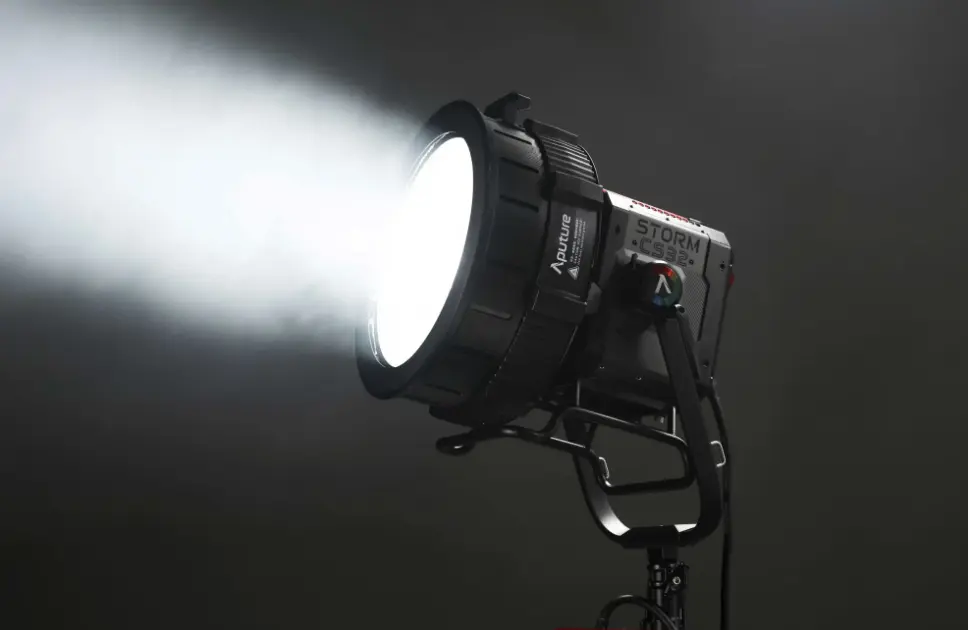
The unveiling of the Aputure STORM CS32 represents a significant technological milestone in resolving this compromise. Positioned as a 4K HMI-class tunable color LED monolight, the STORM CS32 bridges the historical divide between raw, heavy-duty cinema output and single-operator portability.
At the heart of this fixture is Aputure’s proprietary BLAIR-CG light engine—a seven-emitter architecture designed to deliver full-spectrum color control without sacrificing the high-lux output required for demanding film and television sets. Offering an ultra-wide Correlated Color Temperature (CCT) range of 1,800K to 20,000K, smart power management that adapts to household circuits, and a modular physical design, the STORM CS32 aims to democratize high-output lighting for independent filmmakers and major rental houses alike.
Detailed Chronology: The Evolution of High-Output LED Technology
To understand the engineering significance of the STORM CS32, one must look at the broader timeline of solid-state lighting (SSL) in cinema.
[Early 2010s] Low-power, low-CRI LED arrays (Indie/Prosumer)
      │
[Mid 2010s] Single-source COB white light (e.g., Aputure LS 120d/300d)
      │
[Late 2010s] Introduction of RGBWW color mixing panels (Nova Series)
      │
[Early 2020s] High-output Daylight/Bi-color point sources (LS 600d/1200d Pro)
      │
[Mid 2020s] Advanced multi-emitter architectures (BLAIR-CG Engine)
      │
[2026] Release of the STORM CS32: 4K HMI-Class Tunable Monolight
The Early Era of LED Adoption
In the early 2010s, LEDs were largely dismissed by high-end gaffers and directors of photography due to poor color rendering, low output, and noticeable green spikes. Early fixtures were restricted to low-power panel configurations, useful only as close-up fill lights.
Aputure disrupted this landscape in the mid-2010s with the introduction of its Light Storm (LS) series. By utilizing Chip-on-Board (COB) technology, they successfully concentrated LED power into a single point source, allowing for the use of traditional bowens-mount modifiers. Fixtures like the LS 120d and LS 300d proved that LEDs could serve as viable key lights for independent productions.
The Quest for High-Output and Color Tunability
As the industry transitioned into the 2020s, the demand for higher output grew. Aputure responded with heavy-hitting daylight and bi-color fixtures such as the LS 600d Pro and the LS 1200d Pro. These fixtures began replacing smaller HMIs (like 575W and 1.2kW units) on professional sets.
However, color-tunable (RGBWW) point-source lights historically suffered from a major drawback: when white light is generated by mixing red, green, blue, and white emitters, the overall output drops significantly compared to dedicated daylight-only or bi-color COB chips. Gaffers were forced to choose between the high output of a bi-color fixture or the creative flexibility of a color-tunable fixture.
The development of the STORM line, previewed at major industry trade shows and officially launched with the STORM CS32, resolves this dichotomy. By abandoning traditional RGBWW configurations in favor of a specialized multi-emitter architecture, Aputure has successfully delivered an LED fixture that matches the raw output of a 4K HMI while maintaining absolute color control across the entire visible spectrum.
Supporting Context & Technical Metrics: Inside the BLAIR-CG Architecture
The capability of the STORM CS32 relies on its internal color science and electrical engineering. Rather than relying on standard color-mixing techniques, Aputure’s engineers developed a highly sophisticated seven-emitter array.
The BLAIR-CG Light Engine Explained
Traditional RGBWW fixtures mix Red, Green, Blue, Warm White, and Cool White to create colored and white light. This often results in "spectral valleys"—gaps in the spectral power distribution (SPD) that lead to unnatural skin tones and poor color reproduction under certain camera sensors.
The STORM CS32 utilizes the BLAIR-CG engine, which stands for:
- Blue
- Lime
- Amber
- Indigo
- Red
- Cyan
- Green
| Emitter | Primary Function | Spectral Impact |
|---|---|---|
| Blue & Indigo | Deep blue and near-UV spectrum | Enhances fluorescence; eliminates "dead" spots in cool tones |
| Cyan & Green | Mid-spectrum transition | Fills the cyan gap; ensures smooth transitions in skin tones |
| Lime & Amber | High-efficiency white generation | Maximizes lumen-per-watt efficiency in the middle of the visual spectrum |
| Red & Extended Red | Deep red saturation | Vital for rendering human blood flow and rich skin textures |
By introducing dedicated Indigo and Extended Red emitters, the CS32 achieves a continuous spectral distribution. This prevents the synthetic, "digital" look of early LED fixtures, allowing subjects to fluoresce realistically under the light—a quality previously unique to natural sunlight and high-end continuous-spectrum source lamps.
Color Fidelity and Precision Metrics
This emitter architecture allows the STORM CS32 to maintain color fidelity across its CCT range:
- CCT Range: 1,800K to 20,000K (capable of replicating candlelight up to deep blue sky light).
- SSI (P3200): 93 (Spectral Similarity Index, measuring fidelity against tungsten sources).
- SSI (CIE D5600): 92 (measuring fidelity against daylight sources).
- Color Space Coverage: Covers over 90% of the Rec. 2020 color space.
- Green/Magenta Control: Full 100% plus/minus green adjustment across the entire ASC MITC range, allowing gaffers to match the light to existing green-spiked practical fixtures on location.
Photometric Performance and Power Management
When configured with its included medium reflector, the STORM CS32 produces a highly concentrated beam:
$$textOutput at 3 Meters (5600K) = 105,300 text Lux$$
To put this in perspective, this output level allows the fixture to act as a primary key light even when bounced off large diffusion frames or directed through heavy grid cloth, matching the performance of traditional 4K HMI heads.
Traditional 4K HMI:
[4000W Draw] ──> [Massive Ballast] ──> [Fixed Daylight Temp] ──> [High Heat / Noise]

Aputure STORM CS32:
[Smart Power Draw] ──> [Compact Control Box] ──> [1,800K - 20,000K + Full Color] ──> [Silent / Cool]
To support this output without requiring heavy industrial power generators, Aputure designed an intelligent power management system:
- Household Outlet Mode (120V): When plugged into standard household wall outlets, the CS32 automatically detects the available circuit capacity and throttles its power draw to a safe limit, preventing tripped breakers.
- Boost Mode: When connected to high-capacity power distribution lines (such as 208V/240V systems or heavy-duty generators), the fixture unlocks an additional 25% output boost, reaching its full 4K HMI-equivalent potential.
Physical Dimensions and Rigging Ergonomics
Despite its high-output classification, the STORM CS32 is designed to be operated by single-person crews or small indie setups where heavy grip trucks are unavailable.
- Lamp Head Weight: 17.0 kg (37.5 lbs)
- Lamp Head Dimensions: 36.0 × 39.7 × 33.1 cm
- Control Box Weight: 10.8 kg (23.8 lbs)
- Control Box Dimensions: 34.5 × 16.0 × 37.6 cm
This physical separation of the heavy electronics (housed in the ballast/control box) from the lamp head ensures that the center of gravity on lighting stands remains low, reducing the risk of tipping and making high-overhead rigging considerably safer.
Official Statements: Engineering Philosophy and Market Positioning
The development of the STORM CS32 highlights Aputure’s commitment to pushing the physical limits of solid-state lighting technology.
Mitch Gross, Director of Marketing for Aputure, emphasized the engineering challenges involved in designing a fixture of this caliber:
“Our goal was the impossible light—can we make a fixture with no compromises in light output and light quality yet still remain lightweight? With each new product, our engineers push to cram in as much performance as possible while continuing to reduce size and slash weight… High Output, Full Spectrum, Small Size. A triple treat.”
Gross’s statement highlights a key shift in Aputure’s corporate strategy. While the company built its reputation on affordable, prosumer-grade gear, products like the STORM CS32 and the Electro Storm series position Aputure as a direct competitor to high-end industry standards like Arri, Creamsource, and Mole-Richardson. The focus is no longer just on convenience; it is on delivering uncompromised color quality that meets the rigorous demands of colorists and cinematographers working on major studio features.
Future Outlook: The Transformation of Set Lighting
The introduction of the Aputure STORM CS32 points to a future where traditional gas-discharge and tungsten lamps are entirely phased out of modern film sets.
┌────────────────────────────────────────────────────────┐
│               The Changing Set Ecosystem               │
├───────────────────────────┬────────────────────────────┤
│   Traditional HMI Set     │    Modern STORM CS32 Set   │
├───────────────────────────┼────────────────────────────┤
│ • Loud generator trucks   │ • Standard wall outlets    │
│ • Dangerous high voltages │ • Safe, low-voltage lines  │
│ • Physical gel swaps      │ • Wireless color control   │
│ • Long cool-down periods  │ • Instant on/off workflow  │
└───────────────────────────┴────────────────────────────┘
Environmental and Financial Impacts
The shift from HMIs to fixtures like the STORM CS32 has significant operational benefits:
- Power Efficiency: By drawing significantly less power than equivalent HMI setups, productions can operate with smaller generators, reducing fuel consumption and carbon footprints.
- Reduced Thermal Footprint: Traditional HMIs heat up closed studio stages rapidly, requiring heavy air conditioning. The cooler operation of LEDs keeps actors comfortable and reduces HVAC noise on set.
- Logistical Cost Savings: Eliminating the need for fragile spare globes, massive ballasts, and heavy head cables simplifies transportation. A single gaffer can transport a CS32 in a standard vehicle, bypassing the need for a dedicated grip truck.
Control and Integration
As virtual production and real-time VFX continue to grow, lighting fixtures must integrate seamlessly into digital workflows. The STORM CS32 features robust connectivity options, including CRMX, Art-Net/sACN, and Aputure’s Sidus Link ecosystem. This allows lighting programmers to control color coordinates, match LED walls dynamically, and execute complex lighting effects instantly from a console.
The STORM CS32, which was previewed at NAB 2026, represents a major step forward for on-set lighting. By combining the color precision of its BLAIR-CG engine with high-output performance, Aputure has delivered a versatile tool that promises to streamline workflows and expand creative possibilities for filmmakers at every level.