Executive Overview
In the storied, century-long history of Bentley Motors, weight has traditionally been worn as a badge of honor. The Crewe-based manufacturer built its legend on locomotivesque grand tourers—mighty, leather-lined, wood-veneered iron fist in a velvet glove cruisers that crossed continents at triple-digit speeds while isolating their occupants from the crude realities of the asphalt beneath them. But automotive paradigms shift, and luxury performance is undergoing a profound philosophical recalibration.
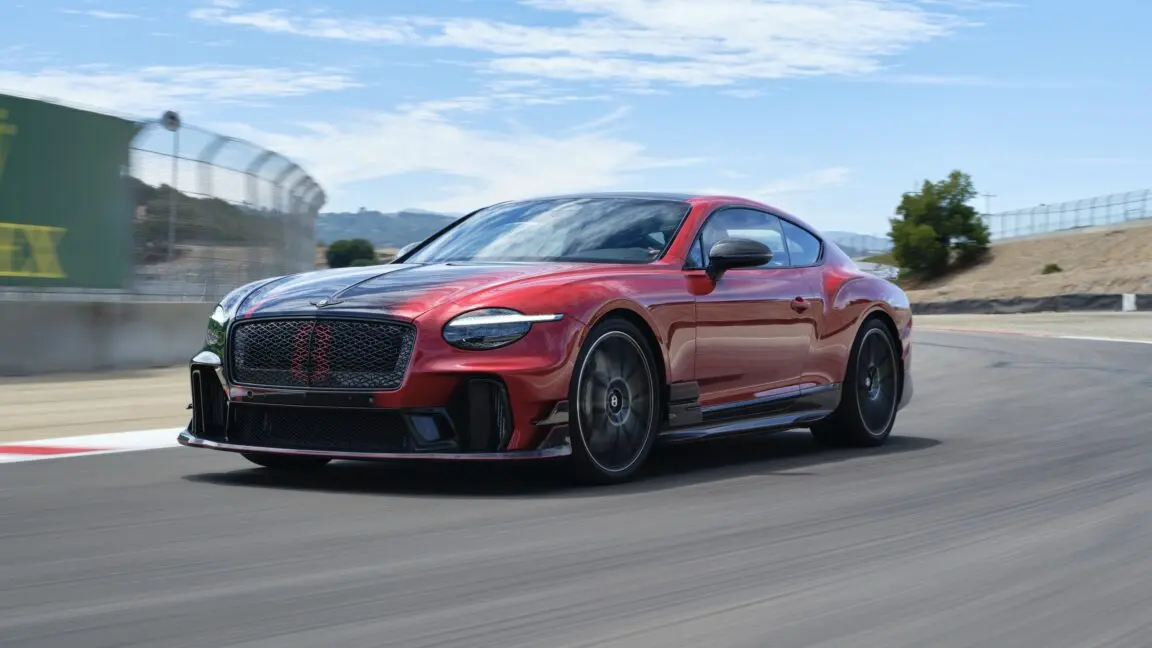
Enter the new Bentley Supersports: a machine that shatters decades of institutional inertia to claim the title of the lightest production Bentley since 1941.
Unveiled dynamically against the demanding topography of WeatherTech Raceway Laguna Seca, this newest iteration of the Supersports nameplate is not merely a styling exercise or a minor power bump. It is a visceral, driver-centric assault on physics. Powered by a heavily revised, ferocious variant of Bentley’s signature 4.0-liter twin-turbocharged V8, the car produces 657 horsepower (490 kW) and 590 lb-ft (800 Nm) of torque. Yet, its true marvel lies in its relationship with gravity. Tipping the scales at “less than 4,407 lbs (1,999 kg),” the new Supersports bridges the yawning chasm between opulent grand touring and uncompromising circuit capability.
This comprehensive report examines how Bentley engineered its lightest vehicle in over eight decades, exploring the metallurgical and aerodynamic wizardry behind the build, the track dynamics observed at Laguna Seca, and what this radical shift means for the future of ultra-luxury performance automobiles.
Detailed Chronology: From Concept to the Corkscrew
The development of a vehicle intended to rewrite the dynamic DNA of an ultra-luxury marque does not happen overnight. The Genesis of the modern Supersports began quietly inside the engineering hubs of Crewe several years ago, born out of a challenge: How do you distill the essence of Bentley performance without diluting its core tenets of craftsmanship, while radically reducing mass?
Phase One: The Weight-Loss Mandate (Years 1–2)
Early feasibility studies focused on identifying every ounce of superfluous mass within the standard Continental architecture. Engineers analyzed the chassis, powertrain mounting points, interior bulkheads, and acoustic insulation. The mandate was clear: mass reduction could not come at the expense of structural rigidity or the sensory richness expected of a Bentley cabin.
Phase Two: Powertrain Evolution and Thermal Validation (Years 3–4)
With a target weight established, the powertrain team went to work on a new iteration of the 4.0-liter V8. Moving away from the heavier W12 engine variants of the past, engineers concentrated on extracting maximum specific output from a smaller footprint. The engine block was structurally reinforced, bespoke cylinder heads were designed to optimize airflow and thermal efficiency, and larger-displacement turbochargers were bolted on to deliver immediate throttle response alongside mountainous mid-range thrust. Rigorous testing followed, moving from dynamometer cells in the UK to high-altitude testing in the Alps and hot-weather endurance runs in the deserts of Arizona.
Phase Three: Aerodynamic Integration and Track Testing (Year 5)
By the final year of development, the focus shifted from straight-line dynamics to downforce generation and high-speed stability. Scale models entered the wind tunnel before full-scale prototypes were unleashed on Europe’s most punishing circuits, including the Nürburgring Nordschleife. The culmination of this multi-year development cycle brought the development team to Laguna Seca, where the final production-intent prototypes were put through their paces ahead of their official global debut.
Supporting Context & Metrics: Engineering the Featherweight Giant
To fully appreciate the engineering triumphs embedded within the new Supersports, one must dive deep into the technical specifications that govern its performance envelope.
Powertrain and Mechanical Architecture
At the heart of the beast is a completely overhauled variant of Bentley’s 4.0-liter V8. While it retains a wet-sump lubrication system to ensure reliability under extreme sustained lateral loads, almost everything else has been touched:
- Engine Block & Heads: Strengthened to handle significantly elevated cylinder pressures, paired with redesigned cylinder heads for optimized gas exchange.
- Forced Induction: Larger turbos force-feed the combustion chambers, contributing to the staggering output of 657 horsepower (490 kW) and 590 lb-ft (800 Nm) of torque.
- Transmission Integration: A robust dual-mass flywheel manages the fierce power delivery, feeding power through an ultra-responsive dual-clutch transmission designed to snap through gears under hard acceleration.
Chassis Control and Suspension Dynamics
Power is nothing without control, and Bentley has equipped the Supersports with an array of active chassis systems designed to defy its physical footprint. Both front and rear axles feature 48-volt active anti-roll bars. These electromechanical actuators can react in a blistering one-third of a second, generating up to 960 lb-ft (1,300 Nm) of reaction torque to completely counteract body roll, keeping the chassis utterly flat through high-speed sweepers.
Furthermore, the vehicle utilizes advanced twin-valve dampers and retuned air suspension. Drivers can cycle through three distinct modes—Touring, Bentley, and Sport—each altering the spring rates, damping characteristics, and throttle mapping. When shod in the optional Pirelli Trofeo RS tires, the Supersports is capable of sustaining an astonishing 1.3 Gs of lateral grip in high-speed cornering scenarios.
Aerodynamic Dominance
Descending into Laguna Seca’s legendary Corkscrew—a section of track slated to be officially renamed the "Zanardi Corkscrew"—the aerodynamic profile of the Supersports becomes critically apparent.
- Carbon-Fiber Roof: Lowers the overall center of gravity, aiding in quick directional changes.
- Aero Appendages: The front end features an aggressive carbon-fiber splitter complemented by precision-engineered dive planes (winglets) ahead and aft of the front and rear wheels.
- Rear Wing & Diffuser: A large, curvaceous carbon-fiber rear spoiler works in tandem with an underbody diffuser to clean up trailing airflow.
According to Bentley’s aerodynamicists, this comprehensive package generates at least 661 lbs (300 kg) more downforce than the Continental GT Speed. Crucially, the aero balance has been meticulously tuned to shift rearward as vehicle speed increases, transitioning from a neutral 54:46 front-to-rear starting bias to ensure rock-solid high-speed stability down long straightaways.
Cabin Ergonomics and Structural Weight Management
Dropping nearly 85 years of historical weight standards required drastic measures, yet stepping inside the cockpit reveals no austerity. Acres of exposed carbon-fiber weave adorn the dashboard and door cards, reminding occupants of the car’s lightweight mission.
Yet, comfort has not been sacrificed on the altar of speed. A pair of exquisitely tailored sports seats offer extensive electric adjustment, deep bolstering, and sublime ergonomic support. Even when attacking the apex of the Corkscrew and intentionally riding the high, red-and-white serrated curbs, the cabin remains insulated from violent impacts. The chassis absorbs and dissipates the intrusion before it can disturb the driver, proving that lightweight engineering does not have to come at the cost of Grand Touring refinement.
Official Statements and Track-Side Perspectives
Speaking on background during the high-speed validation runs at Laguna Seca, members of Bentley’s vehicle dynamics engineering team shed light on the philosophy guiding the project.
"We set out to build a car that honors the legacy of our historic racers while utilizing the absolute pinnacle of modern lightweight materials and electronic chassis controls," noted a senior vehicle dynamics spokesperson. "The Supersports nameplate demands aggression, but it also demands composure. By dropping below the 4,407-pound threshold, we haven’t just altered the numbers on a spec sheet—we’ve fundamentally transformed how the car communicates with the driver’s fingertips."
Factory test drivers pushing the car over the Laguna Seca crests emphasized the predictability of the aerodynamic balance.
"When you’re braking hard downhill into the Corkscrew at triple-digit speeds, balance is everything," a lead development driver shared trackside. "With the rearward aero-shift working dynamically as velocity climbs, the rear axle plants itself precisely when you need the most confidence. It allows you to lean on the Pirelli Trofeo RS compounds with total trust."
Future Outlook: The New Era of Performance for Crewe
The arrival of the new Bentley Supersports marks a definitive turning point for the brand. For decades, ultra-luxury GT cars have wrestled with the compounding weight penalties of electrification, enhanced safety regulations, and consumer demands for ever-more lavish interior amenities. Bentley has chosen a different path—one where lightweight composite materials, active 48-volt dynamics, and wind-tunnel-honed aerodynamics can successfully push back against the tide of mass.
As the automotive industry stands on the precipice of an electrified future, the engineering lessons learned from developing the lightest Bentley since 1941 will inevitably echo across future product lines. Whether applied to hybrid powertrains or fully battery-electric platforms, the pursuit of mass reduction, structural rigidity, and driver-focused chassis calibration will remain paramount.
For now, the new Supersports stands alone: a bridge between Bentley’s illustrious racing heritage and its cutting-edge modern engineering future. It proves that supreme luxury and track-devouring agility are not mutually exclusive—provided you are willing to rewrite the rules, shed the excess, and let physics work in your favor.