Executive Overview
A quiet revolution is underway at the intersection of international regulation, computational linguistics, and global commerce. The European Union’s landmark Regulation (EU) 2024/1689—widely known as the EU AI Act—has officially shifted from a theoretical legislative framework into an enforceable reality. Designed to champion transparency, consumer protection, and ethical oversight, the legislation mandates that all "synthetic" media, including machine-generated text, must be explicitly machine-detectable.
While noble in its intent to combat disinformation and deceptive deepfakes, the compliance mechanisms required to satisfy this law are introducing profound secondary consequences. Chief among them is the creation of a standardized technological infrastructure capable of sorting, tracking, segregating, and potentially censoring written content based entirely on its automated provenance rather than its intellectual quality, factual accuracy, or editorial value.
In direct response to these regulatory mandates, leading frontier AI lab Anthropic recently announced that all future iterations of its industry-standard Claude large language models (LLMs) will natively embed invisible, text-based cryptographic and statistical watermarks. Competitors across the generative artificial intelligence ecosystem are rapidly following suit, transforming proprietary AI models into self-identifying digital engines.
For the global digital marketing community, particularly resource-constrained ecommerce operators, small businesses, and independent agencies who rely heavily on generative AI to scale digital operations, this transition poses an existential threat. The technical ability to effortlessly spot AI-generated copy strips away the operational parity that generative AI once provided. Platforms ranging from search engines and social networks to email clients and rival LLMs now possess the tools to filter, suppress, or outright banish machine-assisted writing.
This deep-dive investigation explores the mechanics of text watermarking, specifically Google’s pioneering SynthID-Text architecture, the hidden vulnerabilities of statistical detection, and the looming spectre of algorithmic censorship hanging over modern digital marketing.
Detailed Chronology: From Legislative Intent to Cryptographic Enforcement
The collision course between artificial intelligence developers, legislative bodies, and marketing professionals has been years in the making. Understanding how we arrived at an era of invisible text watermarking requires tracing the evolution of regulatory pressure and technical capability.
- Early 2023: Following the explosive public debut of OpenAI’s ChatGPT, enterprise adoption of generative AI skyrocketed. Content marketers weaponized LLMs to draft blog posts, product descriptions, social media captions, and email campaigns at unprecedented speeds.
- Late 2023: As the web flooded with synthetic text, anxieties surrounding mass-produced misinformation, SEO spam, and the degradation of search engine result page (SERP) quality prompted regulatory bodies worldwide to re-examine digital transparency.
- Mid-2024 (The EU AI Act Adoption): The European Parliament officially adopted Regulation (EU) 2024/1689. The comprehensive framework classified AI systems according to risk tiers, imposing stringent transparency requirements on general-purpose AI models and explicitly demanding that synthetic audio, video, image, and text content be marked as artificially generated or manipulated.
- Late 2024 to 2025: Tech giants and AI research labs scrambled to build reliable compliance tools. While image and video watermarking had achieved reasonable maturity, watermarking natural language proved exceptionally difficult due to the continuous, discrete nature of human text.
- The Breakthrough: Google DeepMind expanded its cryptographic watermarking system, SynthID, from image and audio generation into natural language processing. SynthID-Text emerged as the gold standard for embedding hidden patterns directly into the token generation pipeline without degrading linguistic fluency.
- The Present Era: Facing mounting legal pressure from European regulators and the impending enforcement windows of the AI Act, frontier model providers like Anthropic have begun integrating native text-watermarking solutions into their production architectures. This has transformed theoretical compliance into practical reality, forcing digital marketers to reckon with an ecosystem where their tools carry permanent, machine-readable digital fingerprints.
Supporting Context & Metrics: Decoding the Mechanics of SynthID-Text
To understand how marketers will be impacted, one must first demystify the underlying mechanics of modern text watermarking. For years, amateurs and casual observers attempted to identify AI-generated text using surface-level heuristics—hunting for overused em dashes, predictable colons, or formulaic transitions like "In conclusion" or "Delve into." However, these amateur heuristics are entirely ineffective; punctuation marks have existed for centuries, and generative models are explicitly trained to mimic human writing styles more naturally with every passing iteration.
Reliable identification requires programmatic intervention at the infrastructural level. Enter SynthID-Text, developed by Google and adopted across major AI architectures.
The Anatomy of the Next Token
In the universe of large language models, text is processed and generated through "tokens"—bite-sized fragments of data that can represent individual characters, punctuation marks, whole words, or sub-word root elements (e.g., the prefix un-).

When a user prompts an AI model to draft a product description or an email marketing sequence, the model does not write prose like a human. Instead, it evaluates the existing prompt and calculates the statistical probability of the very next token.
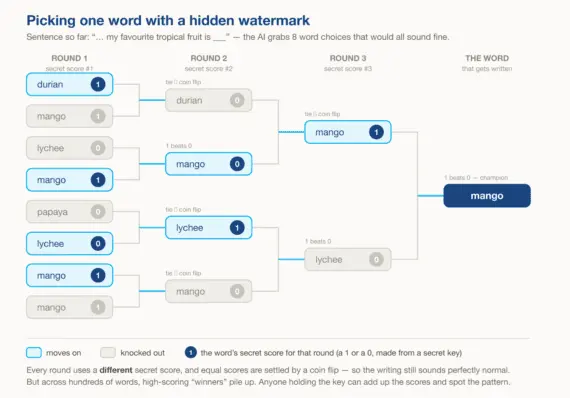
For instance, consider the sentence fragment: "My favorite tropical fruit is…"
An LLM evaluates dozens of potential subsequent tokens—such as "mango," "papaya," "durian," "banana," or "pineapple." Through mathematical probability, the model selects one. However, it rarely selects the absolute highest-probability word every single time; introducing randomized temperature parameters allows the model to choose from a pool of reasonable alternatives, ensuring human-like linguistic variety.
The Tournament System
SynthID-Text leverages these pools of reasonable alternatives to run a hidden, multi-stage statistical "tournament" during the generation of every single token:
- Candidate Selection: When the model prepares to write a word, the algorithm evaluates multiple plausible candidate tokens.
- Secret Scoring: Using a cryptographic pseudo-random function governed by a secret key, the system assigns invisible scores to the competing candidates based on a seeded mathematical pattern.
- Bracket Elimination: The candidates undergo a series of simulated tournament rounds, pitting words against one another based on their secret scores.
- The Winning Selection: A word that aligns with the hidden watermarking seed is subtly nudged forward to win the tournament, provided it remains contextually and grammatically appropriate within the sentence.
- Accumulation of Evidence: Because "mango" might win a tournament in one sentence but lose in another based on shifting context, a single watermarked word proves nothing. However, across an entire multi-paragraph document, hundreds of sequential tournaments introduce a subtle, statistically anomalous bias toward seed-influenced tokens. This collective pattern forms the invisible watermark.
The Detection Process
A specialized "detector" algorithm equipped with the secret key can ingest a passage of text, break it down into its underlying tokens, reconstruct the historical tournament scores, and evaluate whether the frequency of watermarked token choices crosses a predetermined statistical threshold.
- Length Matters: Short social media posts (one or two sentences) contain too few tokens to yield statistically significant evidence; a few watermarked words could easily occur by chance. Conversely, long-form content, white papers, and comprehensive blog posts provide hundreds of tokens, making the detection threshold exceptionally accurate.
- Factual Constraints Reduce Evidence: When a model writes strict factual passages or undergoes rigorous user-guided editing during composition, its available pool of acceptable alternative tokens shrinks dramatically. In these tightly constrained scenarios, the watermarking signal becomes weaker because the model has fewer degrees of freedom to manipulate token selection.
Official Statements and Industry Reactions
The implementation of mandatory text watermarking has triggered intense debate across the technology, legal, and marketing sectors. Stakeholders are sharply divided over whether the technology achieves transparency or lays the groundwork for algorithmic overreach.
European regulators maintain an optimistic stance regarding the enforcement of the AI Act. In recent policy briefings, Commission spokespersons emphasized that machine readability is essential to safeguard democratic discourse. "Citizens have an absolute right to know when they are interacting with an autonomous machine or consuming synthetic propaganda," noted one EU digital policy official. "Transparency is the bedrock of digital trust; technical watermarking ensures that accountability scales alongside generative capabilities."
Conversely, tech developers and AI safety advocates have raised technical and ethical concerns. Anthropic’s engineering teams, while complying with emerging standards through their Claude text-watermarking rollouts, have repeatedly acknowledged the inherent limitations of statistical detection. In technical documentation accompanying their watermark releases, Anthropic noted that watermarking systems remain vulnerable to adversarial tampering—such as paraphrasing models, human editing, or translation loops that can strip away statistical signatures without destroying the underlying semantic meaning.
Digital marketing associations have offered scathing critiques of the commercial implications. Speaking on condition of anonymity, a policy director for a major international digital commerce coalition warned:

"By forcing AI models to wear a permanent digital scarlet letter, regulators are handing tech monopolies and platform gatekeepers an automated tool for discrimination. Watermarking was sold as an anti-fraud measure, but it is fast becoming a pre-packaged mechanism for algorithmic censorship."
Future Outlook: The Looming Threat to Ecommerce and Content Marketing
As technical watermarking standards mature and platform compliance tightens, the commercial landscape for digital marketers faces a profound reckoning. The ability of search engines, social media platforms, email service providers, and rival LLMs to effortlessly isolate and identify AI-generated text introduces sweeping operational hazards.
1. Search Engine Devaluation and SERP Suppression
Search engines like Google, Bing, and emerging AI-first search aggregators have long emphasized "content quality" over production origin. However, as watermarked text becomes universally detectable, search algorithms could easily utilize the watermark as a blunt proxy for quality. Pages carrying high statistical concentrations of AI watermarks could be systematically discounted, pushed down the ranking hierarchy, or stripped entirely of indexing privileges—undermining the core SEO strategies that small ecommerce brands rely on for organic acquisition.
2. Social Media Distribution Penalties
Social platforms are already experimenting with algorithmic suppression. Pinterest, for instance, has actively worked to limit the organic reach of purely synthetic media. With standardized text watermarks embedded natively in content produced by Claude, GPT series, and Gemini models, social networks can instantly throttle the distribution of AI-assisted posts, treating marketing copy with the same suspicion traditionally reserved for spam and bot networks.
3. The Email Deliverability Trap
For email marketers, inbox placement is the holy grail. Modern spam filters, managed by dominant email clients like Gmail and Microsoft Outlook, analyze thousands of signals to route promotional messages. The integration of text-watermarking detectors means that an email campaign drafted with the assistance of an LLM could be automatically flagged and routed straight to the spam folder—or segregated into a dedicated "AI-Generated" tab—drastically eroding open rates, conversion metrics, and campaign ROI.
4. The Erosion of Operational Parity
Perhaps the greatest casualty of widespread text watermarking is the democratization of commerce. Generative AI served as a monumental equalizer, allowing bootstrapped entrepreneurs, solo founders, and lean marketing departments to compete against multinational enterprises by producing high volumes of professional-grade content, product descriptions, and localization assets at minimal cost. If synthetic text is systematically segregated, penalized, or censored, small businesses will lose their competitive edge, forcing them back into expensive traditional agency models they can ill afford.
Conclusion
Regulation (EU) 2024/1689 was enacted to bring order to a chaotic digital frontier. Yet, by forcing generative AI providers to adopt cryptographic and statistical watermarking architectures like SynthID-Text, the regulatory state has inadvertently catalyzed a new era of digital segregation.
For digital marketers, the message is clear: the era of frictionless, unmonitored AI content creation is drawing to a close. As platforms gain the technological infrastructure to instantly identify, filter, and suppress machine-assisted prose, the future of content marketing will demand a delicate hybrid approach—where artificial intelligence acts strictly as an ideation partner, and human editorial oversight rewrites, polishes, and humanizes every token before it ever meets the public eye.