The professional filmmaking landscape is undergoing a silent but rapid transformation. As production schedules compress and crew sizes optimize, the demand for highly integrated, reliable, and color-accurate on-set monitoring has reached an all-time high. Historically, wireless video transmission and high-end monitoring existed as separate, often cumbersome components of a camera rig—connected by a web of SDI cables, mounting brackets, and competing battery plates.
With the release of the Pyro 7 Ultra, Hollyland aims to disrupt this fragmented workflow. By combining a high-brightness Quantum Dot LCD (QD-LCD) display, broadcast-grade color calibration, dual-band wireless transmission, and multi-brand camera control into a single 7-inch chassis, Hollyland is positioning itself at the forefront of the modern production ecosystem.
Executive Overview
The Hollyland Pyro 7 Ultra represents a major leap forward in the centralization of camera-top and director’s monitor technology. Designed specifically for cinematographers, directors, camera operators, Digital Imaging Technicians (DITs), and focus pullers, the device is engineered to eliminate the latency, color drift, and signal degradation that have long plagued wireless monitoring setups.
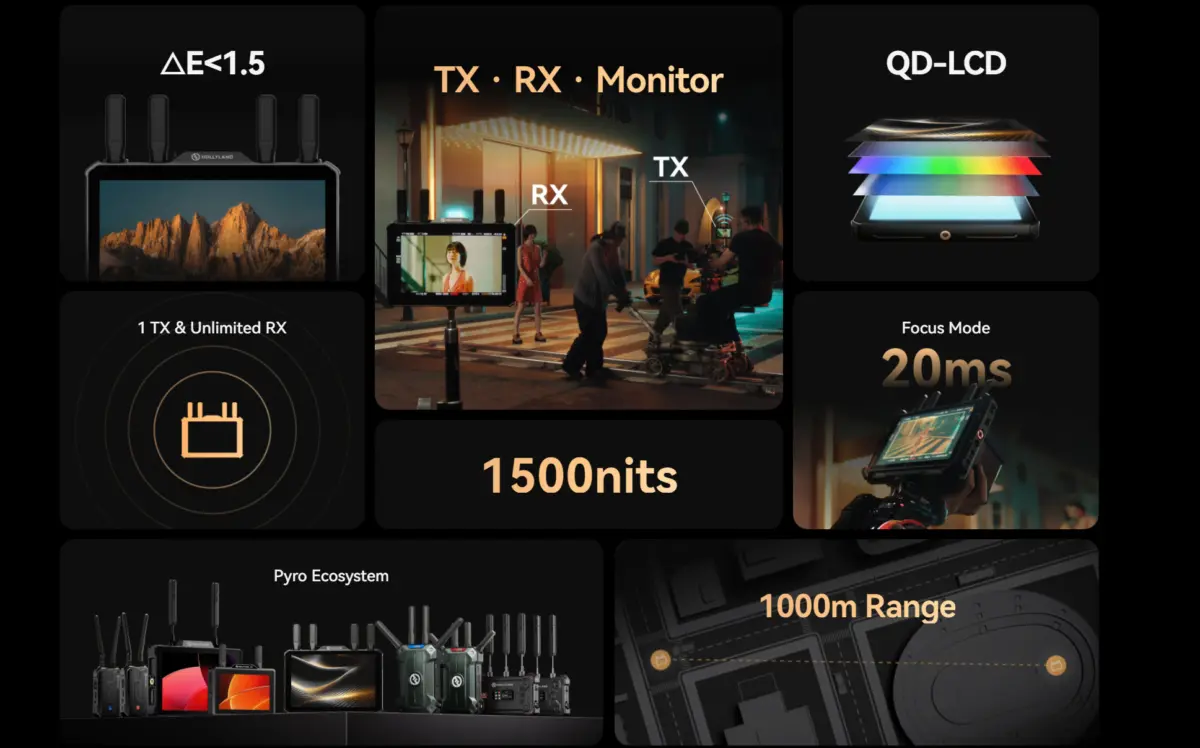
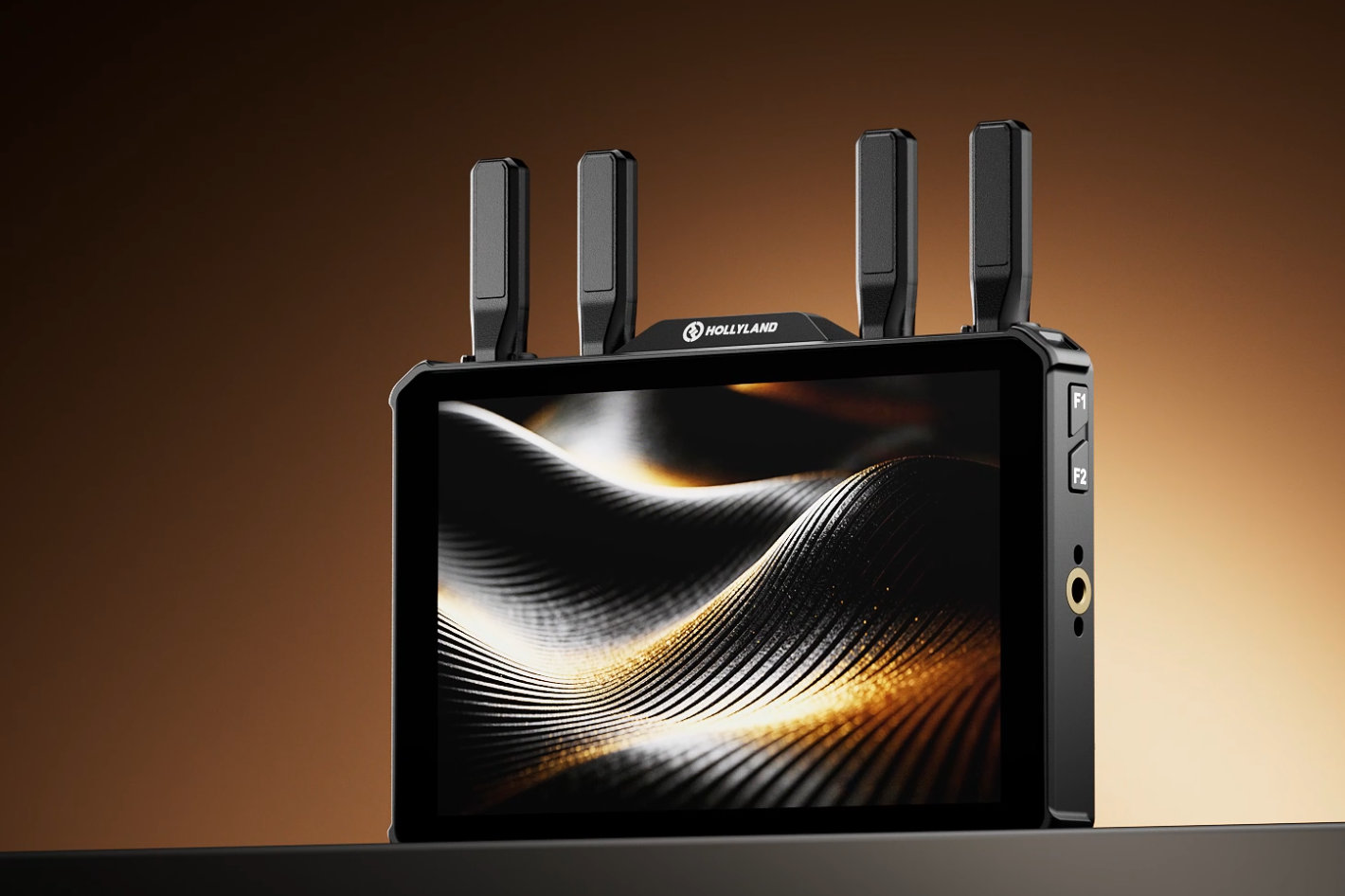
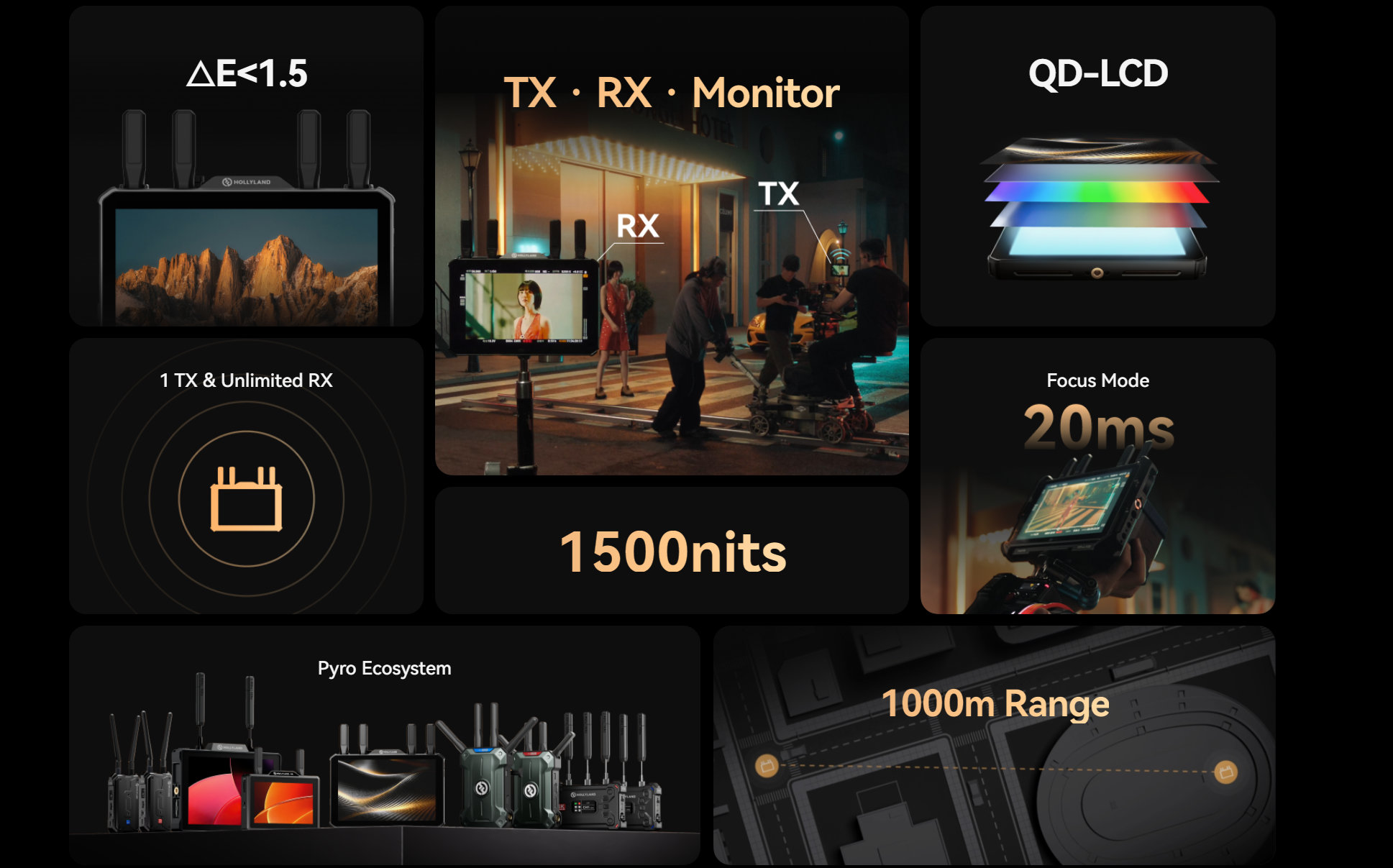
At its core, the Pyro 7 Ultra features a premium 7-inch QD-LCD display boasting a peak brightness of 1,500 nits, making it fully daylight-viewable. What sets it apart from typical high-brightness monitors, however, is its out-of-the-box color fidelity. Each unit is Calman pre-calibrated to achieve a Delta E ($Delta E$) of less than 1.5, covering 99% of the Rec.709 and 95% of the DCI-P3 color spaces.
On the wireless front, the Pyro 7 Ultra utilizes Hollyland’s proprietary Twin-WiFi (TWiFi) technology. Operating across both 2.4 GHz and 5 GHz bands simultaneously, the system delivers a transmission range of up to 1,000 meters (3,300 feet) with a latency of just 20 milliseconds in its specialized Focus Mode. Supporting cross-compatibility across the broader Pyro ecosystem, the monitor can act as either a transmitter or a receiver, facilitating seamless scalability on sets of any size.
Priced at $1,399 USD, the Pyro 7 Ultra enters the market not just as a tool, but as an infrastructure upgrade for independent productions and commercial film sets alike.
Detailed Chronology: The Evolution of On-Set Monitoring
To understand the engineering significance of the Pyro 7 Ultra, one must examine the chronological progression of wireless monitoring over the past two decades.
+-----------------------------------------------------------------------------+
|                                 CHRONOLOGY                                  |
+-----------------------------------------------------------------------------+
|                                                                             |
|  [2000s - Early 2010s]  --->  [Mid-2010s]          --->  [Late 2010s - 2020] |
|  The Analog & Early           The Modular                The Integrated     |
|  Digital Tether               Wireless Era               Revolution         |
|  • Heavy SDI/HDMI cables      • External Tx/Rx units     • SmallHD & Teradek|
|  • High physical risk         • Complex "director        • Proprietary,     |
|  • Limited mobility             cages" on set              high-cost links  |
|                                                                             |
|                                                                             |
|                               [Present Day]                                 |
|                               The Democratized Ecosystem                    |
|                               • Hollyland Pyro 7 Ultra                      |
|                               • Built-in QD-LCD, TWiFi, & Camera Control     |
|                               • Professional specs at accessible price      |
|                                                                             |
+-----------------------------------------------------------------------------+
The Analog and Early Digital Tether (2000s–Early 2010s)
In the early days of digital cinema, monitoring was strictly a wired affair. Heavy, shielded SDI cables snaked across studio floors, connecting cameras to bulky CRT or early LCD production monitors at the DIT cart. While reliable, this "tethered" workflow restricted camera movement, posed constant trip hazards, and slowed down setups during rapid location changes. Early wireless transmitters existed but were plagued by massive latency, low resolutions, analog interference, and high power consumption.
The Modular Wireless Era (Mid-2010s)
As digital wireless technology matured, standalone transmitters and receivers operating on uncompressed zero-latency bands became industry standard. However, this introduced a different kind of complexity. A typical "director’s monitor" setup resembled a complex science experiment: a third-party monitor bolted to a cage, with a wireless receiver strapped to the back, powered by a dual-NP-F or V-mount battery plate, and connected via fragile, right-angle HDMI or SDI patch cables. These rigs were heavy, prone to cable failure, and required tedious troubleshooting when the signal dropped.
The Integrated Revolution (Late 2010s–2020)
Recognizing the limitations of modular rigs, manufacturers began experimenting with integrated monitor-receivers. While these early attempts streamlined the physical footprint, they often forced filmmakers to choose between color accuracy and wireless performance. High-end integrated systems remained prohibitively expensive, costing several thousands of dollars per unit, which kept them out of reach for mid-tier and independent productions.
The Era of Democratized, High-Fidelity Ecosystems (Present Day)
The launch of the Hollyland Pyro series, culminating in the Pyro 7 Ultra, represents the current phase of this technological evolution. By integrating a highly accurate QD-LCD panel with dual-band, low-latency transmission hardware and software-driven camera control, Hollyland has consolidated the entire video pipeline into a single, cohesive unit. This chronological shift from heavy tethers to modular rigs, and finally to intelligent, unified ecosystems, highlights the industry’s demand for simplified on-set operations.
Supporting Context & Technical Metrics
The Pyro 7 Ultra’s capabilities are best understood through a technical analysis of its display technology, transmission physics, and software integration.
Quantum Dot LCD (QD-LCD) and Color Science
Traditional LCD monitors rely on white LED backlights filtered through red, green, and blue subpixels. This filtering process often results in broad, imprecise spectral peaks, leading to muted colors and limited color gamut coverage.
The Pyro 7 Ultra bypasses this limitation by incorporating a Quantum Dot enhancement film between the backlight and the LCD panel. When excited by blue LEDs, these microscopic semiconductor nanocrystals emit highly precise, saturated red and green light. The result is a dramatically wider color gamut and purer primary colors.
Traditional LCD:  [Blue LED] -> [Yellow Phosphor] -> [RGB Filters] -> Broad, Imprecise Spectra
Quantum Dot: [Blue LED] -> [Quantum Dot Film] -> [RGB Filters] -> Pure, Saturated Primaries- Color Gamut Coverage: 99% Rec.709 and 95% DCI-P3. This ensures that the monitor can display the rich, saturated tones required for modern HDR and cinema color grading workflows.
- Delta E ($Delta E$) < 1.5: Delta E measures the difference between a displayed color and its input target. A value below 2.0 is generally considered imperceptible to the human eye. With a factory-calibrated $Delta E < 1.5$, the Pyro 7 Ultra provides reference-grade color accuracy directly out of the box.
- Luminance: 1,500 nits of peak brightness allows crew members to accurately judge exposure, contrast, and composition under direct sunlight without the absolute necessity of a bulky sun hood.
- PC-Free Calibration: Over time, all LCD panels suffer from color drift. To address this, Hollyland introduced the "Hollyland Color Calibrator." This holistic solution allows users to recalibrate the screen directly on set without connecting the monitor to a computer or relying on expensive, complex third-party calibration software.
Transmission Physics: Twin-WiFi (TWiFi) Technology
Wireless video transmission on modern film sets is incredibly challenging. A typical set is saturated with radio frequency (RF) interference from wireless follow-focus systems, wireless DMX lighting controllers, crew mobile phones, and local Wi-Fi networks.
                       +-------------------------+
                       |  Pyro 7 Ultra (Tx Mode) |
                       +-------------------------+
                        /
        2.4 GHz Carrier /                          5.0 GHz Carrier
                       /
                      v                             v
             [Path A: Signal Packet]       [Path B: Signal Packet]
                                                   /
                                                  /
                        v                         v
                       +-------------------------+
                       |  Pyro 7 Ultra (Rx Mode) |
                       +-------------------------+
                       *Auto Frequency Hopping (AFH) reconstructs
                        the cleanest signal in real time.
To combat this, Hollyland developed Twin-WiFi (TWiFi) technology. Unlike standard single-band transmitters, TWiFi splits the video signal and transmits it simultaneously across both the 2.4 GHz and 5 GHz frequency bands.
- Dual-Path Redundancy: By sending redundant data packets over two separate frequencies, the receiver can seamlessly reconstruct the video stream even if one of the bands experiences severe interference or signal dropouts.
- Automatic Frequency Hopping (AFH): The Pyro 7 Ultra continuously scans the RF spectrum and automatically hops to the cleanest available channels without interrupting the video feed.
- Range and Latency Metrics: The system boasts a line-of-sight transmission range of up to 1,000 meters (3,300 feet). In Focus Mode, the system prioritizes transmission speed, dropping latency to an incredibly low 20ms—fast enough for focus pullers to confidently pull focus on fast-moving subjects.
- Broadcast Mode: In standard configuration, one Pyro transmitter can link with up to four discrete receivers. However, by enabling "Broadcast Mode," the transmitter can broadcast a 4K60 video signal to an unlimited number of receivers on set, catering to massive commercial productions with multiple monitoring stations (e.g., client monitor, makeup, hair, and script supervisor).
Hardware Interoperability & Camera Control
The Pyro 7 Ultra features both HDMI and 3G-SDI inputs and outputs, supporting loop-through and cross-conversion. This means an HDMI input can be output via SDI, and vice versa, eliminating the need for dedicated cross-converter boxes on the camera rig.
| Feature | Specifications / Supported Protocols |
|---|---|
| Display Panel | 7-inch QD-LCD |
| Peak Brightness | 1,500 Nits |
| Color Gamut | 99% Rec.709 / 95% DCI-P3 |
| Color Accuracy | Calman Pre-calibrated ($Delta E < 1.5$) |
| Wireless Range | 1,000 Meters (3,300 Feet) Line-of-Sight |
| Latency | Low as 20ms (Focus Mode) |
| Transmission Tech | Twin-WiFi (TWiFi) Dual-Band (2.4GHz + 5GHz) |
| Physical I/O | 3G-SDI In/Out, HDMI In/Out (Cross-conversion supported) |
| Max Resolution | Up to 4K at 60 frames per second |
| Operating System | HollyOS (With Waveform, Vector, False Color, 3D LUTs) |
| Camera Control | Select Sony, Canon, Nikon, and ARRI models |
Beyond video transmission, the monitor integrates physical camera control. By connecting the monitor to a compatible camera via a control cable, operators can access vital camera settings directly from the touch screen. This includes real-time adjustment of:
- Shutter Speed / Angle
- Aperture (Iris)
- ISO / Gain
- White Balance and Color Temperature
This integration is particularly beneficial for small crews, gimbal operators, and crane setups, where physically accessing the camera body to change a setting is difficult or time-consuming.
Official Statements & Strategic Analysis
The strategic launch of the Pyro 7 Ultra highlights a broader shift in Hollyland’s product development philosophy. Jay Sun, Product Manager at Hollyland, emphasized the critical nature of color fidelity in professional environments:
"For professional productions, an accurate monitor is essential because every department needs a reliable visual reference on set. Even minor color differences can affect decisions and create problems later in post-production. With Pyro 7 Ultra’s QD-LCD technology, crews can trust what they see during production with professional-grade color accuracy."
Sun’s statement gets to the heart of a major financial and operational pain point in filmmaking: color drift. When a director, cinematographer, and DIT are looking at different monitors with uncalibrated colors, critical decisions regarding lighting, exposure, and filtration are compromised.
For example, if a camera-top monitor displays a green tint that isn’t actually in the camera’s sensor data, the gaffer might compensate by adding magenta gel to the lights. This incorrect adjustment is then baked into the raw footage, forcing colorists to spend valuable hours in post-production correcting mistakes that could have been avoided with an accurate on-set reference.
Uncalibrated Monitor -> Displays False Green Tint -> Gaffer Adds Magenta Gel -> Baked-In Error -> Costly Post-Production Correction
Calibrated Pyro 7 Ultra -> Displays True Color -> Accurate Lighting Decisions -> Clean Raw Footage -> Fast, Creative Color Grading
By guaranteeing a pre-calibrated $Delta E < 1.5$ and providing a simple, PC-free calibration tool, Hollyland is democratizing the role of the DIT. They are placing high-end color science—previously restricted to elite, expensive production monitors—into an affordable, rugged, and mobile package.
Future Outlook
The introduction of the Pyro 7 Ultra is set to accelerate several key trends in the cinema and television production industries.
The Rise of Unified Ecosystems
The Pyro 7 Ultra is not a standalone product; it is designed as a core node within the broader Hollyland Pyro ecosystem. The ability to seamlessly pair the Pyro 7 Ultra with Pyro H, Pyro S, and future wireless transmitter/receiver systems ensures that production companies can scale their gear package as their needs grow. This cross-compatibility prevents "vendor lock-in" and protects the user’s long-term hardware investment.
The Transition to IP-Based Workflows
As wireless protocols continue to advance, we are witnessing a convergence of traditional RF wireless video and IP-based streaming. The integration of HollyOS within the Pyro 7 Ultra hints at a future where monitors are not just passive receivers, but active network devices. We can foresee future firmware updates or iterations of the Pyro line incorporating direct-to-cloud proxy uploading, real-time remote editing collaboration, and integration with Frame.io or other Camera-to-Cloud (C2C) platforms.
The Democratization of High-End Tech
Historically, uncompressed, zero-latency wireless systems and reference-grade monitors were rented, not owned, by mid-tier filmmakers due to their high capital cost. At $1,399 USD, the Pyro 7 Ultra challenges this dynamic. By making broadcast-grade monitoring and transmission accessible to owner-operators, boutique production houses, and independent filmmakers, Hollyland is leveling the playing field.
Ultimately, the Pyro 7 Ultra is more than just a combination of a screen and an antenna. It is an elegant solution to some of the most persistent logistical challenges on set. By unifying color accuracy, range, latency, and system control, Hollyland has delivered a tool that allows filmmakers to focus less on troubleshooting their hardware and more on the creative process of visual storytelling.