Executive Overview
Public data has consistently signaled a resounding public rejection of artificial intelligence in news consumption. Despite this, Silicon Valley venture capitalists and tech startups continue to chase the mirage of automated broadcasting. The latest incarnation of this ambition comes from Mirage, the AI startup recognized for its popular video-editing application, Captions. Fresh off a $75 million funding round that valued the company at a staggering $500 million, Mirage launched a high-profile, daylong experiment known as the "Mirage News Network."
Costing approximately $50,000 to execute, the 24-hour livestream featured artificially generated anchors reading real-world news stories compiled from wire services. While the broadcast pulled in modest viewership and generated considerable debate across social media, it laid bare a profound philosophical and operational schism between Silicon Valley technologists and the traditional journalistic establishment.
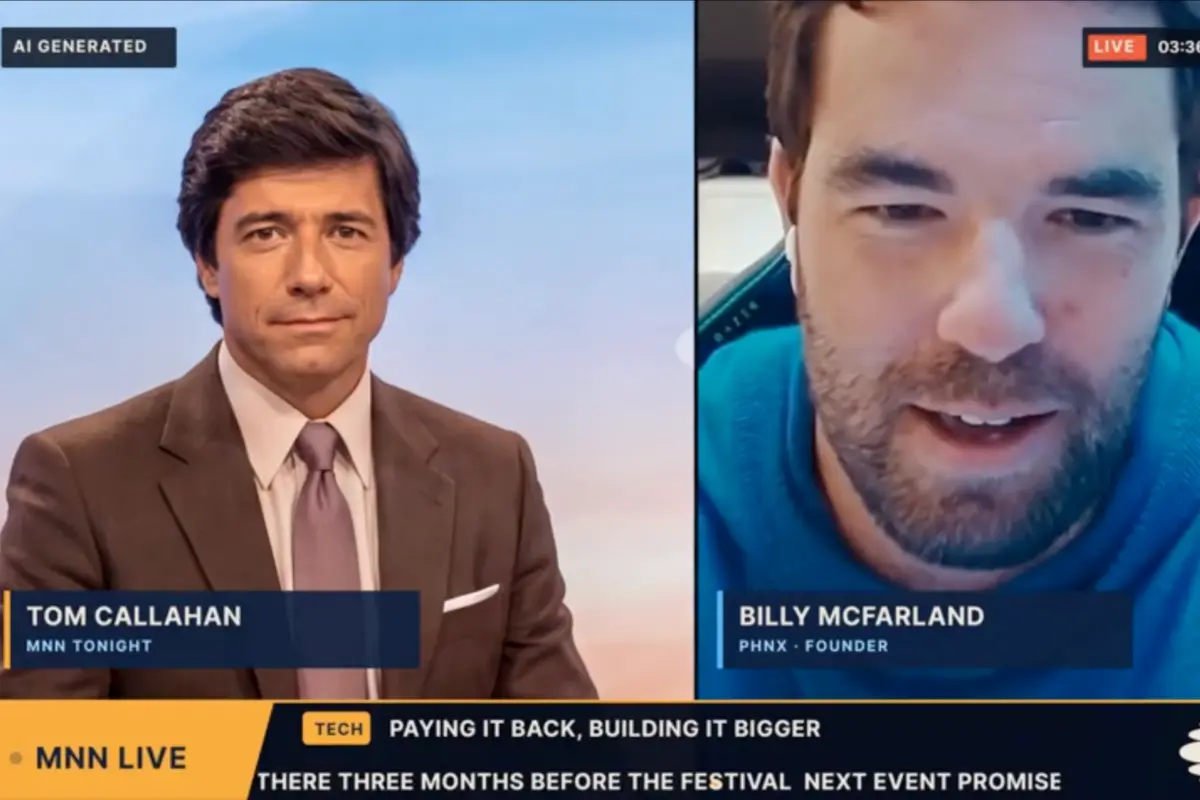
Promoted heavily on X (formerly Twitter) through paid placements and artificial avatars with 1980s aesthetic sensibilities—complete with names like "Tom Callahan" and "Marcus Sterling"—the project sought to answer a provocative question: Is there an unserved appetite for a newscast where everything except the underlying facts is manufactured by machines?
To critics, trade organizations, and veteran journalists, the endeavor was not a pioneering step forward, but rather a misguided devaluation of editorial expertise and a dangerous erosion of human connection. As media organizations grapple with rapid technological changes, the Mirage experiment serves as a major flashpoint in the ongoing debate over automation, credibility, and the definition of truth in the digital age.
Detailed Chronology: Anatomy of a 24-Hour AI Broadcast
The conceptualization, execution, and aftermath of the Mirage News Network unfolded with the speed characteristic of modern software development, bypassing the deliberate, methodical safeguards typical of legacy broadcasting.
Building the Network in Days, Not Decades
The entire enterprise was conceived, built, and managed almost single-handedly by Mirage CEO Gaurav Misra. Utilizing approximately $30,000 worth of Claude Code, Misra engineered a complex pipeline that married various generation models to produce a continuous news stream.
The anchors themselves were products of Mirage’s proprietary Avatar X model. Their scripts were supplemented by ChatGPT’s image generator for graphic assets and Google’s Gemini Text-to-Speech engine for voice modulation. To populate the broadcast with content, Mirage licensed days-old stories from Reuters’ wire service. The only tangible human elements on screen were the subjects captured in Reuters’ original B-roll footage and stock packages.
The "Guest" Roster and AI Interviews
To mimic the interactive nature of a traditional cable news segment, Mirage integrated artificial interview segments. Rather than using completely fabricated personas for these guests, the company recruited more than a dozen real people—predominantly venture capital professionals—who authorized their likenesses and approved the scripts read by their digital avatars.
Among the more surreal moments of the broadcast was the inclusion of Billy McFarland, the infamous founder of the disastrous Fyre Festival, whose digital likeness appeared to discuss current events after securing an early release from federal prison.
Broadcast Reality and Algorithmic Errors
The livestream went live on a Tuesday, reaching a total of 50,000 viewers on X. Its primary promotional post amassed over 824,000 impressions, sparking reactions that ranged from intellectual curiosity to severe critique.
However, the rapid deployment of automated tools yielded predictable structural and factual failures. Most notably, the AI broadcast incorrectly identified a woman featured in a Reuters package as then-President Donald Trump. While Mirage disclosed these errors on its X account after the fact, the corrections were not integrated into the live broadcast loop in the manner expected of professional newsrooms. Misra monitored the stream hours ahead of broadcast to catch glaring anomalies, but the live environment proved too dynamic for static guardrails.
The internal ethos of the project was perhaps best summarized by Mirage software engineer Jason Silberman, who wrote on X: "When the CEO starts tokenmaxxing too hard and spends $50k in a day on a marketing stunt." The term "tokenmaxxing"—maximizing AI token usage and treating raw computational volume as proof of corporate productivity—encapsulated the engineering-first mindset that drove the stunt.
Supporting Context & Metrics: Public Skepticism Versus Tech Ambition
The launch of the Mirage News Network sits in stark contrast to empirical data regarding how consumers actually perceive and interact with AI-generated information. While tech executives champion automation as a democratization of content creation, media consumers remain deeply distrustful.
The Gallup and Pew Data Divide
Data from a May Gallup survey paints a grim picture for AI-delivered news. Only 7% of Americans indicated they rely either "a great deal" (2%) or "a fair amount" (5%) on AI to source their news. Conversely, nearly 40% of respondents stated that a news organization’s use of artificial intelligence would actively reduce their trust in the reported information.
These findings mirror broader societal trends identified by the Pew Research Center. Studies examining audience interactions with AI chatbots revealed that nearly 60% of adults aged 18 to 29, and 51% of adults aged 30 to 49, believe that at least some of the news produced by automated models is inaccurate. Furthermore, Pew’s research indicates that 40% of Americans believe the broader societal impact of AI will ultimately be negative.
The Background of the Technologists
The ideological divide is further widened by the professional backgrounds of those building these platforms. Gaurav Misra’s professional history is rooted in software engineering at major tech firms like Snap and Microsoft, rather than investigative journalism or editorial management.
When asked about the ethical framework governing the broadcast, Misra noted that the machine was instructed to adhere to "general journalistic standards" rather than codified industry bibles such as the Associated Press (AP) stylebook or the Society of Professional Journalists (SPJ) Code of Ethics. The project was constructed by a lean team of fewer than ten individuals, none of whom possessed long-term institutional experience in the news media sector.
Official Statements and Industry Pushback
The Mirage News Network drew swift, sharp condemnation from professional journalism bodies and ethics watchdogs who viewed the experiment as a threat to the fundamental integrity of information dissemination.
The Society of Professional Journalists Responds
Dan Axelrod, a former journalist who chairs the SPJ’s ethics committee, pulled no punches when evaluating the project. Axelrod categorized the endeavor not as a legitimate news network, but as a "news delivery project" that failed to add genuine value to the public marketplace.
"Nobody says, ‘Let me go do my own surgery,’" Axelrod remarked during discussions surrounding the project. "Few people say, and many immediately come to regret it, ‘Let me defend myself in court.’ Everybody thinks they can communicate, or be the best communicator, or be the best storyteller, and they don’t take into account all of the training and all of the experiential learning and all of the ethical guidance that a high-level professional journalist follows."
Axelrod emphasized that journalistic credibility hinges on a foundational social contract: the promise that a human being endowed with professional judgment, empathy, and accountability stands behind the reporting.
"We watch it to see and feel the things that other humans see and feel," Axelrod added. "And that goes for the journalists, not just the people covered in the stories."
The Ethics Committee Adjusts for the AI Age
In response to the proliferation of automated content generation, the SPJ ethics committee has introduced draft revisions to its Code of Ethics. These proposed updates are specifically designed to press modern journalists to maintain strict accountability, transparency, and editorial oversight as emerging technologies alter the media landscape.
While Mirage maintained a degree of on-screen transparency—utilizing a graphic in the top-left corner to indicate that anchors, interviews, and commercials were artificially generated—critics argue that visual disclaimers do not absolve creators of the responsibility to verify facts, contextualize events, and respect the human labor embedded in original reporting.
Future Outlook: Is Automated News Inevitable?
Despite the technical errors, high costs, and widespread skepticism, Mirage CEO Gaurav Misra views the $50,000 experiment as a proof-of-concept for an inevitable future.
The Tech Executive’s Perspective
Initially tackling news because he believed it was one of the few industries resistant to AI replication, Misra now argues that AI-generated newscasts are coming. His reasoning is rooted in the machine’s perceived neutrality:
"The goal of this was not exactly to be the news or to fool anybody, or to pretend to look real," Misra stated. "In fact, the goal was to make sure that people know that this is AI-generated. That was the most important part."
Misra contends that AI models excel at "stating the facts" in a manner that avoids editorial bias or loaded commentary—a trait he believes appeals to audiences fatigued by polarized media environments. Describing his own news consumption habits as a mix of television clips, Google News aggregations, and TikTok, Misra envisions a media ecosystem where everyday consumers prefer synthetic avatars for a fresh stylistic angle, lowering the barriers to entry for independent content creators.
The Permanent Value of Human Judgment
Yet, as the media industry looks ahead, the tension between algorithmic efficiency and human craftsmanship remains unresolved. Silicon Valley continues to view news as a delivery problem to be solved through code and token optimization, while traditional journalists view news as a relational trust to be cultivated through lived experience, ethical accountability, and moral courage.
As the AI avatar "Stephanie Kwan" queried during a Mirage segment covering robot dogs replacing security guards in Atlanta—"So why swap out the humans?"—the question lingers over the entire tech sector. For now, the public data suggests that audiences are not asking for synthetic replacements. Until technologists bridge the chasm between raw computational output and genuine human empathy, projects like the Mirage News Network will remain expensive experiments searching for an audience that refuses to log on.