Executive Overview
For the better part of three decades, the foundational playbook of Silicon Valley enterprise software was clear, rigid, and wildly successful. The archetype went something like this: A visionary founder builds an early iteration of a product. Soon after, venture capitalists and corporate boards step in to install a hardened "operator"—a seasoned executive whose primary currency is scale, market penetration, and aggressive sales execution. This executive implements a disciplined, unyielding sales machine, transforming a raw technology asset into a multi-billion-dollar enterprise.
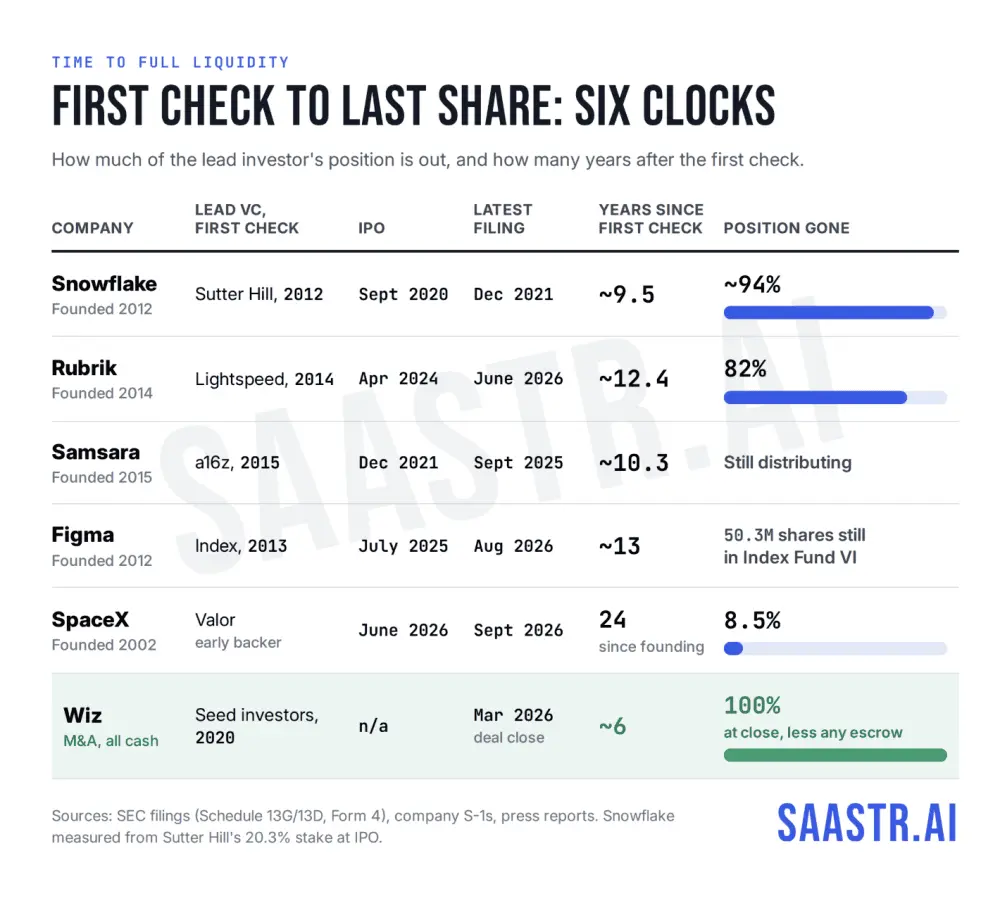
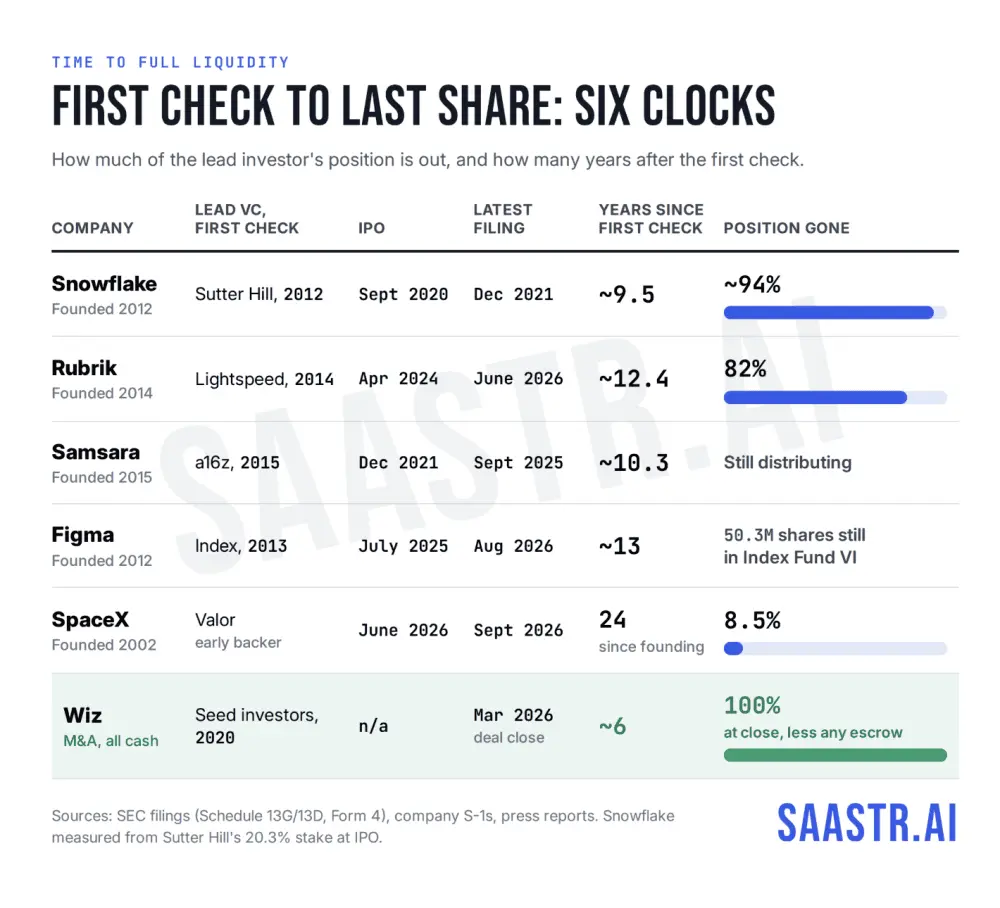
Frank Slootman remains the undisputed archetype of this era. As the only CEO in history to take three enterprise software companies public—Data Domain, ServiceNow, and Snowflake—Slootman’s legacy is synonymous with top-down commercial dominance. At their peaks, those three entities commanded a staggering combined valuation exceeding $200 billion.
Yet, looking at the crop of the fastest-growing B2B and AI enterprises today—including powerhouses like Databricks, Replit, Harvey, Fireworks AI, Sierra, Decagon, Abridge, and OpenEvidence—a striking reality emerges: the career sales operator who ascends straight to the corner office has become an anomaly.
The industry is undergoing a structural shift. The modern enterprise software and AI landscape is no longer driven by executives who cut their teeth carrying a bag or running regional sales quotas. Instead, it is being shaped and steered by technical founders, researchers, and domain experts who approach commercial growth not as a brute-force human machinery problem, but as an engineering challenge.
Detailed Chronology: The Evolution of Enterprise Leadership
To understand how the software industry arrived at this pivot point, it is instructive to examine the historical trajectory of enterprise leadership and the quiet nuances of its supposed legends.
The Myth of the "Sales-First" CEO
For twenty years, the prevailing corporate lore held that scaling an enterprise software firm required a leader whose background was steeped in revenue generation. However, a closer look at the resumes of legendary operators complicates this narrative.
Take Frank Slootman himself. Despite his reputation as the ultimate commercial scaler, Slootman never actually carried a bag. He entered Compuware in 1993 as a product manager, directed UNIFACE in Amsterdam as a General Manager, and subsequently ran the EcoSystems division in Campbell. From 2000 to 2003, he served as Senior Vice President of Products at Borland, overseeing the engineering and product management functions directly before securing his first CEO seat. There is no Vice President of Sales or Chief Revenue Officer (CRO) role on his resume; his commercial reputation was forged by how he orchestrated organizational execution, not by how he climbed through field sales.
Marc Benioff of Salesforce fits the traditional sales archetype more cleanly, boasting thirteen years at Oracle spanning sales, marketing, and product. Yet, Benioff’s roots are equally technical: he founded Liberty Software at age 15, writing and selling Atari games, and later wrote assembly code within Apple’s Macintosh division during his college years.
The Great Divergence: 2016 to the Present
The turning point for modern enterprise leadership crystallized in the mid-2010s, specifically highlighted by diverging paths taken by foundational data giants.
In January 2016, Databricks faced a severe existential crisis. Having raised approximately $174 million at a roughly $1 billion valuation, the company suffered from near-zero revenue growth while heavyweights like AWS and Cloudera aggressively absorbed Apache Spark into their own ecosystems. Founding CEO Ion Stoica agreed to step aside to return to his professorship at UC Berkeley.
The conventional playbook dictated bringing in a seasoned Silicon Valley sales operator—the exact strategy Snowflake executed on its path to a $33 billion IPO. Instead, Databricks’ co-founders advocated for Ali Ghodsi, then Vice President of Engineering, a career academic who had never run a business. Early venture investors initially balked at the idea of swapping one academic founder for another. However, after a trial period, Ghodsi proved them wrong. Today, Databricks stands as a monumental enterprise, cementing its valuation in the stratosphere while growing at a blistering pace, completely redefining what a technical CEO can achieve at scale.
Conversely, Snowflake’s leadership transition in early 2024—when Slootman retired and Sridhar Ramaswamy stepped into the role—initially triggered a 20% stock drop as Wall Street panicked over the loss of a proven sales maven. Yet, Ramaswamy, a computer scientist who previously scaled Google’s advertising business from $1.6 billion to over $100 billion, did not falter. He simply approached the sales organization as an engineering problem, restructuring the commercial engine to be AI-native and driving record sequential dollar growth and expanding Net Revenue Retention rates.
Supporting Context & Metrics: The Numbers Behind the Shift
Recent proprietary data from venture capital indices, such as Leonis Capital’s comprehensive tracking of over 10,000 AI startups between 2022 and 2025, provide empirical weight to this structural transformation.
1. The Dominance of the Technical CEO
Across the 100 fastest-growing AI-native companies indexed by Leonis:
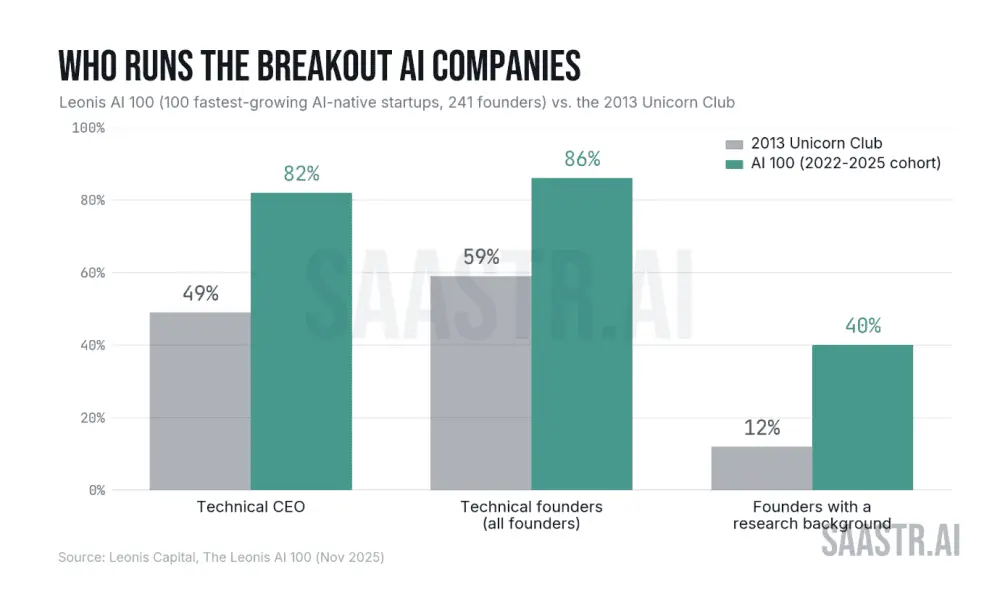
- 82 out of 100 are led by technical CEOs.
- 208 out of 241 founders (86%) possess a technical background.
- By contrast, Aileen Lee’s original "Unicorn Club" index from a decade prior featured just 49% technical CEOs and 59% technical founders.
2. Research Pedigree and Youth
The research pedigree of today’s founders has similarly exploded:
- 40% of AI 100 founders boast an active research background, compared to just 12% in the legacy Unicorn Club.
- 58% of these modern companies feature at least one co-founder originating directly from institutional research—including Berkeley PhDs, DeepMind and OpenAI alumni, and international olympiad medalists.
- Furthermore, these leaders are significantly younger. The median age at founding for the AI cohort is 29, compared to 34 in the previous cycle, with the single most common founding ages resting at 26 and 27. These founders transition straight from the lab to the boardroom, bypassing a decade-long climb through middle management.
3. The Pivot Velocity Gap
Speed is the ultimate competitive advantage in an era where foundational AI model capabilities shift quarterly. According to data metrics:
- Two-thirds of the AI 100 cohort pivoted their business models at least once, compared to 54% of legacy unicorns.
- Researcher-led teams executed pivots in a median time of 12 months, compared to 18 months for non-researcher teams.
- Companies helmed by technical CEOs pivoted in a median of 12 months, whereas firms led by non-technical CEOs took a sluggish 27 months.
In an ecosystem where entire software categories can be rendered obsolete overnight by a single model release, a 15-month lag in strategic pivoting is an insurmountable handicap.
Official Statements and Industry Perspectives
The debate over whether operators or engineers make superior leaders has drawn sharp commentary from industry titans who have witnessed both eras firsthand.
Venture capitalist Ben Horowitz, an early investor and board member in companies like Databricks, initially doubted Ali Ghodsi’s appointment as CEO, questioning the wisdom of substituting one professor for another. Yet Horowitz has since reversed his stance entirely, frequently citing Ghodsi as the single best-performing CEO across Andreessen Horowitz’s sprawling portfolio of hundreds of companies.
Conversely, exponents of the traditional commercial model argue that the ultimate sales engine remains undefeated. ServiceNow CEO Bill McDermott—whose career spans executive leadership roles at Xerox, Gartner, Siebel, and SAP—continues to put up staggering numbers. Following ServiceNow’s Q2 2026 earnings report, which highlighted subscription revenues surging 24.5% year-over-year to nearly $3.9 billion and AI annual contract values crossing the $1 billion milestone, McDermott defended the traditional commercial playbook in a statement to Fortune: "We are who we said we were."
Even so, market reactions illustrate a profound recalibration. Despite posting a stellar quarter and maintaining the elite "Rule of 56" metric, ServiceNow’s valuation has faced downward pressure, reflecting a broader market shift where investors increasingly prioritize foundational technological differentiation over sheer distribution multiplier effects.
Frank Slootman himself has offered a pragmatic acknowledgement of the changing tides. Rather than resisting the shift, Slootman participates in it as an angel investor in Fireworks AI—a venture founded by the former head of PyTorch at Meta. The old guard is not fighting the engineering-led wave; they are underwriting it.
Future Outlook: What This Means for Founders, Boards, and Sellers
As the enterprise software ecosystem matures past the initial Gold Rush of generative AI, the structural relationship between technology and go-to-market execution is permanently altered. Several key implications emerge for the future of tech leadership:
1. For Founders Considering Leadership Transitions
The dramatic 12-versus-27-month pivot velocity gap proves that a CEO who cannot directly evaluate a technical model release is fundamentally disadvantaged. Bringing in an external non-technical operator too early risks widening the gap between product vision and market reality. Founders must either cultivate deep technical literacy to evaluate model shifts firsthand or ensure their co-founders retain strategic authority over product direction.
2. For Boards Managing CEO Successions
The successes of Databricks and Snowflake demonstrate that technical leaders can successfully master commercial execution. When promoting an engineer or researcher to the corner office, boards must mandate that they own the revenue metric directly. Being technical does not excuse a CEO from solving commercial problems; rather, it empowers them to reconstruct the sales apparatus into a modern, data-driven engine.
3. For Enterprise Sales Leaders
The role of the Chief Revenue Officer remains vital, but the nature of the career path has evolved. While companies like Anthropic, OpenAI, and Replit continue to scale massive go-to-market organizations numbering in the hundreds or thousands, these departments now report to technical CEOs. Aspiring enterprise sellers who dream of the corner office would do well to study the authentic paths of leaders like Slootman and Benioff—stepping out of pure field sales to spend years owning product lines, understanding engineering realities, and mastering the underlying technology before attempting to scale it to the world.