The global landscape of digital piracy enforcement is undergoing a paradigm shift, characterized by coordinated, multi-jurisdictional strikes against large-scale unauthorized streaming operations. In the crosshairs of this modern enforcement wave are Kemo IPTV and Lemo TV, two prominent internet protocol television services that have long operated in the gray areas of digital distribution.
The alleged primary operator of these services, Ammar Towir, is currently fighting a two-front legal war that spans continents. While defending against a massive civil copyright infringement lawsuit in a U.S. federal court brought by broadcasting giant DISH Network, Towir simultaneously faces severe criminal prosecution in Dubai. The latter action was triggered by a formal complaint from the Alliance for Creativity and Entertainment (ACE), the world’s leading anti-piracy coalition, representing major Hollywood studios and streaming giants including Apple, Disney, Netflix, and Amazon.
This high-stakes legal drama recently intersected when a U.S. federal judge in Florida dealt DISH Network a procedural setback, denying the broadcaster’s request for a staggering $28.65 million default judgment. The court ruled that DISH failed to adequately prove proper service of process on the defendants. However, the ensuing court filings have blown the lid off a broader international investigation, exposing how global media conglomerates are leveraging local law enforcement agencies—ranging from the Dubai Police to specialized cybercrime units—to dismantle the infrastructure of commercial piracy syndicates.
As the legal maneuvers unfold in both Florida and the Middle East, the case serves as a watershed moment for the IPTV industry. It underscores the mounting perils faced by operators who attempt to hide behind complex webs of shell companies, international jurisdictions, and nominal resellers, only to find that global media alliances can pierce corporate veils and initiate criminal proceedings across international borders.
Detailed Chronology of a Transnational Legal Conflict
The unfolding saga of Kemo IPTV and Lemo TV is a masterclass in modern intellectual property litigation, involving complex cross-border coordination, digital forensics, and procedural hurdles.
The Genesis of the U.S. Lawsuits
The seeds of the current legal battle were planted when DISH Network, a frequent litigator in the war against unauthorized streaming, set its sights on the infrastructure powering Kemo IPTV and Lemo TV. Last October, DISH filed a comprehensive civil lawsuit in a U.S. federal court. The complaint targeted not only the alleged masterminds behind the dominant streaming brands but also secondary actors, including Florida-based reseller entity "1 Dollar IPTV," which allegedly acted as a commercial conduit for the service.
The legal strategy followed a familiar blueprint: identify the domain registrars, payment processors, and hosting providers associated with the services, tie them to real-world identities, and hit the operation with damages severe enough to permanently shutter the business. Initially, the litigation moved swiftly. When none of the named defendants entered an appearance or responded to the formal allegations within the mandated statutory windows, DISH moved for a default judgment. By March, the broadcaster formally requested a massive $28.65 million payout, signaling to the industry that operating unauthorized IPTV services carries catastrophic financial consequences.
The Florida Federal Court Rebuff
For months, it appeared the lawsuit would conclude in a swift, unilateral victory for DISH Network. That illusion shattered in September when Ammar Towir, identified by DISH as the owner and operator of the core Kemo and Lemo infrastructure, broke his silence. Towir formally petitioned the U.S. District Court to set aside the default judgment, asserting a fundamental defense: he had never been properly served under international law.
Towir maintained that he resided in Dubai, United Arab Emirates, rather than the Malaysian residential address where DISH’s legal notices had supposedly been delivered. DISH countered aggressively, pointing to an extensive paper trail linking Towir directly to the domain renewals, financial accounts, and administrative control panels of the pirate services.
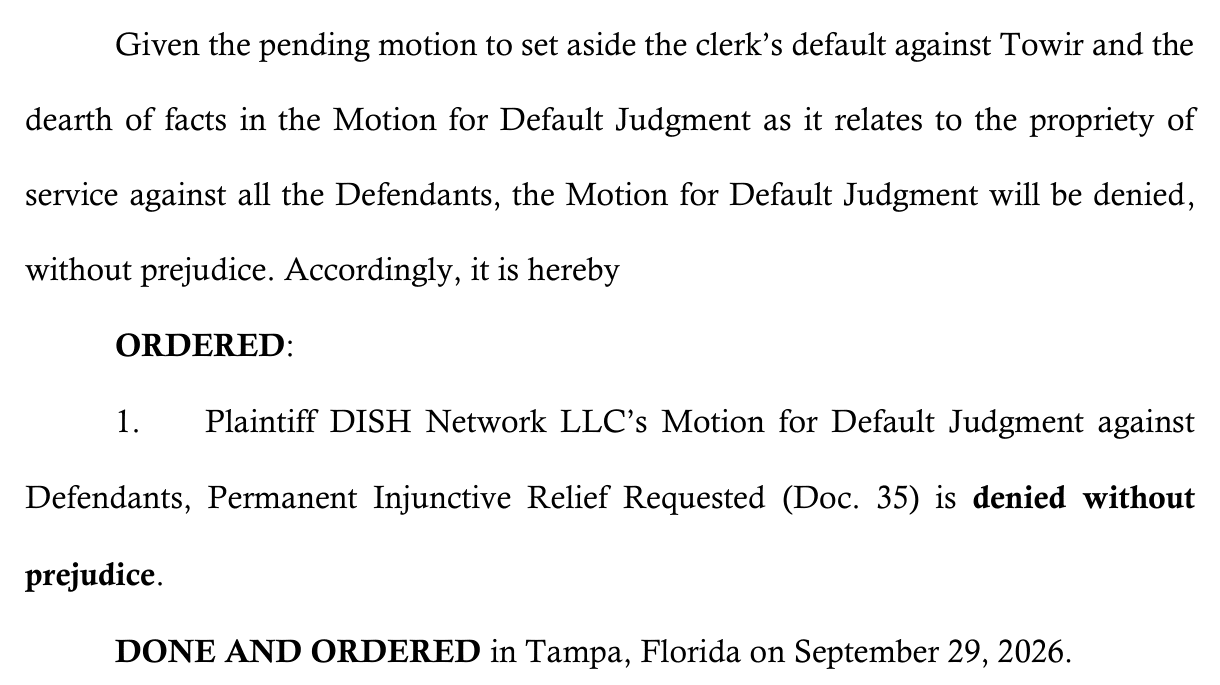
However, U.S. District Judge Charlene Edwards Honeywell sided with the defense on procedural grounds. In her ruling, Judge Honeywell denied DISH’s $28.65 million default judgment motion without prejudice, noting a critical flaw in the broadcaster’s filings. The judge emphasized that DISH had merely asserted that proper service had been executed without providing the necessary factual backing or citations to Malaysian legal authority to validate the method of service used.
While DISH was granted the opportunity to refile its motion once the service of process is legally verified—a matter now before a magistrate judge—the ruling marked the second major setback for the broadcaster’s anti-piracy campaign this year. Earlier in March, a California federal court dismissed a related $25 million lawsuit filed by DISH against UK-based hosting provider Innetra, citing a lack of personal jurisdiction.
The Dubai Criminal Probe Surfaced
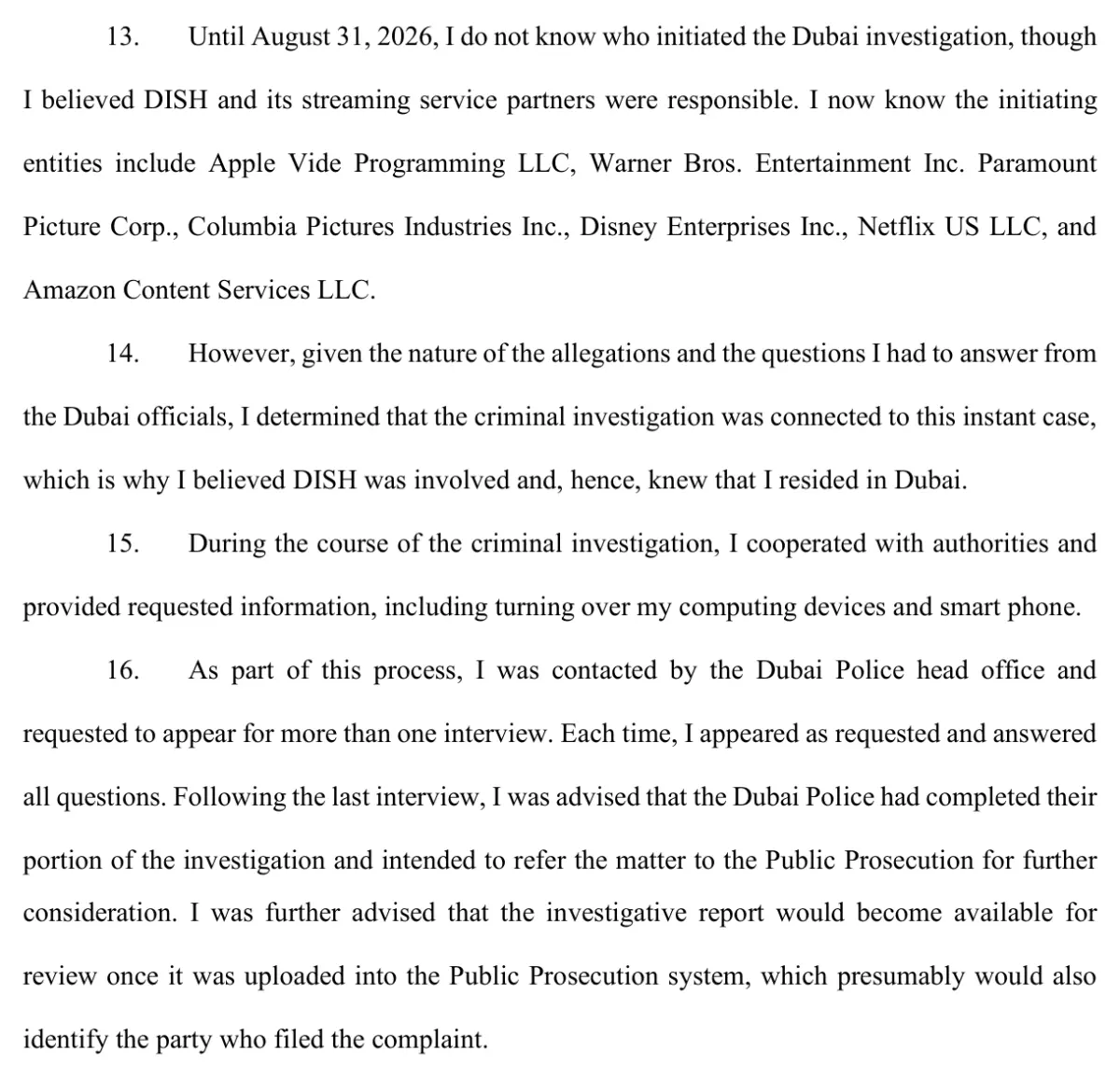
While the procedural chess match played out in Florida, Towir’s court filings revealed a far more ominous development unfolding in the Middle East. Explaining his initial failure to respond to the U.S. litigation, Towir stated that he was completely consumed by an unfolding criminal investigation in Dubai.
Initially operating under the assumption that DISH Network had instigated the Middle Eastern action, Towir eventually discovered that the criminal complaint had been filed by an altogether different entity: the Alliance for Creativity and Entertainment (ACE). This revelation transformed a standard civil copyright dispute into an international criminal proceeding, highlighting the multi-layered strategy deployed by content owners to neutralize major piracy networks.
Supporting Context, Evidence, and Metrics
The courtroom sparring matches in both the United States and Dubai offer a rare, transparent look into the mechanics of modern digital piracy operations and the rigorous forensic evidence required to dismantle them.
Unraveling the Financial and Technical Footprint
In its opposition briefs against Towir’s motion to set aside the default, DISH Network presented a compelling mosaic of digital evidence designed to tie the defendant directly to the enterprise. Rather than relying solely on circumstantial assumptions, the broadcaster’s legal team compiled financial records, registrar data, and digital identifiers:
PayPal Accounts: Investigators unearthed PayPal records explicitly listing Ammar Towir as the verified owner and beneficiary of accounts operating under commercial designations such as "KEMO IPTV" and "KEMO E MARKETING SDN. BHD."
Registrar and Hosting Records: Credit card payment trails linked directly to Towir were deployed to pay for the Namecheap accounts used to register and routinely renew critical domain names, including kemoiptv.com and lemotv.com.
Wholesale Defense vs. Direct Operation: In his defense declarations, Towir offered a nuanced counter-narrative. He acknowledged that he participated in commercial transactions involving the purchase of streaming inventory from an upstream wholesaler for resale to customers outside the United States. However, he fiercely denied that these specific business dealings had any connection whatsoever to Kemo IPTV or Lemo TV—a defense that DISH has continuously rejected as an implausible fabrication given the overlapping financial paperwork.
The Global Scope of ACE’s Enforcement Machinery
The involvement of the Alliance for Creativity and Entertainment (ACE) in the United Arab Emirates illustrates the coalition’s expanding international reach. Formed in 2017 by leading media companies, ACE combines the legal resources, investigative manpower, and intelligence networks of global powerhouses like Amazon, Apple, Columbia Pictures, Disney, Metro-Goldwyn-Mayer, Netflix, Paramount, Sony Pictures, Universal Studios, and Warner Bros. Discovery.
The timeline of the enforcement actions underscores the careful synchronization required to target transnational operations:
April 2025: DISH initiates its legal pressure against Lemo and Kemo with an initial filing in a Texas federal court.
July 2025: ACE files a formal criminal complaint in Dubai against Ammar Towir, nearly three months prior to DISH’s Florida filing. This timing suggests that preliminary findings from early U.S. discovery or independent coalition intelligence directly informed the decision to escalate the matter to Dubai law enforcement.
Late 2025: Following a thorough intake review by specialized law enforcement units, the Dubai Public Prosecutor formally refers the criminal case to the Dubai Criminal Court, where it remains active and pending.
Official Statements and Interoperable Enforcement
The convergence of civil litigation and criminal enforcement highlights a unified front among content creators and broadcast distributors. While civil actions seek to recover astronomical statutory damages and secure asset freezes, criminal referrals aim to impose personal liberty restrictions and tangible deterrents on operators who believe they can hide behind foreign borders.
When contacted for comment regarding the Dubai proceedings, an ACE spokesperson provided explicit confirmation of the coalition’s role:
"We can confirm that ACE is behind the complaint filed in Dubai in late July 2025 against the alleged operator of the Kemo Lemo IPTV service, Mr. Ammar Towir. The matter was subsequently referred to a specialized law enforcement unit."
ACE further verified that the Public Prosecutor elevated the investigation to the Dubai Criminal Court, moving the case closer to a definitive judicial verdict. Because the proceedings are actively ongoing, coalition representatives have exercised discretion regarding further public disclosures. However, the legal footprint left by the defendant provides vivid details of the enforcement actions on the ground in the UAE.
According to court filings submitted by Towir, his interaction with local authorities has been exhaustive and restrictive. The alleged IPTV operator stated that he was subjected to multiple rigorous interrogations by the Dubai Police, during which he was compelled to surrender electronic devices, including computers and a smartphone, for digital forensic analysis.
Furthermore, Towir noted that he has been subjected to a strict travel ban—an administrative measure automatically triggered upon the filing of criminal complaints in the jurisdiction. In his declaration, Towir remarked on the compounding nature of the legal pressure:
"Interestingly enough, as the travel ban that is automatically instituted when a criminal complaint is filed in Dubai was about to expire, another criminal complaint was filed against me further prohibiting me from traveling."
This legal strategy effectively anchors the defendant within the jurisdiction of the court, ensuring that he remains available to face local prosecution and cannot flee to more permissive regulatory environments.
Future Outlook: The Evolving Battlefield of IPTV Piracy
The dual-front legal battle facing the operators of Kemo IPTV and Lemo TV establishes several critical precedents for the future of digital copyright enforcement:
The Obsolescence of Geographic Arbitrage: Historically, operators of unauthorized streaming services believed that basing their physical bodies in jurisdictions with complex extradition treaties or distinct legal frameworks would shield them from Western copyright judgments. The Kemo/Lemo case demonstrates that major entertainment conglomerates can successfully partner with local authorities in regional hubs like Dubai to initiate criminal proceedings, rendering geographical distance an increasingly ineffective shield.
The Resilience and Mutation of Pirate Networks: Despite the massive legal pressure, criminal investigations, and civil lawsuits, the resilience of commercial piracy networks remains striking. Evidence from ongoing monitoring reveals that at least one storefront associated with the Kemo ecosystem—operating under the domain kemoiptv.io—continued to offer active subscriptions to consumers, even as domains were targeted for seizure and operators faced criminal prosecution. This highlights the hydra-like nature of IPTV operations, where new domains can be rapidly spun up to replace compromised infrastructure.
Procedural Rigor in Transnational Litigation: DISH Network’s recent setback in Florida underscores that courts will not bypass fundamental due process requirements, even when dealing with alleged industrial-scale copyright infringements. Broadcasters and anti-piracy coalitions must ensure meticulous compliance with international service treaties—such as the Hague Convention or applicable bilateral mechanisms—to secure enforceable judgments that can withstand appellate scrutiny.
As the magistrate judge reviews the questions of service of process in the Florida federal court, and as the Dubai Criminal Court prepares to adjudicate the charges brought by ACE, the ultimate fate of Ammar Towir hangs in the balance. For the broader IPTV ecosystem, the message is unmistakable: the walls are closing in, and the alliance between civil litigants and international law enforcement agencies is forging an increasingly inescapable net for commercial pirates worldwide.