Executive Overview
As every new Premier League season kicks off, it is accompanied by a familiar ritual: high-profile warnings detailing the sweeping economic damages of digital piracy. This year, the anti-piracy landscape sees the return of BeStreamWise—a heavily backed coalition comprising heavyweights such as Sky, the Premier League, FACT (formerly the Federation Against Copyright Theft), the BBC, and the UK Intellectual Property Office. To mark the occasion, the campaign released a flagship report this week entitled "The Price of Piracy."
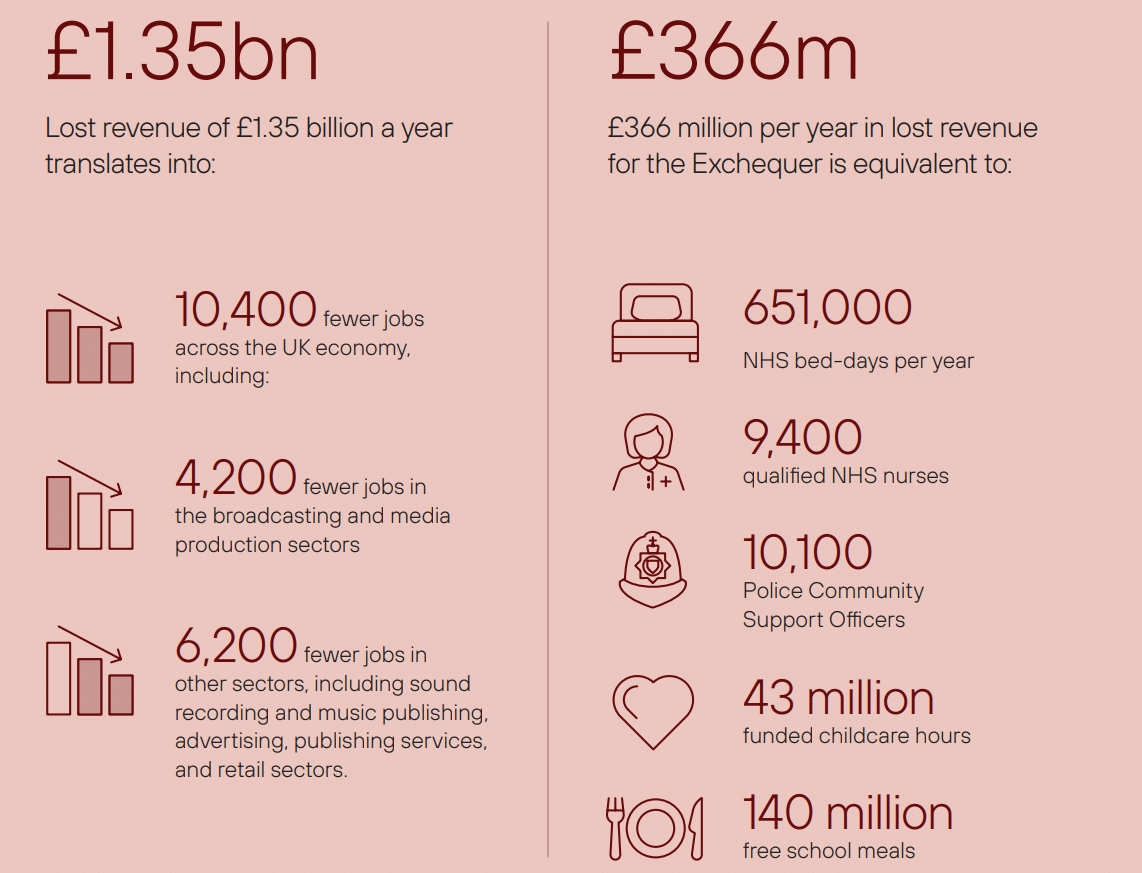
Authored by consultancy firm WPI Economics, the report attempts to assign hard financial figures to an illicit ecosystem that has long frustrated rightsholders and broadcasters. According to its core findings, illegal streaming and downloading cost UK broadcasters an estimated £1.35 billion annually in missed revenue. Translated further through economic modelling, this shortfall supposedly accounts for 10,400 lost jobs and £366 million in missing tax income for Her Majesty’s Treasury.
To drive its point home, the campaign frames these missing tax receipts in visceral human terms. The £366 million, the report suggests, could alternatively fund the employment of 9,400 qualified National Health Service (NHS) nurses, or deliver 140 million free school meals to children across the United Kingdom.
Yet, beneath these striking metrics lies a complex methodology built on hypothetical consumer scenarios, unadjusted survey data, and an exceptionally broad definition of what constitutes a "pirate." While rightsholders continue to push for aggressive public awareness campaigns and cross-sector crackdowns, a closer examination of The Price of Piracy reveals that the £1.35 billion headline figure is far from a guaranteed financial windfall.
Detailed Chronology: The Genesis and Methodology of The Price of Piracy
The foundations of the latest anti-piracy push were laid earlier this year, culminating in the formal publication of the WPI Economics report in autumn.
The February Poll and the 16.8 Million Figure
The cornerstone of the £1.35 billion estimate is a consumer survey conducted in February, which polled 2,501 UK adults. When questioned about their media consumption habits, nearly a third of respondents—31%—admitted to engaging with some form of illegal streaming or downloading within the preceding three months.

Extrapolating this sample to the broader British demographic yields a startling projection: an estimated 16.8 million UK adults could be categorized as digital video pirates.
The Hypothetical Scenario
To bridge the gap between a survey respondent watching unauthorized content and a multi-billion-pound corporate deficit, WPI Economics constructed a counterfactual economic model.
When researchers asked survey participants who admitted to pirating which legal subscription services they would hypothetically be willing to pay for if illegal alternatives vanished overnight, those affirmative responses were collated. WPI Economics then multiplied these stated intentions by the average retail cost of those subscription services, before extrapolating the totals across the entire UK population.
Crucially, the report only factored in respondents who explicitly stated they would pay full price in this hypothetical vacuum. However, this methodology introduces a textbook economic pitfall known as "hypothetical bias." Decades of behavioral research demonstrate a consistent disparity between what consumers say they will pay in surveys and how they actually behave when faced with real-world financial transactions.
When pressed on whether any statistical correction factor was applied to account for this bias, a BeStreamWise spokesperson confirmed that WPI Economics did not adjust the raw survey data. The answers were taken entirely at face value.
Supporting Context & Metrics: Inside the Pirate Mindset and Changing Platforms
While the economic models project billions in theoretical recovery, the survey data simultaneously exposes the stubborn underlying drivers of digital piracy that make those billions practically unreachable.

Why Do People Pirate?
Economics dictate that consumer behavior is largely driven by friction and cost. The BeStreamWise survey itself underscored this reality, highlighting that financial savings remain the primary catalyst for illicit consumption:
- 38% of respondents cited cost as their principal justification—noting that unauthorized streams are simply cheaper than legal alternatives.
- 31% pointed to convenience, illustrating that fragmented streaming ecosystems and complex geoblocking can sometimes make piracy a frictionless alternative.
- 24% expressed a general fatigue or desire to avoid subscription models altogether.
Furthermore, over half of the self-identified pirates surveyed (52%) stated that they were likely to continue their habits regardless of warnings, legal crackdowns, or moral appeals.
Social Media as the Primary Conduit
Perhaps the most surprising empirical revelation in the report involves how modern consumers access unauthorized content. While traditional anti-piracy measures have historically focused on dedicated IPTV boxes, torrent indexers, and specialized pirate websites, the new data points elsewhere.
According to the report, a majority of active illegal streamers—54%—access unauthorized content via mainstream social media platforms. By comparison:
- 28% stream or download via unofficial websites.
- 26% use purchased physical devices and dedicated illegal subscription services.
- 15% rely on legacy distribution methods such as torrents or cloud-sharing platforms.
- 7% buy compromised login credentials or passwords for legitimate legal accounts.
The Problem of Definition
This heavy reliance on social media highlights a critical nuance regarding the scope of the survey. The report’s definition of piracy is remarkably broad. It explicitly includes "watching via social media platforms" as a standalone category—alongside using Virtual Private Networks (VPNs) to bypass geographic content restrictions.
Consequently, an ordinary internet user who watches a single, unauthorized 10-second clip of a Premier League goal or a viral television excerpt on platforms like X (formerly Twitter), Instagram, or TikTok is statistically grouped alongside hardcore commercial IPTV operators. Because BeStreamWise has not publicly released the exact phrasing of the polling questions, independent verification of these behavioral categorizations remains difficult.
Official Statements & Strategic Recommendations
Rather than proposing draconian new legislation or expanding dynamic website-blocking injunctions—tactics that have defined UK copyright enforcement for over a decade—The Price of Piracy pivots toward softer, more collaborative solutions.
1. Amplifying Public Awareness Campaigns
The report’s primary recommendation urges the UK Government to leverage its official communications channels to amplify existing consumer education initiatives, with BeStreamWise positioned as the prime vehicle for this state-backed messaging.
Beyond reiterating the legal risks of intellectual property theft, the report argues that government-backed campaigns should focus heavily on the personal dangers consumers face. Specifically, it cites an estimated £270 million in financial harms—including malware infections, financial fraud, and identity theft—frequently linked to shady pirate websites and unverified streaming apps.
"Amplifying BeStreamWise’s data and insights would be an ‘oven-ready’ move that would be game-changing in signposting the risks of piracy… and would begin to combat the £270m of financial harms illegal streamers face each year," the report states.
2. A Cross-Sector Voluntary Framework
The secondary recommendation calls for a voluntary, multi-stakeholder framework overseen by the government. This cooperative model would bring together online social platforms, internet service providers (ISPs), and content rightsholders to collaboratively curb the spread of unauthorized streams without requiring fresh parliamentary statutes.
Future Outlook: Bridging the Gap Between Theory and Reality
As broadcasters, sports leagues, and anti-piracy coalitions brace for another season of digital cat-and-mouse, reports like The Price of Piracy serve a dual purpose. On one hand, they provide rightsholders with powerful lobbying ammunition, translating abstract copyright infringements into tangible societal losses like NHS nurses and free school meals.
On the other hand, the absence of methodological adjustments for hypothetical bias means the £1.35 billion figure functions more as an aspirational ceiling than an accurate ledger of recoverable cash. Millions of consumers who rely on social media snippets or free, ad-supported pirate streams are simply never going to convert into paying subscribers at full retail price—regardless of how many awareness campaigns are launched.
Ultimately, while voluntary frameworks and public awareness drives may successfully nudge marginal consumers back toward legitimate ecosystems, rightsholders must recognize a fundamental truth: a significant portion of that £1.35 billion exists only on paper. Until legal streaming services can effectively match the cost, flexibility, and convenience demanded by modern digital consumers, the shadow economy of online piracy will remain firmly entrenched.