Executive Overview
For nearly three decades, rightsholders, industry associations, and anti-piracy advocacy groups have attempted to forge a rhetorical and operational link between digital copyright infringement and transnational organized crime, drug trafficking, and terrorism. What began in the late 1990s as an effort by the International Federation of the Phonographic Industry (IFPI) to curb cross-border CD smuggling has gradually transformed into a sophisticated policy-advocacy framework. This framework increasingly frames unauthorized digital streaming not merely as an economic injury to copyright holders, but as a direct threat to national security.
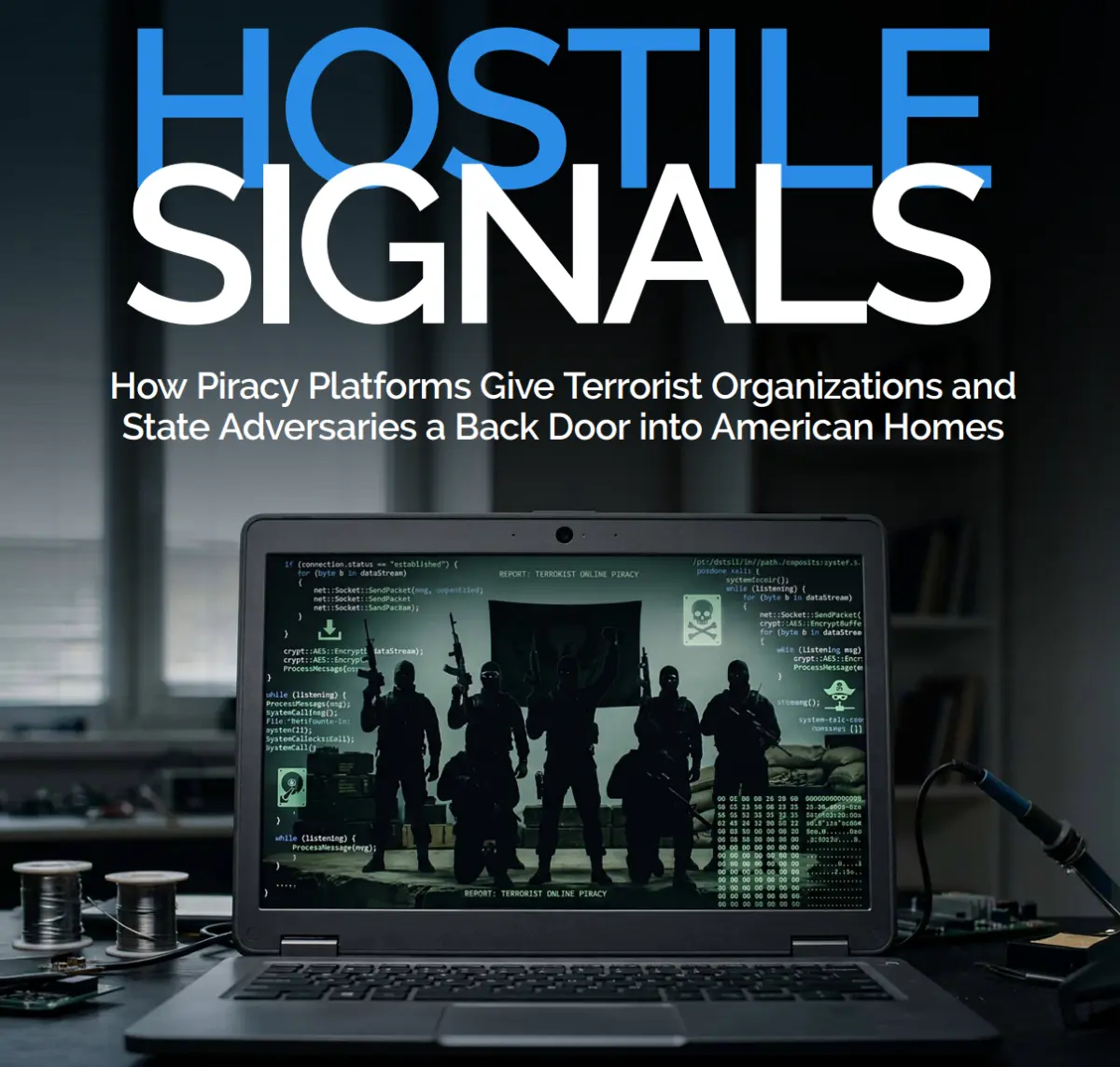
The latest contribution to this narrative comes from the Digital Citizens Alliance (DCA), a Washington, D.C.-based consumer advocacy organization working in close alignment with creative industries. In a newly published report titled “Hostile Signals,” the DCA—drawing on investigative research conducted by Atlanta-based security firm risk3sixty—asserts that unauthorized Internet Protocol television (IPTV) networks are doing more than just undercutting subscription revenues for major media conglomerates. According to the report, these illicit networks are allegedly acting as sanction-circumventing broadcasting channels, inadvertently or intentionally providing a digital back door for designated terrorist organizations and state-sanctioned adversaries to reach Western audiences.
Released strategically ahead of the 25th anniversary of the September 11 terrorist attacks, the timing of the report is anything but coincidental. By evoking the solemn rallying cry of “Never Forget,” the report seeks to inject national security urgency into an ongoing, high-stakes legislative battle in Washington. Specifically, rightsholders and industry coalitions are leveraging the findings to champion aggressive site-blocking legislation—such as the American Copyright Protection Act (ACPA) sponsored by Rep. Darrell Issa and the Foreign Anti-Digital Piracy Act (FADPA) sponsored by Rep. Zoe Lofgren.
However, a closer examination of the report’s methodology, combined with technical realities of the modern internet, reveals a landscape of considerable nuance. While the presence of state-backed and extremist media on pirate platforms is a matter of documented technical fact, the actual mechanics of these streams—many of which are freely accessible via open web domains outside U.S. jurisdiction—raise critical questions about whether site-blocking targeting copyright infringement is an effective or proportionate counterterrorism tool.
Detailed Chronology: The Evolution of the Piracy-Terrorism Narrative
To understand the weight and intent behind “Hostile Signals,” it is essential to trace the historical lineage of how copyright infringement has been coupled with national security threats over the past twenty-five years.
The Late 1990s: Economic Crime Meets Border Smuggling
The initial convergence of intellectual property (IP) theft and organized crime emerged during the commercial explosion of optical disc technology in the late 1990s. As physical piracy ran rampant across international borders, the IFPI and allied music industry groups began sounding the alarm. They argued that the profits generated from counterfeit compact discs were not merely the work of casual counterfeiters, but rather the output of sophisticated transnational criminal syndicates capable of smuggling illicit goods past customs checkpoints.

2003–2009: The Post-9/11 Security Shift
The rhetoric shifted dramatically following the events of September 11, 2001. In 2003, the U.S. House of Representatives held a landmark hearing explicitly examining piracy’s emerging links to organized crime and terrorism. During this period, then-Interpol Secretary General Ronald Noble delivered a stark assessment to Congress, testifying that IP crime had evolved to become “the preferred method of funding for a number of terrorist groups.”
This narrative reached a milestone in 2009 with the publication of a widely cited, movie industry-funded RAND Corporation study. The report explicitly sought to connect film piracy with street gangs and terrorist networks. Although subsequent analysts and legal scholars heavily criticized the study for blurring the lines between physical trademark counterfeiting, wholesale digital piracy, and direct terrorist financing, the RAND report established a foundational citation that creative industries have continuously referenced in lobbying efforts ever since.
2017–Present: Expanding the Threat Matrix
Over the past decade, the DCA has aggressively sustained and modernized this tradition. In 2017, the organization published a report that bundled digital piracy alongside ISIS recruitment videos, malware proliferation, and the rising tide of online disinformation.
As the technical delivery mechanisms of television consumption shifted from physical storage media to subscription-based digital streaming, the focus pivoted toward pirate IPTV. In May of this year, the DCA released a report linking unauthorized IPTV services directly to drug trafficking networks, weapons smuggling syndicates, and traditional organized crime syndicates (the mafia).
The release of “Hostile Signals” represents the culmination of this trajectory, expanding the threat landscape from financial support and revenue generation to active, sanction-bypassing geopolitical broadcasting.
Supporting Context & Metrics: Inside the “Hostile Signals” Findings
The empirical backbone of the DCA’s “Hostile Signals” report is derived from an analytical study conducted by the cybersecurity firm risk3sixty. Between May and August of this year, researchers at the firm systematically subscribed to and monitored 25 distinct commercial pirate IPTV services accessed via standard residential U.S. internet connections.

The Findings: Hezbollah, the Houthis, and State-Sanctioned Broadcasters
Out of the 25 tested pirate IPTV platforms, researchers discovered that 17—accounting for 68% of the sample—carried at least one television channel explicitly tied to a designated foreign terrorist organization (FTO) or a heavily sanctioned state-backed broadcaster.
The distribution of specific networks across these platforms highlights a concentration of militant and adversarial state media:
- Al-Manar: The primary television station of Hezbollah—an organization designated as a foreign terrorist group by the United States, held responsible for hundreds of American military and civilian deaths over decades—was present on all 17 of the pirate platforms that carried flagged channels.
- Al-Masirah: The primary media outlet operated by the Houthi movement in Yemen appeared on nine of the services.
- Al-Alam: The Arabic-language state-run news network operated by the Iranian government was found on seven of the platforms.
- Al-Aqsa TV: The media wing associated with Hamas was identified on two of the services.
The report specifically singled out several commercial pirate IPTV operators—including Lion OTT, Sansat VIP, OTTOcean, Belitvision, and Wish IPTV—as accessible and operational within the United States.
The "Back Door" Argument
The central thesis constructed by the report is that federal law enforcement and regulatory agencies have spent the past two decades systematically dismantling the broadcast infrastructure of these hostile entities. For instance, the U.S. government blocked Al-Manar’s satellite transmissions back in 2004, and subsequent criminal prosecutions—such as the conviction of a Brooklyn resident sentenced to 69 months in prison for providing material support to a terrorist organization by reselling the channel—demonstrated the seriousness of these enforcement actions.
Despite these efforts, the report argues that the proliferation of unregulated, black-market streaming boxes and IPTV subscriptions has effectively bypassed traditional regulatory choke points. "A piracy subscription has restored what two decades of federal action removed," the report grimly concludes.
Official Statements and Industry Strategy
The release of “Hostile Signals” has been met with vocal support from media executives and legislative champions who have long sought robust tools to combat digital infringement. The timing—sandwiched between the approach of the 9/11 anniversary and renewed legislative maneuvers in Washington—underscores a calculated public relations strategy.

The Legislative Push: ACPA and FADPA
For years, U.S. copyright holders have looked enviously at European and Commonwealth nations that utilize dynamic court-ordered site-blocking injunctions to force Internet Service Providers (ISPs) to sever access to notorious pirate domains. Domestic rightsholders argue that traditional enforcement mechanisms—such as DMCA takedown notices, voluntary payment processor crackdowns, and piecemeal domain seizures—are fundamentally insufficient against agile overseas piracy syndicates that simply spin up mirror sites within minutes.
To bridge this gap, federal lawmakers have introduced structural legislation:
- The American Copyright Protection Act (ACPA): Spearheaded by Rep. Darrell Issa, the ACPA aims to establish a legal framework allowing rightsholders to seek court orders compelling ISPs to block access to foreign-based copyright-infringing sites.
- The Foreign Anti-Digital Piracy Act (FADPA): Championed by Rep. Zoe Lofgren, this companion effort attempts to address foreign pirate infrastructure while balancing user rights and due process concerns.
Rep. Issa has recently indicated that a consolidated, bipartisan, and bicameral site-blocking bill is nearing completion. Industry leaders are wasting no time aligning their advocacy with national security imperatives. Notably, in August, Motion Picture Association (MPA) Chairman and CEO Charles Rivkin—alongside leadership from the National Intellectual Property Rights Coordination Center (IPR Center)—invoked the complexities of digital enforcement during high-profile sporting events to press for expanded site-blocking authorities.
The “Hostile Signals” report is widely expected to be deployed as evidentiary ammunition in upcoming congressional hearings, providing content owners with a powerful narrative framework that connects commercial copyright piracy directly to geopolitical terrorism.
Analytical Nuance and Critical Counterpoints
While the data presented by risk3sixty regarding the presence of channels like Al-Manar on pirate IPTV platforms is technically striking, cybersecurity analysts, digital rights advocates, and technical experts emphasize that the report’s alarming conclusions require significant contextual nuance.
1. Viewership Mechanics and Content Overload
A critical admission buried within the report itself is that its findings provide zero empirical insight into the actual viewership or engagement levels of these extremist channels. Pirate IPTV services typically bundle thousands of live international channels, video-on-demand (VOD) movie libraries, and sports packages into a single, low-cost subscription.

Furthermore, the majority of the flagged channels—including Al-Manar, Al-Masirah, and Al-Alam—broadcast exclusively in Arabic, frequently without English subtitles or translation aids. Consequently, the presence of a channel within a massive directory of a gray-market streaming service does not automatically equate to active radicalization or widespread consumption by Western audiences.
2. The Open Web Availability Paradox
Perhaps the most significant challenge to the report’s core premise is that pirate IPTV subscriptions are entirely unnecessary for anyone seeking to access these specific state-backed or militant media outlets.
Many of the streams in question are freely, publicly, and openly accessible via the broadcasters’ own web domains. For example, while the U.S. Department of Justice seized 13 Hezbollah-linked domains in 2023—including several carrying the network’s name—Al-Manar’s primary digital operations continue to reside comfortably under Lebanon’s .lb top-level domain. Because this infrastructure sits entirely outside the jurisdiction of U.S. courts and domestic registrars, American web users can access the live streams directly through standard web browsers without purchasing an illicit IPTV service.
This technical reality somewhat blunts the DCA’s argument that piracy services act as a unique, irreplaceable "back door" for radicalization, as the front door remains wide open across the public internet.
3. Proportionality and the Site-Blocking Debate
Civil liberties groups, open-internet advocates, and major technology companies have historically pushed back against legislative site-blocking proposals in the United States, raising serious concerns regarding over-blocking, freedom of expression, and the erosion of network architecture.
Critics argue that framing copyright infringement through the lens of counterterrorism creates a slippery slope. If standard internet filtering infrastructure—typically reserved for matters of imminent national security, CSAM (Child Sexual Abuse Material), or extreme violent terrorism—is co-opted to resolve commercial intellectual property disputes, the threshold for collateral internet censorship risks dropping dangerously low. Legitimate websites, independent publishers, and non-infringing content hosted on shared server infrastructure frequently fall victim to broad, automated site-blocking mechanisms in other jurisdictions, such as the UK and Australia.

Future Outlook
As Washington policy circles prepare for a heated legislative showdown over the American Copyright Protection Act and related site-blocking bills, the release of “Hostile Signals” marks a definitive escalation in the rhetorical war over digital piracy.
Rightsholders are no longer content to make a purely economic appeal based on lost box-office revenue or subscriber churn. By aligning their commercial interests with national security, counterterrorism, and geopolitical risk mitigation, industry associations are attempting to broaden their coalition of political allies. Lawmakers focused on foreign adversaries, border security, and counterterrorism are far more likely to engage with proposals that promise to choke off the digital arteries of sanctioned actors.
However, as the legislative debate unfolds, policymakers will face a fundamental challenge: separating the legitimate imperatives of national security from the specific commercial grievances of the entertainment industry. Whether Congress will be persuaded to enact sweeping domestic site-blocking legislation under the banner of counterterrorism—despite the existence of open-web alternatives and the complexities of gray-market streaming—remains one of the most contentious technology policy questions of the decade.