The landscape of American copyright enforcement and internet governance is facing its most significant legislative inflection point since the infamous Stop Online Piracy Act (SOPA) of 2011. Capitol Hill has become the battleground for a high-stakes legislative duel as two competing, aggressive site-blocking bills vie for Congressional favor. Following closely on the heels of the American Copyright Protection Act (ACPA)—a measure spearheaded by Representative Darrell Issa that explicitly places virtual private networks (VPNs) in the crosshairs of mandatory site-blocking obligations—a unified, bipartisan bicameral proposal has emerged.
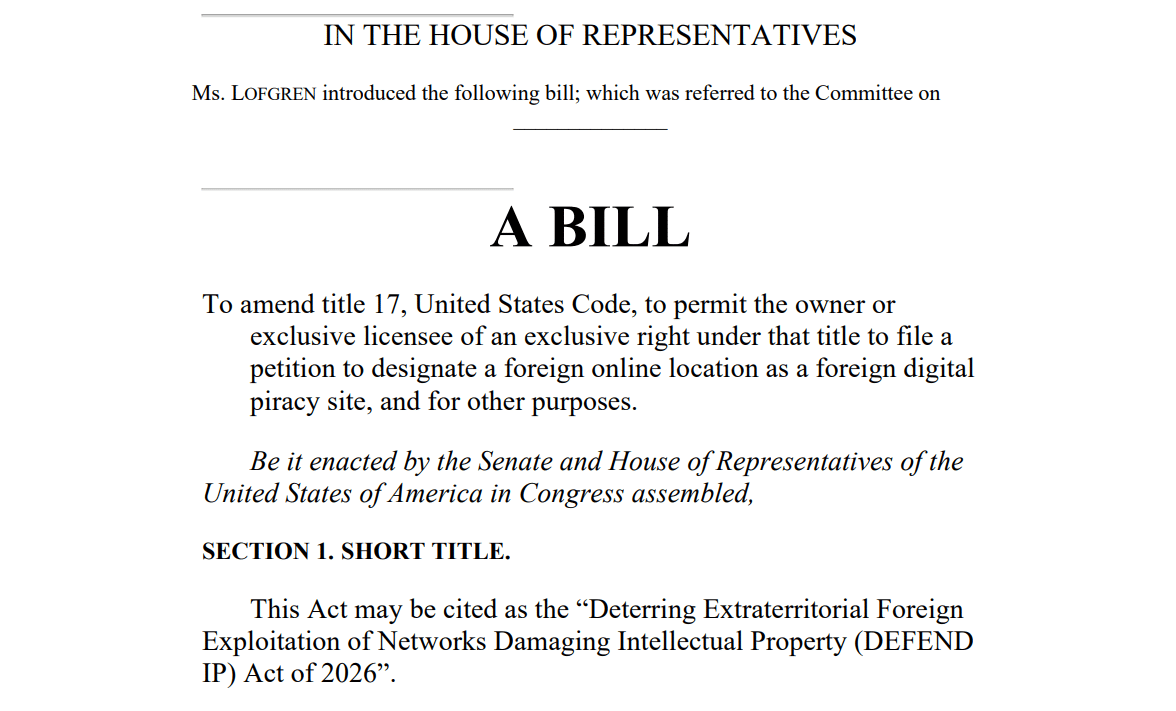
Officially introduced as the DEFEND IP Act (an acronym for the Deterring Extraterritorial Foreign Exploitation of Networks Damaging Intellectual Property), this newly synthesized legislation is the product of a strategic merger between two previously distinct legislative efforts: Representative Zoe Lofgren’s Foreign Anti-Digital Piracy Act (FADPA) and Senator Thom Tillis’s long-gestating "Block BEARD" draft. Backed by a formidable coalition of bipartisan lawmakers—including Senators Chris Coons, Marsha Blackburn, and Adam Schiff, alongside Representative Ben Cline—the DEFEND IP Act seeks to establish a streamlined, federal court-mandated mechanism to sever domestic internet traffic to overseas piracy havens.
Yet, despite its stated goals of safeguarding American intellectual property while preserving free speech and an open internet, the bill has immediately ignited fierce debate. While the DEFEND IP Act notably exempts standalone VPN services from direct blocking orders—distinguishing it from Issa’s ACPA—it retains controversial provisions targeting major broadband providers and public DNS resolvers. Major entertainment conglomerates and copyright alliances have lauded the measure as a long-overdue modernization of anti-piracy tools. Conversely, digital rights organizations and civil liberties watchdogs, most notably Public Knowledge, have fiercely condemned the bill as an overreaching instrument of state-sanctioned internet censorship.
With the current legislative session rapidly drawing to a close in January—and with key congressional champions like Rep. Issa and Sen. Tillis preparing to exit Congress—the race is on to determine whether either of these competing site-blocking frameworks can achieve what SOPA failed to do over a decade ago.
Detailed Chronology of the Legislative Push
The Long Shadow of SOPA and the Path to the DEFEND IP Act
The journey toward the DEFEND IP Act spans more than three years of quiet drafting, behind-the-scenes lobbying, and strategic compromises. For over a decade following the dramatic public collapse of SOPA and the PROTECT IP Act (PIPA)—which triggered massive internet blackouts and fierce public pushback—mainstream U.S. lawmakers tread cautiously around mandatory site-blocking legislation. However, as international digital piracy syndicates migrated to sophisticated offshore networks, streaming technologies evolved, and enforcement loopholes widened, Hollywood and major rightsholder associations steadily rebuilt their political capital on Capitol Hill.
The groundwork for the current legislative climate accelerated through separate legislative tracks. Senator Thom Tillis, a staunch proponent of intellectual property protection, spent years developing the "Block BEARD" proposal, focusing heavily on cutting off access to rogue foreign domains at the network level. Concurrently, Representative Zoe Lofgren pursued a more targeted approach through the Foreign Anti-Digital Piracy Act (FADPA), aiming to strike a balance between curbing foreign intellectual property theft and preserving the foundational architecture of an open internet.
Recognizing that competing bills would dilute their political influence, Tillis and Lofgren ultimately bridged their differences to forge a unified front. The resulting DEFEND IP Act was formally introduced as Senate Bill 5529 (S. 5529) and immediately referred to the Senate Judiciary Committee, while a companion bill was advanced in the House.
The Two-Step Judicial Mechanism
Like its counterpart, the ACPA, the DEFEND IP Act outlines a rigorous, two-step judicial process designed to compel internet intermediaries to choke off traffic to designated infringement hubs.
Foreign Digital Piracy Site Designation: The initial phase requires copyright holders to petition a federal court to formally classify a targeted platform as a "foreign digital piracy site." To successfully secure this designation, rightsholders must prove that the website in question is primarily designed to facilitate piracy, possesses no commercially significant purpose other than copyright infringement, or is explicitly marketed as a destination for illicit content. Operators of accused sites are granted a 20-day window to respond; however, to prevent evasive maneuvers, federal judges retain the authority to issue ex-parte emergency orders if the statutory requirements are conclusively met.
Execution of Blocking Orders: Once a site is officially designated, rightsholders can return to the presiding judge to request formal blocking orders directed at qualifying intermediaries. The court must evaluate whether implementing the requested blocks is "technically feasible and effective," or whether less burdensome alternatives exist.
Crucially, these blocking orders are not indefinite; they remain valid for a renewable one-year term. Furthermore, to combat the persistent "whack-a-mole" dynamic inherent in web piracy—whereby targeted sites instantly migrate to fresh domain names or alternative IP addresses—the legislation permits rightsholders to petition the court to dynamically update existing orders.
In addition to traditional on-demand media, the DEFEND IP Act includes specialized provisions tailored to curb unauthorized live-streaming of high-value events, most notably professional sports. Under the framework, rightsholders can secure anticipatory injunctions when an impending live transmission "will likely violate" their exclusive broadcast rights, effectively allowing courts to flag and block pirate streams before the opening whistle blows.
Supporting Context & Technical Metrics: Scope and Exemption Controversies
A granular examination of the legislative text—made publicly available via Rep. Lofgren’s office—reveals critical nuances regarding which infrastructure providers fall within the scope of potential blocking mandates, and which are deliberately spared.
Broadband Providers and Public DNS Resolvers in the Crosshairs
The DEFEND IP Act establishes explicit jurisdictional thresholds to determine which network intermediaries can be legally compelled to enforce blocking orders:
Broadband Providers: Telecommunications and internet service providers (ISPs) with a minimum baseline of 50,000 subscribers are subject to the legislation.
Public DNS Resolvers: Entities operating public Domain Name System resolvers that generate more than $100 million in annual revenue are directly captured by the framework. In practical terms, this provision places global infrastructure giants such as Google and Cloudflare squarely within the enforcement mechanism.
The VPN Exemption Debate: A Point of Divergence
The most striking technical distinction between the DEFEND IP Act and Representative Issa’s competing ACPA bill lies in their treatment of virtual private networks.
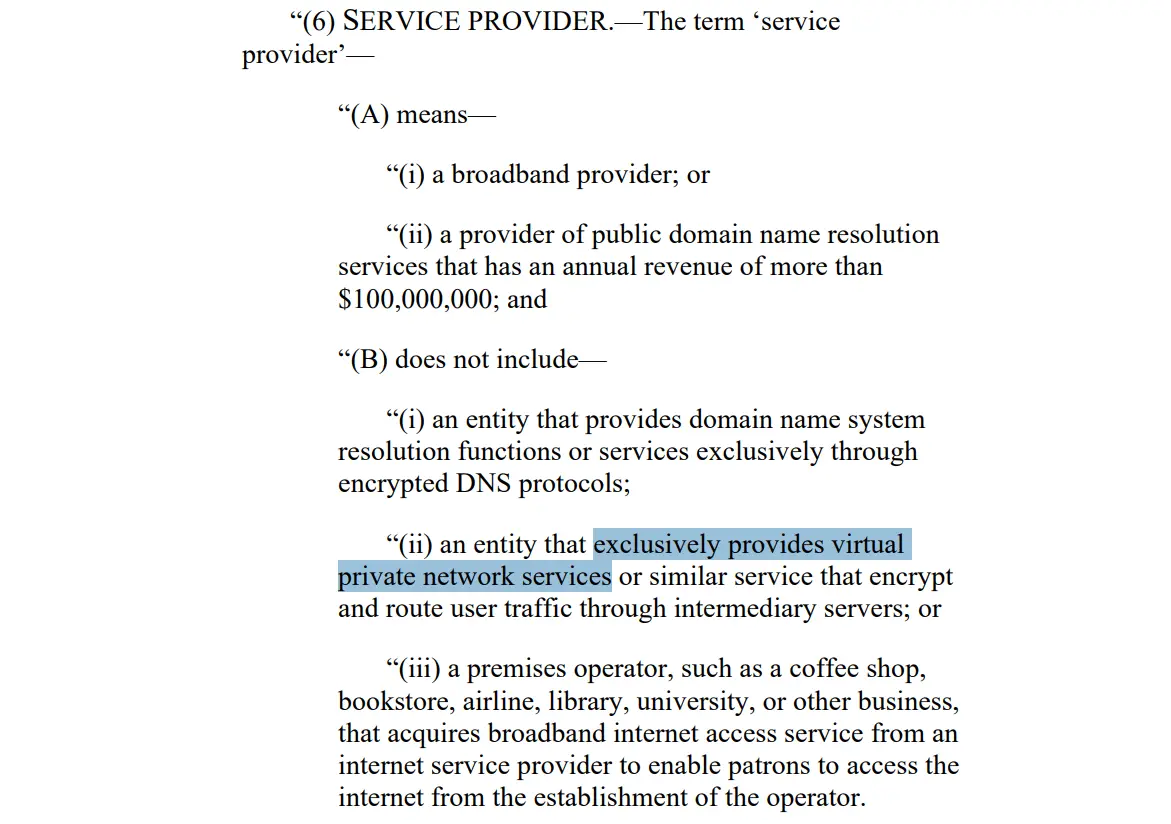
While the ACPA explicitly expands the definition of targeted intermediaries to include VPN providers—ignoring warnings from privacy advocates that doing so would compromise user security and undermine encrypted routing tunnels—the DEFEND IP Act explicitly carves out an exemption for them. The bill’s statutory text explicitly excludes from its definition of a service provider:
"an entity that exclusively provides virtual private network services or similar service that encrypt and route user traffic through intermediary servers."
However, legal experts and digital rights analysts have immediately flagged potential ambiguity in the word "exclusively." The legislative text offers little guidance on how this exemption applies to technology conglomerates or multi-service software providers that bundle a VPN feature alongside cloud storage, antivirus suites, or productivity applications. If a company does not exclusively operate as a VPN, it risks falling into a regulatory grey area.
A similarly rigorous standard applies to public DNS resolvers. The DEFEND IP Act exempts DNS providers only if they deliver their routing services "exclusively through encrypted DNS protocols"—such as DNS over HTTPS (DoH) or DNS over TLS (DoT). Because major public resolvers like Cloudflare and Google historically handle a vast hybrid mix of unencrypted and encrypted queries, this high technical bar implies they may still be forced to implement site-blocking protocols across their encrypted architecture to maintain compliance.
Safeguards and the Missing Compensation Safety Net
To appease network operators, the DEFEND IP Act integrates several structural safeguards:
Courts are explicitly prohibited from prescribing specific, proprietary technical methods for blocking (leaving the implementation details to the discretion of the provider).
Intermediaries acting in good faith to comply with court orders are granted statutory immunity from civil liability.
Providers retain the legal avenue to request that petitioning rightsholders cover a portion of the operational costs incurred by executing the blocks.
Legitimate websites mistakenly caught in the collateral crossfire of a poorly targeted block can petition the court to modify or rescind the order.
Unlike Representative Issa’s ACPA, which includes provisions for up to $250,000 in statutory compensation to mitigate financial damages suffered by wrongly blocked entities, the DEFEND IP Act provides no direct financial payout for collateral damage. Critics argue this omission leaves small businesses, independent bloggers, and misidentified web services with zero financial recourse for the lost revenue and operational disruptions caused by erroneous global blocks.
Official Statements and Industry Perspectives
The introduction of the DEFEND IP Act has sharply polarized digital stakeholders, drawing swift, contrasting reactions from Hollywood elites, telecommunications lobbies, and civil liberties organizations.
Proponents: Hollywood and Copyright Alliances Rally Support
Major entertainment studios, music labels, and creative guilds have thrown their full political weight behind the unified bill, viewing it as a long-overdue, precise scalpel to neutralize foreign revenue drain.
Charles Rivkin, Chairman and CEO of the Motion Picture Association (MPA), praised the bipartisan nature of the initiative in an official announcement:
"By enacting this legislation, our country can deploy a highly effective tool to protect creators and consumers from overseas digital piracy, all while safeguarding free speech and preserving the open internet."
The MPA’s enthusiasm is echoed by a formidable coalition of over a dozen major industry organizations backing the bill, including the Recording Industry Association of America (RIAA), the Copyright Alliance, SAG-AFTRA, and the Directors Guild of America. For these stakeholders, the DEFEND IP Act represents a vital modernization of legal enforcement mechanisms that can neutralize offshore pirate sites operating with impunity outside the direct jurisdictional reach of U.S. law enforcement.
Detractors: Public Knowledge Warns of "Censorship Infrastructure"
Conversely, public interest groups and digital rights advocates have launched blistering critiques against both the ACPA and the DEFEND IP Act, framing them as twin threats to foundational internet architecture.
Public Knowledge, a prominent digital rights advocacy organization, issued a scathing rebuttal immediately following the bill’s introduction:
"For the second time in as many weeks, rightsholders have convinced Congress to build out an expansive infrastructure for censorship rather than go after the root of the problem: operators of overseas piracy websites."
Highlighting the technical realities of modern internet routing, the group underscored the systemic dangers of weaponizing infrastructure-level resolvers:
"Let us repeat: Applying blocking orders to global DNS resolvers causes global blocks."
Critics argue that even with exemptions for standalone VPNs, compelling massive DNS providers and broadband networks to alter routing tables establishes a dangerous domestic precedent. Such mechanisms, watchdogs warn, could easily be weaponized or repurposed by future administrations to suppress non-copyright-related online speech, paving the way for authoritarian-style information controls historically criticized when implemented by foreign regimes.
Future Outlook: The Legislative Horizon and the Legacy Clock
As the dust settles on Capitol Hill, the DEFEND IP Act and the ACPA find themselves locked in a complex legislative horse race. Fourteen years after the catastrophic collapse of SOPA sent toxic political shockwaves through Washington, two distinct site-blocking proposals are simultaneously competing for limited floor time and institutional backing in Congress.
However, time is the ultimate adversary for both bills. The legislative clock is ticking down to an absolute expiration date: the current session of Congress officially concludes in January. Compounding this urgency is the impending departure of key legislative architects. Representative Darrell Issa is retiring from the House, and Senator Thom Tillis is not seeking reelection. Consequently, neither of the primary champions behind these competing frameworks will be present in the next Congress to reintroduce their proposals if they fail to pass during the current lame-duck or closing legislative windows.
Whether the DEFEND IP Act can successfully navigate the committee process, survive intense constitutional scrutiny over free speech concerns, and avoid the explosive public backlash that doomed SOPA remains entirely uncertain. What is certain, however, is that the battle over who controls the routing architecture of the internet—and to what extent private corporations can be conscripted as border guards for intellectual property enforcement—will remain one of the most fiercely contested battlegrounds in modern digital policy.