Executive Overview
For decades, the standard playbook for software-as-a-service (SaaS) and Product-Led Growth (PLG) has relied on a rigid convention: the 14-day free trial. Copied verbatim from enterprise giants like Salesforce and HubSpot fifteen years ago, this arbitrary timeline has dictated how millions of users evaluate, purchase, and commit to digital tools. But as software markets mature, consumer behavior shifts, and artificial intelligence changes the cost structure of digital products, historical assumptions are finally facing empirical scrutiny.
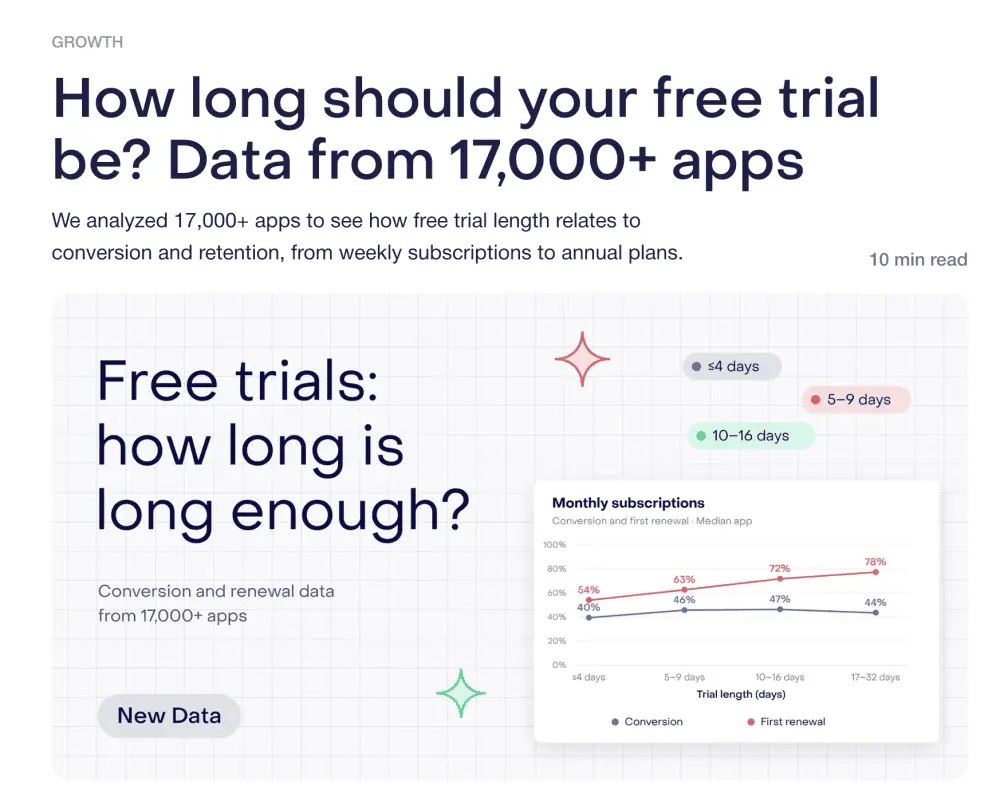
Enter RevenueCat. Powering over 60% of all mobile subscription applications globally—spanning fitness, photo editing, productivity, and utility workflows—the platform has just published what is arguably the largest, richest dataset on free trial behavior ever compiled. Examining more than 17,000 mobile applications over a full twelve-month evaluation period (August 2025 through July 2026), the study cuts through conventional wisdom to expose how trial length directly impacts conversion rates, long-term retention, and profitability.
While a substantial portion of RevenueCat’s ecosystem skews toward B2C apps, the underlying dynamics—particularly concerning annual commitments, recurring billing cycles, and workflow tools—offer vital, data-backed lessons for B2B founders and AI product leaders alike. The core finding challenges foundational habits: when it comes to annual subscriptions, stretching evaluation periods closer to 30 days yields significantly higher conversion and retention rates than the traditional 14-day model. Conversely, for artificial intelligence applications burdened by the continuous costs of generative inference, extended trials can act as a financial anchor, dragging down margins without delivering proportional returns.
Detailed Chronology and Industry Context: The Evolution of the Trial Paradigm
To understand why trial duration matters so much today, one must examine the evolution of software distribution. In the early days of cloud computing, companies needed a mechanism to bridge the trust gap between buyer and seller. Eliminating friction through self-serve, time-gated access became the cornerstone of PLG. The 14-day trial emerged as a safe middle ground—long enough for a user to experience a moment of value, but short enough to induce urgency before the pipeline went cold.
However, as mobile applications and modern B2B tools matured into subscription-first business models, software operators began blindly copying category leaders. Weekly apps defaulted to four-day trials; monthly and annual tools defaulted to seven or fourteen days. These timelines were rarely optimized against a product’s true "time-to-value" (TTV); instead, they were dictated by legacy benchmarks or a Chief Financial Officer’s immediate demand for cash-flow velocity.
RevenueCat’s dataset—spanning an unprecedented 17,000 apps over a full year—marks a turning point in this chronology. Backed initially in 2018 by the SaaStr Fund when it was tracking only a few hundred applications, RevenueCat has grown into the default subscription and monetization infrastructure for mobile-first software. Because its data now encompasses a vast cross-section of workflow, utility, productivity, and consumer apps, it provides a rare, transparent look into how modern digital consumers react when given varying amounts of time to evaluate financial commitments.
Supporting Context & Metrics: Breaking Down the Data
The insights extracted from RevenueCat’s study shatter several long-held assumptions regarding trial lengths, conversion curves, and geographical variations.
1. Annual Plans: The Power of the 30-Day Window
Conventional SaaS wisdom suggests that keeping friction high and timelines short forces a quicker decision. On annual plans, the data proves the exact opposite.
Conversion rates for annual subscriptions climbed steadily with every incremental increase in trial length:
- 4 days or less: 24.0% conversion rate
- 5 to 9 days: 33.0% conversion rate
- 10 to 16 days: 43.0% conversion rate
- 17 to 32 days: 44.6% conversion rate
The impact on first-year renewals was even more dramatic, surging from 18.3% on short trials to 47.5% on trials lasting up to 32 days. When combining these metrics to look at the total share of trial users who ultimately paid and renewed a year later, the shift is staggering: conversion jumped from 3.5% on the shortest trials to 18.5% on the longest. While the number of trial starts remained identical, the longest trials generated more than five times the number of retained customers.
The underlying psychology mirrors enterprise contract negotiations. Committing capital for a full twelve months up front represents a high-friction, difficult-to-undo decision. Buyers demand adequate time to test edge cases, integrate the tool into their routines, and justify the expense. Those who receive that runway—and still choose to buy—exhibit significantly higher stickiness.
2. The Trap of the Short Trial: Weekly and Monthly Benchmarks
Despite performance data favoring longer evaluations, short trials remain ubiquitous. Between 81 and 100 of the top 100 mobile apps per category run weekly trials of four days or less. For monthly and annual formats, the majority cap trials at nine days or less.
Why do operators persist with compressed timelines despite superior data for longer windows? Short trials offer undeniable short-term operational perks: cash reaches the balance sheet faster, paid user-acquisition campaigns receive rapid feedback loops, and infrastructure costs for free users remain low. Yet, much of this behavior is driven by mimicry—copying category leaders rather than analyzing proprietary product metrics.
For monthly self-serve products—the closest structural analog to PLG B2B software—conversion peaked at 46.6% on 10-to-16-day trials. Beyond that threshold, renewal rates continued to climb slightly, but initial conversion tapered off. For businesses evaluating their funnels, a standard 14-day trial sits safely in the sweet spot for monthly billing, balancing immediate conversion velocity with subsequent retention.
3. The Paradox of No-Trial Models
Some founders attempt to bypass trial fatigue entirely by eliminating free trials altogether, forcing immediate financial commitment. RevenueCat’s renewal data reveals the complex trade-offs of this strategy:
- Monthly buyers with no trial renewed at 49.5%.
- Monthly buyers coming off 17-to-32-day trials renewed at 77.5%.
On annual plans, however, the dynamic inverted. Buyers who paid for an annual plan with no trial renewed at 26.6%—outperforming buyers who endured short trials (18.3% at $le$4 days; 25.3% at 5–9 days). Only trials extending past 10 days beat the no-trial annual cohort, peaking at 47.5%.
In B2B terms, the no-trial annual buyer is typically a high-intent, sales-assisted, or referral-driven customer who already understands the product’s value proposition. Conversely, a customer pushed into an annual commitment after a hasty 3-day trial represents one of the weakest cohorts in the entire dataset.
Official Insights: The B2B and AI Frontier
For software builders operating at the intersection of B2B SaaS and artificial intelligence, the RevenueCat study delivers a stark warning regarding operational margins and unit economics.
The AI Inference Dilemma
AI applications carry an economic burden entirely foreign to traditional deterministic software: every single user interaction consumes real-time computational power and inference tokens.
The data reveals that extended trials stop paying off much sooner for AI-driven applications:
- On monthly AI plans, 5-to-9-day and 10-to-16-day trials converted similarly (38.2% and 38.5% respectively).
- However, when trials stretched to 17 to 32 days, conversion plummeted to 31.8%, while retention flatlined around 64.1%.
- Crucially, AI apps underperformed non-AI applications across every single monthly trial length, leaving virtually no margin for error in funnel optimization.
Granting two extra weeks of completely free inference to hesitant users produced fewer paying customers and zero retention gains. For B2B AI products, roughly two weeks represents the strict ceiling for time-based trials.
To navigate this constraint, product leaders must decouple evaluation time from infrastructure consumption. If annual buyers require extended evaluation periods, teams should offer hybrid models—such as usage caps, credit allotments, or seat limitations—rather than open-ended calendar time. This gives buyers the schedule runway they need to evaluate enterprise utility without bankrupting the company on backend API tokens.
Regional Nuances
Global market expansion also demands localized trial strategies. North American and Western European markets demonstrated higher conversion rates with every incremental increase in annual trial length up to 32 days. Conversely, regions like the Middle East and Africa, India, Southeast Asia, and Latin America peaked much earlier, achieving optimal conversion on 5-to-9-day trials, with performance deteriorating significantly on extended timelines.
Future Outlook: Redesigning the Subscription Funnel
As the software industry absorbs these findings, the era of uncritical adherence to legacy benchmarks is drawing to a close. Founders and product leaders can no longer afford to set trial lengths based on what Salesforce did in 2011 or what a competitor launched last quarter.
The data provides a clear roadmap for future iteration:
- Match Trial Length to Payment Term: If you are aggressively pushing annual commitments, extend your evaluation window toward the 30-day mark to accommodate the buyer’s hesitation and psychological friction.
- Protect AI Margins via Usage Caps: For generative AI and compute-heavy B2B products, avoid open-ended time-based trials that bleed inference costs. Use feature-gated or credit-based models to extend evaluation without inflating variable costs.
- Test Regional Variations: Tailor trial lengths to local market behaviors rather than enforcing a monolithic global default.
- Audit Your Funnel Empirically: While correlation exists between active late-stage trial users and final conversion, the underlying benchmarks offer an invaluable baseline. Run controlled experiments on your own pricing pages before executing broad organizational changes.
Ultimately, RevenueCat’s comprehensive dataset proves that time is one of the most powerful, yet poorly managed, levers in software monetization. By aligning trial duration with buyer psychology and structural product costs, modern software operators can unlock unprecedented efficiency, higher retention, and sustainable long-term growth.