As each new Premier League season kicks off, it arrives accompanied by a familiar ritual: the high-profile media campaign warning football fans, television enthusiasts, and digital consumers about the hidden costs of illegal streaming. This year, the anti-piracy coalition BeStreamWise—backed by heavyweight stakeholders including Sky, the Premier League, FACT (Federation Against Copyright Theft), the BBC, and the UK Intellectual Property Office—has released a comprehensive report designed to reframe the debate surrounding digital copyright infringement.
Titled "The Price of Piracy" and prepared by consultancy firm WPI Economics, the report places a staggering £1.35 billion price tag on the annual revenue missed by UK broadcasters due to unauthorized streaming. According to the document, this fiscal shortfall directly translates into 10,400 lost jobs and £366 million in unrealized tax revenue for the public purse.
Yet, beneath the glossy infographics and dramatic public service comparisons lies a methodology rooted in hypothetical scenarios, behavioral assumptions, and an unusually broad definition of what constitutes a "pirate." As the digital landscape continues to evolve, an investigative look into The Price of Piracy reveals a complex intersection of economics, media consumption habits, and the perpetual war over intellectual property.
Executive Overview
The primary objective of The Price of Piracy is to shift the public perception of digital piracy from a victimless crime—often viewed by consumers as merely a harmless swipe at corporate conglomerates—into a tangible threat to public services and national economic stability. To achieve this, the report converts theoretical corporate losses into concrete societal deficits.
For instance, the campaign calculates that the £366 million in missing tax income could theoretically fund the employment of 9,400 qualified National Health Service (NHS) nurses, or alternatively provide 140 million free school meals to children across the United Kingdom. By framing copyright infringement as a direct deficit to healthcare and child welfare, the report attempts to alter the moral calculus of illegal streaming.
However, independent analysis of the report’s underlying data reveals that these figures are built upon theoretical models rather than empirical balance sheets. The headline-grabbing £1.35 billion figure does not represent actual money stolen from corporate vaults, nor does it measure verified lost sales. Instead, it is an extrapolated projection based on a survey of consumer intentions in a hypothetical world where illegal streaming options have entirely vanished.

Detailed Chronology & Background: The Evolution of Anti-Piracy Advocacy
The release of The Price of Piracy is the latest chapter in a multi-decade escalation of anti-piracy initiatives within the UK. Historically, rights-holder campaigns focused primarily on hard enforcement: shutting down peer-to-peer (P2P) networks, prosecuting individuals running prominent torrent indexers, and lobbying internet service providers (ISPs) to implement aggressive website-blocking injunctions.
Over the past five years, however, the strategy has shifted from judicial coercion to psychological and behavioral persuasion. Initiatives like BeStreamWise—which famously launched a high-profile anti-piracy campaign utilizing a fake-site scam to educate users—represent a pivot toward consumer-facing psychological framing. Rather than simply threatening users with legal action, these campaigns aim to de-normalize piracy by highlighting cybersecurity risks, such as malware, financial fraud, and identity theft.
The commissioning of WPI Economics to draft The Price of Piracy represents the continuation of this strategic pivot. By partnering with economic consultancies, right-holders seek to provide their advocacy efforts with an academic veneer, transforming corporate lobby talking points into peer-reviewable economic data. This chronology reflects an industry desperate to quantify an ephemeral phenomenon that traditional accounting metrics fail to capture.
Supporting Context & Metrics: Dissecting the £1.35 Billion Figure
To understand how WPI Economics arrived at the £1.35 billion valuation, one must examine the mechanics of the study’s foundational survey. Conducted in February, the poll surveyed 2,501 UK adults. Among the respondents, nearly a third (31%) confessed to engaging with some form of illegal streaming or unauthorized content acquisition within the preceding three months. When extrapolated to the wider UK demographic, this percentage suggests a staggering 16.8 million potential video pirates operating within the country.
The "Hypothetical Bias" Problem
The critical juncture in the study’s methodology occurs when survey respondents who admitted to pirating were asked a pivotal question: Which legal subscription services would you be willing to pay for if pirate services were no longer an option?
WPI Economics took these hypothetical affirmations, multiplied them by the average market cost of the respective legal services, and extrapolated the total across the broader population. The resulting product is the £1.35 billion figure.

Behavioral economists, however, immediately point out a well-documented phenomenon known as hypothetical bias. Decades of psychological and economic research demonstrate a profound divergence between what individuals say they will do in a hypothetical scenario and how they actually behave when spending real money. When asked about moral or civic duties—such as supporting legal media or funding public health—survey respondents routinely overestimate their willingness to pay.
Crucially, a spokesperson for BeStreamWise confirmed to media outlets that the WPI study applied no correction factor to account for this bias. The survey answers were accepted entirely at face value. Consequently, while the £1.35 billion figure makes for compelling press releases, it is an idealized projection rather than an economic certainty.
The Economics of Convenience and Cost
Paradoxically, the same survey data reveals that consumers are driven primarily by factors that legal subscription models have struggled to resolve:
- Cost: 38% of respondents cited financial savings as their primary justification for pirating.
- Convenience: 31% pointed to the ease of access provided by alternative platforms.
- Subscription Fatigue: 24% expressed a deliberate desire to avoid managing multiple streaming subscriptions.
Furthermore, over half of the surveyed pirates (52%) explicitly stated that they are likely to continue pirating regardless of legal alternatives or public awareness campaigns. This indicates that a substantial portion of the pirate demographic would simply forego the content entirely rather than convert into paying subscribers if illicit platforms were eradicated.
Redefining the Pirate: Social Media as the Primary Vector
One of the most provocative findings in the report concerns where piracy actually takes place. Conventional wisdom often pictures illegal streaming as the domain of sophisticated IPTV black-boxes, dedicated Kodi builds, or specialized torrent sites.
However, the survey indicates that social media platforms have eclipsed traditional piracy vectors:
- 54% of active illegal streamers access unauthorized content via social media platforms.
- 28% stream or download via unofficial websites.
- 26% use purchased devices and illegal subscription services.
- 15% rely on torrents or cloud-sharing services.
- 7% buy compromised logins or passwords for legal streaming services.
This broad categorization reveals why the estimated number of "pirates" reaches nearly 17 million. The survey’s methodology classifies watching an unauthorized clip of a football goal, a movie trailer, or a television excerpt on platforms like X (formerly Twitter), Instagram, or TikTok as an act of illegal streaming. By casting such a wide net, the report equates casual social media scrollers with dedicated commercial pirates, a classification that blurs the line between copyright violation and everyday digital habits.
Official Statements and Industry Recommendations
Rather than calling for draconian new legislation or expanded web-blocking powers—mechanisms that rights-holders have argued are reaching a point of diminishing returns—The Price of Piracy report pivots toward two "oven-ready" solutions aimed at structural cooperation and public education.
1. Amplifying State-Backed Awareness Campaigns
The first recommendation calls upon the UK Government to leverage its official communication channels to amplify consumer awareness campaigns, specifically endorsing BeStreamWise. The report argues that government backing would be a "game-changing" move to educate the public not just on copyright law, but on the hidden dangers of piracy.
The campaign heavily emphasizes the estimated £270 million in secondary financial harms that consumers face annually through malware infections, financial fraud, and identity theft originating from shady pirate websites and apps. By framing anti-piracy education as a consumer-protection measure against cybercrime, right-holders hope to enlist government departments as active marketing partners.
2. Cross-Sector Voluntary Frameworks
The second proposal advocates for the establishment of a voluntary, cross-sector framework overseen by the UK government. This initiative would bring together online platforms, internet service providers, and content creators to share intelligence and collectively disrupt the digital pathways utilized by unauthorized distributors—particularly focusing on the social media ecosystems identified as primary distribution channels.
Future Outlook: Bridging the Gap Between Industry Metrics and Consumer Reality
As the Premier League season unfolds and broadcasters continue to battle illegal streams, The Price of Piracy report serves as both a strategic lobbying document and a window into the modern media consumption crisis.
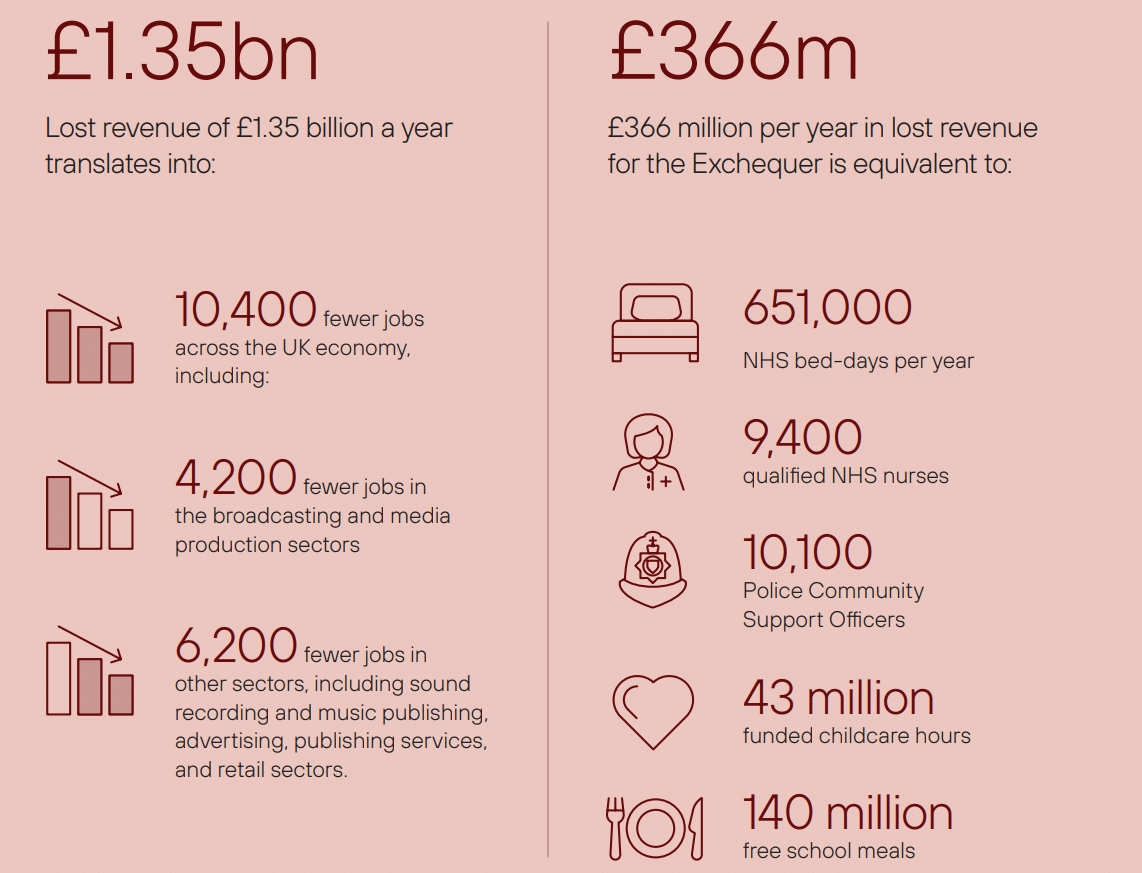
While the headline figure of £1.35 billion in missed revenue and its associated NHS nurse equivalents provide powerful rhetorical ammunition for right-holders, they ultimately highlight a fundamental disconnect in the modern media economy. As the streaming market fractures across dozens of competing corporate platforms, each requiring its own subscription fee, consumers increasingly experience severe subscription fatigue.
Awareness campaigns and voluntary frameworks may successfully nudge a subset of consumers toward legal channels, but as long as cost and convenience remain the dominant drivers of digital behavior, a multi-billion-pound shadow economy will persist. Ultimately, rights-holders may find that closing the gap on that hypothetical £1.35 billion requires not just better public relations or inflated economic modeling, but a fundamental reimagining of pricing, accessibility, and product delivery in an increasingly fragmented digital age.