Executive Overview
The European Union stands at a pivotal crossroads in the ongoing digital war against intellectual property theft. For years, sports leagues, television networks, and exclusive rights-holding conglomerates have mounted relentless pressure on the European Commission, demanding urgent, aggressive, and unified interventions to suppress the rampant unauthorized live-streaming of major sporting events and premium broadcasts.
While the EU attempted to address these grievances in 2023 with a non-binding recommendation encouraging member states to streamline their domestic takedown procedures, rightsholders largely dismissed the measure as toothless. Consequently, regulatory enforcement across the bloc has remained uneven. While some nations—most notably Italy with its aggressive "Piracy Shield" system—have adopted draconian real-time blocking measures, others have taken virtually no notable action, leaving rightsholders to navigate a fragmented and unpredictable legal landscape.
Now, a newly released study commissioned by the European Parliament’s Committee on Legal Affairs (JURI) threatens to upend the status quo. Authored by Professor Giovanni Maria Riccio of the University of Salerno and titled "Countering online piracy of sports and broadcast in the EU," the comprehensive report argues that voluntary guidance is entirely inadequate for the technical speed and scale of modern live broadcasting.
Instead, the study proposes a dramatic escalation: transitioning from advisory frameworks to a binding, EU-wide Regulation. At the heart of this aggressive proposal is a mandatory 30-minute takedown timer for internet intermediaries, coupled with an expanded enforcement footprint that ropes in VPN providers, content delivery networks (CDNs), and third-party DNS resolvers.
However, the report walks a precarious tightrope. Even as it champions the Italian Piracy Shield model—a system notorious for sweeping overblocking and collateral damage—the study openly acknowledges the severe risks of deploying such "blunt instruments." As the European Union weighs its next legislative moves, policymakers must grapple with a foundational dilemma: how to effectively protect multi-billion-dollar media rights without shattering the foundational architecture of the open internet.
Detailed Chronology: The Escalation of EU Anti-Piracy Policy
To understand the weight of Professor Riccio’s new report, it is essential to trace the legislative trajectory that brought European intellectual property policy to this friction point.
The 2023 Recommendation: A Missed Opportunity
For well over a decade, sports federations—led by giants such as UEFA, the English Premier League, and LaLiga—have argued that traditional court injunction processes operate far too slowly to combat live-streaming piracy. By the time a standard judge signs off on an injunction to block an illicit IP address or domain, the 90-minute football match or championship prize fight has long since concluded, rendering the remedy useless.
In response to these persistent lobbying efforts, the European Commission published a targeted recommendation in May 2023. The framework explicitly encouraged member states to empower rightsholders and administrative authorities to secure prompt injunctions and facilitate the rapid takedown of unauthorized live streams.
However, because the document was formatted as a mere recommendation rather than a hard legislative directive, it carried zero legal compulsion. Major rightsholders expressed profound disappointment, pointing out that without mandatory enforcement mechanisms, the patchwork of national laws across the 27 EU member states would remain fundamentally broken. While nations like Italy seized the political momentum to draft radical new laws, the vast majority of the bloc maintained standard, slow-moving judicial protocols.
The JURI Committee Intervention
Frustrated by the persistent regulatory fragmentation, the European Parliament’s Committee on Legal Affairs (JURI) commissioned Professor Riccio to draft an independent, authoritative assessment of the situation. Released for parliamentary review, the resulting study diagnoses the EU’s current counter-piracy posture as "fragmented and not fully adapted to the speed and technical complexity of live broadcasts."
The report marks a significant escalation in tone. Rather than asking member states to voluntarily clean up their acts, it urges the European Commission to draft a dedicated, binding EU Regulation. Such a law would supersede national discretion, establishing uniform procedural standards, rigid enforcement timelines, and synchronized regulatory oversight across every corner of the Single Market.

Supporting Context & Metrics: The Mechanics and Perils of the Proposed Framework
The JURI-commissioned study draws heavy inspiration from Italy’s controversial "Piracy Shield" platform, importing its most aggressive features while attempting to graft them onto a pan-European framework.
The 30-Minute Takedown Window and the Tech Chain
At the core of Professor Riccio’s recommendations is a strict temporal requirement: internet intermediaries must be legally mandated to sever access to unauthorized live streams within a compressed timeframe. Citing the Italian model, the report highlights the feasibility of a 30-minute takedown timer, forcing technical operators to act almost instantaneously upon receiving validated automated alerts from authorized rightsholders or enforcement agencies.
Crucially, the study argues that liability and operational obligations cannot stop at traditional Internet Service Providers (ISPs). The report asserts that effective live-stream suppression requires targeting the entire technical ecosystem that facilitates modern web traffic:
- Content Delivery Networks (CDNs): Infrastructures such as Cloudflare that cache and distribute content globally.
- Third-Party DNS Resolvers: Public lookup services like Google DNS and OpenDNS that translate human-readable URLs into machine-readable IP addresses.
- Virtual Private Networks (VPNs): Services that allow users to mask their geographic locations and bypass standard regional blocks.
- Dedicated Server Providers: Entities hosting the underlying hardware of rogue streaming operations.
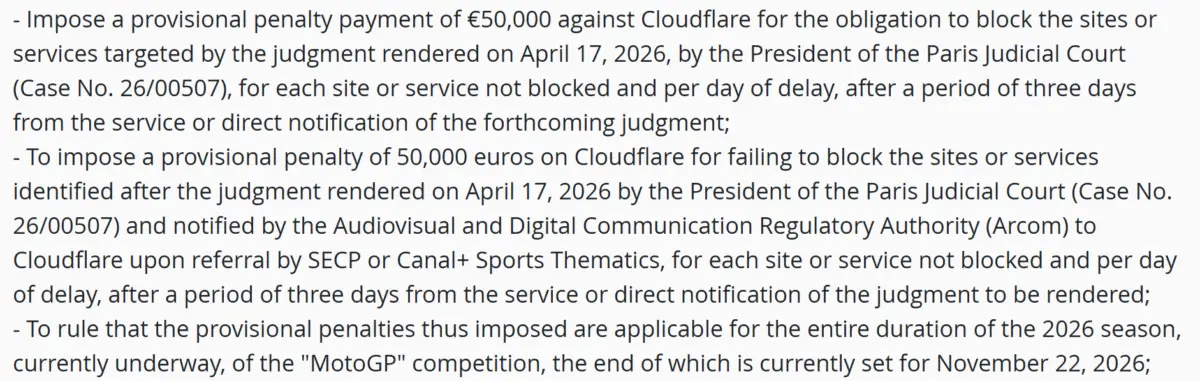
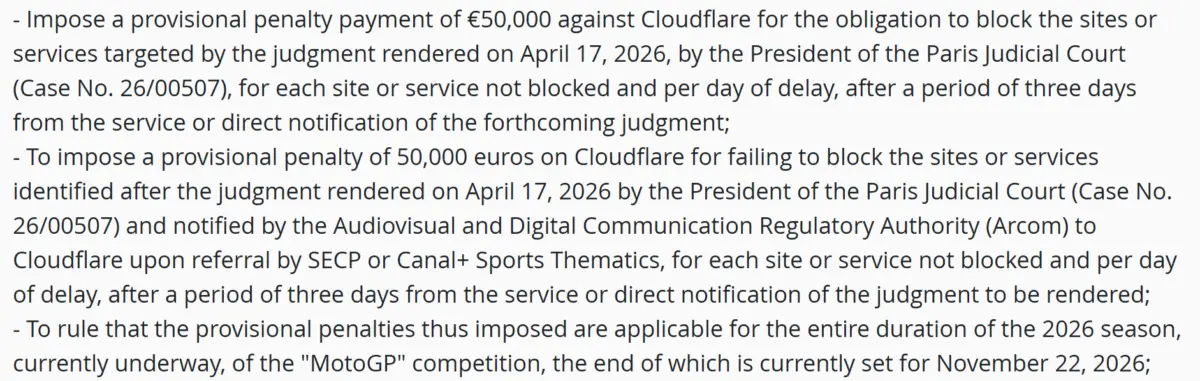
This expansive scope mirrors recent legal trends in Europe. Notably, the Paris Judicial Court made waves by issuing simultaneous site-blocking orders that compelled not only traditional French ISPs but also third-party DNS resolvers and VPN providers to actively block pirate domains.
Replicating AGCOM Across the Bloc
In Italy, the administrative agency responsible for overseeing the Piracy Shield is the Autorità per le Garanzie nelle Comunicazioni (AGCOM). The JURI report recommends exporting this administrative model to every single EU member state.
Under this setup, specialized administrative authorities—either newly created or empowered through existing bodies—would handle site-blocking procedures outside the traditional, overburdened court system. Proponents argue this is the only way to achieve the speed necessary for live events. Critics, however, warn that stripping the judiciary of its gatekeeping role removes essential checks and balances against administrative overreach.
The Spectre of Overblocking and Collateral Damage
Perhaps the most striking aspect of the JURI study is its intellectual honesty regarding the limitations of its own proposals. Even as it advocates for the widespread adoption of the Piracy Shield methodology, the report openly warns that "IP and DNS blocking remain inherently blunt instruments."
Because modern web hosting relies heavily on shared infrastructure—where thousands of distinct websites, cloud applications, and legitimate services may share a single IP address or content delivery network node—automated blocking systems cannot reliably isolate illegal sports streams without sweeping up innocent bystanders.
This collateral damage, commonly known as overblocking, has plagued Italy’s Piracy Shield since its inception. Empirical research underscores the severity of this phenomenon:
- An empirical study published by the Open Observatory of Network Interference (OONI) revealed that following a single aggressive blocking order issued under LaLiga’s enforcement initiatives in Spain, more than 554,000 unique domains were blocked at least once during football match broadcasts.
- The unintended casualties of this sweeping digital dragnet included vital non-profit, humanitarian, and public resources, such as websites belonging to Amnesty International, the American Civil Liberties Union (ACLU), UNICEF, the United Nations High Commissioner for Refugees (UNHCR), the Australian Senate, and critical Amazon S3 cloud storage endpoints.
Furthermore, the report nods to a landmark Centre for European Policy Studies (CEPS) analysis covered earlier this year by TorrentFreak. That study went so far as to call for an outright ban on IP-based blocking while recommending that rightsholders be held legally liable for the financial and operational damages inflicted on innocent third parties by mistaken blocks.
Despite these glaring warnings and empirical proofs of systemic collateral damage, Professor Riccio’s report recommends pressing forward with the Piracy Shield approach anyway. To mitigate the fallout, it proposes administrative safeguards—such as limiting block durations strictly to the runtime of the live event, maintaining regulatory oversight, and adhering to the principle of proportionality mandated by the Court of Justice of the European Union (CJEU). Whether these theoretical guardrails can prevent widespread digital collateral damage remains a subject of intense debate.

The Demand-Side Equation: Affordability and Accessibility
Significantly, the JURI report does not place the entirety of the blame on technological gaps or sluggish intermediaries. It explicitly acknowledges a fundamental economic truth often ignored by aggressive rightsholders: no amount of technical blocking will eradicate piracy if legitimate legal viewing options remain fragmented, overly complex, and prohibitively expensive.
The study notes that modern sports fans are frequently driven toward illicit streaming networks simply because legal alternatives are locked behind multiple, competing subscription packages, artificial geo-blocking barriers, and frustrating user interfaces. To truly curb consumer demand for pirate streams, the report insists that media companies must improve the accessibility, affordability, and user experience of legal platforms.
Official Statements and Industry Reactions
The release of the JURI study has intensified an already polarized debate across the European digital landscape, drawing sharp lines between content creators, technology giants, and civil liberties advocates.
Pro-blocking coalitions, representing elite sports leagues and major broadcasting networks, have welcomed the report as a vital step forward. Speaking on condition of anonymity, representatives from several European sports federations argued that the economic survival of grassroots and professional sports alike depends on cutting off the financial oxygen of pirate operations within minutes of kickoff. They contend that voluntary guidelines have failed because tech platforms and ISPs lack the commercial incentive to act decisively without the threat of heavy regulatory penalties.
Conversely, technology companies, digital rights organizations, and infrastructure providers have expressed alarm over the report’s expansive scope. Google and various civil society groups have consistently opposed mandatory site-blocking regimes in Europe, arguing that forcing recursive DNS resolvers and infrastructure providers to act as real-time content police degrades the stability, security, and neutrality of the internet.
Furthermore, ongoing deliberations within the European Commission regarding the review of the Copyright in the Digital Single Market Directive have laid bare these deep ideological divisions. While sports rightsholders continue to push aggressively for centralized EU-wide blacklists and mandatory real-time filtering obligations, technology associations warn that enshrining a 30-minute takedown regime will inevitably codify systemic collateral damage, silencing innocent publishers and damaging digital trust.
Future Outlook: What Lies Ahead for EU Anti-Piracy Legislation?
As it stands, Professor Riccio’s study remains a piece of third-party advisory research commissioned by a European Parliament committee rather than a piece of codified statute. It carries no immediate legal force, and its recommendations must navigate the complex, often labyrinthine legislative machinery of the European Union before they can manifest as binding law.
The immediate battleground will take place within the European Commission, where bureaucrats are actively weighing inputs from both pro-blocking sports lobbies and anti-blocking technology advocates.
If the Commission decides to draft a formal legislative proposal based on the JURI study’s recommendations, it will ignite a fierce political showdown in the European Parliament and the Council of the European Union. Member states with robust telecommunications industries and strong digital rights traditions may push back aggressively against proposals that mimic Italy’s heavy-handed Piracy Shield model. Conversely, nations heavily invested in commercial media and sports tourism may champion the 30-minute takedown mandate as an economic necessity.
Ultimately, the European Union faces a profound philosophical challenge. In its race to protect the revenues of the sports entertainment industry from the agile ingenuity of modern pirates, Brussels risks enacting blunt legislative instruments that erode network stability, trample innocent digital infrastructure, and undermine freedom of expression. Whether policymakers can successfully thread this needle—crafting a targeted, responsive legal framework without breaking the internet in the process—will define the future of European digital policy for the next decade.