In the modern digital economy, revenue is rarely generated by accident; it is engineered word by word. For entrepreneurs, marketers, and independent operators, copywriting serves as the primary engine for customer acquisition. While many treat writing as an artistic endeavor driven by eloquence and prose, top-tier practitioners recognize it as a high-stakes, data-driven science.
Having generated over seven figures online primarily through written marketing channels—such as blog posts, social media distributions, and targeted email newsletters—industry veterans understand that the ultimate objective of copy is not to win literary awards, but to convert attention into measurable ROI. This comprehensive blueprint outlines the ten foundational copywriting strategies essential for driving sustainable business growth, eliminating writer’s block, leveraging artificial intelligence correctly, and scaling conversion rates across modern digital platforms.
Detailed Chronology: The Evolution of Modern Copywriting
The landscape of customer acquisition has shifted dramatically over the past two decades. Understanding how copywriting has evolved from traditional print advertising to dynamic digital ecosystems highlights why tactical execution must adapt to modern consumer behavior.
The Print and Direct Mail Era (Late 20th Century): Copywriting relied heavily on long-form sales letters, heavy psychological triggers, and deep-seated pain points delivered through postal mail or magazine inserts. Practitioners like Gary Halbert and Dan Kennedy established the rules of direct response.
The Web 1.0 and SEO Boom (Early 2000s): As the internet matured, writing shifted toward keyword stuffing and high-volume blog publishing. The focus was on search engine visibility rather than deep user engagement or psychological resonance.
The Social Media and Content Marketing Wave (2010s): Platforms like Facebook, Twitter, and LinkedIn fractured attention spans. Copywriters had to adapt by shortening hooks, improving visual layouts, and creating native content that felt organic rather than promotional.
The AI and Multi-Channel Ecosystem (Present Day): Today’s copywriters face unprecedented noise. With the rise of generative AI tools like ChatGPT, basic content is commoditized. True differentiation now lies in deep customer research, authentic personal branding, and precise attribution modeling that connects words directly to revenue.
Supporting Context & Metrics: What Makes a Great Copywriter?
Becoming a great copywriter does not mean expanding your vocabulary or writing more eloquently. In fact, complex prose often alienates readers and depresses conversion rates. Great copywriters are clear, concise, and relentlessly focused on converting readers into buyers.
Instead of obsessing over the craft of writing for its own sake, professionals must obsess over generating a higher return on investment (ROI) than the market average. If you can prove that your words yield a predictable financial return, your value in the marketplace skyrockets.
1. Talk Directly to Your Customers
Your job as a copywriter is to capture attention, build trust, introduce a viable solution, dismantle objections, and convert the reader. To achieve this, you must intimately understand your audience’s daily reality, anxieties, and desires.
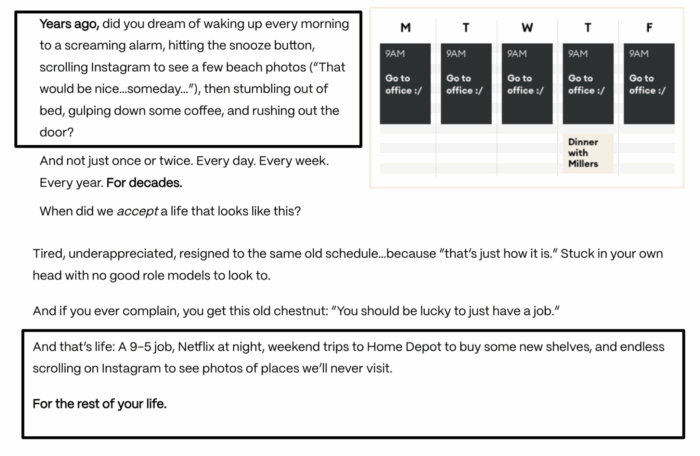
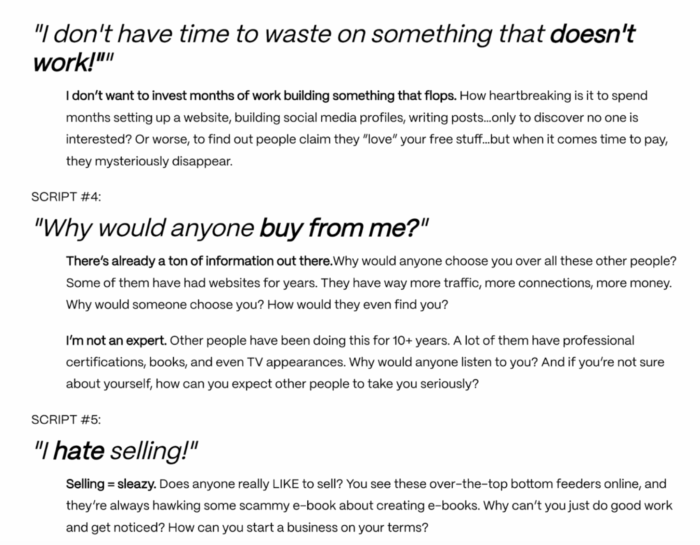
Consider top-tier landing pages, such as those used by Ramit Sethi for his Earnable program. Instead of relying on generic platitudes like "learn how to make more money," high-converting copy mirrors the exact psychological pain points of the target prospect: the monotonous 9-to-5 job, evening television scrolling, weekend errands, and financial anxiety.
Tactical Execution for Customer Research:
Interview Sales Teams: If you are freelancing and lack direct access to customers, speak extensively with the client’s sales representatives to uncover frequent objections and pain points.
Analyze Call Transcripts: Download sales call recordings, ingest the transcripts into an AI tool like ChatGPT, and prompt the system to categorize the most common customer hurdles.
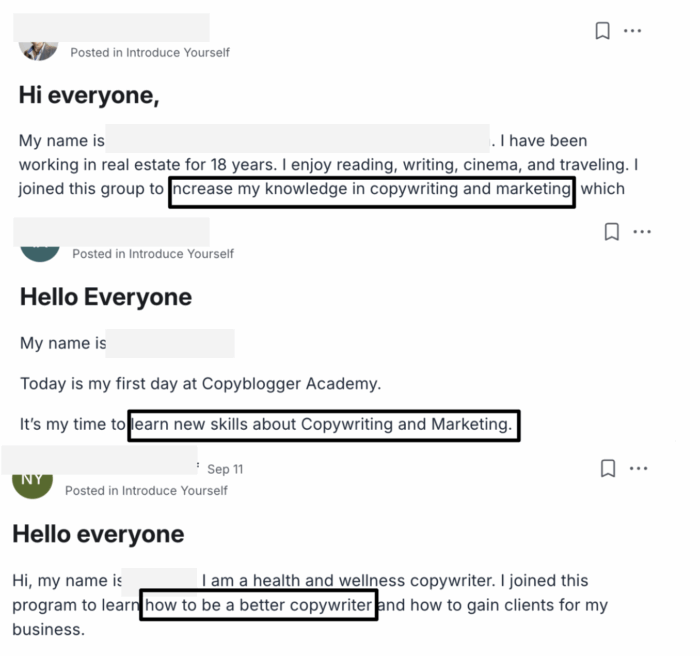
Mine Online Communities: Dive into specialized subreddits and Facebook groups. Search for discussions surrounding competing products to absorb the exact language, tone, and emotional triggers your audience uses naturally.
2. Learn From Competitors Through Ad Libraries
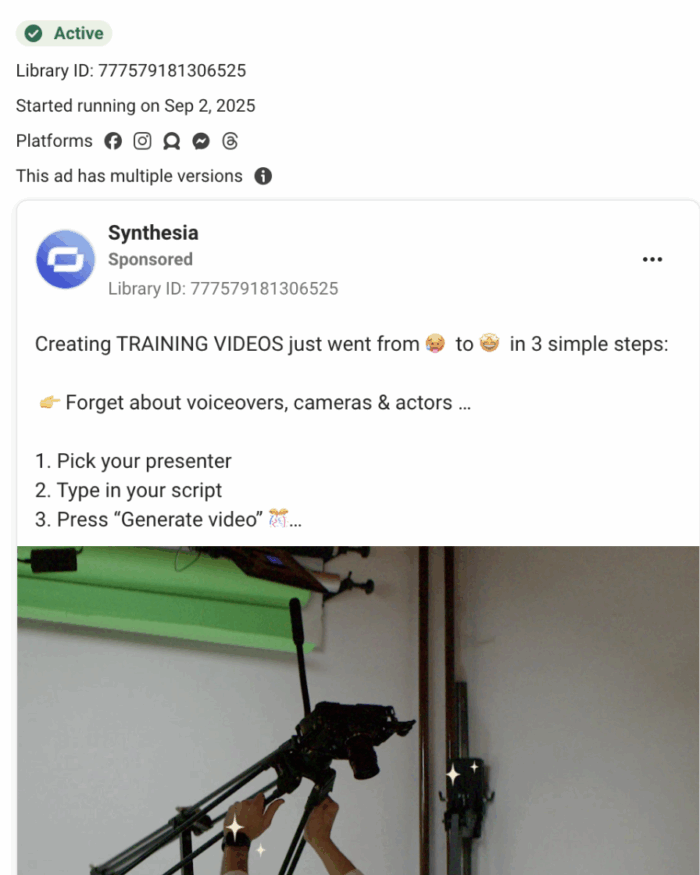
The leading enterprises in your niche have already invested hundreds of thousands of dollars testing copy variations. Rather than starting with a blank slate, analyze their campaigns.
The LinkedIn and Meta (Facebook) Ad Libraries are invaluable repositories. Because paid advertising requires ongoing financial commitment, ads that run for extended periods (such as several weeks or months) are generally winning variations. By reviewing these long-running ads, you can identify which core pain points resonate most deeply within your industry.
3. Build and Maintain a Swipe File
Elite copywriters rarely invent new structures from scratch; they curate frameworks that have historically proven successful. Start a personal swipe file cataloging high-converting headlines, email sequences, and sales pages that capture your attention.
Additionally, reference curated repositories like SwipeFile.com (maintained by veteran copywriter Neville Medhora). Reviewing copy praised by seasoned professionals sharpens your analytical eye far faster than examining advertisements aimed at casual consumers.
4. Establish a Repeatable Writing Process
Relying on sudden bursts of inspiration is a recipe for missed deadlines and writer’s block. Establishing a systematic writing process ensures your copy consistently hits all critical conversion milestones:
Research & Pain Mapping: Gather customer insights, competitor data, and product specifications.
Outline Construction: Sequence your thoughts logically—starting with a magnetic hook, transitioning into the core problem, presenting the solution, overcoming objections, and concluding with a clear Call to Action (CTA).
Drafting & Refining: Write freely without self-editing, then tighten the prose for maximum clarity and punchiness.
5. Practice Writing Through Real-World Application
Writing proficiency improves only through deliberate repetition. However, practicing in a vacuum limits growth. The most effective way to hone your skills is to write copy for your own digital assets or side projects.
Whether you launch a niche affiliate blog, build a micro-SaaS tool via platforms like Lovable, or establish a personal brand on LinkedIn, driving traffic and conversions for your own ventures teaches you the difference between vanity metrics (visitors and likes) and purchase intent. Furthermore, these personal projects serve as undeniable case studies when pitching prospective clients.
Embracing AI for the Right Use Cases
Artificial intelligence has fundamentally changed the writing workflow. While generative AI should not be relied upon to write authentic, voice-driven copy from scratch, it serves as a powerful operational partner when used for specific tasks:
Pain Point Research: Prompt AI to analyze broader market frustrations, jogging your memory for angles you can validate with real customer data.
Sentence Phrasing & Clarity: When a paragraph feels clunky or overly dense, paste it into an AI tool with the prompt: "Can you rewrite this passage with maximum clarity?"
Finding Expert References: Use AI to locate real-world case studies, quotes, or discussions from industry practitioners on platforms like LinkedIn to back up your arguments with authoritative proof.
Official Statements & Industry Perspectives
Industry leaders emphasize that copywriting is ultimately an exercise in empathy and economic attribution.
"Copywriting is not about clever wordplay; it is about stepping inside the mind of your prospect, understanding their deepest frustrations, and clearly demonstrating how your solution makes their life better." — Digital Marketing Consensus
Furthermore, experts highlight the necessity of measuring economic output over subjective style preferences:
"If you give the same piece of copy to ten different editors, you will get ten different opinions. Data does not care about opinions; it cares about conversion rates and revenue generated." — Senior Conversion Strategist
Future Outlook: Mastering Platforms and Measuring ROI
As digital platforms continue to fragment, the future belongs to copywriters who specialize deeply and track performance meticulously.
Master One Platform
Different digital environments require entirely different psychological approaches. Thought leadership and personal storytelling thrive on LinkedIn and X (formerly Twitter), whereas high-intent, long-tail information retrieval dominates search engines through blog content. Mastering the algorithmic nuances and structural requirements of a single platform allows you to command premium pricing.
Measure the True ROI
To prove your value, you must track beyond surface-level metrics:
For Ghostwriting: Monitor the profile quality of engaged users (e.g., decision-makers versus general consumers) and implement custom conversion fields on inbound lead forms.
For Blog Content: Set up advanced conversion tracking in Google Analytics (GA4) to tie organic traffic directly to product signups or purchases.
For Email & Sales Funnels: Partner directly with clients to review revenue attribution dashboards tied to specific email broadcasts and landing page funnels.
Adopt Naval Ravikant’s Core Principle
Sustained success requires adhering to the philosophy shared by investor Naval Ravikant: Be impatient with action, and patient with results. Push yourself to write, test, and iterate aggressively every single day, but commit to the long-term horizon required for compounding momentum to take effect.
By combining rigorous customer research, systematic processes, data-backed attribution, and continuous community feedback—such as the resources found within professional ecosystems like Copyblogger Academy—aspiring copywriters can transform their words into a reliable, seven-figure growth asset.