Executive Overview
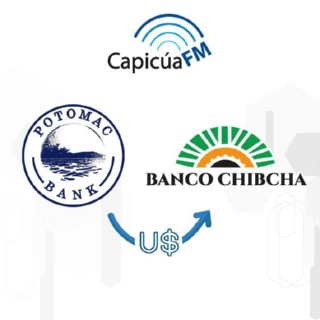
In international finance, a single word can be the difference between a successful transaction and a catastrophic systemic failure. This reality served as the foundation for a groundbreaking audio drama produced by Allan Tépper on his acclaimed podcast, CapicúaFM. The episode features a simulated live broadcast of a historic, first-of-its-kind $1 billion wire transfer between two fictitious financial institutions: the Potomac Bank in the United States and Banco Chibcha in Colombia.
What begins as a celebratory corporate milestone quickly devolves into a multi-billion-dollar nightmare. The culprit is not a cyberattack, nor is it a corrupt executive. Instead, the crisis is born from a fundamental, systemic linguistic discrepancy: the difference between the English word "billion" ($10^9$, or one thousand million) and the Castilian Spanish word "billón" ($10^12$, or one million million).
To bring this narrative to life, Tépper went to extraordinary lengths to establish absolute realism. Rather than relying on generic storytelling tropes, the production featured fully realized corporate identities for the fictitious banks—complete with custom-designed logos, registered web domains, and highly targeted casting. By utilizing voice actors with precise regional accents, the episode exposed a glaring linguistic vulnerability at the intersection of global banking, translation, and lexicography.
Detailed Chronology of a $999 Billion Misunderstanding
[Potomac Bank (US)]  --- Transmits $1,000,000,000 (10^9) --->  [Banco Chibcha (Colombia)]
                                                                       |
                                                            Expected: $1,000,000,000,000 (10^12)
                                                                       |
                                                            Deficit:  $999,000,000,000
The Setup: Live from the Digital Airwaves
The dramatic scene unfolds as a live-to-air broadcast on CapicúaFM, hosted by Allan Tépper playing a stylized version of himself. He introduces two high-ranking banking executives poised to execute a historic financial transaction:
- Fernando Villanueva, Vice President of International Wire Transfers at the Potomac Bank (based in the United States).
- Sandra Restrepo Betancourt, Vice President of International Wire Transfers at Banco Chibcha (based in Colombia).
The atmosphere is initially triumphant. Both executives express their excitement to the global audience, framing the impending transfer as a monumental leap forward for cross-border financial integration.
The Transaction and the Sudden Fallout
With the press of a button, Villanueva initiates the wire transfer from Washington, D.C. On the receiving end in Bogotá, Restrepo watches her terminal. The confirmation screen flashes, but the celebratory mood instantly vanishes.
Restrepo’s expression turns from excitement to profound concern. "We have a problem," she announces.
Villanueva, speaking in Castilian, is perplexed: "¿Qué pasa? ¿No recibieron la transferencia?" ("What’s wrong? You didn’t get the transfer?")
Restrepo responds: "La recibimos, pero no es la cantidad pactada." ("We received it, but it is not the agreed-upon amount.")
The Mathematical Discrepancy
As the two executives scramble to diagnose the error, the core of the conflict is laid bare:
- Villanueva’s Defense: He insists that he executed the transaction perfectly, entering the numeral 1 followed by nine zeros ($1,000,000,000$). In the financial and linguistic paradigm of the United States, this is the absolute definition of one billion dollars.
- Restrepo’s Counterpoint: She argues that the transfer is catastrophically short. In Colombia, as in the rest of the Spanish-speaking world, a billón is defined by a 12-zero format ($1,000,000,000,000$).
By sending a short-scale "billion" to an institution expecting a long-scale "billón," Potomac Bank had delivered a mere fraction of the expected funds, leaving an astronomical deficit of $999,000,000,000 (nine hundred ninety-nine billion dollars).
+----------------------------------------------------------------------------+
|                       THE MATHEMATICAL GAP                                 |
+----------------------------------------------------------------------------+
| US "Billion" (Short Scale)   : $1,000,000,000         (9 Zeros)            |
| Spanish "Billón" (Long Scale): $1,000,000,000,000     (12 Zeros)           |
+----------------------------------------------------------------------------+
| Shortfall / Deficit          : $999,000,000,000       (99.9% Deficit)      |
+----------------------------------------------------------------------------+
The Uninvited Guest: The Royal Academy Intervenes
In a satirical twist, the live call is suddenly breached by Dulcinea, a public relations spokesperson representing the Real Academia Española (RAE)—the official governing body of the Castilian language.
Dulcinea attempts to pacify the panicked bankers by offering a bureaucratic compromise: "Not to worry," she chirps. "You are both correct according to our latest Dictionary!"

This academic hand-waving only infuriates Restrepo. The Banco Chibcha VP points out the absolute absurdity of a linguistic authority declaring two vastly different mathematical values as equally valid in a global economy. Restrepo argues that the Academy’s failure to maintain a rigid, unambiguous standard for numerical terms has directly caused this financial disaster.
Holding the RAE legally and financially culpable for the blunder, Restrepo demands that the Academy immediately wire Banco Chibcha the missing $999,000,000,000 to cover the shortfall. Caught off guard and thoroughly embarrassed, Dulcinea feigns a poor connection—pretending the international call is failing—and abruptly hangs up.
The Reality Check
Following the climax of the drama, Tépper steps back into his role as host to debrief the audience. He clarifies that the segment was a carefully crafted simulation designed to highlight a real-world vulnerability.
To ground the episode in contemporary financial reality, Tépper credits a 2022 investigative article written by journalist Nathalia Morales Arévalo for the Colombian financial newspaper La República. The article detailed a major milestone in Colombian banking: domestic institutions offering specialized accounts denominated in US dollars through foreign subsidiaries. Tépper closes the segment by extending an open invitation to Arévalo to appear on a future episode of CapicúaFM to discuss the evolving mechanics of cross-border Latin American banking.
Linguistic Analysis: The Battle of Short Scale vs. Long Scale
The conflict at the heart of Tépper’s audio drama is rooted in a historical divide in how large numbers are named. This divide is categorized into two systems: the Short Scale and the Long Scale.
Scale Comparison for 10^9 and 10^12:

Power of 10   | US/UK (Short Scale) | Continental Europe/Spanish (Long Scale)
--------------|---------------------|----------------------------------------
10^9          | Billion             | Mil millones / Millardo
10^12         | Trillion            | Billón
The Short Scale ($10^9$)
Principally used in the English-speaking world (including the US, Canada, and modern-day Great Britain), the short scale increases by factors of a thousand.
- Million = $10^6$ (one thousand thousands)
- Billion = $10^9$ (one thousand millions)
- Trillion = $10^12$ (one thousand billions)
The Long Scale ($10^12$)
Historically used in continental Europe and throughout Spanish-speaking Latin America, the long scale increases by factors of a million.
- Millón = $10^6$ (one million)
- Mil millones (or Millardo) = $10^9$ (one thousand millions)
- Billón = $10^12$ (one million millions)
The Lexicographical Friction
The Real Academia Española (RAE) has historically defended the long-scale definition of billón. However, as American financial dominance has globalized the short-scale "billion," English-to-Spanish translations have increasingly blurred these lines.
When reference dictionaries attempt to document colloquial usage—where some Spanish speakers in highly globalized environments adopt the American "billion" to mean $10^9$—they introduce systemic risk. In financial law and contract drafting, such ambiguity is highly dangerous. A contract promising a "billón" could be legally interpreted in two entirely different ways, leading to litigation of unprecedented scale.
Production Design and Acoustic Realism
To ensure the audio drama resonated as a legitimate broadcast rather than a simple comedy sketch, Tépper approached the production with the meticulousness of an investigative journalist and a seasoned sound designer.
+-----------------------------------------------------------------------------+
|                         TACTICAL PRODUCTION DESIGN                          |
+-----------------------------------------------------------------------------+
| 1. Corporate Identity : Custom logos & registered domains for Potomac Bank  |
|                         and Banco Chibcha.                                  |
| 2. Acoustic Profiles  : Precise casting of regional accents to reflect      |
|                         organizational culture and geography.               |
| 3. Narrative Anchors  : Grounding the fiction in real-world financial       |
|                         journalism (La República).                          |
+-----------------------------------------------------------------------------+
1. Corporate Branding and Web Infrastructure
Tépper did not stop at scriptwriting. To make the fictitious entities searchable and credible to any listener attempting to verify their existence, he:
- Commissioned professional graphic design assets to create distinct corporate logos for both Potomac Bank and Banco Chibcha.
- Purchased and registered active web domain names for both fictitious banks, establishing an online paper trail that mirrored real-world financial institutions.
2. Phonetic Casting and Dialectology
In audio-only storytelling, the voice is the sole vector of identity, geography, and authority. Tépper carefully selected his voice cast to leverage the cultural connotations of specific Spanish accents:
- The Colombian Accent (Sandra Restrepo Betancourt): Cast with a native speaker displaying the clear, professional, and melodious cadence typical of Colombian Spanish (often associated with Bogotá or Medellín). This accent immediately grounded Banco Chibcha in its regional reality, conveying corporate competence and local pride.
- The Americanized/Neutral Accent (Fernando Villanueva): Designed to reflect a bilingual professional operating within the United States financial system. The accent was highly standardized, reflecting the linguistic profile of a corporate executive bridging the gap between Latin American clients and Wall Street.
- The Peninsular Accent with Distinción (Dulcinea): To portray the RAE spokesperson, Tépper cast a voice actress utilizing the classic distinción dialect of central and northern Spain—where the soft "c" and "z" are pronounced as a voiceless dental fricative ([θ], like the "th" in "think"), distinct from the "s" sound. This acoustic profile instantly signals to Spanish-speaking audiences the historical weight, academic traditionalism, and continental authority of Madrid’s Royal Academy.
3. The Science of Pronunciation: Seseo vs. Distinción
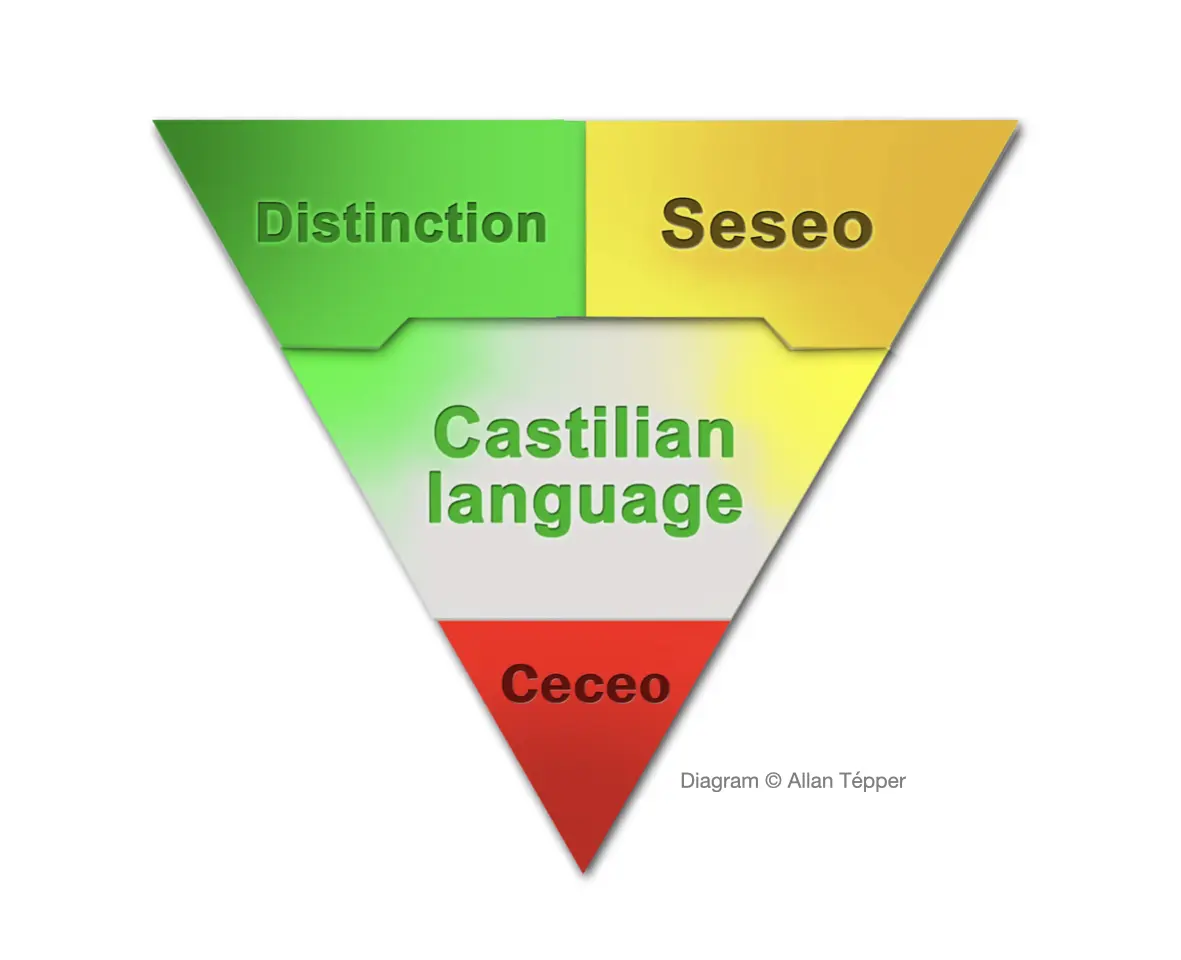
This phonetic choice is further explored in Tépper’s educational project, Speak Castilian, particularly in the premiere episode titled "Castilian lisp? Think again!"
Tépper uses these dramatic narratives to debunk common linguistic misconceptions. For example, he explains that the Peninsular pronunciation of "c" and "z" is not a "lisp" (a speech impediment), but rather a systematic phonetic feature known as distinción. This stands in contrast to seseo (typical of Latin America and parts of southern Spain), where "c", "z", and "s" are homophones. By integrating these real linguistic phenomena into his fictional worlds, Tépper elevates the educational value of his creative productions.
Supporting Context & Metrics
The meticulous nature of Tépper’s productions is designed to serve a highly educated, international audience. Since its launch in 2014, CapicúaFM has cultivated a robust global footprint.
According to verified metrics from Podtrac, the show has achieved:
- 515,239+ unique plays worldwide.
- An active listener base spanning 161+ countries.
This diverse audience profile makes CapicúaFM the ideal vehicle for exploring high-concept linguistic issues. The show’s listeners are uniquely positioned to appreciate the subtle humor and systemic danger of translation errors, as many of them operate across borders, navigating bilingual environments daily.
Official Statements and Analytical Commentary
The Lexicographical Defense (Simulated RAE Stance)
While the character of Dulcinea fled the call in the dramatic simulation, real-world lexicographers often defend the inclusion of multiple definitions as a reflection of living language.
In response to critics who demand rigid linguistic standardization to protect international commerce, academic bodies often argue that dictionaries are descriptive rather than prescriptive. If a significant portion of the Spanish-speaking business community in Miami or New York uses "billón" to mean $10^9$ due to English influence, lexicographers argue it is their duty to document this shift—even if it introduces financial risk.
The Financial Compliance Perspective
Conversely, international banking compliance officers and legal translators view such linguistic fluidity with deep concern. Modern financial systems rely heavily on standardized codes (such as SWIFT and ISO standards) to bypass natural language entirely.
"Natural language is an inherently risky medium for high-value transactions," notes one international trade attorney. "This is precisely why financial contracts must specify not only the currency but also the mathematical notation system—explicitly defining whether numerical terms follow the short or long scale. Relying on a dictionary to define a multi-billion-dollar contract is a recipe for litigation."
Future Outlook
As global markets become more integrated, the friction between English financial terminology and regional linguistic standards will only intensify. Allan Tépper’s CapicúaFM continues to serve as an important cultural and educational touchpoint, using narrative fiction to expose these invisible points of vulnerability.
Listeners can expect more high-fidelity dramatic scenes in future episodes of CapicúaFM, as Tépper continues to explore the intersections of language, technology, and human error. By combining rigorous research with immersive audio design, the podcast demonstrates that in the modern world, understanding the nuances of language is not merely an academic pursuit—it is a financial imperative.
To stay updated on upcoming articles, reviews, books, and seminars by Allan Tépper, you can subscribe to his bulletins in both English and Castilian at his official portals, AllanTepper.com and radio.AllanTepper.com.