Executive Overview
In the high-stakes theater of modern commercial spaceflight, milestones are frequently measured in seconds of engine burn, telemetry milestones, or clean separations. However, the true holy grail of the modern aerospace industry remains rapid, full reusability. For SpaceX, that ultimate objective hinges on a gargantuan, stainless-steel vehicle known as Starship.
While the company’s long-term operational vision for Starship relies on precision “catch” maneuvers executed by mechanical arms integrated directly into the launch tower—a technique colloquially dubbed “Mechazilla”—recent developments in the remote expanses of the Indian Ocean have injected a dramatic new chapter into the spacecraft’s development lifecycle.
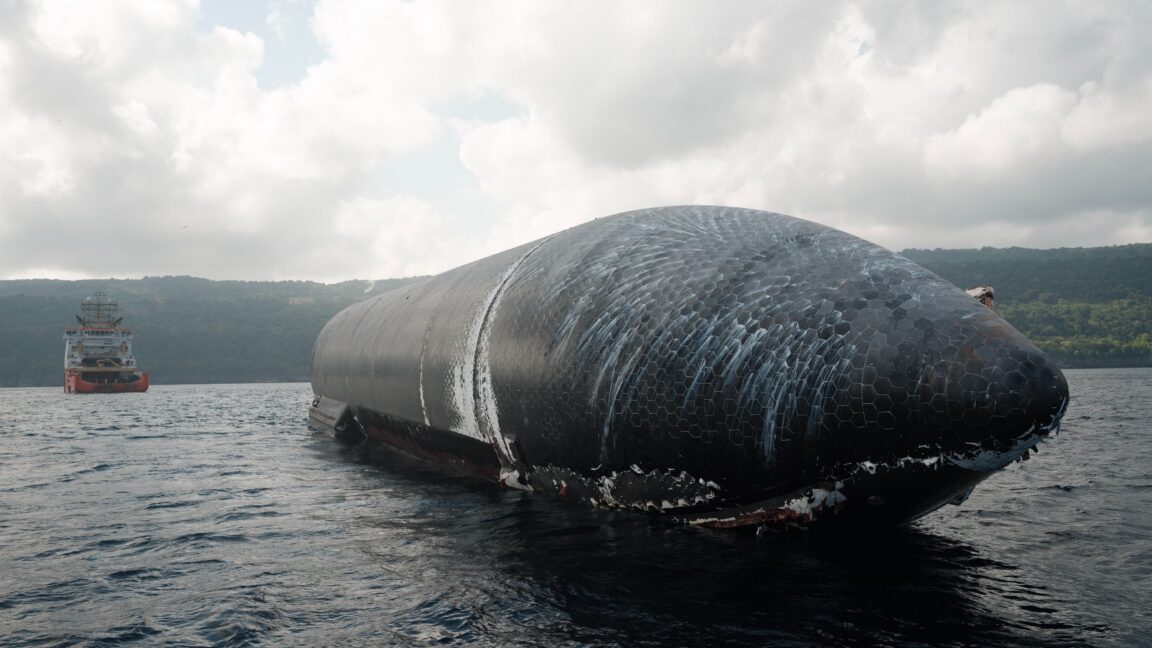
Following a remarkably successful atmospheric reentry and controlled descent, a recent Starship test vehicle achieved what many within and outside the company initially deemed improbable: it survived splashdown intact, remained afloat in unforgiving ocean conditions, and was successfully towed to the remote shores of Christmas Island.
Though this specific vehicle will never fly again—having succumbed to the corrosive nature of sea water and structural damage sustained during a post-splashdown tip-over—its salvage represents a monumental engineering triumph. For SpaceX recovery crews, keeping the massive rocket afloat using air-filled Yokohama fenders was an ad-hoc masterclass in marine salvage. For SpaceX engineers, retrieving the physical hardware provides an unprecedented, subterranean treasure trove of flight data. Most critically, it allows recovery teams to pull close-up, physical diagnostics of the vehicle’s 18,000-tile ceramic heat shield and engine array, offering crucial insights that will dictate the evolution of future interplanetary architectures.
Detailed Chronology: From Atmospheric Reentry to Christmas Island Salvage
The journey of this particular Starship test article from the edge of space to the shores of an isolated Australian territory in the Indian Ocean read like an aerospace thriller, full of sudden reversals and high-tension operational hurdles.
The Descent and the Odds
As the vehicle plummeted back toward Earth during its latest orbital test flight, the primary objective was gathering telemetry and proving the structural integrity of the spacecraft through the brutal plasma heating of atmospheric reentry. Historically, early-generation Starships suffered significant thermal degradation, shedding tiles and sustaining structural burn-throughs. This flight, however, defied expectations, holding together through the plasma layer and executing a controlled, vertical flip-and-burn maneuver just above the ocean’s surface.
Yet, surviving the descent was only half the battle. Splashing down in the open ocean is inherently hazardous for a spacecraft not designed for marine landings. Salt water is a notoriously aggressive agent, swiftly degrading high-performance stainless steel alloys, clogging sensitive internal electronics, and corroding complex Raptor engine manifolds.
Compounding these environmental hazards, the vehicle suffered a partial tip-over event immediately following its impact with the waves. For hours, uncertainty gripped mission control. Just a week prior to the successful salvage, SpaceX Chief Executive Officer Elon Musk struck a sobering tone during internal evaluations, bluntly admitting to teams that recovering the ship was "not looking good."
The Indian Ocean Operation
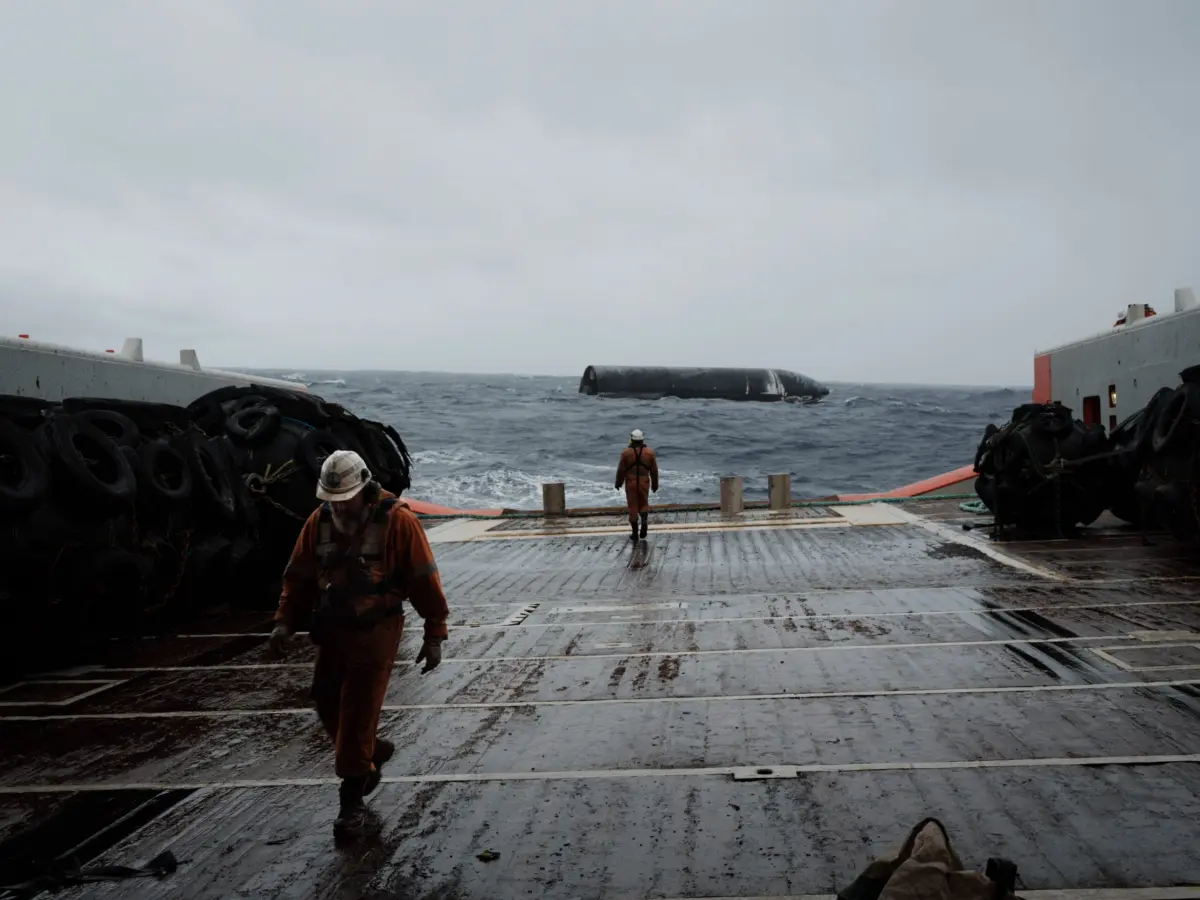
Despite the pessimistic early outlook, SpaceX’s specialized marine recovery fleet—stationed in the Indian Ocean precisely for this contingency—swung into action. Confronted by turbulent seas and swells that threatened to break the massive steel hull apart, the offshore teams executed a delicate, high-risk stabilization operation.
Divers and marine engineers deployed massive, air-filled Yokohama marine fenders—heavy-duty rubber bumpers typically used to cushion supertankers during ship-to-ship transfers—securing them around the submerged and listing Starship. This improvised scaffolding kept the vehicle buoyant and stable, preventing it from sinking into the oceanic abyss.
Once stabilized, the fleet initiated a slow, arduous tow toward Christmas Island (Kiritimati), an isolated Australian external territory in the Indian Ocean. Bringing Starship safely to port was an unexpected coup. It transformed a nominal expendable splashdown into a physical material-recovery mission, granting engineers direct access to flight-proven hardware that had hitherto been lost to the deep sea.
Supporting Context & Metrics: The Heat Shield Dilemma
To understand why the recovery of this specific Starship hull is causing ripples across the aerospace sector, one must examine the critical technology protecting it: the thermal protection system (TPS).
The 18,000-Tile Challenge
Starship’s exterior is blanketed by approximately 18,000 hexagonal ceramic tiles. This intricate thermal armor is designed to insulate the vehicle’s structural stainless-steel shell from the blinding, multi-thousand-degree temperatures generated when compressing atmospheric gas during hypersonic reentry.
The concept is not entirely novel; NASA’s iconic Space Shuttle fleet utilized silica-based thermal protection tiles to survive reentry. However, the Space Shuttle program served as a cautionary tale regarding operational turnaround times. Following every single shuttle mission, armies of technicians spent weeks meticulously inspecting, repairing, and replacing thousands of individual tiles by hand.
For SpaceX, which operates under a paradigm of aircraft-like operations where a vehicle must fly, land, refuel, and fly again multiple times a day, the Shuttle-era maintenance model is a non-starter. To achieve the economic thresholds required to build self-sustaining bases on the Moon and Mars, SpaceX must completely eliminate tile replacements and drastically minimize pre-flight inspections.
The Metrics of Reusability
The stakes are mathematically staggering. Consider the operational parameters:
- Thermal Extremes: Reentry exposes the windward side of Starship to temperatures exceeding 1,400°C (2,550°F).
- Fleet Scale: A mature Starship fleet conducting multi-daily launches will subject tens of thousands of tiles to cyclic thermal shock, acoustic vibrations, and mechanical stress.
- Turnaround Velocity: The gap between landing and the next launch must shrink from months (the NASA paradigm) to hours.
During SpaceX’s inaugural quarterly earnings call on August 4, Elon Musk made headlines by declaring that he now considered the long-standing Starship heat shield problem "solved." This bold assertion stemmed from the dramatically improved visual state of the tiles post-flight compared to earlier, highly fractured iterations.
Yet, external aerospace analysts and veteran propulsion engineers remain cautious. While the current generation of tiles is undeniably robust enough to preserve the hull through a single descent, proving durability across a repeated operational cadence remains an entirely different engineering beast. The physical retrieval of the Christmas Island vehicle provides the empirical ground truth needed to bridge this gap. By removing recovered tiles and subjecting them to destructive laboratory testing—as well as analyzing the micro-structural wear on the underlying steel bonding pins—SpaceX can transition from qualitative optimism to quantitative certainty.
Official Statements and Industry Perspectives
The duality of opinion between SpaceX’s leadership and external aerospace observers highlights a fascinating philosophical divide in modern rocket engineering: empirical iteration versus conservative qualification.
SpaceX’s Internal Perspective
From the perspective of SpaceX leadership, the successful salvage operation validates an iterative design philosophy that prioritizes rapid prototyping in real-world flight environments over endless computer simulations and wind-tunnel tests.
Speaking about the deployment of teams in the Indian Ocean, Musk emphasized the immediate utility of the recovered hardware. Close-up, high-resolution imagery and physical samples taken from the heat shield and the cluster of Raptor engines are already being cataloged.
"Teams were able to obtain close-up photos and physical samples of the heat shield and engines for future upgrades,"
company representatives noted, framing the salt-water exposure not as a catastrophic failure, but as a minor hurdle outweighed by the sheer volume of forensic data acquired. By examining how specific bond-lines held up under thermal and mechanical duress, SpaceX engineers can fine-tune the next iterations of tile adhesives and retention mechanisms.
The Skeptical Industry Consensus
Conversely, independent aerospace analysts urge caution, pointing out that surviving a single flight is a far cry from achieving true rapid reusability.
As noted in contemporary aerospace assessments, "despite recent successes, rapid reuse of Starship remains a tough nut to crack." Critics argue that while the exterior tiles of the recovered ship appeared structurally intact from a distance, microscopic thermal fatigue, micro-fissuring of the ceramic matrix, and degradation of the underlying attachment pins may only become apparent after exhaustive metallurgical and non-destructive testing in a cleanroom environment.
Furthermore, industry veterans point out that ocean recovery—even when successful—fundamentally compromises the cleanliness of the vehicle. Salt water deposits sodium and chlorine ions onto metal surfaces, which, if not meticulously mitigated, can accelerate stress-corrosion cracking in high-strength stainless steel alloys like the 304L variant used on Starship. Consequently, while this salvaged hull has given SpaceX invaluable forensic gifts, future operational vehicles will bypass the ocean entirely, returning straight to the arms of the launch tower.
Future Outlook: Toward Tower Catches and Interplanetary Fleet Scaling
The ultimate trajectory of the Starship program is clear, and the lessons learned from the Indian Ocean salvage will directly inform the immediate roadmap for upcoming flight tests.
Refining Mechazilla
While snaring a tumbling rocket out of the sky with giant mechanical arms sounds like science fiction, SpaceX has already demonstrated the feasibility of the concept with the Super Heavy booster catch. Extending this capability to the orbital Starship upper stage is the final puzzle piece in eliminating maritime recovery entirely.
Catching Starship at the launch site solves multiple engineering bottlenecks simultaneously:
- Elimination of Saltwater Corrosion: By avoiding ocean splashdowns, SpaceX protects sensitive electronics, avionics bays, and Raptor engine components from the destructive environment of sea water.
- Immediate Turnaround: A tower-caught vehicle can be placed back onto a launch mount, inspected via automated optical systems, refueled, and prepared for reflight within a fraction of the time required to ship a vehicle back from a remote ocean basin.
- Structural Preservation: Avoiding the mechanical trauma of hitting water and subsequently tipping over preserves the airframe integrity, ensuring that fatigue cycles are accurately mapped solely to flight loads rather than landing mishaps.
The Road Ahead: Moon, Mars, and Beyond
The data harvested from the Christmas Island artifact will serve as the baseline for the next generation of Starships currently rolling off the production lines at Starbase, Texas. Whether the heat shield is definitively "solved" in the eyes of all critics matters little; the empirical data extracted from these recovered ceramic tiles will ensure that subsequent iterations are incrementally more resilient.
As SpaceX eyes ambitious architectures to transport massive payloads and human crews to lunar outposts and Martian settlements, every piece of salvaged debris pulled from the Indian Ocean represents a foundational stepping stone. The dramatic rescue of Starship off Christmas Island may have been an unplanned detour, but it has ultimately provided the empirical fuel needed to power humanity’s most ambitious aerospace endeavor closer to reality.