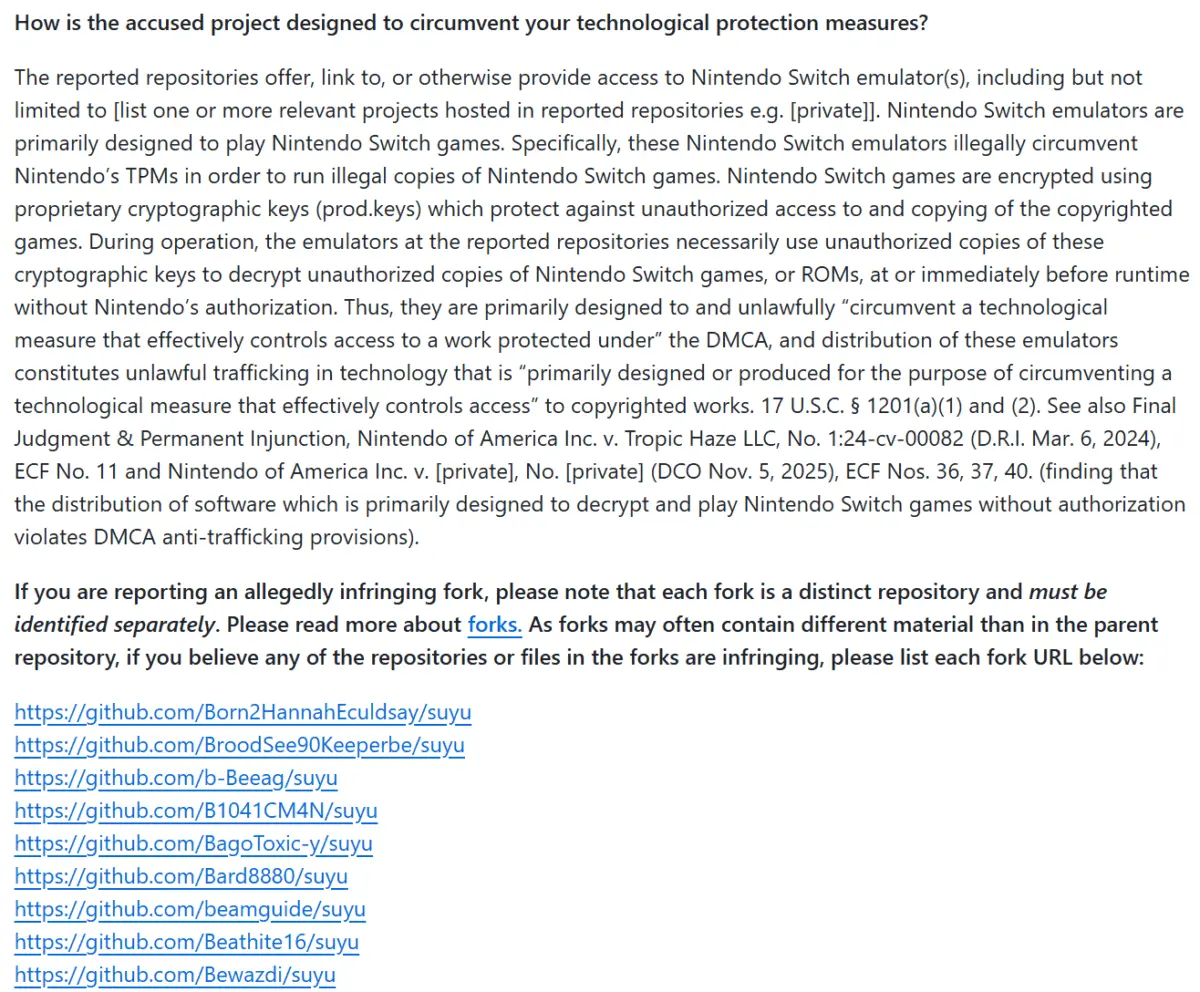
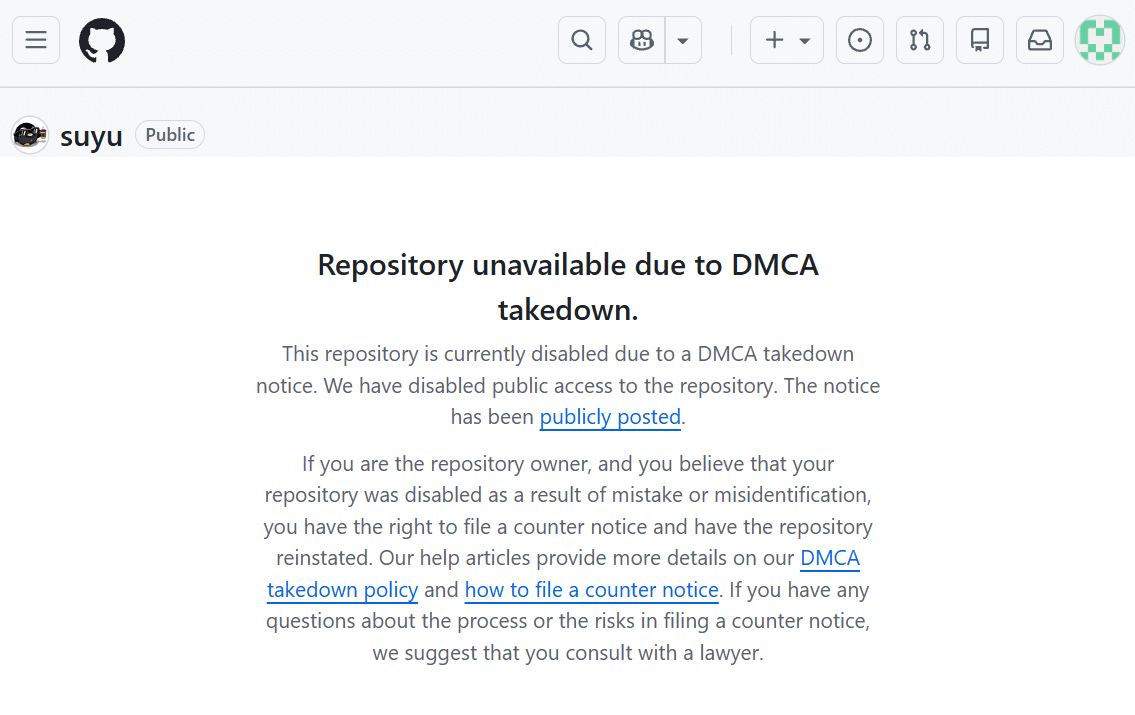
In a massive, coordinated anti-piracy campaign, Nintendo has successfully leveraged the Digital Millennium Copyright Act (DMCA) to purge more than 400 Nintendo Switch emulator repositories from the code-hosting platform GitHub. Filed in a single day across seven separate anti-circumvention notices, this sweeping offensive targeted the remnants of several high-profile emulation projects, including community-driven forks of the defunct Yuzu emulator, the popular successor project suyu, and even Skyline—an independent Android-based Switch emulator that voluntarily shut down its operations years prior.
This aggressive legal strike underscores Nintendo’s relentless strategy to protect its intellectual property and enforce strict control over its proprietary hardware and software ecosystems. By targeting the source code networks responsible for bypassing its cryptographic security measures, Nintendo aims to choke off the lifeblood of the Switch emulation community. However, this high-stakes digital whack-a-mole game highlights a persistent dilemma for rightsholders in the modern era: while mainstream repositories can be scrubbed through automated administrative channels, the decentralized, open-source nature of software development ensures that deleted code has a tendency to rapidly resurface elsewhere.
Detailed Chronology: The Anatomy of a Mass Takedown
The recent GitHub purge is the latest chapter in a multi-year campaign by Nintendo to eliminate Nintendo Switch emulators from the public internet. The timeline of this systemic crackdown reveals a clear trajectory from targeting flagship commercial projects to stamping out smaller community forks and archival mirrors.
The Fall of the Giants
The foundational precedent for Nintendo’s current enforcement strategy was set in early 2024. In February of that year, Nintendo secured a monumental legal victory—and a $2.4 million settlement—against Tropic Haze, the development team behind Yuzu, widely considered the most successful Switch emulator at the time. Facing insurmountable legal pressure, the creators of Yuzu agreed to shut down the project permanently, handing over their domain names and code repositories to Nintendo.
Encouraged by this decisive win, Nintendo expanded its scope. In October 2024, Ryujinx, another major and independently developed Nintendo Switch emulator, abruptly ceased operations following private pressure from Nintendo representatives. With the two leading platforms dismantled, a vacuum was immediately created in the emulation community.
The Rise of the Successors and Forks
True to the nature of open-source software, the closure of Yuzu and Ryujinx did not spell the end of Switch emulation; rather, it fragmented the community. Developers and enthusiasts quickly stepped in to pick up the mantle, creating unauthorized forks, experimental builds, and spiritual successors.
Projects like suyu emerged almost overnight, attempting to keep the Yuzu codebase alive and compatible with new Switch firmware updates. Other contributors began circulating specialized ports, such as Android adaptations (yuzu-android), Early Access development builds, and alternative programming implementations like MonoNX, a C#-based emulation effort.
The Seven-Notice Strike
Recognizing that these derivative projects were rapidly filling the void left by Yuzu, Nintendo executed a calculated, mass-enforcement operation. In a single day, the company’s legal representatives submitted seven distinct DMCA anti-circumvention notices to GitHub.
The scope of these notices was staggering, sweeping up over 400 unique repositories through GitHub’s network-takedown protocol, which automatically removes all downstream forks when a parent repository is successfully hit with a valid DMCA claim.
Parent Repository Notice
Project Identity
Scope of Impact
vstyler96/suyu
suyu (Yuzu Successor)
311 repositories (Full network)
skyline-emu/skyline
Skyline (Android, Independent)
29 repositories (Full network)
NicolasArvani/yuzu
Yuzu Fork
14 repositories (Full network)
liushuyu/yuzu-android
Yuzu (Android Port)
8 repositories (Full network)
exverge-0/yuzu-EA4176
Yuzu (Early Access Build 4176)
21 specific forks listed
irlbunny-archive/MonoNX
MonoNX (C#-Based Emulator)
17 specific forks listed
IpwnedU/yuzu-master
Yuzu Fork
Parent repository only
As a result of this coordinated action, visitors navigating to these URLs are now met with standard GitHub administrative notices confirming that the repositories have been disabled in response to a DMCA takedown request. In several instances, developers chose to voluntarily delete their repositories altogether, resulting in HTTP 404 error pages.
Supporting Context & Metrics: The Legal Argument and Precedents
To understand the mechanics of Nintendo’s GitHub purge, one must examine the specific legal framework invoked under the DMCA, as well as the precedents cited by the company’s legal counsel.
The Anti-Circumvention Argument
Unlike traditional copyright infringement claims—which usually require rightsholders to prove that unauthorized copies of specific copyrighted works (such as game ROMs) are being distributed—Nintendo’s notices rely heavily on the anti-circumvention provisions of the DMCA (Section 1201).
In all seven notices, Nintendo’s legal argument centers on the premise that Switch emulators cannot function without bypassing the console’s robust cryptographic security architecture. The notices explicitly state:
"During operation, the emulators at the reported repositories necessarily use unauthorized copies of these cryptographic keys to decrypt unauthorized copies of Nintendo Switch games, or ROMs, at or immediately before runtime without Nintendo’s authorization."
By framing the emulator software itself as an illegal circumvention tool—rather than merely a software utility for playing legitimately acquired backup copies—Nintendo bypasses the need to track down individual copyright infringers. Instead, it targets the tools that make decryption possible.
Relying on Uncontested Precedents
To reinforce its legal standing within the administrative takedown notices, Nintendo cites two key judicial outcomes:
The Tropic Haze (Yuzu) Consent Judgment (2024): Resulting in a $2.4 million judgment and a permanent injunction against the distribution and development of the Yuzu codebase.
The "EveryGameGuru" Default Judgment (October 2024): A Colorado federal court ruling ordering pirate streamer Jesse Keighin to pay $17,500 after he systematically streamed unreleased Nintendo games and ignored court proceedings.
Legal analysts point out a critical nuance regarding these citations: neither case established a formal judicial precedent on the merits of emulator legality through a contested trial. The Yuzu case ended in a settlement (consent judgment), while the EveryGameGuru case concluded via default judgment because the defendant ceased responding and allegedly destroyed evidence. Consequently, U.S. courts have yet to issue a definitive, trial-tested ruling explicitly declaring all console emulation illegal under the DMCA.
Nevertheless, for the purposes of administrative takedowns on GitHub, these legal anchors provide sufficient weight. GitHub’s internal policy dictates that while platform administrators carefully review anti-circumvention claims—erroneously erring on the side of developers when validity is ambiguous—the overwhelming weight of Nintendo’s previous legal victories has normalized these bulk removals.
Official Statements and Platform Policies
GitHub occupies a delicate position in the modern software development ecosystem. As home to hundreds of millions of public and private code repositories, it serves as the ultimate collaborative hub for the global developer community. However, it is also bound by strict statutory liabilities under the DMCA Safe Harbor provisions, requiring swift compliance when valid takedown notices are processed.
GitHub’s Takedown Criteria
According to internal disclosures and previous transparency reports, GitHub employs specialized legal and technical teams to evaluate complex anti-circumvention claims. Because Section 1201 claims regarding cryptographic keys and emulators often sit in a legal gray area distinct from standard copyright piracy, GitHub historically maintains a policy of caution. If a rightsholder’s anti-circumvention argument is legally deficient, speculative, or overly broad, the platform reserves the right to reject the notice or request clarification.
However, the sheer volume of Nintendo’s documentation—bolstered by explicit acknowledgments of code infringement derived from the Yuzu settlement—leaves little room for administrative hesitation. When a parent repository’s network exceeds 100 entries (as was the case with suyu’s 311-repo network), automated batch processing kicks in, efficiently wiping out the entire cluster of derivative forks in a single sweep.
The Developer Community Response
The reaction from the independent developer community has been a mix of resignation and defiance. Many maintain that emulating hardware architecture is a legally protected form of reverse engineering aimed at interoperability, digital preservation, and educational research—a defense famously upheld in landmark historical rulings such as Sega v. Accolade.
However, the financial might of Nintendo, combined with the chilling effect of multi-million dollar lawsuits against commercial emulation projects, has effectively deterred major developers from publicly hosting active Switch emulator source code on mainstream corporate platforms like GitHub.
Future Outlook: The Endless Cycle of Code Suppression
Nintendo’s recent multi-pronged strike against GitHub repositories demonstrates an unrivaled administrative efficiency in removing unauthorized code from centralized platforms. Yet, industry observers agree that this tactical victory does not represent a permanent strategic solution to the problem of console emulation.
The Decentralization Dilemma
Open-source software is fundamentally viral and resilient. The moment a popular codebase is flagged and scrubbed from GitHub, alternative distribution channels immediately activate. Developers routinely pivot to decentralized, censorship-resistant alternatives, including:
Self-hosted Git instances: Private Gitea or GitLab servers hosted in privacy-friendly offshore jurisdictions.
Encrypted messaging groups: Direct sharing of source code patches via Telegram, Discord communities, and specialized forums.
Even the inclusion of Skyline—an independent Android Switch emulator whose original developers abandoned the project in 2023—proves that dormant code never truly dies. Because Skyline was open-source, downstream enthusiasts continue to archive, modify, and build upon its legacy, ensuring that Nintendo will be forced to issue takedown notices indefinitely.
What Lies Ahead?
As Nintendo prepares for the eventual commercial rollout and hardware lifecycle of its next-generation console (widely speculated to be the long-awaited Switch successor), the company’s legal posture is crystal clear. Nintendo has established a zero-tolerance precedent for any software tooling that encroaches upon its digital rights management (DRM) and cryptographic frameworks.
For rightsholders, getting emulator repositories removed from GitHub will remain the easy part. But as long as consumer demand for backwards compatibility, performance enhancements, and preservation remains high, the broader challenge for Nintendo will not be winning individual DMCA skirmishes, but attempting to manage an endlessly recurring hydra of decentralized code.