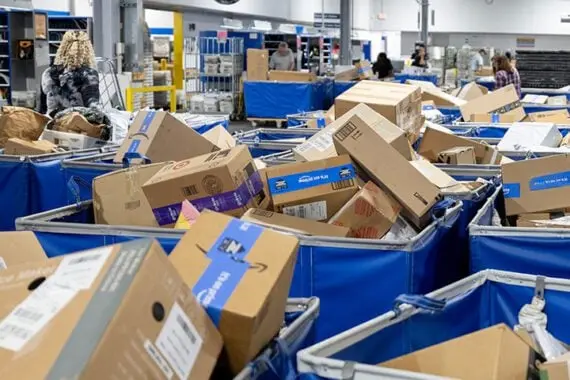
The United States Postal Service (USPS) is executing a fundamental shift in its commercial and operational strategy. Amid an enduring liquidity crisis, leadership at the quasi-governmental agency is signaling a definitive departure from the decades-long push for volume-driven growth. Instead, the Postal Service is aggressively leaning into a pricing strategy that prioritizes per-unit revenue yields over total package and mail volume.
Speaking at the August 7, 2026, open session of the USPS Board of Governors, Postmaster General and CEO David Steiner laid bare the harsh realities of the agency’s financial position. Despite posting an improved financial report for the third quarter of fiscal year 2026—highlighted by an operating revenue of $19.9 billion and a narrowed net loss of $2.5 billion—the Postal Service remains mired in deep systemic debt.
To bridge this fiscal gap, Steiner and his administration are embracing a counterintuitive economic calculus: raising parcel and mail prices, even if it means deliberately shedding volume. Recent financial results have emboldened this approach. During the quarter ending June 30, 2026, the USPS generated an additional $588 million in shipping and package revenue—a 7.7% year-over-year increase—despite handling 55 million fewer packages.
For the e-commerce sector, this policy shift carries profound implications. Direct-to-consumer (DTC) brands, online merchants, and third-party logistics (3PL) providers have long relied on the Postal Service as a cost-effective alternative for lightweight residential deliveries and rural last-mile logistics. As the USPS continues to align its pricing model with commercial market forces rather than historical volume targets, online retailers must prepare for sustained upward pressure on shipping rates, potential structural changes to service offerings, and a marketplace where cheap, subsidized shipping is increasingly a relic of the past.
Detailed Chronology of the 2026 Fiscal Pivot
To understand how the USPS arrived at this strategic crossroads, it is necessary to examine the operational and financial sequence that defined the spring and summer of 2026.
April 2026: The Implementation of Temporary Adjustments
As the third quarter of fiscal 2026 commenced, the Postal Service faced mounting pressures from inflationary labor costs, fluctuating fuel expenses, and legacy infrastructure maintenance. In response, leadership implemented a temporary, transportation-related price increase across select parcel services in April. While typical postal rate adjustments follow predictable, regulated annual calendars, this supplemental adjustment signaled a more aggressive, tactical willingness to use pricing as an immediate shock absorber against market volatility.
June 30, 2026: Closing the Third Fiscal Quarter
By the close of the fiscal quarter on June 30, the true impact of these pricing maneuvers began to emerge in internal balance sheets. While overall volume metrics continued their secular decline—falling across both traditional mail and parcel segments—the financial yield per item rose sharply. Ground Advantage, the flagship shipping service launched to consolidate various ground options, proved to be a primary catalyst for revenue generation, proving that commercial shippers were willing to absorb higher costs in exchange for reliable delivery networks.
August 7, 2026: The Board of Governors Address
The strategic thesis behind the spring pricing actions was formalized on August 7, 2026, during the USPS Board of Governors open session. Postmaster General David Steiner delivered remarks that dismantled the traditional assumption that the Postal Service must chase ever-higher volume targets to achieve solvency. By framing postal pricing around basic supply-and-demand economic principles—drawing direct parallels to commercial airlines and grocery stores—Steiner formally codified the new corporate doctrine: revenue optimization takes precedence over volume retention.
Supporting Context & Metrics: The Numbers Behind the Strategy
The rationale for the USPS’s pivot is anchored in hard financial data. A granular analysis of the third-quarter fiscal 2026 financial statements reveals why leadership believes pricing leverage is their most potent remaining tool.
Operating Revenue and Net Losses
For the third quarter ended June 30, 2026, the Postal Service reported total operating revenue of $19.9 billion, representing a 6.1% increase compared to the same period in fiscal 2025. Concurrently, the net loss for the quarter narrowed significantly to $2.5 billion, down from a net loss of $3.1 billion during the corresponding quarter of the previous year. While a multi-billion-dollar quarterly loss would spell immediate doom for a private enterprise, within the context of the USPS’s historical deficits, this contraction was viewed by leadership as a tangible step toward fiscal stabilization.
The Decoupling of Volume and Revenue
The most telling metrics from the Q3 report center on the shipping and packages division:
Package Revenue: Generated $8.25 billion, marking an increase of $588 million or 7.7% year-over-year.
Package Volume: Declined by 55 million pieces, representing a 3.4% drop compared to the previous year.
This inverse relationship—higher revenues generated from a smaller operational footprint—demonstrates that the pricing elasticity of postal shipping services is far more resilient than previously feared. By shedding 55 million low-margin or unprofitable parcels, the agency simultaneously reduced its handling, sorting, and transportation overhead while extracting greater top-line value from the shipments it did retain.
This phenomenon was not restricted to parcels. The agency’s core monopoly product, First-Class Mail, exhibited the exact same economic behavior. First-Class Mail revenue climbed 4.3% during the quarter, even as total volume slipped 3.5%.
Regulatory Frameworks and Market Power
Unlike private, for-profit logistics giants such as UPS, FedEx, or DHL, the Postal Service operates under a complex statutory framework overseen by the Postal Regulatory Commission (PRC). Price-setting authority for monopoly products like First-Class Mail is tightly constrained by statutory caps designed to protect consumers.
However, for competitive products—namely commercial parcel delivery, Ground Advantage, and Priority Mail—the USPS enjoys considerably more pricing flexibility. While still bound by baseline federal oversight, the quasi-governmental agency is realizing that it has historically underpriced these services. By shifting its corporate mindset away from universal volume maximization toward commercial yield management, the agency is beginning to exercise the full extent of its pricing power.
Official Statements and Leadership Perspectives
The ideological anchor of the 2026 fiscal pivot rests squarely on the shoulders of Postmaster General David Steiner. His public statements before the Board of Governors provide critical insight into the operational philosophy guiding the modern Postal Service.
Addressing the Board on August 7, Steiner was unequivocal regarding the success of recent pricing experiments and the necessity of continued rate hikes:
"The results this quarter show the strong leverage that pricing can have on results, and pricing is one lever that we have to use now to grow revenue."
Steiner pushed back against critics who argue that raising prices will inevitably price the Postal Service out of the competitive shipping market. Pointing to the Q3 numbers, he asserted that the agency has not yet reached the inflection point where further rate increases would destroy aggregate revenue:
"All of the statistics and results show that we have yet to cross the point that we should be changing our pricing strategy, and that we have more price [increases] to take in the marketplace. It would be financially irresponsible of us not to do so."
To clarify this economic philosophy for stakeholders, Steiner invoked the basic supply-and-demand mechanics found in standard commercial industries, contrasting the legacy mindset of the Post Office with modern retail and transport models:
"Thus far, applying those basic principles has favored raising prices even though there has been a modest decrease in volumes… Just as airlines and grocery stores adjust prices to maximize financial returns rather than simply trying to sell the greatest possible quantity, the Postal Service must operate with the same financial discipline."
However, Steiner was equally quick to temper expectations regarding what pricing adjustments alone can achieve. While price hikes can narrow quarterly deficits and relieve pressure on overburdened sorting networks, they cannot cure structural imbalances baked into the foundational mandates of the organization:
"As things stand, the Postal Service is expected to be self-sustaining while, at the same time, fulfilling mandates that are inherently unsustainable and do not cover their costs. We need to fix the business model that has produced the 17-year-long imbalance in costs and revenue — and that is going to require Congressional involvement."
The E-Commerce Impact: Redefining the Last-Mile Partnership
For well over a decade, the explosive growth of e-commerce was cast as the ultimate salvation for the U.S. Postal Service. As traditional letter mail entered a permanent, secular decline driven by digital communication, the rise of online shopping promised to fill mailboxes, delivery trucks, and processing plants with parcels.
Online merchants and direct-to-consumer brands eagerly embraced this arrangement. The USPS offered an unmatched advantage: universal reach. While private carriers routinely levied heavy surcharges for residential deliveries, remote addresses, and rural routes, the Postal Service was legally mandated to deliver to every single address in the United States six days a week. For merchants, leveraging the post office for "last-mile" delivery was a cornerstone of affordable shipping strategies.
The underlying economic theory was straightforward: the USPS had to maintain nationwide infrastructure—post offices, postal workers, and delivery routes—regardless of package volume. Therefore, every e-commerce package added to the network absorbed fixed overhead costs, contributing marginal revenue that helped sustain the broader postal mission.
The Shift in Corporate Calculus
David Steiner’s recent strategy fundamentally challenges this premise. Maximizing parcel volume is no longer viewed as an unmitigated good if those parcels are priced below their true operational and infrastructural cost.
By shedding 55 million packages while collecting an additional $588 million, the USPS demonstrated that a leaner, higher-priced delivery model can be more financially advantageous than a bloated, low-margin model that strains labor pools and accelerates vehicle depreciation.
For e-commerce merchants, this evolution requires a strategic recalculation:
Erosion of Subsidized Shipping: The era of artificially low, highly subsidized postal rates for lightweight e-commerce goods is drawing to a close. Brands that built their customer acquisition models around cheap or free shipping must now absorb rising carrier costs or pass them directly to consumers.
Service Redundancy and Hybrid Models: While USPS Ground Advantage remains an attractive, highly competitive product—especially for residential and rural deliveries—merchants can no longer view the postal service as a low-cost volume dump. Diversifying carrier networks to include regional carriers, consolidators, and multimodal logistics providers will become essential for risk mitigation.
Margin Protection Over Growth: Just as the Postal Service is prioritizing revenue over volume, e-commerce retailers will need to focus on margin protection per order rather than raw order volume achieved through unprofitable, free-shipping promotions.
Future Outlook: Structural Hurdles and What Lies Ahead
As the U.S. Postal Service looks toward the remainder of 2026 and into fiscal 2027, the path forward is fraught with both economic tension and legislative uncertainty.
Imminent Rate Pressures
E-commerce merchants and logistics managers should operate under the assumption that postal package rates will continue to rise. With Postmaster General Steiner explicitly stating that the agency has not exhausted its pricing power, additional rate hikes—potentially including strategic surcharges—are widely anticipated ahead of the critical holiday peak shipping season. Retailers planning their Q4 logistics budgets must factor in higher per-unit shipping expenses and build financial buffers to protect their bottom lines.
The Legislative Impasse
Pricing strategies and operational optimization can narrow quarterly net losses, but they cannot rescue the Postal Service from its foundational structural deficits. Steiner’s repeated calls for Congressional intervention highlight an ongoing political stalemate.
The core tensions facing the agency remain deeply entrenched:
Universal Service Obligations (USO): The legal mandate to deliver mail and packages to every American address six days a week is extraordinarily expensive, particularly in rural and low-density areas.
Retirement and Benefit Obligations: Legacy statutory requirements concerning employee health and retirement funding have historically placed immense strain on postal liquidity.
The Monopoly vs. Competitive Split: Balancing statutory price caps on First-Class Mail with the need to compete aggressively in the commercial parcel market creates an uneven playing field.
Until Congress steps in to comprehensively overhaul the Postal Service’s statutory mandate and financial structure, leadership will continue to pull the only major lever entirely within its control: the pricing dial.
Conclusion
The strategic pivot executed by the USPS in mid-2026 marks the end of an era. The blind pursuit of e-commerce volume has been replaced by a disciplined, yield-focused commercial strategy that treats postal services as premium economic assets rather than discounted utility channels. For the broader retail and logistics ecosystem, adapting to this new reality is no longer optional. As the Postal Service charts a course toward financial self-sufficiency through higher prices, e-commerce businesses must recalibrate their pricing, fulfillment, and shipping strategies to survive in an era where the true cost of delivery is finally coming due.