Executive Overview
In what cybersecurity experts are calling one of the most alarming and far-reaching supply-chain security incidents of the decade, terabytes of highly sensitive corporate credentials have been systematically scraped, exfiltrated, and leaked. The breach—stemming from a compromised open-source tool utilized for AI-driven software development—has exposed access secrets, private keys, and administrative tokens belonging to some of the world’s most prominent and security-conscious organizations, including tech giants like Microsoft, Amazon, Cisco, Samsung, and Salesforce.
Disclosed by security intelligence firms CloudSEK and Hudson Rock, the incident highlights a terrifying vulnerability vector: the modern enterprise’s aggressive, breakneck race to integrate artificial intelligence into software delivery pipelines, often at the direct expense of fundamental DevOps hygiene.
The vehicle for this massive compromise was LiteLLM, a popular open-source utility designed to streamline AI-driven software development by acting as a universal proxy for various large language models. According to researchers, malicious actors hijacked specific versions of the software distributed via the official Python Package Index (PyPI) repository. In a mere 40-minute window of exposure, malicious code baked into the dependencies harvested millions of sensitive variables—including cloud administration keys, repository tokens, SSH keys, Kubernetes secrets, and AI provider credentials—affecting roughly 2,500 organizations and infiltrating over 434,000 continuous integration/continuous delivery (CI/CD) software pipelines.
Detailed Chronology: The 40-Minute Window of Destruction
The roots of this catastrophic breach trace back through a sophisticated, multi-tiered upstream supply-chain campaign orchestrated by a threat group known as TeamPCP—a loose collective largely comprised of exceptionally capable teenage hackers who have steadily built a reputation for infiltrating major software infrastructure.
The Upstream Infection
TeamPCP’s campaign initially gained widespread notoriety following the compromise of Trivy, a widely deployed open-source vulnerability scanner utilized by engineering teams globally to catch security flaws before deployment. By successfully injecting malicious payloads into Trivy—alongside other developer tools such as KICS and the Telnyx Python SDK—the threat actors established a persistent foothold within critical software delivery channels.
Through Trivy’s infrastructure, the attackers managed to slip malicious versions—specifically v1.82.7 and v1.82.8—of the LiteLLM package onto the official Python Package Index (PyPI) repository.

The Execution and Exfiltration
When unsuspecting developers or automated build servers downloaded and executed these compromised versions of LiteLLM during a narrow 40-minute window in March, the malicious code sprang into action.
The payload systematically accessed the volatile memory of the infected machines, aggressively scraping local variables, configuration files, and environment strings. It then quietly exfiltrated this rich harvest through an attacker-controlled command-and-control channel.
The result was an uncurated, 195-terabyte digital trash heap containing raw, unencrypted keys to the digital kingdoms of thousands of companies. Security firms CloudSEK and Hudson Rock intercepted and analyzed this massive data repository, uncovering an unprecedented breadth of exposure that spanned cloud infrastructure providers, internal software development kits, enterprise communication tokens, and active database passwords.
Supporting Context & Metrics: The Scale of the Catastrophe
The sheer magnitude of the LiteLLM breach places it in a league of its own, shattering previous assumptions about how quickly an open-source compromise can ripple across the global digital ecosystem.
Key Metrics of the Incident:
- Duration of Exposure: ~40 minutes (while compromised packages remained active on PyPI).
- Impacted Organizations: ~2,500 distinct entities, ranging from mid-sized tech firms to Fortune 500 multinationals.
- Exposed CI/CD Pipelines: Approximately 434,000 continuous integration and delivery pipelines compromised.
- Volume of Data: A staggering 195-terabyte file containing millions of harvested secrets, API tokens, database credentials, and environment variables.
The Attribution Challenge
Disentangling the exact victims from a data dump of this scale proved exceptionally difficult for security analysts. Many CI/CD pipelines and modern cloud architectures are configured generically, utilizing environmental variables that lack identifiable corporate domains, explicit company names, or internal server strings.
For example, security researchers probing the data dump discovered an email address utilizing the @siriusxm.com domain. Initial fears suggested a total breach of the primary satellite broadcasting network. However, subsequent forensic investigation revealed that the compromised environment actually belonged to AdsWizz, an internal subsidiary and advertising technology platform operating under the broader SiriusXM corporate umbrella.
Similarly, the data trove exposed active administrative tokens and internal client secrets for major SaaS and infrastructure platforms, including:
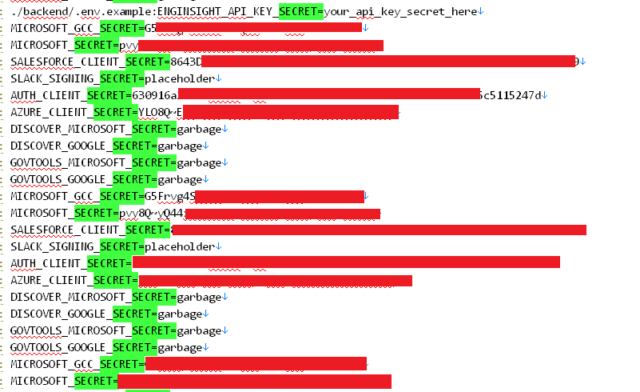
- SALESFORCE_CLIENT_SECRET (Salesforce environments)
- SLACK_SIGNING_SECRET (Enterprise Slack integrations)
- Microsoft Azure Management Credentials (Cloud resource control planes)
Hudson Rock noted that countless organizations continue to harbor active, unrotated secrets sitting exposed inside these leaked databases—frequently remaining entirely oblivious to the fact that their development environments have been compromised.
Expert Commentary and Official Warnings
The security community has reacted to the incident with a mixture of profound shock and weary resignation, pointing out that the breach is less a failure of artificial intelligence as a technology and more a systemic indictment of corporate DevOps negligence.
Independent security researcher Kevin Beaumont confirmed the legitimacy of the leaked data after spot-checking several compromised organizations. Writing on social media, Beaumont did not mince words:
"I’ve confirmed the data is legit by the way, multiple victim orgs. It contains a significant volume of sensitive content at orgs. It’s a massive supply chain breach due to poor AI security—not because AI is the threat, but teens can run circles around orgs obsessed with rushing out AI and poor DevOps security."
The human element of complacency quickly reared its head following public disclosure. In a subsequent post, Beaumont highlighted a disturbing lack of urgency among corporate security teams:
"These creds date from about March. One of the orgs impacted told me they’d rotated them all and it’s a nothingburger, so I looked at their responsible disclosure policy, it allows trying creds, so I tried them all. Almost every one worked. Submitted report. One of the biggest US techcos."
The Open-Source Vulnerability Loop
Compounding the severity of the incident was a critical operational lapse by maintainers during the initial investigation. According to CloudSEK, developers managing the Trivy scanner rotated their automation tokens following the initial breach, but failed to fully revoke them over a critical 20-day window. This administrative oversight handed threat actors nearly three weeks of lingering backdoor access, enabling them to repeatedly force-push malicious code payloads to downstream third-party builds relying on the vulnerability scanner.

Alon Gal, co-founder and Chief Technology Officer of Hudson Rock, emphasized that this incident marks a fundamental turning point for enterprise defense:
"The key takeaway is how supply chains have evolved to make a single upstream breach affect thousands of companies simultaneously. A window of roughly 40 minutes in which the LiteLLM dependency was hacked led to over 430,000 instances in which millions of secrets were harvested. This magnitude pushes us into a completely new world regarding the type of response required from the cybersecurity industry."
Remediation and Future Outlook
As enterprises scramble to assess their exposure, security intelligence firms have issued urgent directives for immediate remediation.
Recommended Action Plan for Affected Organizations:
- Immediate Environment Audit: Organizations utilizing AI proxy infrastructure, third-party CI/CD vulnerability scanners, or downstream AI packages must immediately audit their dependency trees for versions
1.82.7and1.82.8of LiteLLM. - Aggressive Credential Revocation: Security teams must operate under the assumption that any secret or variable accessible to the LiteLLM runtime environment during the spring window has been fully compromised.
- Key and Token Invalidation: All cloud administration keys (AWS, Azure, GCP), Kubernetes service account tokens, GitLab/GitHub Personal Access Tokens (PATs), and third-party API keys must be systematically invalidated and regenerated.
- Enhanced Egress Filtering and Log Auditing: Enterprises should heavily scrutinize audit logs for unauthorized API calls and enforce strict egress filtering to prevent internal applications from communicating with unauthorized external endpoints.
A New Era of Supply-Chain Risk
The LiteLLM breach serves as a brutal wake-up call for the modern software industry. As companies race against one another to integrate generative AI, LLM tooling, and automated coding assistants into production environments, security controls are frequently bypassed in the name of velocity.
When threat actors—even decentralized collectives of teenage hackers like TeamPCP—can compromise foundational developer utilities and extract terabytes of enterprise secrets in less time than it takes to commute to work, the traditional perimeter defense model is rendered obsolete. Securing the modern enterprise now requires total visibility into upstream software dependencies, zero-trust credential management, and an uncompromising approach to rapid vulnerability revocation. Until organizations treat open-source software dependencies with the rigorous scrutiny traditionally reserved for core financial systems, supply-chain attacks of this scale will remain the defining cybersecurity nightmare of our time.