Executive Overview
A high-stakes federal copyright infringement lawsuit targeting some of the world’s most elusive and elite private BitTorrent trackers has taken a dramatic, unprecedented turn. What began as an ambitious legal crusade by an independent filmmaker to unmask the operators of platforms like PassThePopcorn and HDBits has devolved into a courtroom thriller characterized by fabricated investigative firms, phantom witnesses, and a staggering accusation of identity theft.
During a recent telephonic hearing before U.S. District Judge Andrea R. Wood in the Northern District of Illinois, defense attorneys dropped a bombshell: the individual litigating the case under the name "Matthew Schneider" is allegedly an impostor. According to sworn declarations secured from the actual Canadian filmmaker, the real Matthew Schneider resides in Ontario and has had no active hand in prosecuting the federal copyright action.
This startling revelation threatens to collapse the entire lawsuit, exposing the plaintiff to severe judicial sanctions, contempt charges, and immediate dismissal. Initially notable for attempting an unprecedented legal theory—classifying six distinct private trackers as a single, coordinated "piracy enterprise"—the case has now shifted from a routine digital copyright dispute into a profound examination of court integrity, pro se litigation vulnerabilities, and cyber-forensic accountability. As of late August, the presiding judge has frozen all discovery, ordered an in-person evidentiary hearing, and sealed critical docket filings, plunging the proceedings into deep uncertainty.
Detailed Chronology: From Subpoenas to the Impostor Shockwave
Phase 1: The Initial Cloudflare Subpoenas (September 2023)
The legal saga first surfaced in September 2023, when an individual identifying as Matthew Schneider utilized a Digital Millennium Copyright Act (DMCA) Section 512(h) subpoena through a California federal court. The objective was to force cloud infrastructure giant Cloudflare to hand over identifying logs, IP addresses, and account details for administrators behind several prominent private torrent trackers: PassThePopcorn, BroadcasTheNet, KaraGarga, HDBits, and Beyond-HD. Schneider alleged that these exclusive, invitation-only communities had unlawfully distributed his copyrighted cinematic works without authorization.
However, digital rights experts and technical analysts immediately spotted glaring anomalies. Independent investigations revealed that numerous "infringing URLs" submitted within Schneider’s evidentiary cache did not point to functional torrent landing pages. Furthermore, the URL directory paths did not match the actual structural architecture of the targeted websites, and several of the alleged films could not be located anywhere within the communities’ internal databases. Despite these red flags, the administrative docket remained relatively dormant for months.
Phase 2: Escalation to a Federal Civil Lawsuit (December 2023 – February 2026)
In late December, the litigation escalated dramatically. Moving away from administrative DMCA subpoenas, the plaintiff filed a formal copyright infringement complaint in the U.S. District Court for the Northern District of Illinois. Suing ten unnamed "John Doe" defendants pro se (without formal legal representation), the complaint designated a mailing address in Sanborn, New York, while maintaining that Schneider was a United Kingdom-based filmmaker.
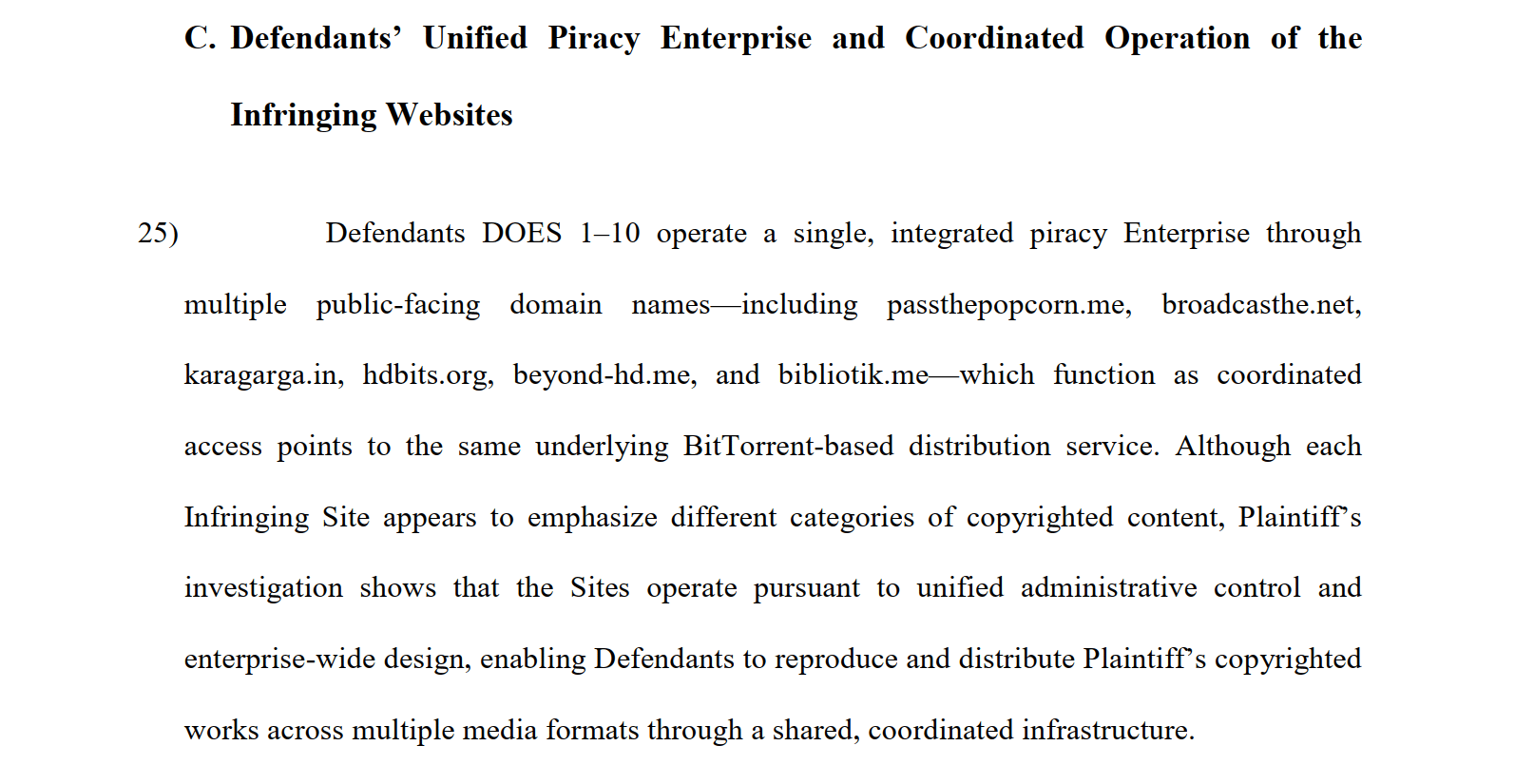
The lawsuit dramatically widened its scope by naming six major private trackers: PassThePopcorn.me, BroadcasTheNet, KaraGarga.in, HDBits.org, Beyond-HD.me, and Bibliotik.me. Rather than treating them as isolated entities, the complaint framed them as a unified "piracy Enterprise"—a synchronized distribution ecosystem operating under single administrative control.
By February 2026, the court permitted Schneider to issue third-party subpoenas to seven major technology and financial platforms: Reddit, GoDaddy, Cloudflare, PayPal, Stripe, Namecheap, and X Corp. The goal was simple: compel these corporations to unmask the anonymous individuals operating the infrastructure behind the Doe defendants.
Phase 3: Pushback and the Exposure of Fabricated Evidence
The issuance of these broad subpoenas galvanized the defense. Experienced digital rights litigators, including attorney Erin Russell (representing Doe 1) and Haley Finch, quickly mobilized to file motions to quash. By May, the court placed all seven subpoenas in abeyance pending the resolution of these constitutional and procedural objections.
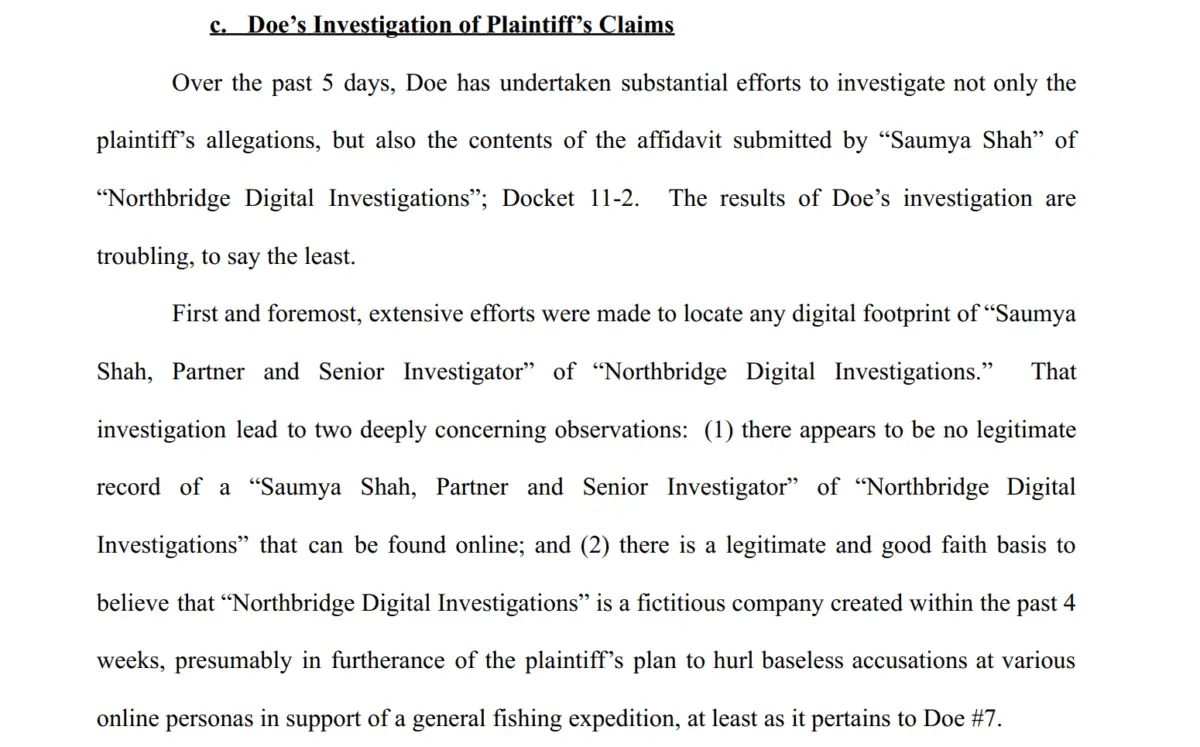
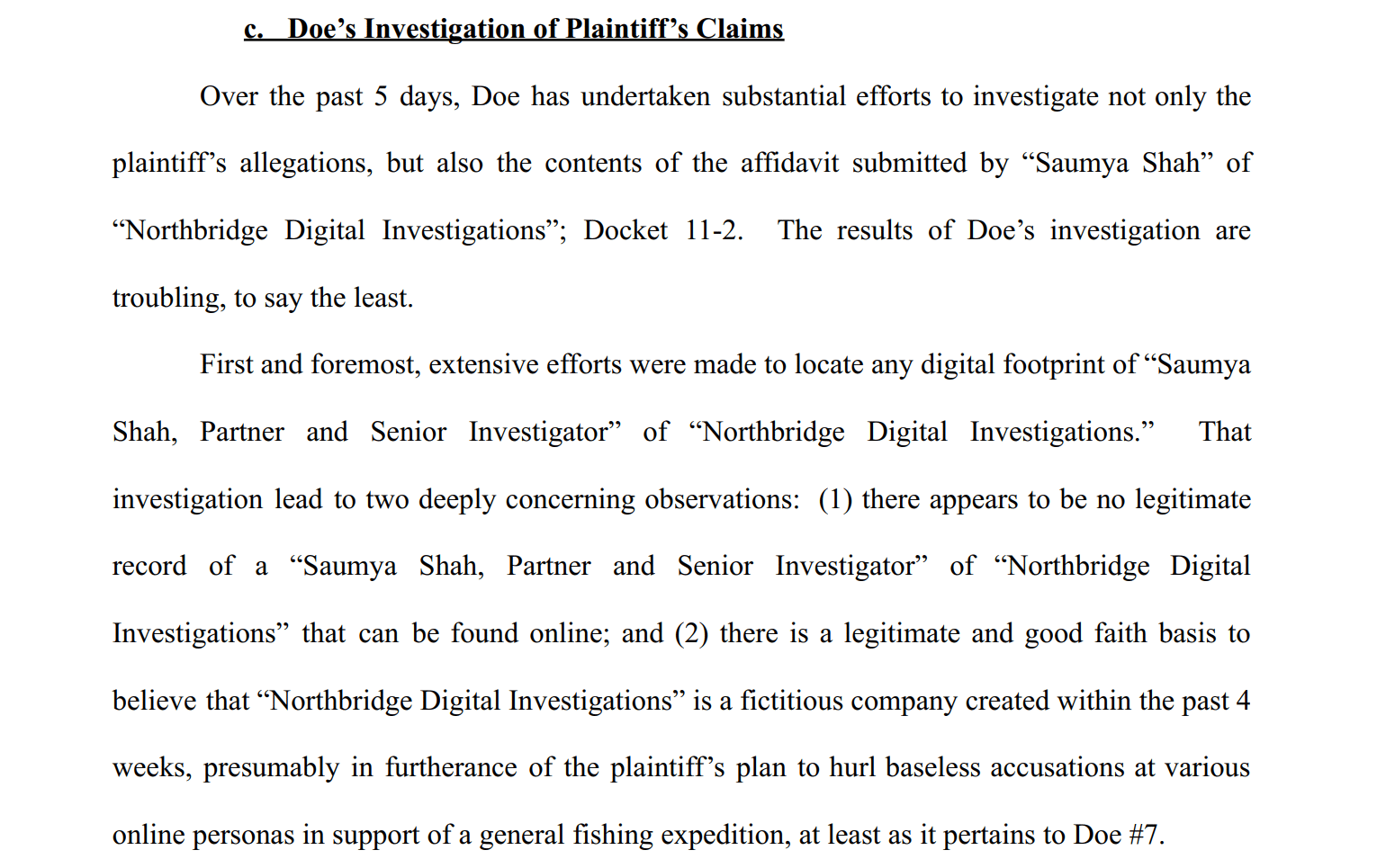
Among the filings, an anonymous defendant designated as "Doe 7"—linked to an active Reddit profile—submitted a blistering motion accusing the plaintiff of constructing his entire case on falsified evidence. Doe 7 pointed out that the foundational sworn declaration supporting the plaintiff’s discovery requests came from a purported executive named "Saumya Shah, Partner and Senior Investigator" at a UK entity called "Northbridge Digital Investigations."
Subsequent investigative work by Doe 7—independently verified by digital media outlet TorrentFreak—revealed that:
- No corporate entity named "Northbridge Digital Investigations" existed within the UK Companies House registry.
- No professional traces, public records, or digital footprints existed anywhere online for an investigator named Saumya Shah.
- The evidentiary exhibits submitted to the court contained approximately 130 URLs pointing to entirely unrelated pirate sites, alongside raw WHOIS lookup data for at least ten private trackers that were not even named in the lawsuit.
While challenged directly on these points, the plaintiff stubbornly doubled down on the validity of his copyright claims against Doe 7, refusing to address the phantom investigator or the ghost corporation.
Phase 4: The Telephonic Hearing and the Great Unmasking
The litigation reached a boiling point during a telephonic status conference presided over by Judge Andrea R. Wood. Prior to the official commencement of the record, defense counsel Erin Russell and Haley Finch took the extraordinary step of contacting the judge’s chambers directly. Working independently, both lawyers had traced the actual cinematic works and the real background of "Matthew Schneider" to a legitimate Canadian production house known as Dirtbag Films.
Utilizing cross-border legal networks and personal industry connections, Finch and Russell managed to establish direct contact with the genuine Matthew Schneider, who lives and works in Ontario, Canada. The real filmmaker executed a formal, signed legal declaration confirming his true identity, expressing total detachment from the Illinois federal lawsuit, and verifying that he had never authorized anyone to file actions in his name.
When Judge Wood confronted the plaintiff on the conference call with these verified findings, his response was dismissive. Maintaining that the revelation should not delay the proceedings, he bluntly told the court, "I’m Matthew Schneider," and urged the judge to fast-track the discovery process.
Judge Wood swiftly denied the plaintiff’s motion to strike Doe 7’s filings, declined to rule on the pending motions to quash, and issued a stern warning. She directed the defense to file a formal motion supported by the Canadian Schneider’s declaration, scheduled an in-person evidentiary hearing for the following month to resolve the identity crisis once and for all, and completely barred the plaintiff from seeking further identifying information regarding the Doe defendants. Shortly after the hearing concluded, the court placed the entire docket under seal.
Supporting Context & Metrics
To comprehend the sheer magnitude of this legal battle, one must examine the ecosystem of elite private BitTorrent trackers targeted by the complaint. Unlike public torrent indexes like The Pirate Bay, private trackers operate as walled gardens governed by strict operational rules:
- Invitation-Only Access: New members cannot simply register via an open web portal; they require secure, vetted referrals from existing users in good standing.
- Ratio Maintenance: Users must maintain strict upload-to-download ratios, ensuring that data availability remains robust across the peer-to-peer swarms.
- Security & Vetting: Platforms such as PassThePopcorn (specializing in movies) and HDBits (specializing in high-bitrate encodes) employ advanced countermeasures to protect their membership base from copyright trolls, law enforcement infiltration, and automated scrapers.
The lawsuit’s central hypothesis—that these distinct, highly insular platforms operate as a unified corporate cartel—was already viewed by IP scholars as legally tenuous. The introduction of fabricated investigative entities and an alleged imposter plaintiff transforms the case from a standard civil copyright action into an unprecedented federal integrity inquiry.
Official Statements and Legal Analysis
Legal experts specializing in intellectual property and cyber-litigation have expressed profound astonishment at the trajectory of the case.
Erin Russell, counsel for Doe 1, emphasized the gravity of contacting a federal judge’s chambers ex parte prior to a hearing: "This was an extraordinary step that wasn’t taken lightly. However, the integrity of the judicial process demanded immediate intervention before any substantive rulings on discovery could prejudice anonymous internet users."
Haley Finch echoed these sentiments, noting the cross-border complexities of tracking down the genuine Canadian filmmaker through industry channels at Dirtbag Films.
From a procedural standpoint, federal courts take the integrity of pro se filings and sworn declarations exceptionally seriously. If the court determines during the upcoming in-person hearing that the plaintiff has systematically misrepresented his identity and utilized fabricated investigative firms (such as the ghost entity Northbridge Digital Investigations), the legal consequences will be severe. Under Federal Rule of Civil Procedure 11, courts possess broad inherent authority to dismiss actions with prejudice, award attorney’s fees to defendants, and refer individuals for criminal contempt or fraud investigations.
Future Outlook
As the legal community awaits the sealed docket’s next developments and the upcoming in-person evidentiary hearing, the immediate trajectory of the lawsuit is frozen.
- Evidentiary Verification: The core battleground will center on the physical appearance and sworn testimony of the individual claiming to be Matthew Schneider versus the verifiable documentation and deposition of the real Ontario-based filmmaker.
- Sanctions and Dismissal: Should the impersonation claims be substantiated under oath, Judge Wood is widely expected to dismiss the federal copyright action immediately, potentially imposing heavy financial sanctions on the plaintiff.
- Implications for Pro Se Litigation: This case serves as a cautionary tale for federal courts regarding the vulnerabilities of pro se filings, highlighting the urgent need for enhanced verification mechanisms when anonymous or remote litigants seek sweeping third-party subpoenas against online service providers.
Ultimately, what began as a routine enforcement action by an independent creator against the shadowy infrastructure of digital piracy has evolved into a landmark courtroom drama—proving once again that in the digital age, truth can be far stranger than fiction.