NEW JERSEY — In a pivotal legal filing that could finally draw the curtain on a grueling, multi-year war of attrition between copyright holders and internet service providers, ISP RCN has formally petitioned a New Jersey federal court. The provider is asking the court to reconsider a six-year-old ruling and dismiss a high-stakes piracy liability lawsuit brought by major record labels.
RCN’s defense rests on a seismic shift in U.S. copyright jurisprudence: the U.S. Supreme Court’s recent decision in Cox v. Sony. According to RCN, that ruling completely obliterated the legal scaffolding supporting the music industry’s contributory and vicarious infringement claims. With nearly identical "repeat infringer" lawsuits against other major ISPs having already been voluntarily dropped or dismissed nationwide, RCN asserts that its case stands as the absolute last major-label lawsuit of its kind still drawing breath in an American courtroom.
Executive Overview
For well over a decade, major record labels and Hollywood movie studios waged a coordinated, aggressive legal campaign to fundamentally alter the responsibilities of internet service providers. Rightsholders argued that ISPs—acting as the digital turnpikes of the modern era—should be held financially and legally accountable when their subscribers engaged in systematic digital piracy. Under this sweeping theory of secondary liability, ISPs that failed to actively sever the connections of users repeatedly flagged for copyright infringement were essentially deemed accomplices, opening them up to astronomical statutory damages.
This high-stakes legal strategy suffered a devastating, fatal blow earlier this year when the U.S. Supreme Court dramatically upended a billion-dollar verdict against Cox Communications. The apex court firmly established that an internet service provider cannot be held liable for contributory copyright infringement merely because it continues to supply internet access to subscribers it knows have been flagged for digital piracy.
Seizing upon this authoritative precedent, RCN has petitioned the U.S. District Court for the District of New Jersey to apply the Cox standard and terminate a legal battle that has dragged on since 2019. RCN’s newly filed motion for reconsideration argues that the legal foundation of the labels’ amended complaint has completely evaporated, leaving the plaintiffs with no viable path forward.
Detailed Chronology: A Seven-Year Standoff
To understand the significance of RCN’s latest maneuver, one must examine the protracted, contentious timeline of a lawsuit that has stubbornly refused to reach a natural conclusion.
Origins and Strategic Leverage (2019)
The legal dispute originated in 2019, when major music publishers and record labels filed a sweeping lawsuit against RCN. However, according to defense filings, the lawsuit was never genuinely intended to proceed to a traditional jury trial. RCN contends that the case was initially brought as a strategic piece of leverage designed to force settlement concessions in parallel litigation involving its sister company, Grande Communications.
The Procedural Stalemate (2020–2022)
As the litigation progressed through the New Jersey federal court, it quickly bogged down in extensive, bitter discovery disputes centered primarily on internal Digital Millennium Copyright Act (DMCA) compliance records and assertions of attorney-client and work-product privilege.
In May 2022, Magistrate Judge Tonianne J. Bongiovanni intervened by staying all fact depositions until the mountain of document discovery and privilege disputes could be formally resolved. Despite this administrative pause, the docket remained hyper-active, accumulating at least 20 separate discovery letter briefs. RCN’s defense team now alleges that the plaintiffs deliberately weaponized this ongoing privilege dispute as economic leverage, banking on the assumption that RCN would eventually grow fatigued and pay a substantial monetary settlement just to avoid a definitive ruling on the discovery issues.

The Supreme Court Earthquakes (2024)
The legal ground shifted dramatically under both parties following landmark appellate rulings and, ultimately, the Supreme Court’s intervention in Cox v. Sony. Realizing the tide had decisively turned, the broader entertainment industry began cutting its losses. Rightsholders swiftly dismissed active secondary copyright infringement cases against Verizon, Altice, and WideOpenWest. Furthermore, film companies voluntarily dropped a near-identical copyright lawsuit against RCN with prejudice.
Yet, for reasons RCN attributes to stubbornness or lingering leverage tactics, the music labels’ lawsuit against RCN remained obstinately alive—prompting this week’s aggressive motion for complete dismissal.
Legal Analysis: No Inducement, No Claim
In its motion for reconsideration and accompanying legal memorandum, RCN’s defense counsel meticulously dissects the impact of the Cox precedent on the two core pillars of the record labels’ lawsuit: contributory infringement and vicarious infringement.
1. The Collapse of Contributory Infringement
Under traditional copyright doctrines, contributory infringement requires a showing that a defendant intentionally induced or encouraged direct infringement, or provided the site and facilities for it while knowing of the infringing activity.
RCN argues that the Supreme Court’s Cox decision definitively established that an ISP is not contributorily liable simply because it continues to sell broadband internet access while cognizant that a fraction of its user base utilizes that connectivity to download or share pirated music. Furthermore, the mere failure to terminate the internet connections of flagged subscribers fails to establish the requisite specific intent or material contribution required by law.
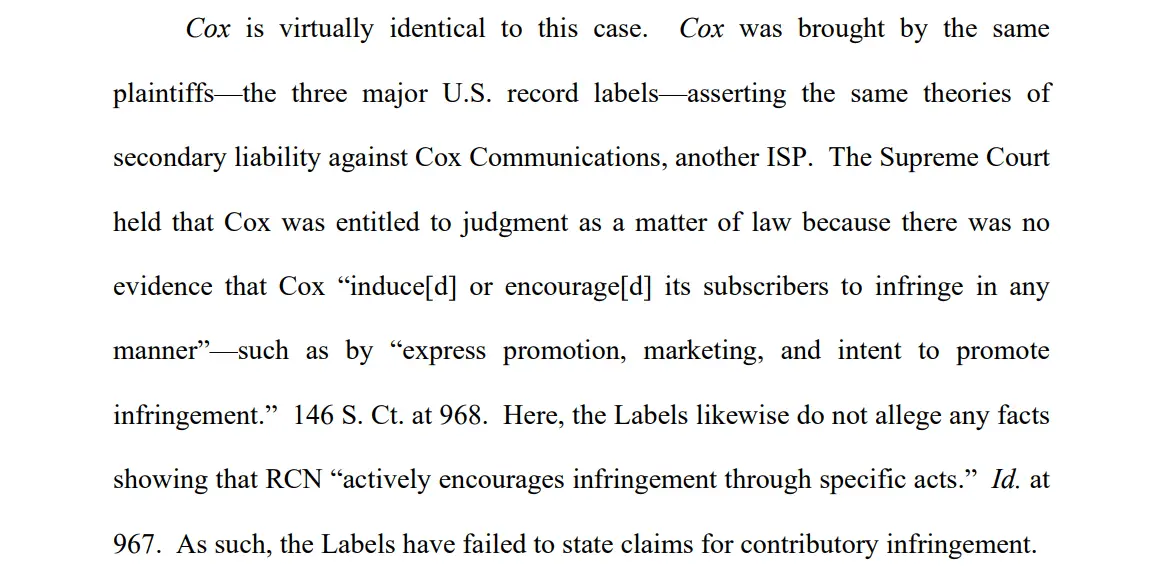
Following Cox, viable liability demands concrete, affirmative proof that the internet provider actively encouraged or solicited infringement through specific, targeted acts, or that its primary service possesses no substantial non-infringing uses. RCN points out that standard broadband internet access undeniably boasts vast, vital non-infringing uses, and that the present action is "virtually identical" to the defunct Cox lawsuit.
2. The Failure of Vicarious Infringement Claims
The secondary leg of the labels’ complaint—vicarious infringement—fares no better under post-Cox scrutiny. To establish vicarious liability, a plaintiff must prove that the defendant possessed the right and ability to supervise the infringing conduct and derived a direct financial benefit from it.
The U.S. Court of Appeals for the Fourth Circuit previously ruled in the Cox litigation that flat-rate monthly subscription fees do not constitute a "direct financial benefit" derived specifically from copyright infringement. When the record labels attempted to appeal that specific holding, the Supreme Court declined to grant certiorari.
RCN echoes this logic in its New Jersey filing. The ISP notes that its subscribers pay a fixed monthly fee for internet access regardless of how they utilize the bandwidth—whether they are streaming high-definition educational content, conducting remote work meetings, browsing social media, or illegally downloading copyrighted albums. Because RCN does not capture a direct financial windfall tied specifically to the volume of pirated tracks downloaded across its network, the legal criteria for vicarious infringement are entirely unmet.
Supporting Context & Metrics: The Last Case Standing
The landscape of American copyright litigation involving internet service providers has transformed almost beyond recognition over the past twelve months.
- The Great ISP Dismissal Wave: Within weeks of the Supreme Court’s Cox v. Sony ruling, rightsholders recognized the structural collapse of their legal theories. Major record labels and movie studios quietly walked away from multi-million-dollar lawsuits targeting top-tier ISPs.
- Sister Companies Falling in Line: RCN’s sister internet service provider, Grande Communications—both entities now operating under the unified Astound Broadband umbrella—has similarly watched its legal exposure recede. While Grande’s litigation is not fully closed due to its insistence on securing a formal, written judicial victory on the docket, the substantive threat has effectively evaporated.
- The RCN Anomaly: According to comprehensive tracking of intellectual property dockets by industry observers and legal analysts, the case pending in the New Jersey federal court is now widely believed to be the absolute last major-label repeat-infringer ISP lawsuit standing in the United States. Every other equivalent secondary liability case has either settled for nominal terms or been voluntarily dismissed with prejudice.
Official Statements and Court Filings
While the major record labels have not yet filed their formal opposition brief to RCN’s motion for reconsideration, the tone of the current legal battle is decidedly sharp.
In their memorandum filed at the U.S. District Court for the District of New Jersey, RCN’s attorneys did not mince words regarding the plaintiffs’ motives:
"Instead, it seems that the Labels view the ongoing privilege dispute as a form of leverage," RCN writes in the court filing. "In other words, the Labels seem to believe that RCN might be willing to pay money to avoid a resolution of that issue."
RCN is formally urging the New Jersey federal court to take three decisive actions:
- Vacate its previous 2020 procedural order that kept discovery rolling under outdated legal assumptions;
- Dismiss the labels’ amended complaint in its entirety with prejudice, barring the plaintiffs from refiling the same claims; and
- Grant an in-person or virtual oral argument so that counsel can thoroughly unpack the sweeping implications of the Cox v. Sony precedent before the bench.
Future Outlook: The End of an Era for ISP Liability?
The resolution of RCN’s motion for reconsideration will likely mark the definitive close of a turbulent chapter in American digital media law. For nearly two decades, rightsholders attempted to force internet service providers to act as private copyright police, leveraging the threat of catastrophic secondary liability damages to compel aggressive subscriber disconnection policies—often referred to in the industry as "three-strikes" or graduated response systems.
If the New Jersey federal court follows the overwhelming weight of post-Cox authority and grants RCN’s motion to dismiss, it will signal total closure for the major record labels’ aggressive campaign against broadband providers. Moving forward, copyright enforcement is expected to pivot even more heavily toward direct-to-consumer litigation, targeted subpoenas against anonymous BitTorrent swarms via DMCA Section 512(h) processes, and technological cooperative measures rather than institutional litigation against the foundational infrastructure of the internet.
Copies of RCN’s newly submitted motion for reconsideration and the comprehensive supporting legal memorandum have been made publicly available through the U.S. District Court for the District of New Jersey for legal scholars, industry analysts, and stakeholders monitoring the final embers of the repeat-infringer wars.