For well over a decade, copyright holders have utilized U.S. federal courts as clearinghouses to unmask anonymous BitTorrent users, transforming peer-to-peer tracing into a standardized, industrial-scale legal routine. Among the pioneers of this litigious model is adult film production giant Strike 3 Holdings. Filing thousands of "John Doe" lawsuits annually, Strike 3 targets individuals accused of downloading adult content via BitTorrent networks.
The mechanism is reliably predictable: the copyright holder subpoenas Internet Service Providers (ISPs) for subscriber identities, leverages that data to pressure the alleged pirate, and extracts a financial settlement that effectively brings the case to a close. Rinse and repeat.
Last summer, however, Strike 3 pivoted from sweeping, low-level consumer enforcement toward a target of unprecedented scale. Alongside Counterlife Media, Strike 3 filed a high-stakes copyright infringement lawsuit against tech titan Meta. The core accusation: Meta systematically downloaded thousands of adult films via BitTorrent not for garden-variety personal entertainment, but to serve as training data for artificial intelligence models. With 2,973 copyrighted adult films at stake, the statutory damages pipeline could balloon to a staggering $446 million.
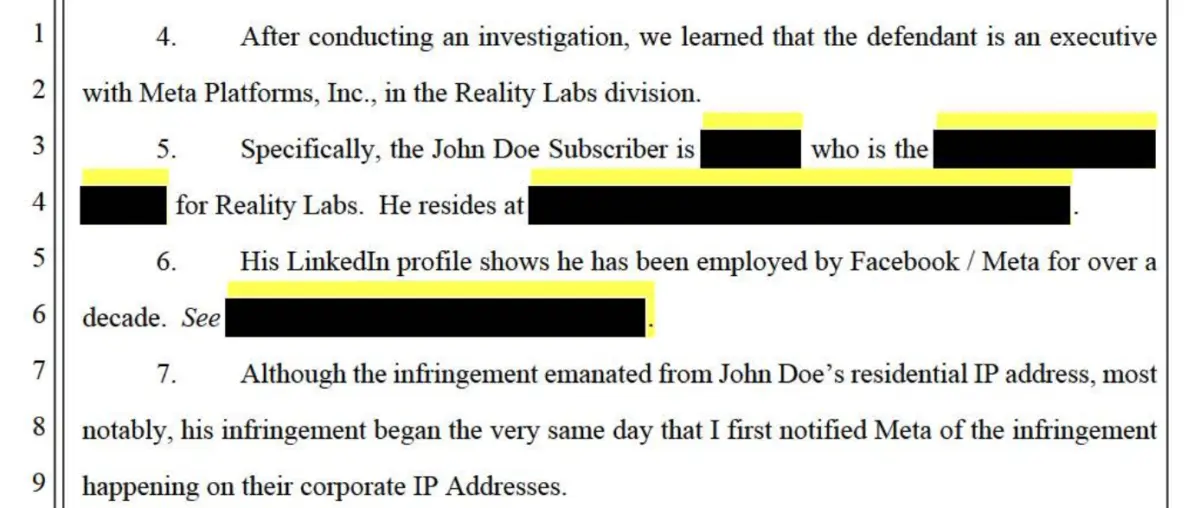
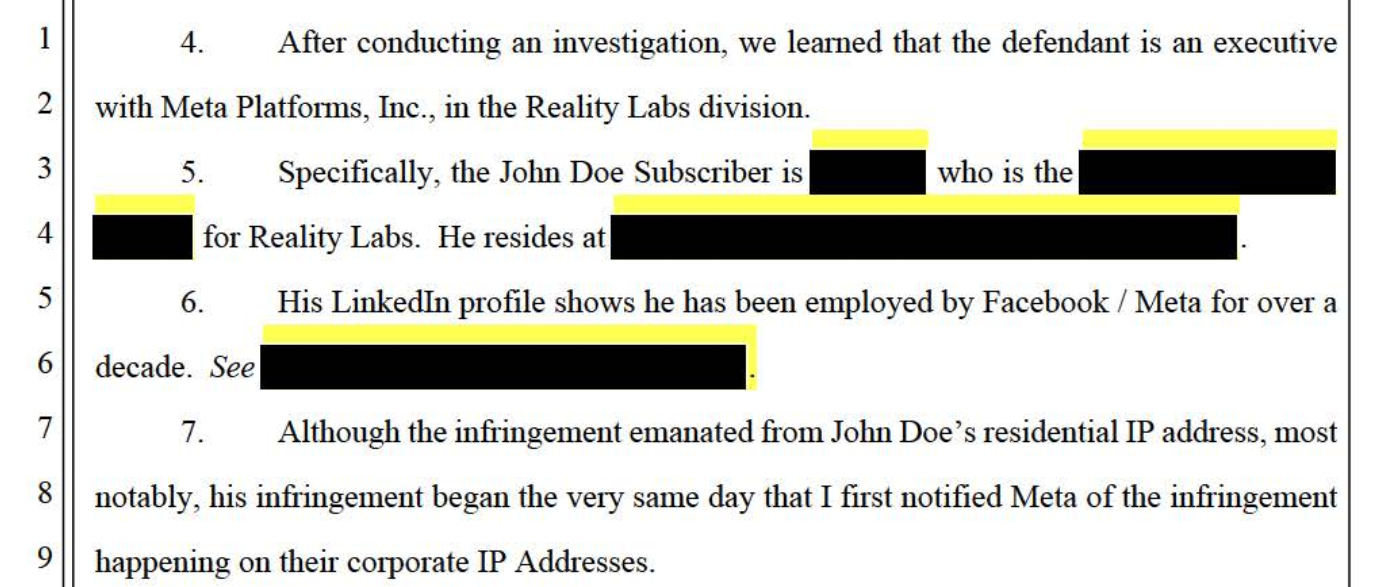
Now, this multi-million-dollar corporate showdown has collided directly with Strike 3’s bread-and-butter consumer litigation playbook. According to a newly unsealed motion filed in a California federal court, an anonymous residential BitTorrent user operating behind an AT&T connection is allegedly a high-ranking executive within Meta’s elite Reality Labs division—the very arm tasked with pioneering the company’s Quest virtual reality headsets.
The intersection of routine ISP subpoenas, corporate artificial intelligence data collection, and internal enterprise liability has transformed a standard civil piracy dispute into an unpredictable legal chess match.
Executive Overview: The Collision of Two Lawsuits
The convergence of Strike 3’s corporate litigation against Meta and its sprawling web of John Doe subpoenas highlights an extraordinary overlap between institutional AI data harvesting and domestic network activity.
At the center of the dispute is a residential IP address (162.192.7.34) tied to an AT&T broadband subscription. Following a legal subpoena granted by Magistrate Judge Virginia K. DeMarchi, AT&T surrendered subscriber records to Strike 3. Upon cross-referencing these logs with professional networks such as LinkedIn, Strike 3’s investigators concluded that the subscriber is a senior executive inside Meta’s Reality Labs division who has maintained a decade-long tenure at Facebook and Meta.
Strike 3 does not view this connection as a random coincidence. Pointing to suspicious temporal correlations, staggering data transfer volumes, and the specialized nature of the downloaded content—including VR-compatible adult titles tailored for Meta’s hardware ecosystem—the adult film producer is aggressively moving to consolidate the John Doe proceeding with its $446 million AI training lawsuit.
Meta, meanwhile, has pushed back. The company argues that an IP address is a notoriously flawed proxy for actual human identity, that Strike 3’s timeline contradicts its own foundational pleadings, and that home internet usage cannot be imputed to corporate engineering directives without tangible proof.
As U.S. District Judge Eumi K. Lee weighs whether to officially relate the two actions, the tech industry is watching closely. The outcome could redefine the boundaries of corporate accountability for employee digital behavior and establish critical legal precedents regarding how courts handle evidentiary trails linking residential torrenting to enterprise AI development.
Detailed Chronology: From a Spring Subpoena to Corporate Consolidation
To understand how a domestic broadband connection in California became a flashpoint in a half-billion-dollar copyright battle, it is necessary to examine the timeline established in court documents.
March 2025: The Escalation
The sequence of events accelerated in March 2025. According to court filings, Strike 3’s general counsel initiated contact with Meta’s legal team, delivering hard forensic evidence indicating active BitTorrent infringement originating from corporate IP addresses controlled by the tech giant.
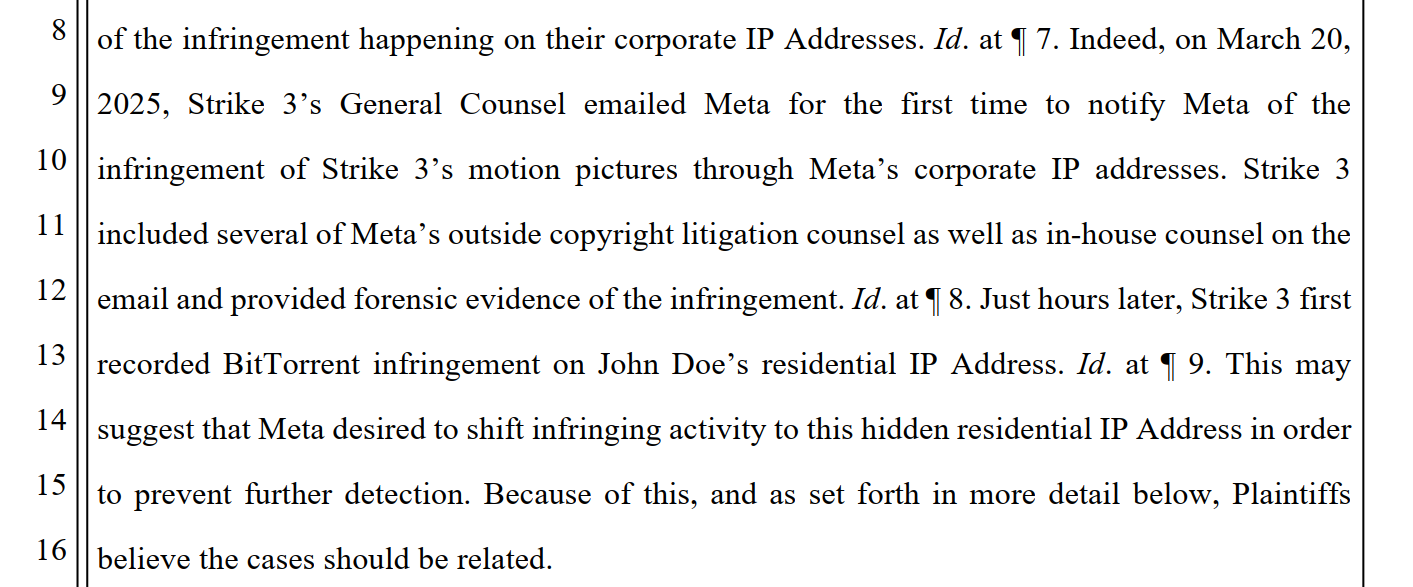
What happened next forms the backbone of Strike 3’s circumstantial case. Just hours after Strike 3’s general counsel emailed Meta’s legal representatives with evidence of corporate network piracy, the adult film producer’s monitoring software recorded the first instance of BitTorrent infringement originating from the residential IP address later tracked to the Meta executive.
Strike 3’s legal team highlights this sequence as a smoking gun:
"This may suggest that Meta desired to shift infringing activity to this hidden residential IP Address in order to prevent further detection," the motion argues.
April 2025: Subpoena and Unmasking
Capitalizing on this residential trail, Strike 3 filed a standard John Doe complaint in March against the subscriber of IP address 162.192.7.34 in the U.S. District Court for the Northern District of California.
By April, Magistrate Judge Virginia K. DeMarchi approved a Rule 45 subpoena directed at AT&T. Crucially, the court ordered that the subscriber’s name remain strictly confidential to protect privacy pending further review. Once AT&T complied with the subpoena, Strike 3’s internal investigation linked the account credentials to the senior Reality Labs executive.
Summer 2025: Surfacing Realities
This is not the first instance of a Meta Reality Labs employee emerging within Strike 3’s crosshairs. Earlier in the summer, Meta was forced to confirm that a former data engineer within the same division was behind a Comcast residential connection linked to the unauthorized downloading of 97 copyrighted films.
Furthermore, parallels have been drawn to separate copyright actions, such as the Kadrey litigation, where Meta utilized a personal-use defense after a Reality Labs contractor was flagged for downloading external materials on home connections.
Present Day: The Motion to Relate
Armed with the executive’s identity—which remains redacted from public filings at Meta’s request—Strike 3 filed a motion asking U.S. District Judge Eumi K. Lee to formally "relate" the John Doe case to the broader $446 million Meta lawsuit.
If Judge Lee grants the motion, both cases will be adjudicated before the same bench, significantly streamlining discovery and bypassing lengthy depositions. More importantly, it would allow Strike 3 to amend its complaint, name Meta directly alongside the executive under a joint liability theory, and demand that Meta appoint a corporate custodian to hand over comprehensive Reality Labs torrenting and data ingestion records.
Supporting Context & Metrics: Quantifying the Scale of Infringement
The plausibility of Strike 3’s argument rests heavily on the staggering volume and specific technical characteristics of the data routed through the executive’s residential connection.
The Numbers Game: Nearly 20,000 Files
According to forensic tracking data presented in court, the volume of material passing through the executive’s AT&T connection defies the profile of a casual consumer. Strike 3 logged nearly 20,000 distinct files downloaded via BitTorrent from the IP address.
The makeup of these downloads spans a wide array of digital media:
Multi-language "Mega Packs" encompassing popular television series, cinematic releases, commercial software packages, and electronic books.
Large quantities of AI-generated pornography.
Specialized Virtual Reality adult titles explicitly engineered for compatibility with Meta’s Quest hardware ecosystem.
Nearly a dozen proprietary titles owned directly by Strike 3.
The "Too Much for One Person" Argument
In its filings, Strike 3 emphasizes the sheer logistical impossibility of an individual managing such a data payload purely for personal amusement. As recently as August 25, monitoring agents recorded over 150 daily downloads originating from the connection.
Strike 3’s motion underscores the absurdity of the personal-use defense given the metrics:
"In short, this is a lot for one person to torrent on an average day, particularly one who has a demanding job."
The copyright holder argues that this high-throughput, automated-seeming behavior aligns far more closely with automated data scraping, research, or training dataset curation than with traditional, leisurely media consumption. Given that Reality Labs focuses on immersive hardware, spatial computing, and next-generation media interfaces, Strike 3 asserts that the acquisition of Quest-compatible adult content directly serves the research and development objectives of Meta’s division.
Official Statements and Legal Arguments
The legal battle lines are sharply drawn, pitting Strike 3’s circumstantial narrative against Meta’s strict evidentiary defenses.
Strike 3’s Theory of Enterprise Liability
Strike 3’s legal strategy relies on establishing a nexus between the corporate wrongdoing alleged in the $446 million lawsuit and the clandestine digital footprint of a senior corporate officer. By demonstrating temporal proximity—specifically the migration of traffic from corporate IP spaces to a residential connection immediately following a legal warning—the studio hopes to pierce the corporate veil of deniability.
If the cases are successfully linked, Strike 3 intends to:
Amend the John Doe complaint to explicitly name Meta as a defendant alongside the executive.
Assert joint and several liability theories.
Compel Meta to surrender corporate discovery documents regarding Reality Labs’ data ingestion pipelines, training datasets, and internal communications regarding copyright-protected media.
Meta’s Defense: The IP Address Fallacy
Responding to the motion to relate the cases, Meta adopted a cautious official stance, noting that it cannot independently investigate whether the subscriber is indeed an employee without reviewing unredacted names. However, the tech giant’s legal representation argues that even if the subscriber matches Strike 3’s description, the underlying logic of the lawsuit collapses under basic evidentiary scrutiny.
Meta’s filing attacks the core assumption of Strike 3’s methodology:
"They simply assume that the Subscriber is responsible for everything done on the IP address, and then leap to the additional, similarly unsupported assumption that he did it for Meta."
Meta leans heavily on established jurisprudence surrounding BitTorrent litigation—specifically the principle that an IP address identifies a network connection, not necessarily the human being operating the device or their specific intent. This vulnerability in P2P lawsuits was tacitly acknowledged by Magistrate Judge DeMarchi when she initially approved the AT&T subpoena under seal.
Furthermore, Meta highlighted a glaring logical contradiction in Strike 3’s timeline. Strike 3’s original corporate complaint alleges that Meta’s unauthorized "off-infra" data harvesting began as early as 2018, and that downloads on corporate IP addresses continued long after the March 2025 warning notices were delivered. Meta argues that Strike 3’s new theory—that the tech giant panicked and shifted its massive data-gathering operation to a single employee’s residential home internet connection hours after receiving an email—cannot be logically reconciled with its existing pleadings.
Future Outlook: Implications for Copyright Law and AI Training
As the legal proceedings unfold in the Northern District of California, the implications of Judge Eumi K. Lee’s impending decision extend far beyond a single adult film producer and a Silicon Valley executive.
1. The Intersection of AI Training and P2P Forensics
As artificial intelligence developers face mounting legal scrutiny over how they source training data—ranging from literary works to copyrighted video—rights holders are increasingly turning to forensic network analysis to prove infringement. If courts begin accepting residential BitTorrent logs as circumstantial evidence of corporate AI research, tech companies may face unprecedented vulnerabilities regarding employees working remotely.
2. The Liability of Remote Work Infrastructure
The normalization of remote and hybrid work has blurred the boundaries between corporate networks and residential broadband connections. Companies like Meta invest heavily in securing enterprise environments, but when high-level engineers and executives utilize home networks for professional tasks or exploratory research, tracking accountability becomes a legal minefield. Meta’s defense—that a home IP address does not legally bind an employer—will test how courts view enterprise responsibility in the era of decentralized workforces.
3. The Future of John Doe Subpoenas
Strike 3 Holdings has built a litigation empire on unmasking anonymous downloaders to extract quick settlements. By attempting to weaponize its own consumer-level John Doe machinery against a multi-trillion-dollar corporate defendant, the studio is testing uncharted legal waters. Whether this aggressive strategy yields a landmark settlement or results in judicial skepticism will shape how copyright holders litigate against big tech moving forward.
For now, the Reality Labs executive remains shielded behind court-ordered redactions, and Meta continues to deny any corporate connection to the residential downloads. All eyes remain fixed on the federal bench in California, where a decision on whether to relate the cases could ignite one of the most explosive intellectual property trials of the decade.