MIAMI — Major media conglomerates have long chased the ever-shifting hydra of digital piracy, frequently finding themselves trapped in an endless game of digital whack-a-mole. Every time a rogue domain is seized or shut down, pirate operations spawn two more, shifting IP addresses, spinning up fresh hosting configurations, and migrating to alternative Content Delivery Networks (CDNs) within hours.
However, Spanish-language media powerhouse TelevisaUnivision (TU) is attempting to fundamentally rewrite the rules of digital enforcement in the United States. Following an initial legal salvo launched earlier this year in a federal court in Florida, the broadcaster is now asking a federal judge to approve a permanent default judgment carrying a staggering $32.7 million price tag—and, more importantly, a groundbreaking, self-expanding injunction that grants the network unilateral power to add new targets, platforms, and domains without ever returning to a court of law.
If granted by U.S. District Judge Kathleen Williams, the order could establish a controversial blueprint for how intellectual property holders combat illicit Internet Protocol Television (IPTV) providers, potentially shifting dynamic site-blocking mechanisms long common in Europe into the American judicial landscape.
Executive Overview
The legal battle centers on a sprawling web of unauthorized streaming services—including Thunder TV, Sunset TV, Tele Latino, Pop TV, and Kaelus TV—that have systematically redistributed TelevisaUnivision’s protected programming without authorization. When the primary defendants failed to mount a defense or appear in court, TU seized the procedural advantage, filing a motion for default judgment on September 4.

While the headline-grabbing $32.7 million in statutory damages and trademark counterfeiting penalties highlights the severe financial risks facing rogue operators, legal experts are zeroing in on the mechanics of the requested permanent injunction. Unlike traditional court orders that require plaintiffs to petition a judge every time a pirate service alters its digital footprint, TU’s proposed order features a dynamic, self-expanding mechanism.
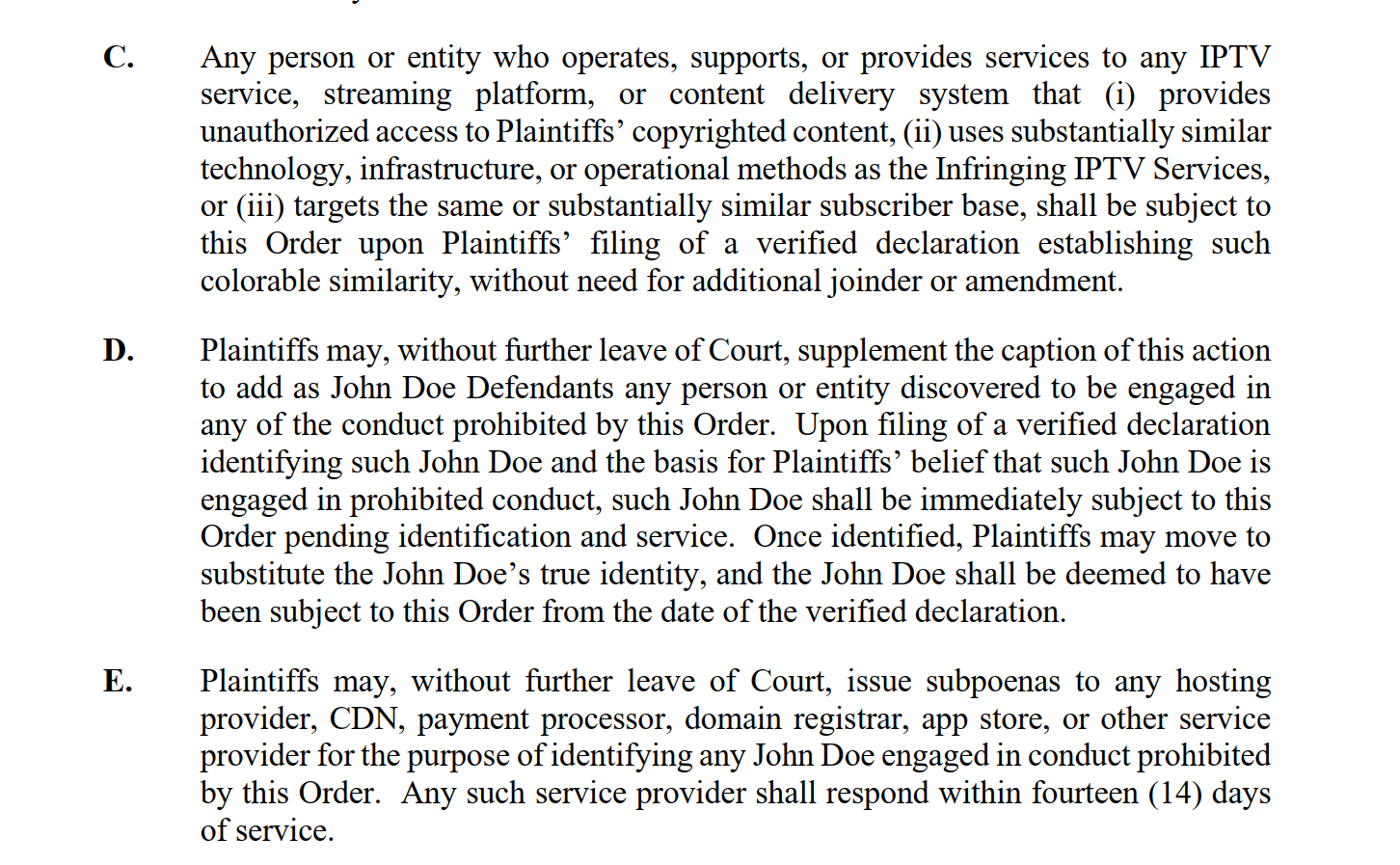
Under this framework, TelevisaUnivision would be legally empowered to independently append new domain names, IP addresses, mirror sites, and even newly discovered corporate entities to the active injunction. By expanding the scope to capture nearly 600 domains, 121 intermediaries—ranging from global domain registrars to mainstream development platforms like GitHub, Vercel, and Automattic—and introducing a "colorable similarity" clause to hunt down successor apps, TU is pushing the boundaries of American civil jurisprudence.
Detailed Chronology: From Preliminary Success to Permanent Expansion
The genesis of this landmark legal action dates back to July, when TelevisaUnivision secured an aggressive preliminary injunction from a federal court in the Southern District of Florida. Initially targeting just five unauthorized IPTV operators, the scope of the restriction snowballed dramatically within weeks as investigators mapped out the underlying infrastructure.
The July Preliminary Injunction
When the lawsuit was first filed, the primary targets included Thunder TV, Sunset TV, Tele Latino, Pop TV, and Kaelus TV. Conspicuously, the operators behind Pop TV and Kaelus TV remained obscured behind anonymous "John Doe" designations, while the operators of the remaining services opted against showing up in court. Capitalizing on the defendants’ default, TU secured a preliminary injunction that came with a built-in flexibility clause: permission to update its target list without judicial oversight.
The broadcaster wasted little time exercising this muscle. Before the preliminary injunction was even a month old, TU had used its self-updating powers twice, ballooning the target list to encompass a diverse portfolio of rogue brands such as XuperTV, Tarjeta Roja, Pirlo TV, and Roja Directa.
The September 4 Default Judgment Filing
With the defendants universally absent, TelevisaUnivision filed its comprehensive motion for default judgment on September 4, asking Judge Williams to transition the temporary safeguards into a permanent, ironclad injunction.
According to court filings, the evolution of the pirate networks necessitated an even broader set of legal tools. For instance, investigative declarations submitted alongside the motion revealed that Thunder TV had effectively ceased streaming TelevisaUnivision content directly. Instead, its operators had migrated their subscriber base to a mirror application christened "Black Eye." Crucially, users could access Black Eye using their pre-existing Thunder TV credentials. Under conventional legal parameters, shutting down Thunder TV would have required an entirely new lawsuit to target Black Eye. Under TU’s proposed permanent injunction, however, the Black Eye application falls squarely into the crosshairs as a direct successor service.
Supporting Context & Metrics: The Scale of the Infrastructure
The sheer breadth of the infrastructure targeted by TelevisaUnivision’s legal team underscores why traditional enforcement mechanisms have proven inadequate. The paperwork submitted to the court paints a picture of a vast, industrialized piracy ecosystem supported by a sprawling global supply chain of technical intermediaries.
The Domain and Brand Footprint
The legal filings catalogue nearly 600 unique domain names tied to the original and secondary pirate brands. The scale of individual operations is immense:
- Thunder TV and Tele Latino: Each accounts for upwards of 90 distinct domain names.
- XuperTV: Described by TU as a white-label service built upon the same technical infrastructure as Magis TV, XuperTV alone adds more than 110 domains to the ledger.
The Intermediary Ecosystem
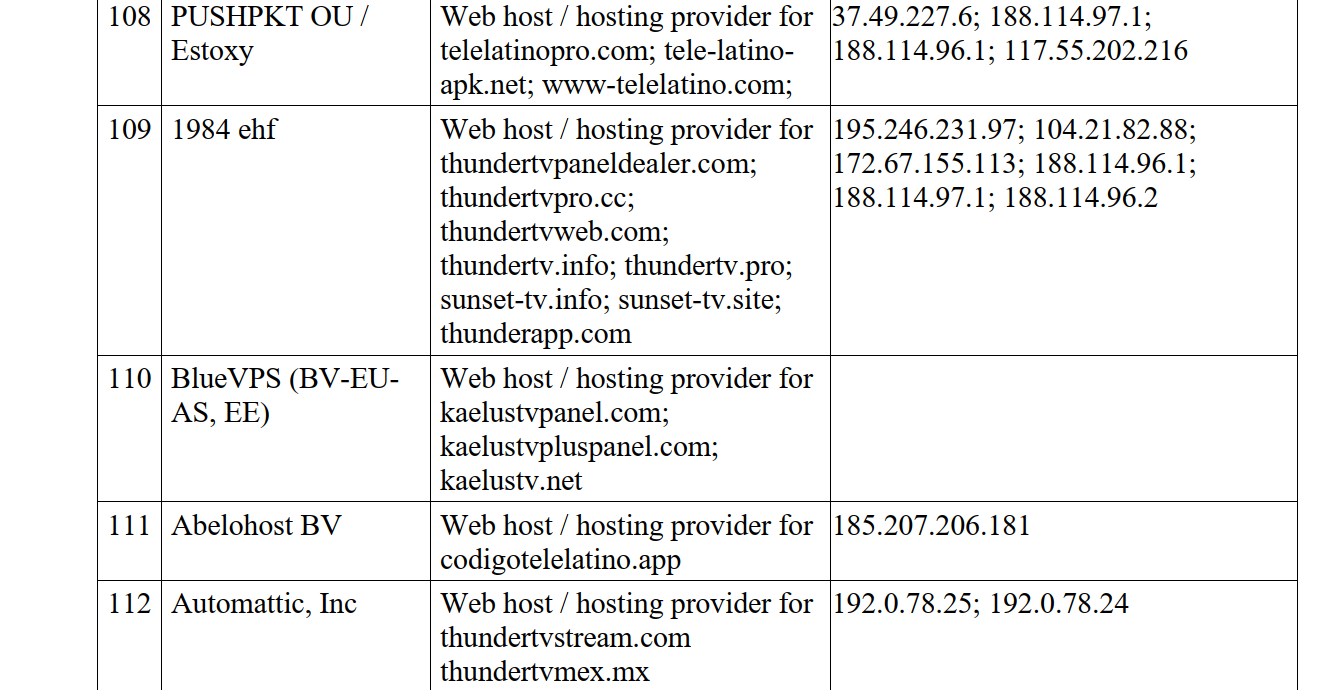
Most strikingly, the injunction targets an unprecedented 121 commercial intermediaries that facilitate the operation of these pirate networks. The list is truly global, encompassing entities across multiple continents and jurisdictions:
- 51 Domain Registrars: Including domestic providers like NameCheap and GoDaddy, alongside international registrars such as Russia’s REGTIME-SU, Vietnam’s Mat Bao, Peru’s NIC.PE, the Netherlands’ Registrar.eu, and Iran’s Aria Shatel.
- 58 Hosting and CDN Providers: Comprising traditional infrastructure providers, cloud services, and notably, mainstream web development and deployment platforms like GitHub, Vercel, Canva, Wix, Squarespace, and Automattic (the commercial entity behind WordPress.com).
- Payment Channels & App Stores: Five financial processing channels and five distinct app distribution platforms, alongside specific directives aimed at hardware and software providers like Roku and the AFTVnews Downloader app to eliminate rogue application downloads and block numerical installation short codes.
In a few instances, the broad sweep of the injunction has raised eyebrows among technical experts. For example, the legal filings mistakenly categorize regional internet registries like RIPE NCC (Europe) and APNIC (Asia-Pacific) as "web hosts/hosting providers." Because these registries merely allocate IP address space rather than routing traffic or hosting content, technical compliance with the order regarding these specific entities remains operationally impossible.
Meanwhile, content delivery giant Cloudflare faces specific, rigorous demands. For roughly 90 IP addresses tied to the pirate domains, Cloudflare is ordered to unmask the true origin servers sitting behind its proxy services, alongside disclosing the account holder names and associated email addresses.

Official Legal Claims and Financial Calculations
The financial penalties requested by TelevisaUnivision reflect the maximum allowable statutory limits under U.S. copyright and trademark law:
- Copyright Infringement: TU is seeking $26.7 million for willful copyright infringement, calculated at the statutory maximum of $150,000 for each of its registered works utilized by the defendants.
- Trademark Counterfeiting: An additional $6 million is demanded for willful trademark counterfeiting, assessed at $2 million per defendant group.
The Reality of Uncollectible Judgments
Legal analysts acknowledge that recovering $32.7 million from anonymous, foreign-based operators who have defaulted and vanished is practically impossible. TelevisaUnivision is under no illusions regarding the collectibility of these funds. Instead, the multi-million-dollar demand serves a dual purpose: it establishes a powerful legal precedent regarding the economic severity of large-scale commercial piracy, and it provides the necessary judicial justification for imposing an extraordinary, infrastructure-level permanent injunction.
This strategy mirrors broader trends across the media landscape. In March, a federal court ordered a Dallas-based IPTV operator to pay Amazon and Netflix $18.75 million. Similarly, a coalition of Hollywood studios secured a $9 million default judgment against an IPTV operator in Pennsylvania in June. Yet, while multi-million-dollar paper judgments are becoming increasingly common, the structural remedies attached to them are rarely as sweeping as the one sought by TU.
Future Outlook: Implications for U.S. Internet Governance
The motion currently sits on Judge Kathleen Williams’ desk, awaiting a final ruling. The central question facing the court is whether American jurisprudence is ready to embrace the concept of self-expanding, dynamic site-blocking orders that have operated in various forms across the European Union for years.
If Judge Williams approves the proposed permanent injunction in its entirety, it could establish a powerful precedent for other major content creators, sports leagues, and broadcasters battling transnational piracy rings. By shifting the burden of tracking down successor domains, alter-ego apps, and mirror platforms away from the courts and directly into the hands of the rightsholders, the ruling would streamline anti-piracy enforcement to unprecedented speeds.
However, civil liberties advocates and intermediary platforms are likely to monitor the fallout closely. Giving a private corporate entity the unilateral authority to expand a federal court injunction—adding new defendants and compelling dozens of international intermediaries to sever ties without judicial review—raises significant due process questions.
For now, TelevisaUnivision’s bold legal maneuver stands as a stark warning to the operators of illicit streaming empires: even if you abandon your domains, hide behind anonymous shell companies, and migrate to successor apps, the long arm of the law—and an increasingly automated legal apparatus—may soon pursue you across every layer of the modern internet.