Executive Overview
For over a decade, the landscape of U.S. federal copyright litigation has been defined by a repetitive, high-volume legal conveyor belt. Adult film studio Strike 3 Holdings has mastered the art of the "John Doe" lawsuit, leveraging mass federal subpoenas against Internet Service Providers (ISPs) to unmask anonymous BitTorrent users, extract monetary settlements, and close the file. It is an industrialized judicial pipeline designed for efficiency over spectacle.
However, a routine procedural maneuver in a California federal court has upended this industrial-scale settlement machine, transforming a standard piracy dispute into a high-stakes corporate warfare saga. Strike 3 Holdings, alongside co-plaintiff Counterlife Media, has taken its aggressive copyright enforcement strategy and pointed the barrel directly at Silicon Valley titan Meta Platforms.
The underlying conflict centers on a jaw-dropping allegation: that Meta systematically pirated nearly 3,000 adult films via BitTorrent to fuel the training of its artificial intelligence (AI) models—a multi-million-dollar copyright infringement claim that could carry statutory damages worth up to $446 million. Now, that mammoth corporate litigation has crashed head-first into Strike 3’s bread-and-butter John Doe enforcement model.
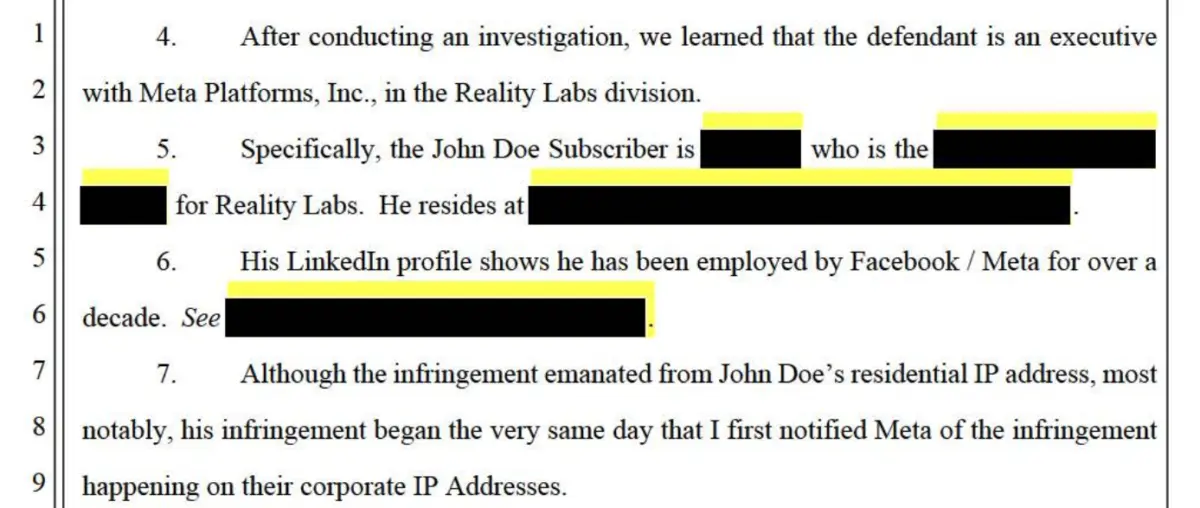
According to a heavily redacted motion filed in the U.S. District Court for the Northern District of California, a residential AT&T Internet connection tied to nearly 20,000 downloaded files belongs to a senior executive within Meta’s ultra-secretive Reality Labs division—the hardware and software arm responsible for the Quest Virtual Reality (VR) headset ecosystem.
Strike 3 is aggressively attempting to fuse the anonymous executive’s residential copyright infringement case with the broader $446 million lawsuit against Meta. If successful, the legal strategy could shatter Meta’s corporate insulation, establish joint liability for executive-level misconduct, and force the tech giant to hand over sensitive internal custodial records. Meta, meanwhile, has hit back with classic tech-industry defense playbooks, arguing that an IP address does not legally identify a human infringer, and that there is zero corporate nexus connecting an employee’s home network to the company’s official AI research infrastructure.
Detailed Chronology: From Subpoena to Silicon Valley
To understand how an ordinary AT&T home internet connection in California became the focal point of a nearly half-a-billion-dollar federal lawsuit, one must examine the meticulous timeline constructed by Strike 3’s legal counsel.
The story begins in March 2024, when Strike 3 initiated a routine John Doe action in the U.S. District Court for the Northern District of California, targeting the subscriber of IP address 162.192.7.34. Operating under standard judicial protections for privacy in initial copyright actions, Magistrate Judge Virginia K. DeMarchi granted Strike 3 a Rule 45 subpoena directed at AT&T. The order explicitly stipulated that the subscriber’s true identity should remain sealed from public view to prevent premature public shaming or unverified accusations.

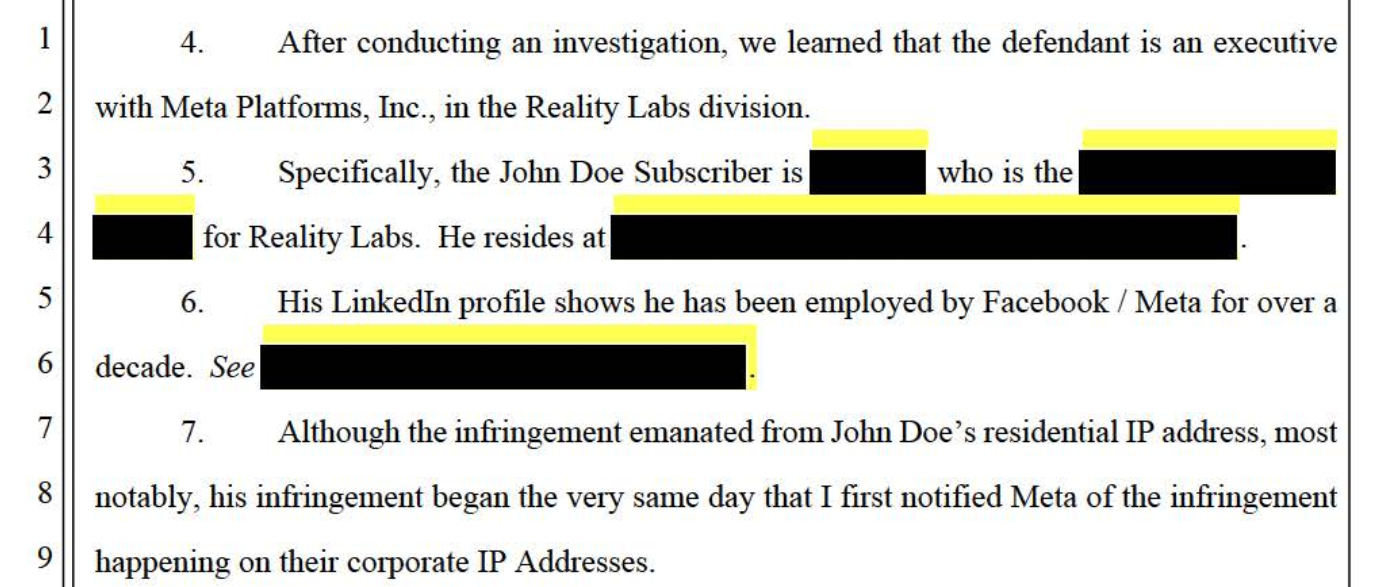
Once AT&T complied with the lawful subpoena and surrendered the subscriber’s account data, Strike 3’s internal forensic investigators initiated a deep-dive background check. Cross-referencing public identifiers with professional networking data—specifically LinkedIn profiles—Strike 3 concluded that the residential account holder was not an ordinary consumer, but a high-ranking executive within Meta’s Reality Labs division. The individual’s tenure at Facebook and Meta reportedly spans over a decade, cementing his status as a long-standing insider within Mark Zuckerberg’s tech empire.
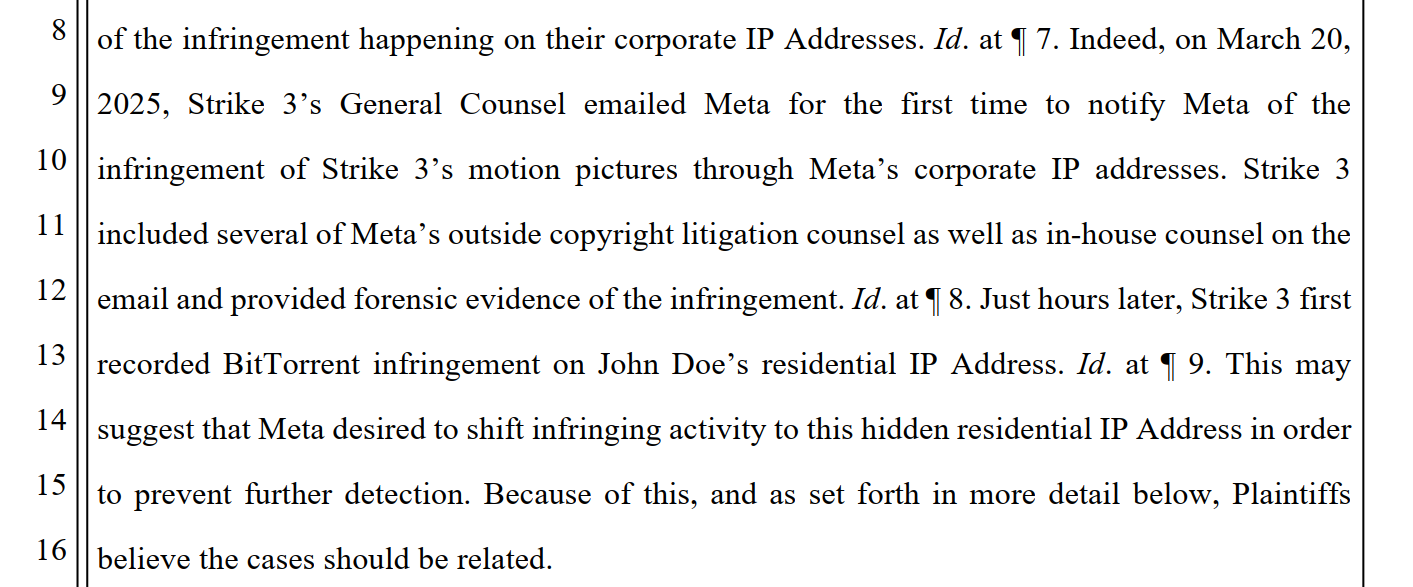
Crucially, Strike 3 argues that the timeline of the executive’s piracy activities points directly to corporate directives rather than casual personal entertainment. The adult film producer’s general counsel dispatched an official forensic warning letter to Meta’s corporate legal team on March 20, 2024. This formal notice detailed extensive, verified BitTorrent infringement occurring directly across Meta’s corporate IP infrastructure.
The legal motion highlights a striking anomaly: mere hours after Strike 3’s general counsel flagged the corporate network piracy to Meta’s lawyers, the adult film producer registered its first wave of BitTorrent infringement originating directly from the John Doe executive’s residential AT&T IP address.
In its filing, Strike 3 explicitly articulates the implication:
"This may suggest that Meta desired to shift infringing activity to this hidden residential IP Address in order to prevent further detection."
Nearly a year later, as the dots were finally connected between the isolated John Doe subpoena returns and the overarching corporate enterprise lawsuit, Strike 3 realized it had potentially captured a smoking gun. The studio is now petitioning U.S. District Judge Eumi K. Lee to formally "relate" the individual John Doe case to the broader $446 million Meta lawsuit, ensuring that both legal actions proceed under the supervision of the same judicial officer.
Supporting Context & Metrics: The Scale of the Infringement
What separates this specific John Doe defendant from the hundreds of thousands of casual torrenters targeted by copyright trolls over the last two decades is the sheer, industrial magnitude of the data flow. Strike 3’s forensic telemetry revealed that the Reality Labs executive’s home connection was not merely dabbling in occasional downloads; it was operating like a localized data center.
According to court filings, Strike 3 logged nearly 20,000 distinct file downloads associated with the targeted AT&T IP address. The scope of this digital haul goes far beyond adult entertainment, encompassing a sprawling array of multi-language "Mega Packs" containing television series, commercial software, mainstream Hollywood movies, e-books, and cutting-edge AI-generated pornography and VR adult films.
The inclusion of VR adult titles is particularly damning within the context of Meta’s business operations. As the driving force behind the Meta Quest VR headset ecosystem, Reality Labs has a vested technological interest in ensuring that its hardware supports immersive adult content—a market segment that has historically driven early technology adoption. Strike 3 notes that the volume of files recovered includes multiple proprietary adult titles produced by the studio itself.
The velocity of the downloads further strains the boundaries of plausibility for personal use. As recently as August 25, Strike 3’s forensic monitoring captured more than 150 daily downloads executed through the residential connection.
In its scathing motion, Strike 3 summarizes the improbability of the activity:
"In short, this is a lot for one person to torrent on an average day, particularly one who has a demanding job."
The studio argues that this relentless, automated ingestion of data is entirely consistent with automated AI training pipelines, machine learning ingestion workflows, or systematic corporate research and development, rather than a human being manually browsing and downloading media for leisure.
Furthermore, this is not an isolated incident within Meta’s ecosystem. Earlier in the summer, Meta was forced to formally confirm that a former data engineer within the same Reality Labs division was the human operator behind a Comcast residential connection linked to the unauthorized downloading of 97 copyrighted adult films. When that particular employee surfaced in separate litigation (such as the high-profile Kadrey v. Meta AI copyright case), Meta defended the worker by claiming the downloads were strictly personal and entirely divorced from corporate duties.
Official Statements and Legal Arguments
The courtroom battle lines are now sharply drawn, featuring classic intellectual property defenses colliding with aggressive corporate accountability theories.
Strike 3’s Expansion Strategy
Strike 3’s legal strategy is multifaceted. By relating the John Doe case to the multi-million-dollar Meta lawsuit, the plaintiff seeks to bypass expensive, time-consuming preliminary depositions and discovery hurdles. More importantly, it provides a legal gateway for Strike 3 to amend its complaint, name Meta directly as a co-defendant in the residential piracy action, argue that the Reality Labs executive bears joint liability for corporate data harvesting, and formally compel Meta to appoint a corporate custodian to hand over internal Reality Labs torrenting logs.
Meta’s Defense: The IP Address Fallacy
Meta has responded to the motion with measured caution, formally taking "no position" on the procedural relation of the cases for the simple reason that, under court seals, the exact identity of the employee has not yet been publicly disclosed to Meta’s defense team. However, the tech giant’s legal filings immediately attack the substantive underpinnings of Strike 3’s assertions.
Meta’s core defense relies on a bedrock principle of internet law: an IP address identifies a network connection, not a human being.
In its legal response, Meta excoriates the plaintiff’s deductive leaps:
"They simply assume that the Subscriber is responsible for everything done on the IP address, and then leap to the additional, similarly unsupported assumption that he did it for Meta."
Meta points out that Magistrate Judge DeMarchi herself highlighted this exact vulnerability when initially granting the subpoena, noting that mere association with an IP address does not establish actionable copyright infringement.
Additionally, Meta’s legal team has highlighted a glaring logical contradiction in Strike 3’s conspiracy narrative. Strike 3’s original complaint against Meta alleges that the tech giant’s unauthorized "off-infra" downloading activities began as early as 2018, and that corporate IP infringement continued unabated even after formal legal notices were delivered. Meta argues that Strike 3’s new theory—that Meta panicked and deliberately shifted its piracy operations to an executive’s secret home Wi-Fi network hours after receiving a warning letter—cannot be logically reconciled with its existing allegations that corporate-level downloading continued openly.
Future Outlook and Industry Implications
As the legal teams prepare for upcoming hearings before U.S. District Judge Eumi K. Lee, the broader technology and legal sectors are watching closely. The implications of this case extend far beyond a dispute over adult film copyrights.
If Judge Lee ultimately decides to link the John Doe proceeding to the $446 million Meta lawsuit, it could create a dangerous precedent for major technology firms engaged in aggressive AI model training. The ruling would strip away the traditional firewall between corporate infrastructure and employee-level home networks, opening tech workers and their employers to joint liability if personal devices or residential connections are weaponized to bypass corporate firewalls and ingest unauthorized training data.
Conversely, if Meta successfully defends the separation between its corporate liability and an employee’s residential broadband usage, it will reinforce the impregnable shield that IP-address ambiguity provides in modern digital piracy litigation. It would validate the tech industry’s stance that isolated employee misconduct—even by high-ranking executives in sensitive R&D divisions—cannot automatically be imputed to corporate balance sheets.
For now, the Reality Labs executive remains cloaked in legal anonymity, their identity shielded from the public ledger even as their digital footprint sits at the center of a half-billion-dollar federal storm. As courts grapple with the chaotic intersection of generative AI, web-scale data scraping, and legacy copyright law, the outcome of this clash will reverberate across Silicon Valley and redefine how digital assets are monitored, protected, and litigated in the automated age.