Executive Overview
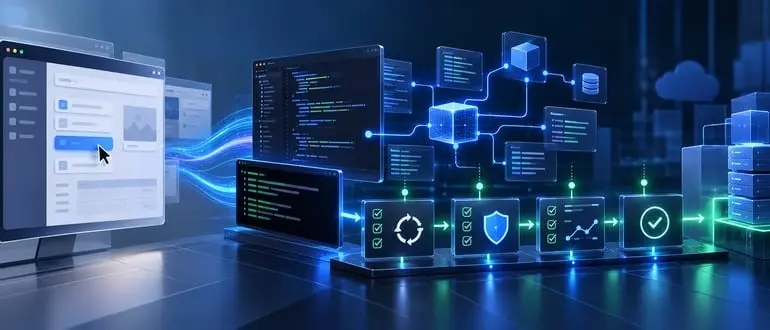
The traditional software delivery lifecycle (SDLC) has long been anchored by the graphical user interface (GUI). From clicking through deployment pipelines to manually navigating cloud dashboards, platforms have historically been engineered around the assumption that a human operator is at the helm, using a mouse and a screen to drive operations. However, the explosive rise of autonomous coding agents—such as Cursor, Claude Code, and specialized IDE-integrated AI assistants—is rendering the GUI-centric model obsolete.
Enter Headless DevOps.
By stripping away the graphical layer and exposing core delivery capabilities exclusively through application programming interfaces (APIs), command-line interfaces (CLIs), and packaged agent skills like Model Context Protocol (MCP) servers, platform engineers are fundamentally altering how work reaches production. In a recent expert discussion, Federico Larsen, co-founder and Chief Technology Officer (CTO) of Copado, sat down with industry analyst Alan Shimel to dissect this paradigm shift, using the complex, enterprise-grade ecosystem of Salesforce development as a prime case study.
Larsen’s insights illuminate a critical reality: simply bolting an API onto an existing platform does not solve the challenges of modern automation. While headless architecture enables developers to delegate complex tasks directly from their development environments without context-switching to a web browser, it simultaneously magnifies the need for robust security, dynamic validation, and intelligent guardrails.
This article explores the mechanics of Headless DevOps, examining how the intersection of AI agents and headless infrastructure is transforming testing methodologies, redefining compliance, and forcing engineering leaders to rethink the boundary between autonomous execution and human oversight.
Detailed Chronology: The Evolution from ClickOps to Agentic Automation
To understand why Headless DevOps has emerged as a critical architectural necessity, one must trace the evolution of software delivery tooling over the past two decades.
Phase 1: The Era of ClickOps and Manual Pipelines
In the early days of continuous integration and continuous delivery (CI/CD), platforms prided themselves on rich, user-friendly dashboards. Engineers would manually configure deployment jobs, click buttons to promote builds from staging to production, and visually inspect logs through web interfaces. While this lowered the barrier to entry, it created significant bottlenecks. GUI-driven workflows are inherently slow, difficult to audit at scale, and resistant to programmatic scaling.
Phase 2: Scripting and Traditional Automation
As cloud-native architectures matured, organizations moved toward "Infrastructure as Code" (IaC) and script-driven pipelines. CI/CD systems like Jenkins, GitHub Actions, and GitLab CI allowed teams to codify their deployment processes. However, these systems were still fundamentally designed to execute predefined, deterministic scripts triggered by human commits or pull requests. The human remained the conceptual driver, orchestrating the logic from afar while the tooling executed rigid, linear steps.
Phase 3: The Rise of the Coding Agent
The current era is defined by the proliferation of LLM-powered coding agents embedded directly inside integrated development environments (IDEs). Developers no longer write every line of code manually; instead, they act as supervisors and architects, delegating feature creation, bug fixing, and refactoring to AI models.
As Larsen pointed out during his conversation with Shimel, developers using next-generation tooling want to push tasks further down the pipeline without breaking their flow state. Forcing a developer to stop coding in Cursor or Claude Code, open a browser, log into a delivery platform, and manually configure a deployment ticket destroys productivity. The agent, capable of writing code and understanding repository context, needs a direct pathway to execute delivery tasks. This realization birthed the architectural framework of Headless DevOps: an environment where delivery platforms expose their entire functional surface area to programmatic consumers—specifically, AI agents.
Supporting Context & Metrics: The Three Access Layers of Headless Delivery
To make a platform truly agent-ready, engineering teams cannot rely on retrofitted webhooks or brittle screen-scraping tools. Modern headless architecture requires a deliberate, multi-layered approach to API design. Larsen highlights three distinct access layers that platforms must provide to support seamless, agentic workflows:
[ AI Coding Agent (Cursor, Claude Code) ]
               │
               ├── 1. APIs (REST / GraphQL / gRPC)
               ├── 2. CLI Commands (Scriptable Shell Tools)
               └── 3. Agent Skills / MCP Servers (Native Context Protocols)
1. APIs (Application Programming Interfaces)
At the foundational level, headless delivery requires robust, well-documented REST, GraphQL, or gRPC endpoints. These APIs allow an agent to programmatically query system states, trigger builds, execute test suites, and manage environment configurations without human intervention.
2. CLI Commands (Command-Line Interfaces)
While APIs are essential for programmatic integration, CLIs provide a flexible intermediary layer that mirrors how developers and advanced agents interact with local environments. Scriptable command-line tools enable agents to execute complex, multi-step operations locally or within secure remote containers by chaining native terminal commands together.
3. Packaged Agent Skills and MCP Servers
The most forward-thinking manifestation of headless architecture is the adoption of native agent protocols, such as the Model Context Protocol (MCP) and pre-packaged agent skills. Instead of forcing an LLM to guess how to format an API request, MCP servers allow platforms to expose their capabilities as structured, callable tools directly to the AI model. The agent instantly understands what operations are permissible, what parameters are required, and how to interpret the output.
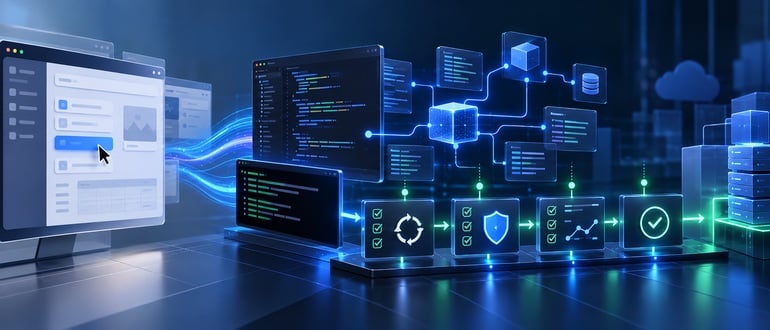
The Salesforce Development Paradigm
Applying these layers to Salesforce development—traditionally known for its reliance on proprietary web interfaces and metadata deployment wizards—demonstrates the sheer power of this approach. By exposing Salesforce org management, metadata validation, and deployment pipelines through headless APIs and CLI tools, developers can command an AI agent to build a custom Lightning Web Component, write the corresponding Apex tests, validate the package against enterprise metadata rules, and initiate a deployment to a scratch org, all without leaving their IDE.
Official Statements & Expert Analysis
The transition to Headless DevOps introduces profound operational questions that extend far beyond mere convenience. During their discussion, Federico Larsen and Alan Shimel unpacked the complex balance between making a platform accessible to AI and maintaining rigorous engineering governance.
"A delivery platform built around screens and mouse clicks assumes a person is doing the work," Larsen noted. "That becomes a constraint when developers delegate tasks to coding agents from inside their development environments. Exposing the same capabilities through APIs, command-line tools and agent interfaces changes how work reaches the platform, but it does not remove the need to test changes, enforce security checks or decide which actions still require a human."
Redefining Quality Assurance and Regression Testing
One of the most significant challenges highlighted by Larsen is the inherently non-deterministic nature of AI agents. Traditional software testing relies on deterministic inputs and fixed expected outputs: given a specific function, the test runner expects an exact return value.
AI agents, however, do not operate with rigid predictability. An agent might solve a coding problem brilliantly in one execution, while taking a slightly more convoluted—yet functionally correct—path in the next. Testing an agentic workflow therefore requires a paradigm shift in quality assurance.
Organizations must evaluate agents not on whether their outputs are identical across runs, but on broader compliance criteria:
- Task Adherence: Did the agent successfully accomplish the user’s core objective without hallucinating extraneous changes?
- Corporate Guardrails: Did the generated code adhere to internal coding standards, security policies, and corporate language requirements?
- Automated Acceptance Criteria: Dynamically generating regression test suites directly from user-story acceptance criteria rather than manually writing rigid unit tests for every conceivable edge case.
Security and Compliance in an Autonomous World
Giving an AI agent direct, programmatic access to delivery pipelines dramatically expands the organizational attack surface. If an agent can trigger deployments and modify configurations, it effectively holds high-level privileges within the software factory.
Larsen emphasized that security scrutiny must shift left and expand outward to encompass three critical domains:
- Connected Applications and Third-Party Integrations: Ensuring that tokens and credentials exposed to agentic workflows are strictly scoped and short-lived.
- IP Range and Network Perimeter Controls: Restricting headless endpoints so that autonomous tools can only operate within secure, authenticated corporate perimeters.
- Agent Behavioral Monitoring: Auditing the decision-making patterns of autonomous agents in real-time to detect anomalous behavior, unauthorized data access attempts, or accidental infrastructure modifications.
Future Outlook: The Imperative of Guardrails and Human-in-the-Loop Governance
As we look toward the future of software engineering, Headless DevOps will transition from an innovative architectural edge to an industry-standard baseline. The sheer velocity enabled by AI coding agents makes GUI-bound delivery pipelines fundamentally unsustainable. Organizations that fail to embrace headless architectures will find their engineering teams bottlenecked by manual approval processes and sluggish user interfaces.
However, the future is not purely autonomous. The distinction between making a platform accessible and making it safe to automate will define the success of platform engineering teams over the next decade.
The Evolution of the Human-in-the-Loop
Headless DevOps does not eliminate the human element; rather, it elevates the engineer from a manual operator to an architectural supervisor. Platforms must be designed with intelligent gates that dynamically determine when an agentic workflow requires human sign-off.
For instance, an agent might autonomously handle routine bug fixes, dependency updates, and isolated feature additions. However, when an execution touches critical security perimeters, alters core database schemas, or impacts financial data models, the headless delivery platform must automatically pause execution, bundle the agent’s output into a reviewable format, and escalate the task to a human engineer.
Conclusion
The convergence of AI coding agents and headless delivery infrastructure marks one of the most profound shifts in software engineering history. By decoupling platform capabilities from graphical user interfaces and exposing them through APIs, CLIs, and agent protocols like MCP, organizations can unlock unprecedented levels of developer velocity.
Yet, as Federico Larsen’s insights underscore, true enterprise readiness requires more than just removing screens. It demands a rigorous commitment to dynamic security, adaptable testing methodologies, and thoughtful governance. By bridging the gap between headless access and uncompromising compliance, engineering leaders can build a resilient, scalable foundation for the age of autonomous software delivery.