Executive Overview
For centuries, humanity has looked to the heavens, to shifting economic policies, and to the rise and fall of political regimes to explain the tumultuous course of history. Yet, a silent, subterranean architect has frequently rewritten the human story from the shadows: the Earth’s mantle. Cataclysmic volcanic eruptions—those titanic explosions capable of injecting billions of tons of sulfur dioxide and ash high into the stratosphere—do more than alter local landscapes. They act as global thermostats, abruptly plunging the planet into unseasonal cold, disrupting agricultural lifelines, triggering famines, and compounding societal vulnerabilities that have catalyzed plagues, rebellions, and the collapse of empires.
Thanks to the foundations laid by nineteenth-century telecommunications during the catastrophic 1883 explosion of Krakatau, humanity first began to document the immediate and long-range planetary consequences of a major volcanic event in near real time. Today, modern volcanologists, climatologists, and environmental historians are synthesizing this empirical baseline with cutting-edge data extraction techniques—ranging from ice-core sampling in Greenland and Antarctica to high-resolution dendrochronology (tree-ring analysis).
The findings are profound: historical anomalies such as the mysterious atmospheric shrouding of 536 CE, the devastating 1257 Samalas eruption, the ominous climate-disease nexus of the Black Death, and the famously disruptive "Year Without a Summer" in 1816 reveal an unyielding correlation between planetary geological shocks and human societal upheaval. As modern societies navigate an era of rapid climate change, these historical case studies provide vital intelligence on how humanity copes with planetary-scale environmental stress, offering a stark reminder that it is only a matter of time before the next geological giant awakens.
Detailed Chronology: A History Etched in Ice and Ash
The effort to link volcanic activity with human history requires navigating a complex detective story written across centuries. Because written records before the modern era were often localized, fragmented, or entirely absent for remote regions, researchers rely on physical archives—primarily polar ice sheets and ancient forests—to reconstruct the timeline of Earth’s volcanic past.
1. The Phantom Shroud of 536 CE
The first profound historical challenge in understanding the volcano-society nexus begins in the mid-sixth century. Across Europe, the Middle East, and parts of Asia, contemporary chroniclers recorded a bizarre and terrifying atmospheric anomaly: the sun was mysteriously dimmed, reduced to a bluish, sickly disc that cast no shadows for 18 months. Temperatures plummeted dramatically, agricultural harvests failed across multiple continents, and within a few short years, the Justinian Plague—the first historically documented global pandemic—swept through civilizations.
While contemporary texts strongly pointed toward a massive atmospheric injection of particulate matter, the smoking gun remained hidden until scientists drilled deep into polar ice cores. When researchers analyzed the annual accumulation layers of ice from Greenland and Antarctica, they discovered a distinct, massive spike in sulfur deposits dating precisely to 536 CE. This chemical fingerprint confirmed a colossal volcanic eruption. However, the precise geographic source of the eruption remains an enduring historical mystery, complicated by the fact that potential source regions, such as Iceland, were not yet populated or chronically documented at the time.
2. The 1257 Samalas Eruption and the Mongol Empire
Seven centuries later, researchers have achieved a far more precise identification of a geological titan. Until 2013, science recognized that an eruption of unprecedented magnitude had occurred around 1257, based on worldwide sulfur distribution in ice cores. That year, an interdisciplinary team successfully radiocarbon-dated ash, pumice, and tephra deposits surrounding Samalas, a massive volcanic complex in Indonesia, definitively linking it to the 1257 event.
The Samalas eruption dwarfed nearly every other volcanic event in recent human history by sulfur output. Dendrochronological studies mapping annual tree growth rings reveal extreme, widespread cooling across North America and Eurasia from 1257 to 1259. The resulting agricultural failures caused widespread starvation in England and devastated rice production in Japan.
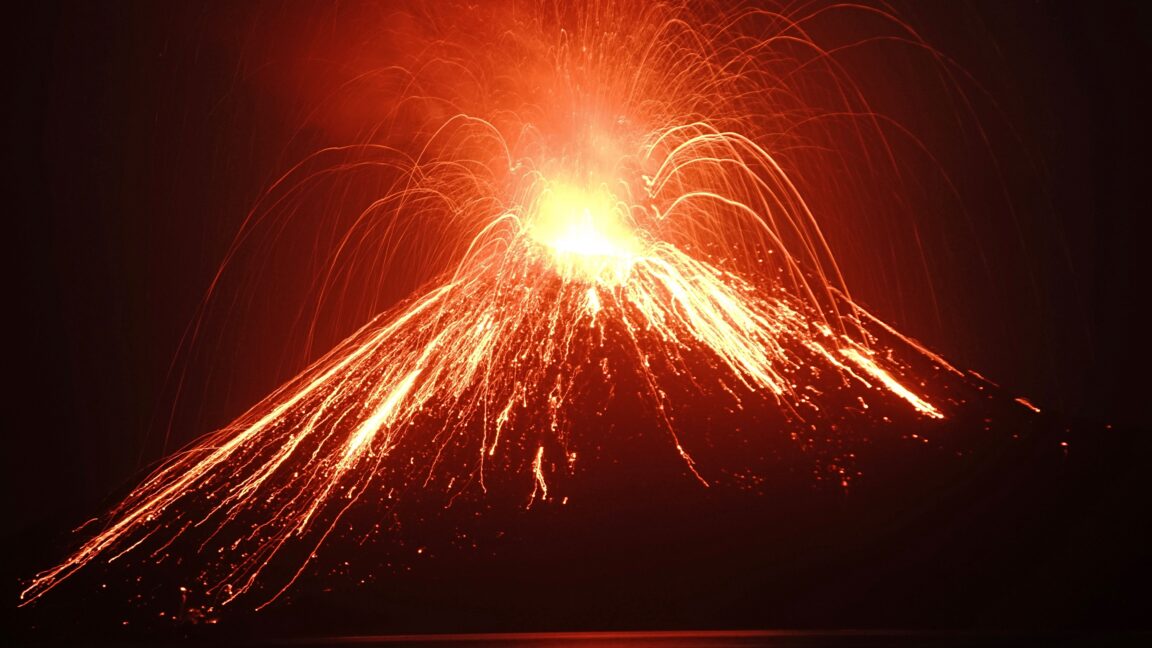
Historians and climatologists have increasingly speculated that the cascading environmental stress of the Samalas eruption helped seal the fate of the Mongol Empire. The empire fractured and ultimately declined following the death of its last great ruler, Möngke Khan, during a military campaign in China in 1259—a period marked by severe epidemics and famine that closely mirrored the climate shockwaves of the eruption.
3. The 1345 Mystery Eruption and the Black Death
A century after Samalas, another chilling convergence of volcanism and pandemic disease emerged. Between 1346 and 1352, the Black Death swept across Europe and Asia, eradicating an estimated 30 to 60 percent of Europe’s human population via the flea-borne bacterium Yersinia pestis.
Historical records from the mid-fourteenth century once again describe darkened skies and abnormal atmospheric hazes. Ice-core records corroborate these observations, documenting a significant volcanic sulfur anomaly around 1345, though the exact volcano responsible remains unidentified.
To determine the climatic impact, an interdisciplinary team led by University of Cambridge tree-ring specialist Ulf Büntgen analyzed European tree rings. The data confirmed that the summers of 1345, 1346, and 1347 were exceptionally cold and wet across southern Europe. As local agricultural systems collapsed under these anomalous conditions, European nations were forced to import grain from distant eastern trade networks. These grain-transport ships inadvertently carried rats infested with Y. pestis, setting off a biological catastrophe that decimated tens of millions of lives.
4. Laki (1783): Iceland’s Toxic Fog and Benjamin Franklin’s Insight
Moving into the historical period with more robust documentation, the 1783 eruption of the Laki fissure system in Iceland offers a vivid case study in regional devastation and long-range atmospheric transport. Erupting continuously for eight months, Laki spewed staggering volumes of lava and toxic fluorine- and sulfur-rich gases. The ensuing fog killed at least one-fifth of Iceland’s human population and decimated livestock through fluorosis and starvation.
The volcanic aerosols drifted southward across Europe, blanketing the countryside in a sulfurous haze that provoked widespread panic in an era lacking instant telecommunications. In France, American ambassador Benjamin Franklin was astute enough to connect the persistent, foul-smelling fog hovering over the European countryside to a distant geological source—correctly deducing that volcanic emissions in Iceland were altering atmospheric transparency and regional weather patterns.
5. Tambora (1815) and the "Year Without a Summer"
Just decades after Laki, the 1815 eruption of Mount Tambora in Indonesia provided the most thoroughly documented historic example of a volcanic climate shock. Tambora’s colossal explosion injected immense quantities of sulfur dioxide into the stratosphere, triggering a multi-year global temperature depression.
In North America and Europe, 1816 became internationally immortalized as the "Year Without a Summer." Severe frosts destroyed crops in the middle of July, leading to widespread famine, skyrocketing grain prices, and mass migrations. In Switzerland, unseasonable cold and relentless rain forced the writer Mary Shelley to remain indoors, inspiring the creation of her seminal gothic novel, Frankenstein.
While western Europe and North America suffered catastrophic crop failures, eastern Europe and western Russia experienced relatively favorable growing conditions, generating grain surpluses that they exported to hard-hit port cities like London and Hamburg. This stark contrast highlighted the vital role that transportation and global trade networks play in buffering societies against environmental shocks.
Supporting Context & Metrics: The Mechanics of Volcanic Climatology
To comprehend how localized geological events translate into global crises, scientists examine the precise physical and chemical mechanisms governing volcanic emissions.
When a volcano erupts, the primary driver of climate cooling is not the ash—which generally settles out of the atmosphere within days or weeks—but rather sulfur dioxide ($SO_2$) gas dissolved in the molten magma. When injected directly into the stratosphere (altitudes exceeding 10 to 50 kilometers), sulfur dioxide reacts with water vapor to form microscopic droplets of sulfuric acid and sulfate aerosols.
[Volcanic Eruption]
       │
       ▼
[Stratospheric Injection of SO₂]
       │
       ▼
[Reaction with Water Vapor ➔ Sulfate Aerosols]
       │
       ▼
[Backscattering of Incoming Solar Radiation]
       │
       ▼
[Global Tropospheric Cooling (0.5°C to 1.5°C drop for 1–3 years)]
These aerosols act as microscopic mirrors, backscattering a fraction of incoming solar radiation directly back into space. The resulting radiative forcing reduces surface temperatures across the Northern Hemisphere by an average of 0.5°C to 1.5°C for periods lasting anywhere from one to three years.
Furthermore, historical data synthesized by modern volcanologists underscores a direct correlation between sulfur yield and climatic disruption:
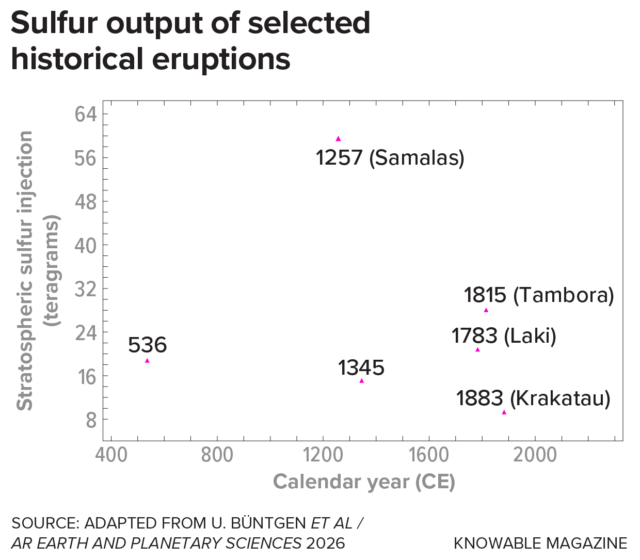
- Krakatau (1883): Injected roughly 5 to 10 megatons of sulfur into the stratosphere, reducing Northern Hemisphere summer temperatures by approximately 0.6°C.
- Tambora (1815): Released an estimated 50 to 60 megatons of sulfur, resulting in catastrophic crop failures across the Northern Hemisphere and defining the benchmark for nineteenth-century climate shocks.
- Samalas (1257): Produced the largest sulfur spike of the last millennium, dwarfing Tambora and driving prolonged, multi-year hemispheric cooling that disrupted medieval agricultural systems from Europe to East Asia.
Expert Analysis and Official Perspectives
The integration of historical archives with modern earth sciences has fostered a new interdisciplinary field: historical volcanology. Researchers emphasize that while volcanic eruptions do not single-handedly dictate the destiny of civilizations, they act as severe stress tests that exploit existing societal fractures.
"In so many different ways, societies were affected—a failure in harvest, or flooding, or a cold summer, or a really cold winter," explains Katrin Kleemann, an environmental historian at the German Maritime Museum in Bremerhaven who has extensively studied the Laki eruption. "In a pre-electronic world, people would not get news alerts on their phone; they would see this strange haze and have no idea where it came from."
This sentiment is echoed by leading volcanologists examining the long-term patterns of geological hazards and human resilience.

"Human society has a lot of susceptibilities and vulnerabilities," notes Clive Oppenheimer, a volcanologist at the University of Cambridge and co-author of comprehensive reviews on volcanoes, climate, and society. "Some climate shocks will come and go… At other times, the climate shock will arrive precisely when there are greater societal vulnerabilities."
Experts stress that these historical insights hold profound relevance for the modern era. Although major volcanic eruptions cool the planet rather than warm it, they represent the exact same category of rapid, planetary-scale environmental shocks that contemporary societies must contend with as global temperatures rise.
Future Outlook: Preparing for the Inevitable Next Blast
As humanity advances deeper into the twenty-first century, the technological landscape of disaster response has transformed entirely. In an era dominated by high-resolution satellite monitoring, real-time seismic sensors, and instantaneous global social media networks, a major cataclysmic eruption will no longer be met with geographical ignorance. Satellites will detect sulfur plumes and ash columns within minutes of the initial blast, and global weather models will project atmospheric dispersion patterns almost instantaneously.
Yet, advanced warning does not equate to immunity. Modern global civilization—characterized by hyper-connected supply chains, densely populated urban centers, and complex agricultural dependencies—remains acutely vulnerable to the cascading effects of a major climate shock. A sudden, Tambora-scale sulfur injection today could disrupt global breadbasket regions, strain international trade corridors, and threaten food security for billions of people.
As historical volcanology demonstrates, the recurrence of such events is not a matter of if, but when. By rigorously studying the physical fingerprints frozen in polar ice cores, analyzing the silent testimony of ancient tree rings, and decoding the chronicles of past generations who endured the "years without a summer," modern society gains the critical foresight needed to build resilience against the next great awakening from the Earth’s fiery depths.