Executive Overview
What began years ago as an experimental anti-piracy measure in France has transformed into a predictable, highly sophisticated annual ritual. As each new European football season approaches, French broadcasting giant Canal+ marches into the Paris Judicial Court seeking sweeping site-blocking orders. These legal actions are designed to choke off the lifeblood of pirate streaming sites and unauthorized IPTV services.
However, the nature of these legal battles has evolved dramatically. What once started as simple, rudimentary internet service provider (ISP) blocking requests has mutated into an aggressive, multi-layered enforcement strategy. Today, Canal+’s legal arsenal targets the entire digital infrastructure supporting online piracy. This comprehensive dragnet now ensnares not just basic ISPs, but alternative DNS resolvers, content delivery networks (CDNs), virtual private network (VPN) services, and major search engine operators.
A batch of fourteen landmark orders signed on July 17, by Vice-President Irène Benac at the Paris Judicial Court, reveals the current apex of this strategy. Split evenly between the 2026/2027 UEFA Champions League and English Premier League (EPL) seasons, these coordinated legal actions capture every category of digital intermediary that Canal+ has systematically pursued since 2022.
Targeting dozens of domain names—including popular streaming brands like Totalsportek, LiveTV, and Kevinsport—this latest judicial intervention highlights a relentless effort by rights holders to eliminate every conceivable loophole. Yet, even as these massive orders are handed down under France’s established framework, the legal landscape is shifting beneath the feet of both broadcasters and pirates alike. With the French Parliament recently passing legislation to enable automated, real-time blocking, this July batch may represent the final hurrah of the manual judicial era.
Detailed Chronology and Legal Mechanics
The timeline of Canal+’s recent anti-piracy crusade culminated on July 17, when Vice-President Irène Benac issued fourteen distinct judicial orders at the Tribunal Judiciaire de Paris. These orders were meticulously divided, with seven dedicated to the Premier League season and seven targeting the Champions League.
The scope of these orders is breathtakingly comprehensive. The Premier League mandates target 47 specific domain names, while the Champions League actions encompass 26 domains. To ensure these blocks hold up against technical workarounds, Canal+ systematically targeted every tier of the internet infrastructure required to deliver content to a viewer’s screen:
- ISPs and Telecom Operators: The foundational layer requires France’s major telecommunications providers—Orange, Free, SFR, and Bouygues Telecom, alongside various overseas operators such as SPM, Telco OI, UTS Caraïbe, and Zeop—to actively block subscriber access to the listed domains and subdomains.
- DNS Resolvers and Infrastructure: Recognizing that savvy users easily bypass ISP-level DNS blocking by switching to alternative public resolvers, Canal+ secured complementary orders against Google Public DNS, Cloudflare, Quad9, and Whalebone (DNS4EU). Notably, Quad9 and DNS4EU failed to present a defense in court, resulting in default judgments.
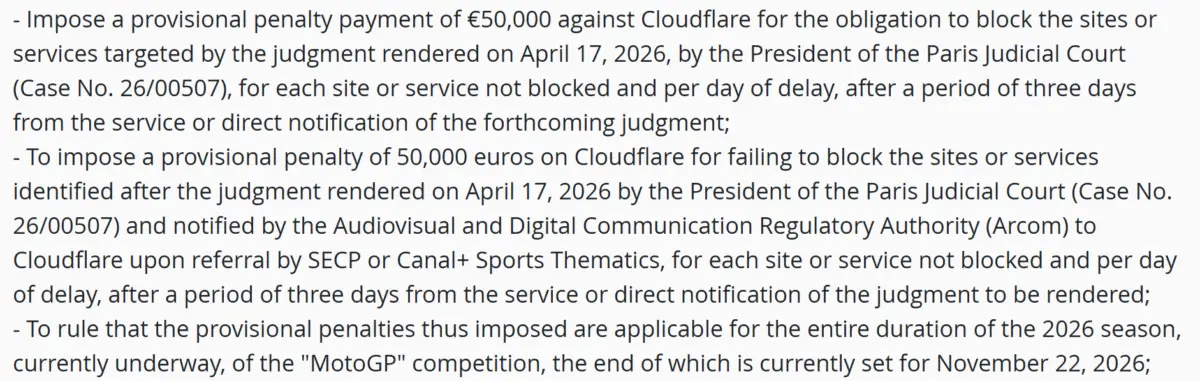
- CDNs and Reverse Proxies: Cloudflare was hit with particularly heavy restrictions. Beyond its 1.1.1.1 DNS resolver, the infrastructure giant was ordered to block targeted domains across its Content Delivery Network (CDN) and reverse proxy services, utilizing whatever technical mechanisms it deems appropriate.
- Search Engine De-indexing (Déréférencement): In an effort to cut off traffic at the discovery phase, Google Search and Microsoft Bing were ordered to strip the offending domains from their search results for users accessing the web from France.
- VPN Providers: To plug the final major leak, Canal+ targeted privacy services. While previously pursuing five VPN providers in earlier campaigns, this round focused on Proton VPN, CyberGhost, and ExpressVPN.
Under the terms of the rulings, enforcement must be enacted swiftly—typically within three days for mainland operators. The duration of these blocks spans the entirety of the football calendar, with Premier League measures running until May 30, 2027, and Champions League restrictions expiring on June 5, 2027. Crucially, these orders are entirely dynamic, meaning ARCOM—France’s audiovisual and digital communications regulator—can unilaterally approve and append new domains to the blocklists throughout the season without requiring a return trip to the courtroom.
The VPN Front: Digital Privacy vs. Copyright Enforcement
While many tech infrastructure companies opted not to fight or quickly acquiesced to the judicial pressure, the VPN sector mounted a vigorous, albeit ultimately unsuccessful, defense. Canal+ scaled back its targets this season, dropping NordVPN and Surfshark from its crosshairs without formal explanation, but the remaining trio—Proton, CyberGhost, and ExpressVPN—sparked a fierce legal battle.

The most detailed arguments came from CyberGhost and ExpressVPN. Anticipating the court’s stance, the providers initially requested a formal stay of proceedings pending a referral to the Court of Justice of the European Union (CJEU). They pointed to the Anne Frank Stichting case, a ruling delivered shortly before the Paris decision which successfully shielded VPNs from strict liability in unrelated copyright disputes.
However, the Paris court summarily dismissed the request for a stay. Presiding officials reasoned that the Anne Frank precedent involved a fundamentally different EU directive and pertained to a publication that was lawful in its own right—a stark contrast to the blatantly illegal commercial streaming sites at the center of Canal+’s grievances.
The VPN providers also mounted a constitutional and statutory challenge, arguing that Article L. 333-10 of the French Sports Code fundamentally conflicts with the EU E-Commerce Directive and should therefore be set aside. The court firmly rejected this argument as well, emphasizing the legal principle of "horizontal direct effect." Because this was fundamentally a private dispute between corporate entities, national courts cannot simply disapply domestic legislation based on an alleged conflict with an EU directive that lacks horizontal applicability.
Furthermore, the court took great pains to articulate why a purportedly neutral intermediary can—and should—be legally compelled to take action if its services facilitate the transmission of infringing material. Addressing the passive nature of VPN routing, the ruling bluntly stated:
"The mere act of serving as a bridge enabling access to the infringing sites fulfills the transmission function."
The judiciary underscored that even if an intermediary operates with absolute passivity and technical neutrality, it remains an indispensable link in the chain of data transmission. By providing the encrypted tunnels that allow French consumers to effortlessly sidestep geographic blocks and ISP restrictions, VPNs actively participate in the ecosystem of copyright infringement.
Google similarly attempted to push back against the search and DNS orders, questioning whether Canal+ possessed truly enforceable exclusive broadcasting rights across France and demanding proof of repeated, per-channel infringements for every single disputed domain. The Paris court swept these objections aside, clearing the path for unfettered enforcement.
Supporting Context, Data, and Targeted Domains
To fully grasp the scale of this legal offensive, one must examine the specific web properties designated as public enemies by the French judiciary. The broad spectrum of URLs targeted by Canal+ reveals an ecosystem heavily reliant on aggregators, IPTV portals, and alternative streaming hubs.

Targeted Premier League Domains (2026/2027 Season)
The 47 domains targeted under the Premier League banner include well-known traffic hubs and obscure proxy networks alike:
- abcsport.tel, abcsport.top
- akhtv.online
- antenasport.org
- empire-sports.store
- kevinsport.org, kevinsport.lat, kevinsport.mom, kevinsport.best
- livetv880.me (along with associated CDNs like cdn.livetv880.me)
- livetv882.me, livetv883.me, livetv884.me, livetv885.me and their respective CDNs
- sports24.cc
- streamonsport.art
- totalsporteki.com, totalsportek.wales, totalsportek.company, live.totalsportek.fyi
- witv.team
- xuperlive.com
- liveon5.zip
- Various obfuscated dynamic DNS and redirect domains, such as zac01bp.mpipzni2naturally32kistomach.ru and lovetier.bz.
- Dedicated IPTV subscription gateways including iptv-abonnement.tv, ott-premium.tv, iptvpremium-europe.com, and smartippon.com.
Targeted Champions League Domains (2026/2027 Season)
The 26 domains targeted under the UEFA Champions League orders feature significant overlap with the Premier League list, demonstrating that piracy operations frequently syndicate content across multiple sports leagues:
- empire-sport.live, empire-sports.store
- kevinsport.org, kevinsport.lat, kevinsport.quest, kevinsport.homes
- kzontop.site, kzontop.space
- sports24.cc
- sportsonline.vc, v3.sportssonline.click
- streamonsport.art
- witv.team
- lovetier.bz
- wilderness.click
- woundsilk.net
- swopglow.net
- Obfuscated routing domains including 7y306yg5flk3x4.dynmaspect.net and tv.business-cloud-8k.ru.
- Commercial IPTV services like iptv-abonnement.tv, ott-premium.tv, smartippon.com, and iptvpremium-europe.com.
Future Outlook: The Dawn of Automated Real-Time Blocking
Though these fourteen detailed orders were formally handed down by Vice-President Irène Benac on July 17, they initially slipped beneath the broader media radar. With the benefit of hindsight, however, the timing of these rulings is exceptionally significant. They were issued a mere four days before the French Parliament officially adopted a revolutionary new sports law designed to completely rewrite the mechanics of digital piracy enforcement.
Under the current legislative regime—under which these July orders still legally operate—rights holders must rely on a somewhat manual, bureaucratic process. ARCOM agents must painstakingly verify individual domain names before a block can be officially requested, vetted, and implemented by ISPs and technical intermediaries. While dynamic additions help bridge the gap, the system has historically lagged behind the lightning-fast agility of pirate operators, who can spin up new mirror domains within minutes of a match kicking off.
The newly approved sports law changes everything. It completely dismantles the traditional manual review system, replacing it with an automated, real-time blocking framework. Under this upcoming regime, new pirate domains can be dynamically identified, processed, and blocked in real time while a live football match is actively broadcasting. While ARCOM’s agents will retain a formal oversight role, their review will shift to an ex-post (after the fact) verification model rather than a mandatory ex-ante approval bottleneck.
While the new automated framework awaits full implementation later this year, Canal+ and other major sports rightsholders are wasting no time keeping the pressure on under existing laws. Once the automated systems officially go live, however, the landscape of French digital piracy enforcement will enter an entirely unprecedented era. For streaming pirates, the days of dodging court orders through rapid domain rotation are rapidly coming to an end, replaced by algorithmic blocks executed at machine speed.