Executive Overview
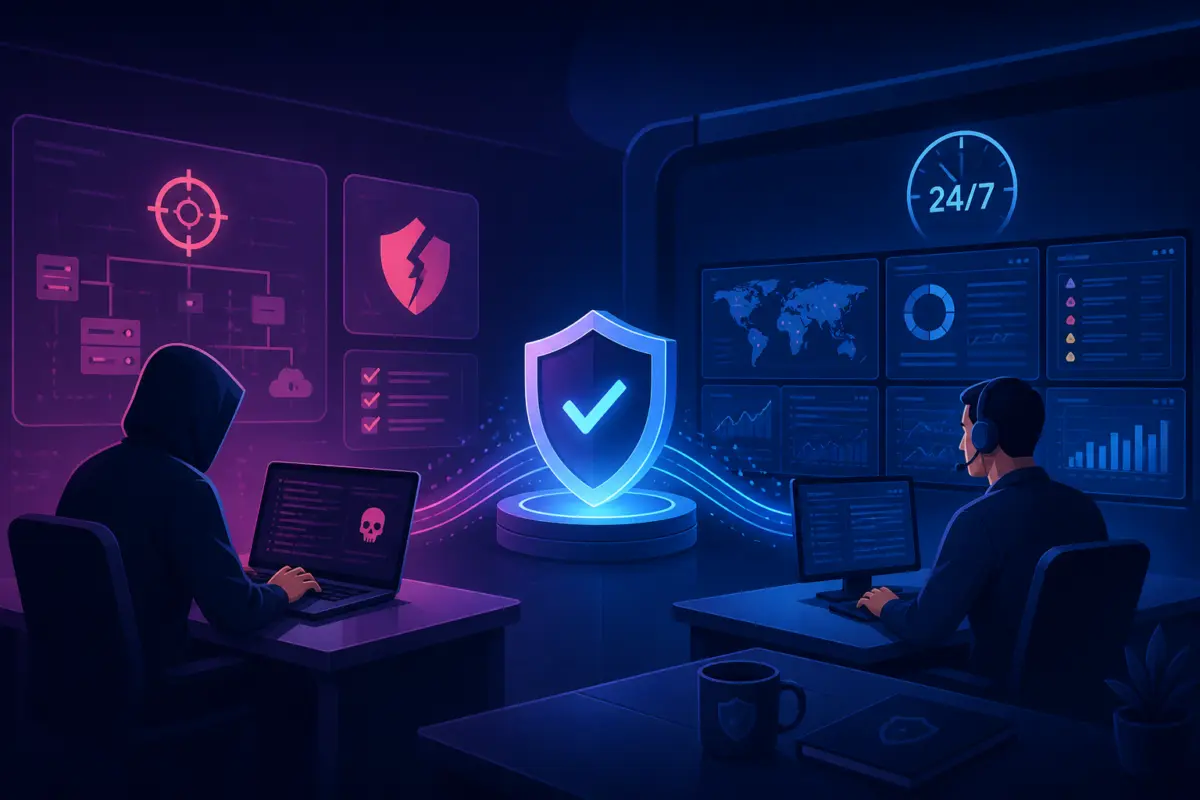
For decades, the cybersecurity industry has operated on a fractured premise: that offensive security—the art of breaking into systems to find flaws—and defensive operations—the 24/7 vigil of monitoring networks to keep intruders out—can function effectively in complete isolation from one another. Traditionally, red teams and penetration testers would drop into a corporate network, compile a static report of vulnerabilities, and hand it over to overwhelmed executives. Meanwhile, Security Operations Center (SOC) analysts would field a relentless deluge of alerts, reacting to anomalies without ever knowing the bespoke, stealthy adversary techniques used during those recent simulations.
Advanced cybercriminals have built their fortunes on exploiting this exact operational seam.
Today, a paradigm shift is quietly revolutionizing the enterprise security landscape. The most effective Managed Detection and Response (MDR) providers are no longer just bundling services under a single master contract; they are actively engineering automated and structured feedback loops that feed real-time penetration testing results directly into SOC detection rules.
Driven by escalating infrastructure complexity, severe internal talent shortages, and the urgent need to replace fragmented tooling, the global MDR market is projected to skyrocket, reaching an estimated $17.64 billion by 2031, according to MarketsandMarkets research. As organizations race to shore up their defenses, the defining differentiator for enterprise security will no longer be whether a vendor offers both offensive and defensive services, but how seamlessly those two disciplines communicate.
This in-depth analysis evaluates the top seven MDR providers bridging the divide today—DeepSeas, Rapid7, eSentire, Sophos, Arctic Wolf, Trustwave, and GoSecure—ranking them by the maturity of their closed-loop ecosystems and examining why this unified methodology is rewriting the rules of corporate cyber defense.
Detailed Chronology: The Evolution of Siloed Security to Closed-Loop Integration
To understand why the convergence of offense and defense is reshaping the industry, it is necessary to trace how enterprise security architecture arrived at its current crossroads.
Phase 1: The Era of Strict Separation (Late 1990s – 2010s)
In the early days of structured corporate cybersecurity, the industry heavily compartmentalized roles. Organizations hired external consultancies or specialized testing firms once or twice a year to conduct compliance-driven penetration tests. These engagements yielded static PDF reports listing vulnerabilities categorized by severity (Low, Medium, High, Critical).
Concurrently, internal IT staff or early-generation security teams managed rudimentary signature-based firewalls and early Security Information and Event Management (SIEM) tools. The communication between the annual "red team" and the daily "blue team" was virtually non-existent. Vulnerabilities were patched based on generalized CVSS scores rather than observed adversarial behaviors, creating a massive disconnect between simulated attacks and live threats.
Phase 2: The Rise of Managed Detection and Response (2015 – 2020)
As attack sophistication outpaced internal capabilities, the cybersecurity market birthed Managed Detection and Response (MDR). Instead of merely collecting logs, MDR providers introduced 24/7 human-led threat hunting, Endpoint Detection and Response (EDR) telemetry analysis, and active containment capabilities.
While MDR dramatically improved the speed of incident detection, the division between offense and defense persisted. Vendors frequently acquired or built both capabilities to capture market share, cross-selling red teaming and MDR under the same corporate umbrella while keeping their operational teams isolated in separate business units.
Phase 3: The Convergence and the Closed-Loop Imperative (Present Day)
Modern threat actors do not operate in silos; they utilize automated discovery, living-off-the-land binaries, and multi-vector lateral movement. Recognizing that traditional compliance-based testing leaves critical blind spots, leading MDR providers are shifting toward operational integration.
In this current phase, the moment an offensive engineer discovers a novel bypass technique during a red team exercise, that telemetry automatically updates the behavioral analytics models and threat-hunting playbooks utilized by the 24/7 SOC. Testing is no longer an isolated annual event; it is an ongoing calibration engine for enterprise defense.
Supporting Context & Metrics: The Cost of Disconnection
The operational friction caused by siloed security teams carries a steep financial and operational price tag. According to the IBM Cost of a Data Breach Report, the average enterprise breach lifecycle spans an astonishing 241 days. Organizations typically require 181 days merely to identify an intrusion, followed by an additional 60 days to contain it.
This prolonged dwell time is a direct symptom of detection engineering isolation. When front-line monitoring teams are restricted by default, out-of-the-box detection logic, they remain blind to creative adversary tactics that chain together minor, seemingly benign misconfigurations.
Conversely, when an organization implements a true closed-loop feedback mechanism:
- Detection Tuning is Accelerated: Unresolved defensive blind spots discovered during an offensive test immediately shape the parameters of subsequent simulation scenarios.
- Alert Fatigue is Minimized: By testing live telemetry against simulated attacks, security engineers can verify whether alerts actually fire and eliminate noisy, false-positive detection rules.
- Measurable ROI is Established: Security spending shifts from purchasing generic compliance checklists to actively hardening the network against real-world compromises.
Evaluating the Top 7 MDR Providers: Ranked by Loop Maturity
True integration means offensive testing directly updates defensive detection rules through a structured feedback loop. The following seven providers occupy different positions along this integration scale, ranging from deeply integrated architectures to more traditional service bundles.
1. DeepSeas: The Closed Loop, by Design
DeepSeas stands out because its foundational architecture treats offense and defense as a single, continuous system rather than two separate product lines. Its offensive suite, DeepSeas RED, pairs directly with DeepSeas MDR+, ensuring that adversary intelligence gathered during simulated exercises flows immediately into active threat-hunting rules.
- The Offensive Side: DeepSeas RED delivers a comprehensive offensive practice encompassing red teaming, penetration testing, and continuous security validation, significantly expanded through the strategic acquisition of RedTeam Security. Engagements simulate complete, end-to-end attack paths across identity directories, multi-cloud environments, and user endpoints, mapping how sophisticated adversaries traverse a corporate network.
- The Monitoring Side: DeepSeas MDR+ provides 24/7 threat detection and response across both operational technology (OT) and corporate IT networks, alongside cloud infrastructure and mobile fleets. Backed by decades of collective defense operations and a top-five Frost Radar ranking in MDR, the company’s SOC protects over 350 organizations, including elite Fortune 100 enterprises.
2. Rapid7
Rapid7 pairs a round-the-clock SOC with an established vulnerability management foundation, linking active attacker behaviors with exposed internal assets via its Managed Threat Complete package.
- The Offensive Side: Rapid7’s primary proactive strength lies in attack surface visibility and vulnerability management through InsightVM, combined with hands-on penetration testing. Its historical roots in the Metasploit project provide unmatched depth in adversarial tooling, helping security teams prioritize flaws based on real-world exploitability.
- The Monitoring Side: Managed Threat Complete delivers 24/7 SOC coverage anchored by the InsightIDR SIEM. Supported by bi-directional Microsoft Defender integration and bundled incident response, it is a robust option for mid-market and enterprise teams seeking customizable detection engineering.
3. eSentire
eSentire delivers both halves of the security equation by offering dedicated offensive security services alongside its proprietary multi-signal MDR platform, protecting a large international customer base through automated disruption.
- The Offensive Side: eSentire conducts rigorous penetration testing and red team simulations designed to unearth exploitable weaknesses before bad actors find them, granting customers access to specialized ethical hackers.
- The Monitoring Side: Its multi-signal MDR combines Extended Detection and Response (XDR) technology with 24/7 threat hunting spanning endpoints, networks, and cloud workloads. Known for hands-on remediation, eSentire successfully safeguards thousands of enterprise environments worldwide.
4. Sophos
Sophos provides around-the-clock detection via global operations centers utilizing an architecture that natively integrates with third-party tools. Its offensive testing assessments complement its defensive core, bolstered by threat intelligence capabilities gained through its integration with Secureworks.
- The Offensive Side: The company delivers structured penetration testing and security posture assessments. Its combination with Secureworks brings deep adversarial research and countermeasure development to the broader Sophos Adaptive Cybersecurity Ecosystem.
- The Monitoring Side: Sophos MDR analysts ingest telemetry from firewalls, email gateways, identity providers, and cloud environments alongside native Sophos sensors. Its vendor-agnostic ingestion model makes it highly practical for organizations managing diverse software stacks.
5. Arctic Wolf
Arctic Wolf operates on a concierge SOC model, pairing customers with named security experts who guide detection, incident containment, and posture management over time.
- The Offensive Side: Arctic Wolf focuses primarily on defensive monitoring and external attack surface management rather than full-scale adversarial red teaming. In-depth penetration testing or custom exploit testing is typically delivered through trusted third-party partners.
- The Monitoring Side: Defense is Arctic Wolf’s core competency. Its Concierge Security Team provides dedicated guidance, documented runbooks, and 24/7 alert handling across endpoints, identity stores, and cloud infrastructure, effectively minimizing alert fatigue.
6. Trustwave
Trustwave is a long-standing managed security provider combining 24/7 SOC operations with deep offensive expertise channeled through its renowned SpiderLabs unit.
- The Offensive Side: The SpiderLabs team provides penetration testing, physical security assessments, red teaming, and advanced threat research, offering customers detailed insight into novel exploit chains and emerging adversary tradecraft.
- The Monitoring Side: Trustwave operates global security centers providing 24/7 detection and response across hybrid cloud and on-premises environments, covering managed detection, database protection, and regulatory compliance.
7. GoSecure
GoSecure delivers managed detection and response alongside hands-on testing services tailored specifically for mid-market organizations seeking proactive testing and continuous defense under one roof.
- The Offensive Side: GoSecure maintains an active offensive security unit capable of executing web application penetration tests, wireless assessments, and red team engagements to uncover gaps before systems go live.
- The Monitoring Side: Its MDR team provides continuous monitoring, automated mitigation, and live threat hunting, catering to companies that require rapid containment capabilities without building an internal SOC.
Official Statements & Industry Perspectives
Industry leaders and analysts emphasize that the market is rapidly moving away from superficial tool bundling toward true operational synergy.
"When offensive testing and defensive monitoring operate as isolated business units, organizations are essentially paying twice for disconnected insights," notes enterprise security architect and consultant Marcus Vance. "The true value of modern MDR is realized only when the findings of a red team engagement automatically rewrite the detection playbooks of the SOC. If a vendor cannot demonstrate how an offensive discovery last month changed a detection rule this month, you are simply buying two separate services packaged under a single invoice."
Market analysts at MarketsandMarkets echo this sentiment, highlighting that enterprise buyers are increasingly scrutinizing MDR vendors for operational depth, integrated threat intelligence, and demonstrable improvements in mean-time-to-detect (MTTD) and mean-time-to-respond (MTTR).
Future Outlook: What Lies Ahead for Unified Defense
As artificial intelligence and automated exploitation tools accelerate the velocity of cyberattacks, the divide between offense and defense will become increasingly untenable for organizations relying on legacy security models.
Looking toward 2030 and beyond, the evolution of MDR will likely center on several key developments:
- Autonomous Feedback Loops: The manual translation of penetration testing reports into detection rules will be replaced by continuous, machine-driven feedback loops where red-team automation scripts instantly trigger defensive signature updates.
- Identity-Centric Attack Simulation: With identity acting as the new enterprise perimeter, offensive simulations will increasingly target cloud identity providers, forcing MDR providers to expand their monitoring coverage into deeply buried directory services.
- Consolidation of Vendor Portfolios: Organizations will aggressively prune fragmented tooling, favoring unified providers that can prove a direct correlation between proactive testing and the mitigation of live corporate threats.
For business leaders and Chief Information Security Officers (CISOs), evaluating prospective MDR partners must go beyond checking boxes on a feature sheet. The definitive question to ask any vendor remains clear and uncompromising: "Show us exactly how your offensive findings directly power your defensive detections." In the modern threat landscape, answers that rely on siloed operations are no longer acceptable.