Executive Overview
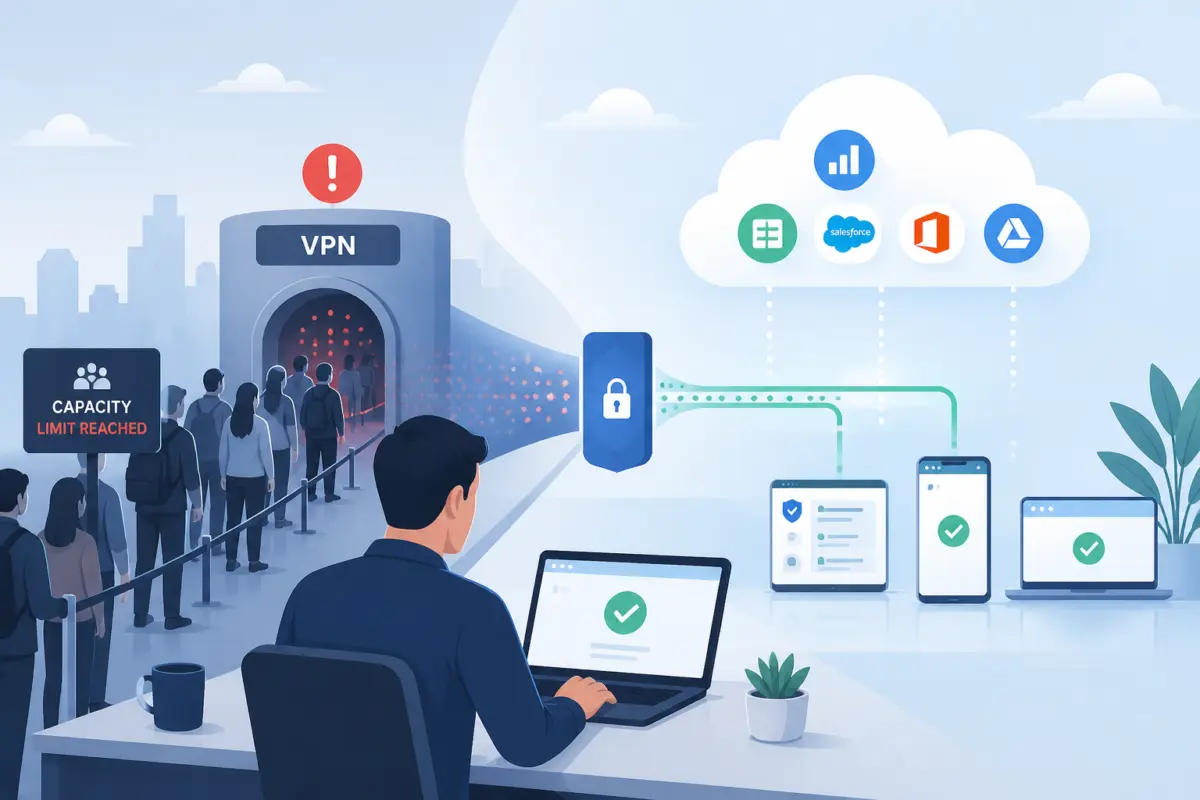
As modern enterprises continue to navigate hybrid work environments, sudden workforce expansions, and corporate mergers, traditional corporate Virtual Private Networks (VPNs) are increasingly pushed past their operational limits. When remote access infrastructure reaches capacity, organizations frequently face sudden bottlenecks that grind productivity to a halt. However, solving these constraints requires a paradigm shift: rather than asking how many additional tunnels a gateway can accept, IT leaders must begin by evaluating which specific applications employees actually need to execute their daily responsibilities.
VPN alternatives—most notably application publishing, desktop virtualization, and browser-based access tools—offer structured pathways to keep employees operational. By moving application sessions outside the traditional network tunnel, these technologies align with modern security frameworks like the National Institute of Standards and Technology (NIST) principle of protecting individual resources rather than entire network segments.
This comprehensive analysis explores the diagnostic processes, technical methodologies, deployment architectures, and phased migration strategies required to relieve congested corporate gateways. By moving away from brute-force network expansion and toward targeted, identity-aware application delivery, organizations can secure high-performance remote access without compromising enterprise security.
Detailed Chronology: The Evolution of Remote Access Pressures
The strain on corporate remote access infrastructure did not happen overnight. Understanding how organizations arrived at the current VPN crisis requires examining the technological and operational milestones that shaped modern enterprise connectivity.
Phase 1: The Perimeter-Based Security Era
Historically, corporate IT architecture relied heavily on a castle-and-moat security model. Employees connected to the corporate headquarters via a hardware or software VPN, which essentially dropped their remote endpoint directly onto the internal Local Area Network (LAN).
- The Assumption: Once inside the VPN tunnel, the user and their device were trusted implicitly.
- The Consequence: This architecture worked well when remote workers represented a tiny fraction of the workforce. However, as remote and mobile work expanded, routing all internet-bound and application-specific traffic through a centralized gateway created massive network congestion.
Phase 2: The Sudden Surge and Gateway Saturation
Global disruptions and rapid corporate scaling forced organizations to onboard hundreds or thousands of remote workers simultaneously.
- The Bottleneck: Traditional VPN gateways quickly exhausted their concurrent-session ceilings, bandwidth capacities, and authentication server allocations.
- The Failure Point: Unlike bandwidth, which degrades gracefully, a connection limit instantly rejects new login attempts, locking out employees entirely even if the underlying servers have plenty of spare processing power.
Phase 3: The Shift Toward Zero Trust and Targeted Delivery
Recognizing the limitations of full-tunnel VPNs, forward-thinking organizations began adopting Zero Trust Network Access (ZTNA) principles and granular application publishing. Instead of granting users full network access—thereby exposing the entire corporate internal network to potential lateral movement if an endpoint is compromised—IT departments began delivering specific application sessions directly to authenticated users. This chronological shift from network-centric access to resource-centric publishing forms the backbone of modern remote access strategies.
Supporting Context & Metrics: Auditing and Diagnosing VPN Constraints
Before implementing any alternative remote access solution, IT teams must conduct a rigorous audit of their current VPN usage to identify precisely where capacity is being consumed. Relying on daily averages is insufficient; diagnostics must capture data during peak operational hours.
Anatomy of a VPN Bottleneck
A thorough audit separates the gateway’s concurrent-session ceiling from its bandwidth and authentication capacities.
- Concurrent Sessions: A hardware or software gateway can only maintain a finite number of active tunnels. Once this ceiling is reached, new authentication requests are dropped.
- Authentication Servers: During peak hours, thousands of simultaneous login requests can overwhelm Active Directory (AD) or Lightweight Directory Access Protocol (LDAP) servers, turning the login screen into a major operational obstacle.
- Bandwidth Aggregation: Single-gateway configurations force all remote traffic through a centralized point. A sudden surge in user count—especially when users access heavy multimedia or large file repositories—strains available bandwidth to its breaking point.
The Three Diagnostic Questions
To pinpoint capacity hogs, IT administrators should record metrics answering three critical questions during peak traffic windows:
- Which specific software packages generate the highest volume of concurrent user traffic?
- Which user groups or departments experience the highest rate of dropped connections or authentication timeouts?
- What is the average bandwidth consumption per user session under standard operational workloads?
The applications that surface at the top of these metrics become the primary candidates for migration outside the VPN tunnel. Their current traffic measurements should be preserved as a baseline to verify whether the chosen alternative successfully relieves gateway pressure.
Technical Methodologies: Publishing, Browsers, and Architecture
Once capacity drains are identified, organizations can choose from several technical approaches to deliver applications securely and efficiently.
Publishing Individual Applications vs. Full Desktop Virtualization
Application publishing delivers specific software programs to remote users while the application executes entirely on centralized servers. Users interact solely with the application window, vastly reducing the attack surface compared to a full network tunnel.
When evaluating these solutions against full virtual desktop infrastructure (VDI), administrators must compare bandwidth consumption under identical workloads. A published application does not inherently consume less bandwidth than a full virtual desktop; factors such as local printing, clipboard redirection, and large file transfers must be tested thoroughly. Platforms ranging from enterprise-grade Citrix environments to alternative stacks like TSplus offer flexible deployment models on both on-premises and cloud infrastructure. Organizations migrating from legacy systems must carefully verify integration requirements to ensure smaller delivery stacks can seamlessly replace established enterprise tooling.
HTML5 Browser Access and Clientless Delivery
To eliminate the friction of client software deployment, organizations increasingly leverage HTML5 browser-based delivery. Employees authenticate through standard web browsers using existing corporate credentials, removing installation bottlenecks while preserving security policies.
This approach is invaluable when rapidly onboarding third-party contractors who cannot install proprietary remote-access software on personal devices. However, "clientless" does not mean universal compatibility. Modern browser-based remote access tools—such as those dictated by Microsoft’s Windows App requirements—frequently mandate supported desktop browsers no more than 12 months old and may exclude mobile browsers entirely. Compatibility checks remain mandatory across all targeted endpoints.
Choosing Between On-Premises, Cloud, and Hybrid Delivery
The underlying infrastructure hosting these alternatives dictates both scalability and control:
- On-Premises Infrastructure: Keeps hosted software and data within corporate facilities, granting IT departments direct control over hardware, security policies, and network configuration.
- Cloud-Hosted Solutions: Platforms like Microsoft Azure Virtual Desktop provide elastic scaling through automated tools, allowing seamless delivery of full desktops and individual applications with autoscaling capabilities.
- Hybrid Strategies: Combine in-house workloads with cloud capacity, routing overflow demand to the cloud during peak operating hours. Before committing to a hybrid model, teams must verify that database and authentication dependencies remain fully accessible from the cloud deployment under maximum expected load.
Official Statements and Industry Insights
Industry analysts and technology standards bodies emphasize that modern remote access must be agile, secure, and cost-effective.
The NIST Perspective
According to guidance from the National Institute of Standards and Technology (NIST Special Publication 800-207), organizations should prioritize protecting individual resources rather than relying on network segment perimeters. In an official statement regarding Zero Trust architecture, NIST highlights that perimeter-based defenses are obsolete in distributed environments:
"Zero trust assumes there is no implicit trust granted to assets or user accounts based solely on their physical or network location. Authentication and authorization are discrete functions performed before a session to an enterprise resource is established."
By shifting from full-network VPN tunnels to targeted application publishing, organizations directly operationalize this NIST mandate, ensuring that even if a remote user’s device is compromised, lateral movement across the corporate network is strictly prohibited.
Licensing and Total Cost of Ownership (TCO)
Financial scalability is just as critical as technical scalability. Industry cost analyses from publications like Forbes Advisor emphasize that software licensing models can become severe operational roadblocks during rapid workforce expansions.
If a legacy VPN contract charges strictly per user or device, doubling the remote staff can instantly double software licensing costs. Furthermore, approval delays can block access even when gateway hardware has plenty of spare capacity. IT decision-makers must evaluate payment terms separately from seat counts, contrasting subscription models against perpetual licenses, and named-user limits against concurrent-user allocations to prevent unexpected budget overruns.
Future Outlook: Phased Migration and Long-Term Strategy
Migrating away from saturated VPN gateways cannot be accomplished overnight. A successful transition requires a structured, phased approach that minimizes business disruption and validates performance metrics before full-scale deployment.
Implementing a Phased Migration Plan
- Compatibility Assessment and Staging: Test essential business applications in a controlled staging environment before migrating end-users.
- Pilot Group Selection: Select an initial department or user group based on measured peak sessions and application traffic. Require launch times and task completion rates to match an established baseline before expanding the pilot.
- Network Quality Benchmarking: Utilize connection-quality guidelines—such as maintaining latency thresholds below 150 milliseconds for non-video workloads—to verify network health during the pilot phase. However, treat these metrics as network checks rather than universal acceptance thresholds, ensuring application owners formally approve response times under peak concurrency.
- Comprehensive Training: Browser-based tools and published applications operate differently than traditional installed clients. Brief training sessions and clear, accessible documentation significantly reduce the volume of support tickets during the initial rollout fortnight.
- Rollback and Retirement Protocols: Before officially retiring VPN access for the pilot group, compare peak gateway traffic metrics against the original audit to confirm reduced pressure. Assign a dedicated rollback owner in case a newly exposed workload reveals an unaddressed system dependency.
Conclusion
As corporate workforces remain fluid and distributed, relying solely on legacy VPN gateways is no longer sustainable. By auditing current usage, embracing targeted application publishing, leveraging HTML5 browser access, and deploying flexible cloud or hybrid architectures, organizations can build a resilient, high-performance remote access strategy. Transitioning beyond the network tunnel not only resolves immediate capacity bottlenecks but also lays a secure, scalable foundation for the future of enterprise work.