In the high-stakes world of professional cinematography, a persistent misunderstanding continues to shape how directors of photography (DPs), camera assistants, and visual effects (VFX) supervisors select and utilize lenses. For decades, the industry has relied on "close focus distance"—the minimum focus distance (MFD) marked on a lens barrel—as a primary metric to determine how large a subject will appear within the frame. However, optical physics reveals a stark reality: close focus distance provides zero predictive value regarding final image magnification.
The assumption that two lenses of identical focal length will yield the same frame size at the same close focus distance is an optical fallacy. The true determinant of image magnification and perspective is a complex, virtual optical construct known as the front entrance pupil. Because the physical design of lens groups varies dramatically between manufacturers, the position of this entrance pupil is rarely consistent, leading to highly unpredictable framing at close ranges.
To eliminate this guesswork, ARRI has introduced a paradigm shift with its Ensō Prime lens series. By prioritizing and marking actual magnification ratios on the lens barrels, ARRI is challenging traditional lens-marking conventions. This article investigates the science of the front entrance pupil, unpacks the mathematics of sensor-to-magnification calculations, details the critical role of the entrance pupil in VFX nodal panning, and explores how this optical truth is reshaping the future of cinematography.
Detailed Chronology
The Legacy of the Minimum Focus Distance (MFD)
The reliance on close focus distance as a primary metric is a byproduct of mechanical convenience rather than optical precision. In the early days of cinema, lenses were mechanical instruments with simple optical designs. The distance scale engraved on the lens barrel was a direct measurement from the film plane (marked by the $Phi$ glyph on the camera body) to the subject.
As lens designs evolved—incorporating retrofocus elements for wide-angle lenses and complex internal focusing groups to minimize physical lens expansion—the relationship between the physical focus distance and the actual magnification of the subject became increasingly decoupled. Despite this decoupling, manufacturers continued to engrave MFD on lens barrels because it remained the easiest physical metric to measure on set with a tape measure.
The VFX Revolution and the Parallax Problem
With the advent of computer-generated imagery (CGI) and digital compositing in the late 20th century, the discrepancies caused by the front entrance pupil transitioned from minor on-set annoyances to costly post-production challenges.
When compositing physical elements with CGI, match-move artists struggled with perspective mismatch. Traditional camera panning and tilting introduced subtle parallax shifts because the camera was rotating around its tripod mount or the sensor plane, rather than the lens’s true center of perspective.
Throughout the 1990s and 2000s, specialized nodal heads (such as those from Ronford-Baker and Cartoni) were developed to slide the camera backward, aligning the lens’s entrance pupil directly over the tripod’s axis of rotation. However, finding the exact location of this pupil remained a process of trial and error, as manufacturers rarely published these technical specifications.
ARRI’s Intervention: The Ensō Prime Paradigm
Recognizing the limitations of traditional focus markings, ARRI’s optical design team sought to standardize close-up performance. The development of the ARRI Ensō Prime lenses represents a deliberate departure from industry norms.
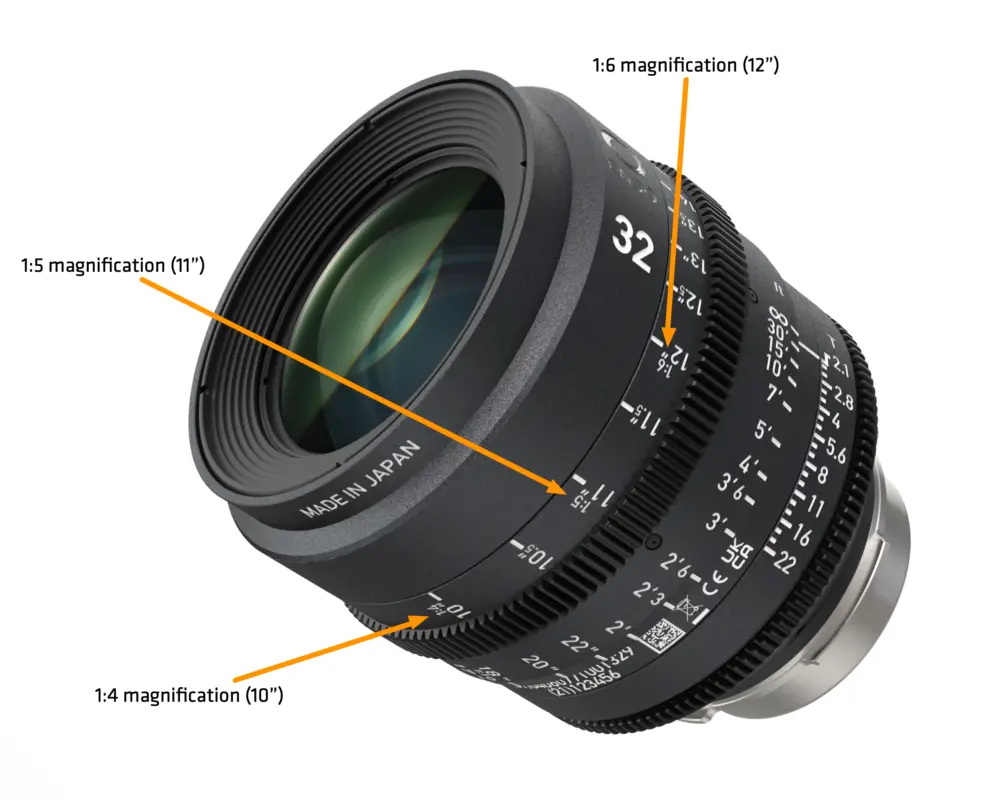
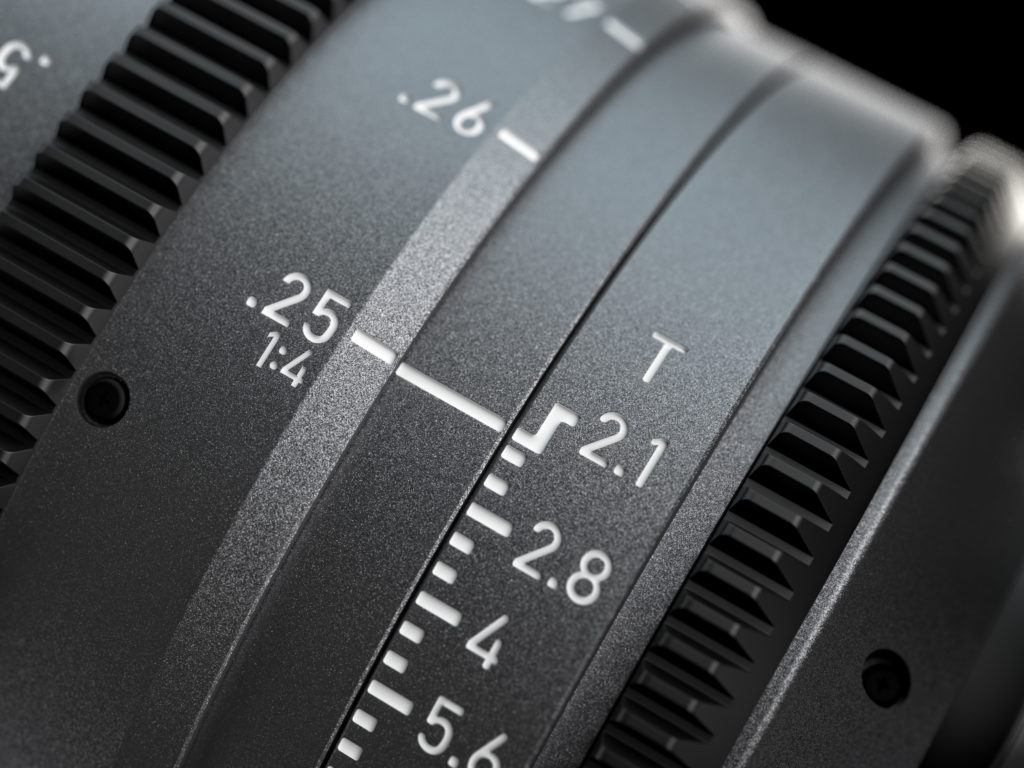
Released to address the needs of both large-format and Super 35 shooters, the Ensō Primes were engineered not just for optical sharpness, but for predictable magnification. By marking precise magnification ratios (such as 1:4) directly on the lens barrel, ARRI has provided cinematographers with a universal metric that guarantees consistent frame sizing, regardless of the focal length employed.
[Evolution of Lens Focus Metrics]

  Traditional Cinema Era (Pre-1990s)
  └─ Metric: Minimum Focus Distance (MFD)
  └─ Focus: Mechanical measurement from film plane to subject.
  └─ Limitation: Ignored internal optical variations and magnification discrepancies.

  The VFX & Digital Era (1990s–2010s)
  └─ Metric: MFD + Trial-and-Error Nodal Alignment
  └─ Focus: Attempting to align camera rotation with the "virtual" entrance pupil.
  └─ Limitation: Parallax errors in pans/tilts; inconsistent close-up framing.

  The Modern Era: ARRI Ensō Paradigm (Present)
  └─ Metric: Standardized Magnification Ratios (e.g., 1:4)
  └─ Focus: Direct correlation between sensor size, magnification, and frame size.
  └─ Benefit: Eliminates optical guesswork; standardized VFX nodal tracking.
Supporting Context & Metrics
The Physics of the Front Entrance Pupil
To understand why close focus distance is an unreliable metric, one must understand the anatomy of a lens. The physical iris blades that control the aperture are buried deep within the glass elements of the lens.
When a viewer looks through the front element of a lens, they do not see the physical aperture itself; rather, they see a optical projection of it. This virtual image of the aperture is the front entrance pupil.
                           THE FRONT ENTRANCE PUPIL
                      (Optical Center of Perspective)

   Subject      [Front Glass]       [Internal Glass]      [Sensor]
      o              /                  /                  |
                     | |   <-- ( * ) --> | |                 |
                      /      Entrance    /                 |
                                Pupil

   * Note: The Entrance Pupil is the virtual image of the aperture
     as seen through the front element. It serves as the true "eye"
     of the lens and the center of perspective.
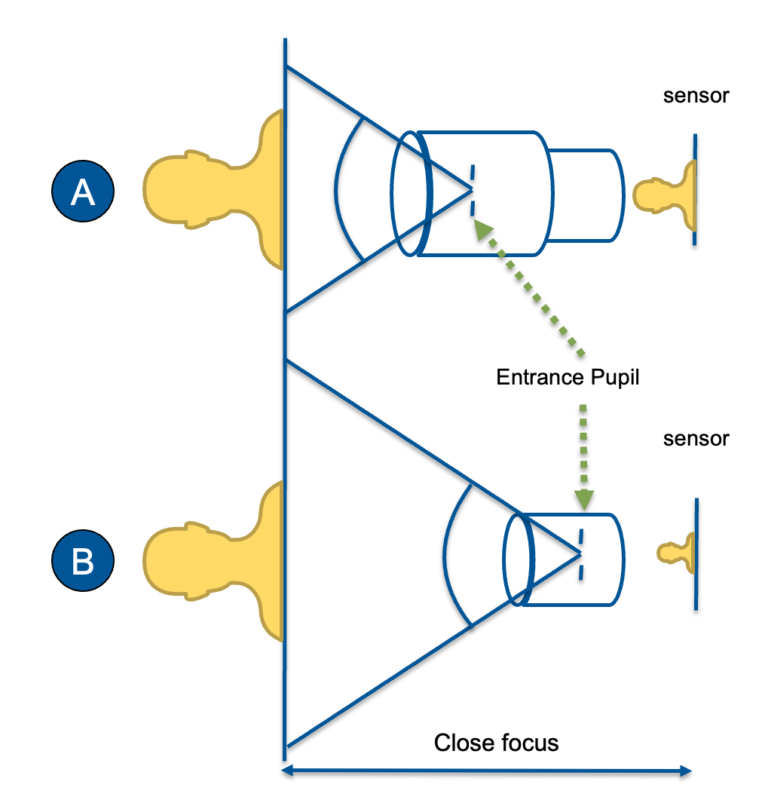
The entrance pupil acts as the true "eye" of the lens. The center of perspective of the entire camera system is located precisely at this point. If two lenses of the same focal length have entrance pupils located at different depths within their respective barrels, their centers of perspective will differ.
Consequently, at identical close focus distances, one lens will magnify the subject more than the other because its entrance pupil is physically closer to the subject, even though both lenses are positioned at the exact same distance from the camera sensor.
Calculating Real-World Frame Sizes
By shifting the focus from distance to magnification ratios, cinematographers can use a simple, mathematically precise formula to calculate the exact physical dimensions of the frame at close focus:
To apply this formula, the magnification ratio (e.g., $1:4$) must first be converted into a decimal value:
$$textRatio = 1 / 4 = 0.25$$
Case Study 1: ARRI ALEXA Mini LF (Large Format)
The ALEXA Mini LF features a large-format sensor with an Open Gate width of $36.7text mm$. When shooting with an ARRI Ensō Prime lens set to its $1:4$ magnification mark, the calculation is as follows:
At this setting, the frame will capture an area roughly the size of a standard postcard ($146.8text mm$ wide), regardless of whether the DP is using a wide, normal, or telephoto Ensō Prime.
Case Study 2: ARRI ALEXA 35 (Super 35)
When the same lens is mounted on an ALEXA 35, which utilizes a Super 35 Open Gate sensor width of $27.99text mm$, the physical magnification of the lens remains completely unchanged. However, because the sensor is smaller, it crops into the projected image circle:
In this scenario, the real-world frame width narrows to $111.96text mm$. This math proves that frame size is a direct product of sensor dimensions and optical magnification, rendering physical focus distance irrelevant to the calculation.
Lens Series (ARRI Ensō)
Target Magnification
ALEXA Mini LF Frame Width (36.7mm Sensor)
ALEXA 35 Frame Width (27.99mm Sensor)
Practical Frame Size Equivalent
12 of 14 Primes
$1:4$ ($0.25$)
$146.8text mm$ ($5.78"$)
$111.96text mm$ ($4.41"$)
Postcard / Small Notebook
14mm Wide-Angle
$1:8$ ($0.125$)
$293.6text mm$ ($11.56"$)
$223.92text mm$ ($8.82"$)
Tablet / Letterhead Paper
10.5mm Ultra-Wide
$1:10$ ($0.10$)
$367.0text mm$ ($14.45"$)
$279.90text mm$ ($11.02"$)
Standard Laptop / Vinyl Record
(Note: The Ensō 10.5mm and 14mm wide-angle lenses cannot physically achieve 1:4 magnification because the subject would have to reside inside the physical glass elements of the lens barrel.)
Practical VFX Applications: The Nodal Pan
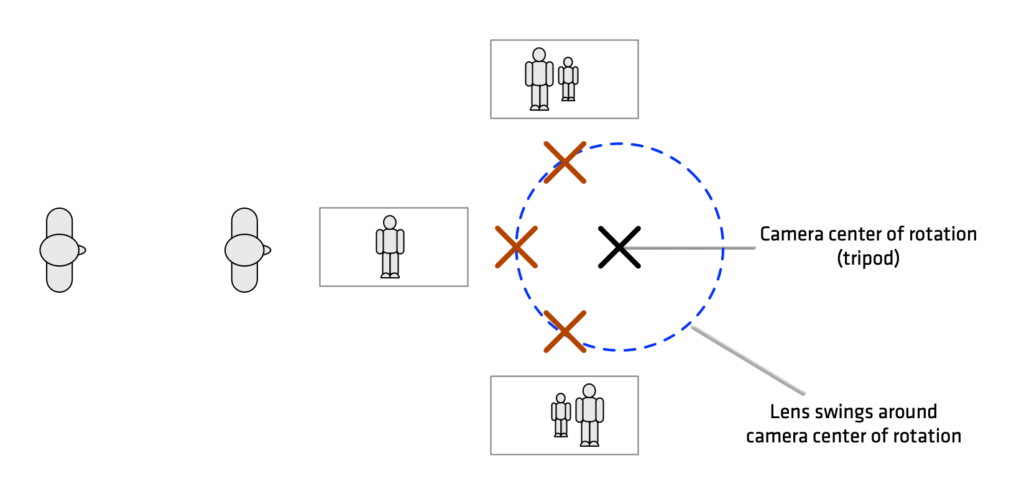
In visual effects and virtual production, aligning the camera’s center of rotation with the front entrance pupil is critical. If a camera is panned or tilted using a standard tripod head, the physical position of the lens shifts through space. This movement introduces parallax, causing foreground objects to slide laterally against the background.
  STANDARD TRIPOD ROTATION (With Parallax)

        [Lens] ------> (Swings through an arc)
          |
          |
     [Tripod Head]  <-- Center of Rotation (Behind the Lens)

  * Result: Foreground and background shift relative to one another.

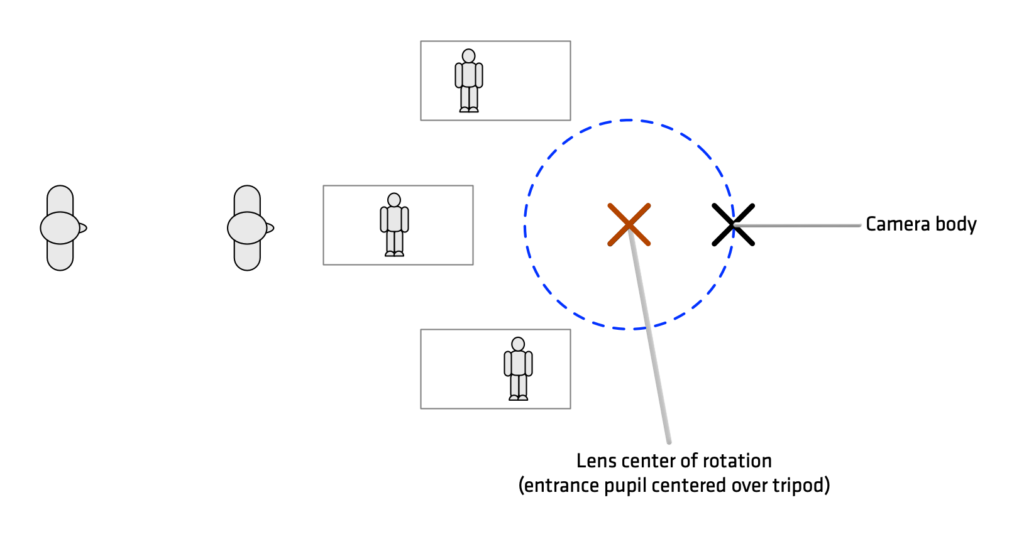
  NODAL TRIPOD ROTATION (Zero Parallax)

       [Entrance Pupil] <-- Aligned directly over Center of Rotation
        [  Lens  ]
            |
      [Tripod Head]

  * Result: Foreground and background remain locked in perfect alignment.
By shifting the camera system backward on a nodal head so that the front entrance pupil sits directly over the tripod head’s center of rotation, the lens rotates on its own optical axis. This eliminates parallax, ensuring that foreground and background elements remain locked in relation to one another during pans and tilts.
Step-by-Step Guide: Calibrating a Nodal Pan on Set
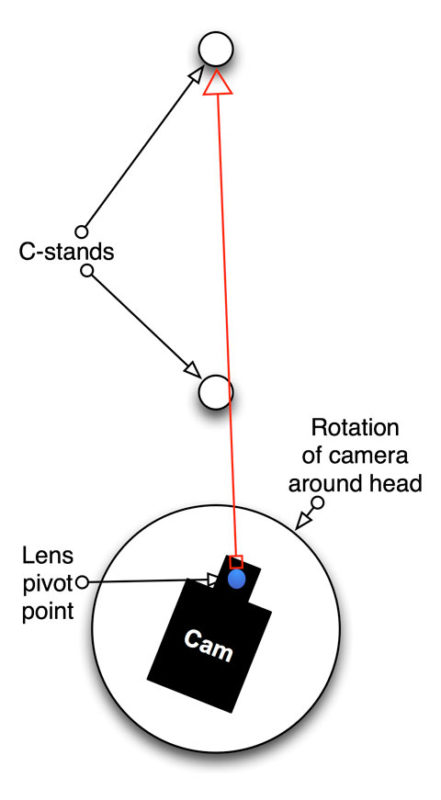
To configure a zero-parallax nodal pan without manufacturer documentation, camera assistants can utilize the "C-Stand Alignment" method:
Establish Two Reference Points: Place a thin vertical object (like a C-stand grip arm or a plumb line) close to the lens, and align it with a distinct vertical feature in the far background (such as a door frame or building edge).
Perform a Test Pan: Rotate the camera to the left and right while observing the monitor.
Analyze the Parallax:
If the foreground object appears to shift in the opposite direction of the pan relative to the background, the camera is positioned too far forward.
If the foreground object shifts in the same direction as the pan, the camera is too far back.
Adjust the Position: Slide the camera plate forward or backward on the nodal rail and repeat the test pan.
Lock the Axis: Once the foreground and background objects remain perfectly aligned throughout the entire pan, the front entrance pupil is positioned directly over the center of rotation. Mark this physical point on the camera rail for future setups.
The Anamorphic Complication
While spherical lenses possess a single, stable front entrance pupil, anamorphic lenses introduce a unique optical challenge. Because anamorphic lenses utilize cylindrical glass elements to squeeze the image horizontally while leaving the vertical axis unaffected, they function essentially as two distinct optical systems working in tandem.
Consequently, anamorphic lenses often exhibit two distinct entrance pupils located at different depths within the lens barrel—one for the horizontal axis and one for the vertical axis.
This optical reality means that it is mathematically impossible to set a perfect nodal point for both axes simultaneously on an anamorphic lens. If the camera is calibrated to eliminate parallax during a pan (horizontal), it will still exhibit parallax during a tilt (vertical), and vice versa. VFX teams shooting on anamorphic glass must limit camera movements to a single axis or rely on post-production match-moving software to correct the resulting perspective shifts.
Official Statements
Perspectives from the Field
The practical implications of these optical principles are well-documented by industry veterans. Art Adams, Product Manager for Lenses at ARRI and a Director of Photography with nearly three decades of active set experience, emphasizes that the traditional focus scale is often misunderstood:
"Whenever I show off a new lens, one of the first questions I hear is always: ‘What’s the close focus distance?’ That isn’t the right question to ask. It makes the assumption that all lenses will deliver the same frame at the same close focus distance. One of the secrets of lens design is that this is almost never the case."
Adams points out that the industry’s reliance on physical distance measurements has obscured the real goal of close-up cinematography: capturing a specific frame size.
"The close focus distance marked on a lens barrel doesn’t tell you anything about the actual frame size at that distance. It also doesn’t guarantee that two lenses, of the same focal length but from different manufacturers, will capture the same size image at the same focus distance. It’s very likely that they won’t. This is due to an ethereal thing called the front entrance pupil."
To resolve this on set, Adams highlights the engineering philosophy behind ARRI’s latest glass:
"To take the guesswork out of close focus framing, ARRI designed ARRI Ensō Primes to show magnification ratios near close focus. At the magnification ratio marked on the lens, you’ll see the exact same frame size, regardless of the focal length used."
Future Outlook
Optical Metadata and Virtual Production
As the film industry transitions toward virtual production—characterized by LED volumes running real-time game engines like Unreal Engine—the role of the front entrance pupil is shifting from a mechanical setup concern to a real-time data requirement.
In an LED volume, the background perspective must update in real time relative to the camera’s movement to maintain the illusion of depth. If the camera tracking system does not know the exact physical location of the lens’s front entrance pupil relative to the tracking markers, the virtual background will drift, ruining the illusion of a physical environment.
  [Real-Time Virtual Production Data Loop]

   Camera Tracking Sensors (Detects Physical Rig Position)
             │
             ▼
   Lens Metadata (LDS-2 / /i Technology)
   ├─ Transmits: Focal Length & Focus Distance
   ├─ Transmits: Dynamic Entrance Pupil Offset (Nodal Point)
             │
             ▼
   Virtual Production Render Engine (Unreal Engine)
   ├─ Calculates: Zero-Parallax Virtual Camera Position
             │
             ▼
   LED Wall Background (Renders Perfect Real-Time Perspective Shift)
To address this, modern lens communication protocols (such as ARRI’s LDS-2 and Cooke’s /i Technology) are beginning to transmit dynamic entrance pupil data directly to the camera and rendering engines. Because the entrance pupil shifts physically inside the lens barrel as the focus ring is turned, real-time metadata tracking is essential.
By sending the precise, frame-by-frame coordinate of the entrance pupil to the virtual production render nodes, the system can render a perfectly matched perspective, eliminating the latency and spatial drift that has challenged early virtual volume productions.
The Evolution of Lens Standardization
ARRI’s decision to engrave magnification ratios on the Ensō Prime series is likely the first step in a broader industry trend toward standardization. As cinematographers demand greater consistency across different lens brands and focal lengths—particularly in multi-camera setups and complex visual effects pipelines—the traditional focus distance scale may eventually take a back seat to magnification-based marking systems.
In the future, we may see hybrid lens barrels that allow camera assistants to toggle between physical distance measurements (for manual focus pulling) and magnification/nodal coordinates (for VFX and tracking integration). By demystifying the front entrance pupil and embracing the physics of magnification, the cinematography industry is moving toward an era of unprecedented optical precision on set.