








Executive Overview
As enterprise organizations rush to modernize their data estates and accelerate generative artificial intelligence (GenAI) deployment, boardrooms and chief information officers (CIOs) face an imperative: proving tangible business value while keeping spiraling infrastructure costs and governance risks under control. Amid widespread cloud optimization efforts, data platforms are undergoing rigorous financial scrutiny.
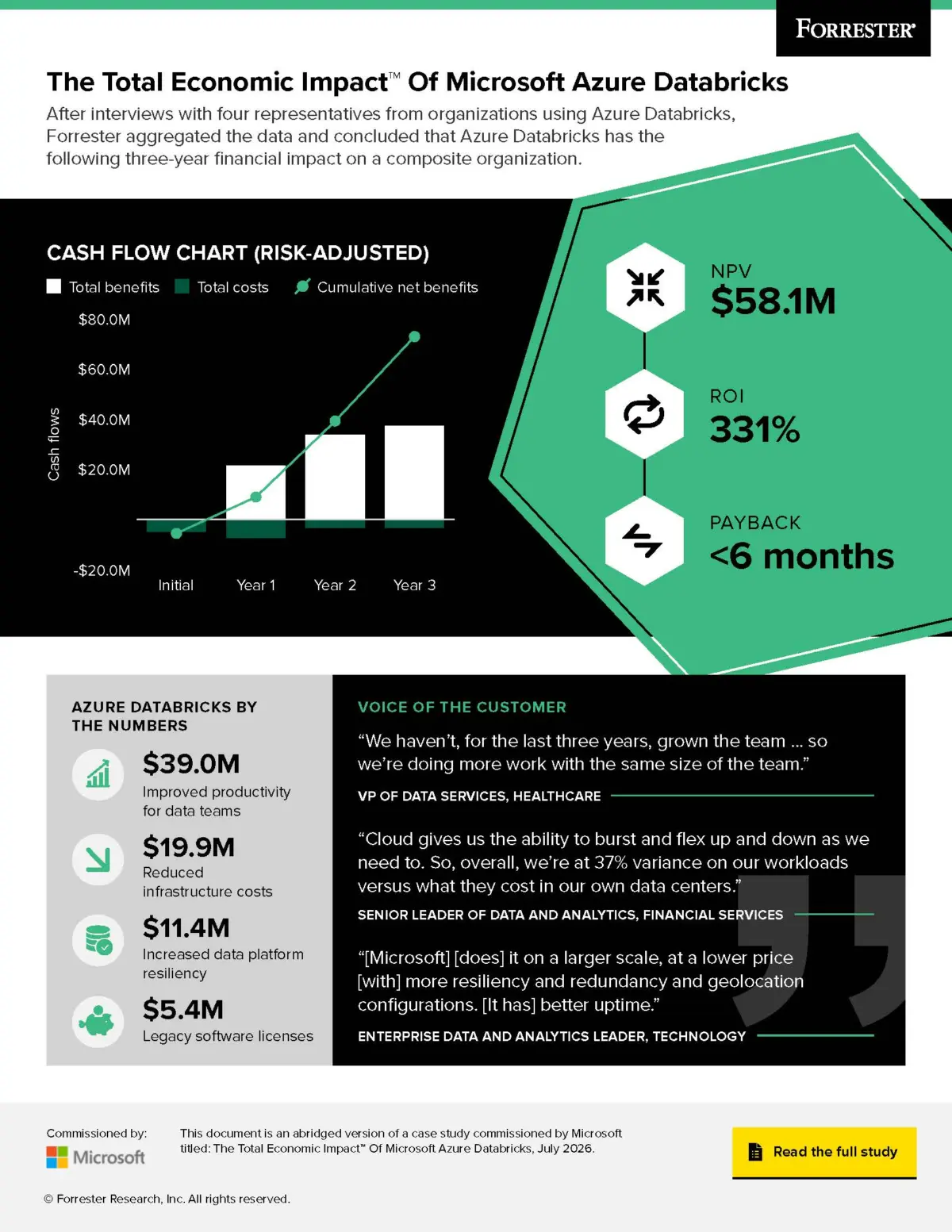
A comprehensive independent study conducted by Forrester Consulting on behalf of Microsoft provides definitive metrics on the economic impact of enterprise lakehouse architecture. Examining the business outcomes achieved by organizations deploying Azure Databricks—a platform co-engineered natively by Microsoft and Databricks—the study reveals that a representative composite enterprise achieved a 331% return on investment (ROI) over three years, generating $58.1 million in Net Present Value (NPV) with a payback period of less than six months.
+-----------------------------------------------------------------------+
|                 AZURE DATABRICKS: FORRESTER TEI METRICS               |
+-----------------------------------------------------------------------+
|  ROI (3-Year):                      331%                              |
|  Net Present Value (NPV):           $58.1 Million                     |
|  Payback Period:                    Less than 6 Months                |
|  Total Quantified Benefits:         $75.6 Million                     |
|  Total Implementation & Operating Cost: $17.5 Million                 |
|  Composite Model Scale:             $6B Revenue | 10 Petabytes Data   |
+-----------------------------------------------------------------------+
These financial returns are backed by rigorous performance testing. Independent benchmark research from Principled Technologies demonstrates that Azure Databricks executes enterprise decision-support queries up to 21.1% faster than competing cloud deployments, while drastically reducing query completion times in multi-tenant, highly concurrent enterprise workloads.
By delivering a deeply integrated, first-party native cloud service rather than a third-party add-on, the co-engineered solution addresses the fragmented architectures, duplicate data silos, and administrative overhead that historically plagued enterprise data engineering.
Detailed Chronology: The Evolution of Co-Engineered Data Infrastructure
Understanding the current financial performance of Azure Databricks requires examining the strategic trajectory of the Microsoft-Databricks alliance, which departed from traditional cloud marketplace vendor models to establish a native, first-party engineering model.
+-----------------------------------------------------------------------+
|                    PARTNERSHIP EVOLUTION TIMELINE                     |
+-----------------------------------------------------------------------+
|  Phase 1: Architecture Co-Engineering                                 |
|  - Joint development of native control planes and optimized runtime   |
|  - Deep integration with Azure storage, networking, and identity      |
|                                                                       |
|  Phase 2: Unified Governance & Platform Cohesion                      |
|  - Deployment of Unity Catalog across multi-cloud and Azure services  |
|  - Integrated security models with Microsoft Entra ID                 |
|                                                                       |
|  Phase 3: GenAI Acceleration & Enterprise Productivity                |
|  - Native integration of Databricks Genie with Microsoft Copilot      |
|  - Grounding enterprise LLMs via Genie Ontology inside M365 & Teams   |
|                                                                       |
|  Phase 4: Independent Validation                                      |
|  - Forrester TEI study validates $58.1M NPV and 331% ROI              |
|  - Principled Technologies confirms superior query speeds             |
+-----------------------------------------------------------------------+
Phase 1: Deep Architectural Co-Engineering
Rather than simply hosting a third-party software-as-a-service (SaaS) tool within a public cloud ecosystem, Microsoft and Databricks initiated a joint architectural engineering motion. The goal was to build a native first-party service directly embedded into the Azure control plane. This foundational work eliminated the complex networking, identity federation, and storage connector friction that typically increases total cost of ownership (TCO) in multi-vendor cloud stack configurations.
Phase 2: Unified Governance and Security Integration
As enterprise data volumes grew into petabyte scales, data sprawl emerged as a primary security and compliance risk. The development roadmap prioritized deep platform governance, connecting Databricks Unity Catalog directly with Microsoft’s enterprise security layer—including Microsoft Entra ID (formerly Azure Active Directory). This integration established fine-grained, attribute-based access controls (ABAC) and unified data lineage across complex enterprise estates without requiring data replication.
Phase 3: GenAI Acceleration and Conversational Intelligence
With the rise of large language models (LLMs) and advanced enterprise analytics, the joint engineering roadmap expanded into conversational AI. Databricks Genie was natively integrated into the Microsoft Copilot ecosystem—including Microsoft 365 Copilot, Microsoft Teams, and Copilot Cowork. This milestone enabled non-technical business users to query multi-petabyte lakehouses using natural language, backed by formal data governance models.
Phase 4: Independent Economic and Technical Validation
To quantify the tangible business returns of this architecture, Microsoft commissioned Forrester Consulting to perform a rigorous Total Economic Impact (TEI) analysis, alongside independent hardware and runtime benchmarks by Principled Technologies. The resulting study provides concrete financial metrics on the operational impacts of running a natively co-engineered lakehouse platform.
Supporting Context & Metrics: Quantifying the ROI
To evaluate the economic impact of Azure Databricks, Forrester interviewed enterprise organizations that migrated from fragmented legacy environments to the co-engineered platform. From these field interviews, Forrester constructed a composite financial model representing a $6 billion revenue enterprise in a regulated sector, managing approximately 10 petabytes of operational data.
Financial Breakdown of the Forrester Study
Prior to standardizing on Azure Databricks, the composite organization managed a fragmented, high-cost data estate characterized by unreliable pipeline performance at scale, excessive manual integration overhead, and complex compliance auditing routines.
                  THREE-YEAR FINANCIAL CASH FLOW ANALYSIS

  $80M +------------------------------------------------------- $75.6M
       |                                                       (Benefits)
  $60M +--------------------------------------------------+
       |                                                 |
  $40M +-------------------------------------------------|
       |                                                 |
  $20M +-------------------------- $17.5M                |
       |                          (Costs)                |
   $0M +-------------------------------------------------+
       |                      Composite Enterprise       |
Over a three-year evaluation horizon, the study documented dramatic operational shifts:
- Total Quantified Present Value Benefits: $75.6 million
- Total Implementation and Operating Costs: $17.5 million
- Net Present Value (NPV): $58.1 million
- Return on Investment (ROI): 331%
- Payback Period: Less than 6 months
Core Value Drivers Quantified by the Model
The total financial return of $75.6 million stems from four primary operational impact categories:
+-----------------------------------------------------------------------+
|                    FOUR PILLARS OF QUANTIFIED VALUE                   |
+-----------------------------------------------------------------------+
|  1. Infrastructure Modernization & Consolidation                      |
|     - Elimination of legacy hardware, expensive proprietary data      |
|       warehouses, and redundant third-party analytics licenses.       |
|                                                                       |
|  2. Engineering Productivity & Pipeline Efficiency                    |
|     - Automated cluster management, serverless compute execution,     |
|       and reduced manual ETL script maintenance for data teams.       |
|                                                                       |
|  3. Faster Time-to-Market for Data & AI Products                      |
|     - Acceleration of data pipeline builds, rapid deployment of       |
|       ML models, and faster delivery of business-critical analytics.  |
|                                                                       |
|  4. Risk Mitigation & Automated Regulatory Compliance                 |
|     - Unified governance via Unity Catalog reducing data breach risks |
|       and streamlining regulatory reporting audit workflows.          |
+-----------------------------------------------------------------------+
Unquantified Value Amplifiers
Beyond the direct cash-flow metrics, the study identified significant strategic benefits that were not assigned explicit dollar figures, but played a pivotal role in driving overall ROI:
- Native Azure Service Ecosystem Integration: Seamless operational connectivity with Azure Data Factory, Azure Machine Learning, Azure Synapse, and Azure Storage.
- Democratized Insights: Broadened enterprise-wide data access via natural language interfaces without compromising centralized governance.
- Automated Lineage with Unity Catalog: Single-pane-of-glass governance across structured, semi-structured, and unstructured data assets.
Independent Performance Benchmarks: The Speed Factor
Financial returns are directly connected to compute performance. In cloud analytics, faster query execution translates directly into lower compute billings and accelerated decision cycles.
To evaluate technical execution, independent benchmarking firm Principled Technologies performed industry-standard TPC-DS-like decision-support workload tests on a 10-terabyte dataset, comparing Azure Databricks against Databricks running on Amazon Web Services (AWS).
+-----------------------------------------------------------------------+
|                 PRINCIPLED TECHNOLOGIES BENCHMARK TESTS               |
|                      (10-Terabyte TPC-DS Workload)                    |
+-----------------------------------------------------------------------+
|  Metric                           | Azure Databricks Advantage        |
+-----------------------------------+-----------------------------------+
|  Single Query Stream Execution    | Up to 21.1% Faster Completion     |
|                                   | (vs. AWS with autoscale disabled) |
+-----------------------------------+-----------------------------------+
|  4 Concurrent Query Streams       | Completed > 9 Minutes Faster      |
|                                   | (Reduced queuing & resource lock) |
+-----------------------------------+-----------------------------------+
The benchmark results revealed significant technical advantages:
- Single Query Stream Execution: Azure Databricks completed the standard query suite in up to 21.1% less time than the equivalent environment on AWS when autoscale was disabled, proving higher baseline runtime efficiency.
- Concurrent Multi-User Scaling: Under a heavy enterprise workload featuring four concurrent query streams, Azure Databricks completed the bench test more than nine minutes faster than the AWS deployment.
These speed gains stem from joint kernel-level optimizations between the Azure infrastructure runtime and the Databricks engine, allowing queries to process data faster while lowering total billable compute instance runtime.
Official Statements & Architectural Perspectives
Industry experts and enterprise platform architects emphasize that the financial performance documented in the Forrester study reflects the advantages of deep engineering integration rather than simple commercial bundle discounts.
"Decision-makers consistently ask how cloud platform capabilities translate into measurable enterprise value," noted a senior cloud architecture director familiar with the study. "The core distinction with Azure Databricks lies in its first-party status. The advantage isn’t bolted on through external connectors—it’s engineered directly into the cloud service fabric. That structural integration is what reduces operational overhead, eliminates unnecessary data duplication, and drops payback periods under six months."
Platform engineering teams highlight the operational benefits of a unified operational model:
"Managing separate vendor billing, fragmented support paths, and divergent product roadmaps introduces a persistent tax on enterprise IT teams," explained an enterprise data platform specialist. "Because Microsoft and Databricks share a single engineering roadmap and unified go-to-market alignment, enterprise customers operate within one motion, receive one bill against their Azure Consumption Commitments (MACC), and rely on a consolidated enterprise support path. That administrative cohesion directly improves engineer productivity."
From a technical architecture perspective, the integration of enterprise artificial intelligence represents a major step forward:
+-----------------------------------------------------------------------+
|               NATURAL LANGUAGE LAKEHOUSE QUERY ARCHITECTURE           |
+-----------------------------------------------------------------------+
|                                                                       |
|   [ Business User ] --> (Asks Plain Language Business Question)       |
|                                     |                                 |
|                                     v                                 |
|   [ Application Layer ] --> (Microsoft Teams / M365 Copilot / Cowork)  |
|                                     |                                 |
|                                     v                                 |
|   [ Intelligence Layer ] -> (Databricks Genie + Genie Ontology)       |
|                                     |                                 |
|                                     v                                 |
|   [ Governance Layer ] ---> (Unity Catalog RBAC & Security Scope)     |
|                                     |                                 |
|                                     v                                 |
|   [ Data Layer ] ---------> (Azure Databricks Lakehouse - 10PB Scale) |
|                                                                       |
+-----------------------------------------------------------------------+
"The integration of Databricks Genie into Copilot Cowork and Microsoft Teams fundamentally changes how non-technical stakeholders interact with enterprise data," added a senior AI solutions engineer. "A business analyst can ask a complex operational question in natural language within Teams. The system uses the Genie Ontology to interpret business context and contextually query the lakehouse. Crucially, every response is constrained by Unity Catalog access policies, ensuring users only see the data they are explicitly authorized to view."
Future Outlook: The Architecture of Enterprise Data in the AI Era
The findings of the Forrester Total Economic Impact study and the Principled Technologies performance benchmarks highlight a broader shift in enterprise IT strategy: the convergence of cloud data lakehouses, enterprise governance, and generative AI interfaces into a single unified platform.
+-----------------------------------------------------------------------+
|                    FUTURE ENTERPRISE PLATFORM TRENDS                  |
+-----------------------------------------------------------------------+
|                                                                       |
|  1. Convergence of GenAI and Governance                               |
|     - Large language models grounded directly on lakehouse data       |
|     - Zero data duplication with real-time ABAC/RBAC enforcement      |
|                                                                       |
|  2. Automated FinOps & Resource Optimization                          |
|     - AI-driven auto-scaling and serverless compute models            |
|     - Elimination of idle cluster spend via joint kernel tuning       |
|                                                                       |
|  3. Democratized Enterprise Analytics                                 |
|     - Natural language replacing SQL for front-line operations        |
|     - Real-time insights delivered natively inside productivity tools  |
|                                                                       |
+-----------------------------------------------------------------------+
Strategic Takeaways for Enterprise Decision-Makers
-
Platform Cohesion Drives Financial Returns: The primary takeaway for CIOs and Chief Data Officers (CDOs) is that architectural fragmentation carries a heavy operational penalty. Siloed data lakes, legacy data warehouses, and custom governance connectors inflate total cost of ownership. A natively co-engineered platform delivers quantifiable financial returns by streamlining operations.
-
Performance directly Impacts Cloud Spend: As demonstrated by the 10-terabyte benchmark tests, query execution speed is not merely a technical performance metric—it is a direct financial variable. Faster execution runtimes directly reduce billable compute consumption, driving lower operational costs across enterprise workloads.
-
Governance is Mandatory for Enterprise GenAI Deployment: Implementing generative AI across operational business units requires rigorous data security. By anchoring conversational interfaces like Databricks Genie within centralized governance framework like Unity Catalog, enterprises can safely expand access to AI tools without creating data leaks or compliance violations.
Long-Term Market Impact
As enterprises build out their long-term data and AI infrastructure, the co-engineered first-party cloud platform model establishes a compelling standard for enterprise software delivery.
By aligning underlying infrastructure runtimes, security layers, user experiences, and commercial structures, Microsoft Azure Databricks demonstrates that deep platform integration offers a proven, measureable pathway to cloud ROI—delivering an evaluated 331% return on investment and setting a benchmark for enterprise modern data platform design.