







Executive Overview
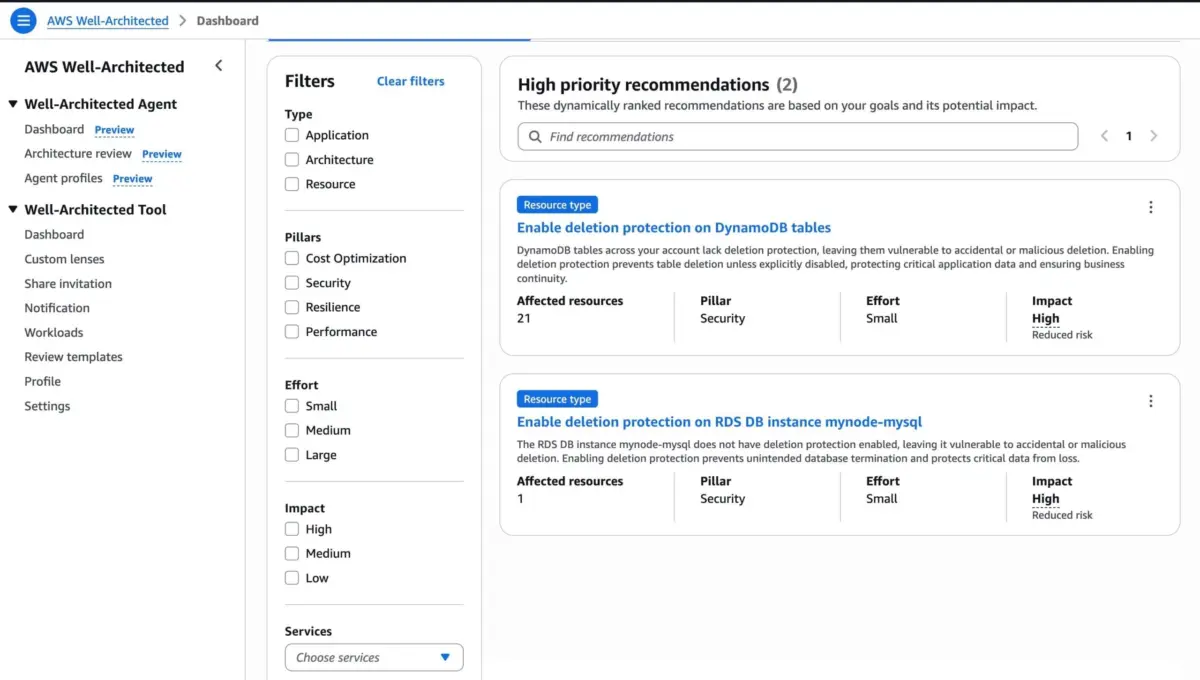
In a strategic move designed to reshape how enterprises manage cloud-scale infrastructure, Amazon Web Services (AWS) has announced the preview release of the AWS Well-Architected Agent. This groundbreaking artificial intelligence (AI) agent functions as an autonomous, virtual cloud architect. It continuously evaluates complex, multi-service environments, aligning configurations, metrics, and application topologies with AWS best practices and specific enterprise business objectives.
As cloud ecosystems expand exponentially in size and complexity, organizations frequently struggle with the manual burden of continuous optimization. The AWS Well-Architected Agent steps into this operational vacuum, analyzing more than 65 AWS services to surface targeted recommendations. Crucially, the tool goes beyond simple diagnostics; it generates actionable remediation guidance and ready-to-deploy code that engineers can seamlessly execute via command line interfaces (CLIs), infrastructure-as-code (IaC) platforms, or automated runbooks.
Far from signaling the obsolescence of human IT professionals, this release represents a fundamental shift in the division of labor between human engineers and autonomous agents. By offloading tedious auditing, configuration tuning, and tradeoff analysis to AI, enterprises can empower leaner IT teams to govern workloads at unprecedented scale, addressing a persistent industry-wide talent shortage.
Detailed Chronology & Operational Mechanics
The Genesis of Autonomous Cloud Architecture
The introduction of the AWS Well-Architected Agent marks a critical milestone in the evolution of AWS’s Well-Architected Framework. Introduced years ago as a set of static whitepapers and review processes, the framework gradually evolved into digital tooling within the AWS Console. However, traditional well-architected reviews have historically been periodic, point-in-time assessments requiring significant manual effort from solutions architects and DevOps teams.
By transforming this framework into a real-time, proactive AI agent, AWS has bridged the gap between static guidelines and dynamic, living cloud environments. The preview rollout allows early-adopting organizations to test the agent’s capabilities in staging and production environments, setting the stage for general availability and deeper integrations across the broader AWS ecosystem.
How the Agent Operates Under the Hood
Functioning much like an elite, tireless cloud architect, the AWS Well-Architected Agent operates through a continuous feedback loop:
- Continuous Data Ingestion: The agent ingests telemetry, operational metrics, resource configurations, and application topology maps from across the AWS environment in real time.
- Contextual Analysis: It evaluates this data against established AWS best practices spanning security, cost optimization, performance efficiency, reliability, and operational excellence.
- Business Objective Alignment: Unlike rigid compliance bots, the agent evaluates findings through the lens of user-defined business goals. If an organization prioritizes rapid feature delivery over cost reduction—or vice versa—the agent adjusts its evaluative lens accordingly.
- Tradeoff Identification: Because cloud engineering inherently involves compromise, the agent explicitly highlights the tradeoffs involved in choosing one architectural path over another.
- Remediation and Code Generation: Upon surfacing issues, the agent provides granular, step-by-step remediation instructions alongside estimated cost impacts. Furthermore, it generates production-ready code snippets that can be deployed instantly through standard automation pipelines.
Supporting Context & Metrics: The Scaling Imperative
The Growing IT Talent Deficit
To understand the significance of the AWS Well-Architected Agent, one must examine the macroeconomic pressures facing modern IT departments. Industry surveys consistently highlight a widening chasm between the volume of cloud infrastructure deployed and the availability of qualified personnel to manage it.
As modern enterprises accelerate digital transformation, embrace microservices architectures, and adopt containerized environments, the sheer volume of configuration parameters, security policies, and cost vectors grows beyond human cognitive limits. Most organizations simply do not possess enough specialized IT staff to continuously audit and optimize their existing deployments.
The AI Acceleration Paradox
This talent bottleneck is poised to become even more acute. The rapid proliferation of generative AI tools makes it easier and faster than ever for developers to build, test, and deploy new applications. While this supercharges business innovation, it simultaneously floods IT and DevOps pipelines with a staggering volume of new workloads that demand oversight, securing, and cost management.

Without autonomous intervention, organizations risk drowning in technical debt, security vulnerabilities, and runaway cloud expenditure. The AWS Well-Architected Agent directly addresses this paradox, acting as an operational force multiplier that allows engineering teams to maintain rigorous architectural standards without scaling headcount linearly.
Official Statements & Industry Perspectives
In unveiling the new preview capability, Jill Fariss, Vice President of AWS Support, emphasized that the ultimate objective of the Well-Architected Agent is not to displace human engineers, but to elevate their operational ceiling.
"The overall goal is not to eliminate the need for humans to manage IT infrastructure, but rather make it simpler for engineers and IT administrators to manage workloads at much higher levels of scale," Fariss noted.
Addressing the core motivations behind the release, Fariss pointed directly to the staffing challenges prevalent across the enterprise landscape. She underscored that the current shortage of IT expertise "is only going to be further exacerbated as advances in AI make it possible to build and deploy even more applications."
Fariss also detailed the nuanced decision-making capabilities built into the agent, highlighting its ability to navigate complex engineering tradeoffs. Whether an organization defines its goals through automated policy definitions or directs the agent to perform open-ended discovery scans, the system is designed to provide transparent, quantifiable insights.
"DevOps engineers or an IT administrator can define the business goals they are trying to meet, or alternatively, opt to run the AWS Well-Architected Agent simply to discover issues and suggestions for resolving them," Fariss explained.
Future Outlook: Navigating the AI Era in IT Operations
The Evolution of DevOps and IT Administration
As autonomous AI agents like the AWS Well-Architected Agent mature, the day-to-day role of DevOps engineers and system administrators is undergoing a profound metamorphosis. The baseline technical expertise required to perform routine configurations and basic troubleshooting is steadily declining as automation abstracts underlying complexity.
This shift presents organizations with strategic choices regarding team composition:
- Amplifying Expert Teams: Some enterprises will leverage AI agents to enable smaller, elite teams of senior engineers to oversee massive, hyper-scale cloud environments that previously required dozens of operators.
- Augmenting Generalist Staff: Other organizations may choose to deploy AI agents to support junior or generalist IT administrators, empowering them to execute complex architectural changes safely and effectively while reducing overall labor overhead.
Establishing Trust and Defining Boundaries
Despite the immense promise of autonomous cloud operations, the transition to agentic AI workflows will not happen overnight. A central theme for IT leaders during the preview phase and beyond is the establishment of operational trust.
Organizations must systematically determine the scope of tasks they feel comfortable delegating to an AI agent with minimal human oversight. While automated remediation code generation is a powerful capability, establishing clear guardrails, approval gates, and rollback mechanisms will remain paramount to prevent unintended outages or security misconfigurations.
Looking Ahead: The Multi-Agent Enterprise Horizon
The AWS Well-Architected Agent is merely a precursor to a broader industry trend. Cloud infrastructure providers will inevitably flood the market with increasingly sophisticated, specialized AI agents designed to handle networking, database tuning, security compliance, and FinOps.
The defining challenge—and opportunity—for IT leadership in the coming months will not be finding tools, but orchestrating them. Determining the precise separation of duties between various AI agents and the human supervisors who manage them will dictate organizational agility, security posture, and bottom-line profitability in the modern cloud era.
Frequently Asked Questions
What is the AWS Well-Architected Agent?
The AWS Well-Architected Agent is an advanced AI-powered assistant currently available in preview. It is engineered to analyze AWS cloud environments continuously, providing targeted recommendations to optimize workloads across five key pillars: cost, security, performance, reliability, and operational excellence.
How does the agent generate its recommendations?
The agent evaluates real-time infrastructure metrics, resource configurations, and application topologies against a comprehensive body of AWS best practices spanning over 65 services. Crucially, it filters these evaluations through the specific business objectives and priorities defined by the organization.
Can the AWS Well-Architected Agent implement changes automatically?
While the agent does not execute changes blindly, it generates precise remediation guidance alongside production-ready code. Engineers can review and implement this code seamlessly using command line interfaces (CLIs), infrastructure-as-code (IaC) platforms, or runbook automation tools.
Does this agent replace DevOps engineers and IT administrators?
No. AWS leadership emphasizes that the agent is designed to augment human staff rather than replace them. By automating tedious auditing, tradeoff analysis, and remediation generation, the agent empowers engineers to manage significantly larger and more complex workloads despite ongoing industry-wide IT talent shortages.