







Executive Overview
The landscape of digital rights enforcement and internet infrastructure has reached a critical inflection point in Belgium. Following a rigorous legal battle between major international technology conglomerates and domestic sports rightsholders, the President of the French-speaking Business Court of Brussels has delivered a definitive ruling upholding mandatory Domain Name System (DNS) blocking requirements.
The decision, issued on August 20, 2025, marks a major victory for sports broadcaster DAZN and the nation’s aggressive anti-piracy enforcement regime. Under the newly validated framework, global public DNS resolution providers—specifically Google, Cloudflare, and Cisco’s OpenDNS—are legally mandated to restrict access to unauthorized streaming domains utilized for pirated live sports broadcasts, notably matches from the Jupiler Pro League.
While Google and Cloudflare have largely adapted their operations to accommodate the legal mandates, Cisco has taken an uncompromising stance. Citing architectural limitations and an inability to implement selective, dynamic, and geolocated blocks without compromising global network performance, stability, and security, Cisco has announced its intention to withdraw OpenDNS from the Belgian market entirely.
This unfolding controversy highlights a profound tension in modern telecommunications: the collision between robust copyright enforcement and the foundational technical architecture of the decentralized global internet. As major public DNS providers face exorbitant daily penalties—capped at €20 million per entity—the regulatory precedent established in Brussels could serve as a blueprint for European rights enforcement, while simultaneously forcing critical infrastructure providers to weigh regional compliance against global service integrity.
Detailed Chronology: From DAZN’s Initial Salvo to the Brussels Court Decision
To fully understand the gravity of the August 2025 ruling, it is essential to trace the rapid escalation of Belgium’s anti-piracy measures, a regulatory environment that has evolved from relative leniency to one of the most aggressive enforcement regimes in Europe.
The Spring 2025 Opening Salvo
Belgium was historically considered a laggard in the deployment of nationwide site-blocking injunctions. However, the inauguration of a dedicated anti-piracy department transformed the country’s legal posture almost overnight. The turning point arrived in April 2025, when sports broadcasting giant DAZN secured the first major blocking order under the new administrative regime.
Rather than limiting its scope to traditional Internet Service Providers (ISPs), DAZN’s legal strategy cast a much wider net. The injunction compelled alternative public DNS resolvers—Cloudflare, Google, and Cisco—to actively filter and refuse the resolution of designated pirate streaming domains. Non-compliance carried a severe financial deterrent: prospective fines of up to €100,000 per day.
The Immediate Industry Fallout
The tech sector’s response was swift and fractured. Cisco reacted with immediate hostility, choosing to pull its OpenDNS service out of Belgium entirely to avoid the legal exposure and technical hurdles dictated by the order. Google and Cloudflare adopted a more conciliatory compliance path, implementing workaround solutions while concurrently joining Cisco to legally challenge the injunction’s validity.

By July 2025, the legal pressure momentarily eased. The Brussels court provisionally suspended the DNS blocking requirements against Cisco pending a comprehensive final review. This temporary reprieve allowed OpenDNS to resume standard operations within Belgian borders and temporarily halted auxiliary DNS blocking actions across the sector. However, this judicial pause proved to be short-lived.
The August 20, 2025 Verdict
The legal suspension dissolved with the arrival of the final ruling on August 20, 2025. The President of the French-speaking Business Court of Brussels firmly rejected the core arguments brought forth by the DNS providers, affirming that mandatory DNS-level filtering remains legally sound and enforceable.
Although the complete judicial order was not immediately published, a supplementary implementation decision issued by Belgium’s anti-piracy department on September 7, 2025, provided granular insights into how the enforcement mechanism will function. The court ruled that alternative DNS providers possess the technical capacity to execute domain-level blocking and that the associated costs do not constitute an undue or disproportionate financial burden. Furthermore, industry anxieties regarding potential geolocation overblocking errors affecting populations near national borders were dismissed as insufficient grounds to invalidate the injunction.
Supporting Context & Metrics: Mechanics of the Blockade and Financial Stakes
The operational framework established by the Belgian anti-piracy department is designed to maximize friction for consumers attempting to access unauthorized streams, specifically targeting live football consumption habits.
Intermittent Blocking and the 90-Minute Clock
Unlike static site-blocking injunctions that permanently sever access to targeted web infrastructure, the Belgian enforcement model relies on dynamic, intermittent disruption. The system operates according to a tightly managed logistical schedule:
- Update Frequency: DAZN is authorized to submit one blocklist update per week, accommodating a maximum of 1,000 new domains per update.
- Notification Window: DAZN must notify the anti-piracy department at least seven working days in advance regarding which specific matchday requires blocklist activation.
- Implementation Period: DNS resolvers are granted a five-working-day window to integrate the updated blocklist into their architecture.
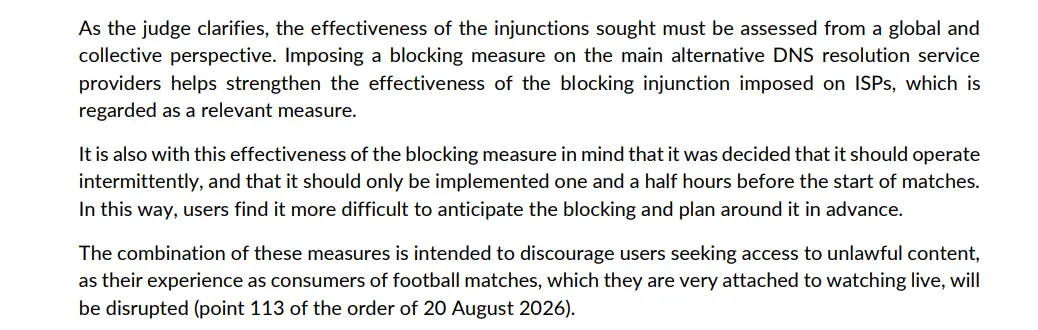
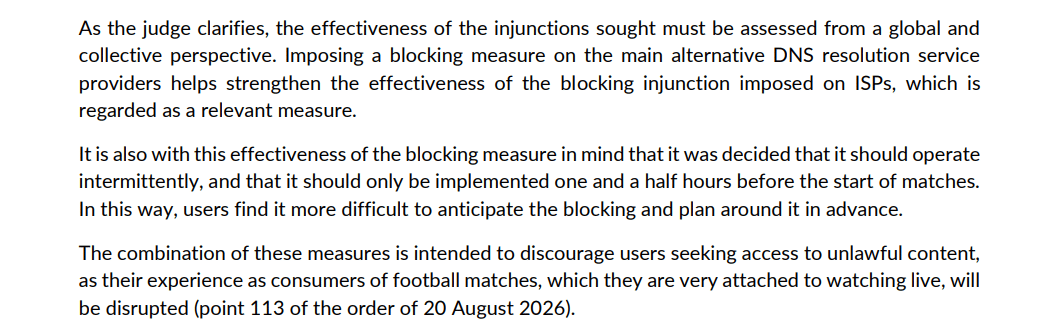
- The 90-Minute Rule: To prevent workarounds and catch illicit operators off guard, the actual blocking filters go live precisely 90 minutes before the kickoff of a scheduled match.
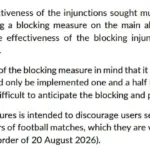
The implementation order explicitly notes the psychological rationale behind this timing: "It is also with this effectiveness of the blocking measure in mind that it was decided that it should operate intermittently, and that it should only be implemented one and a half hours before the start of matches. In this way, users find it more difficult to anticipate the blocking and plan around it in advance."
Scaling the Blocklist
The tangible expansion of the enforcement regime is evidenced by publicly available data regarding the blocklists themselves. When the initial order was handed down, the restricted domain registry contained a modest 58 entries. As the enforcement mechanism matured alongside the Jupiler Pro League season, that figure rapidly expanded, surging to 258 blocked domains and continuing to scale as new pirate mirror sites emerge.
Judicial Concessions and Financial Safeguards
While the court largely ruled in favor of DAZN and the anti-piracy department, the final judgment did introduce several vital modifications and concessions designed to mitigate the absolute liability of the DNS providers:
- Removal of Warning Pages: The court scrapped the requirement compelling DNS resolvers to redirect blocked users to a mandatory warning or landing page, acknowledging that such interface alterations are technically unfeasible for foundational DNS infrastructure providers.
- Refined Penalties: While the daunting €100,000 daily fine remains intact, its application has been restricted. Penalties now accrue exclusively on days when live DAZN matches are actively broadcast.
- Liability Caps and Exceptions: Total cumulative fines are capped at a maximum of €20 million per company. Crucially, the ruling stipulates that fines will not be levied for under-blocking incidents directly attributable to "an exceptional geolocation error."
Official Industry Positions and Strategic Responses
The divergence in corporate responses among Google, Cloudflare, and Cisco highlights the fundamental difficulty of applying broad legal injunctions to foundational internet technologies.
Google and Cloudflare: Pragmatic Compliance
Google and Cloudflare opted to absorb the operational overhead required to comply with the initial 2025 orders. For these global technology giants, the regulatory risks and potential legal liabilities within European jurisdictions outweighed the technical friction of implementing selective routing blocks. Their ongoing participation ensures their continued footprint in the Belgian market, although they remain critical of the precedent being set.
Cisco’s Uncompromising Exit Strategy
Cisco, by contrast, has maintained an uncompromising stance regarding its OpenDNS service. During the legal hearings leading up to the final ruling, Cisco representatives formally notified the anti-piracy department that the company would once again withdraw OpenDNS from Belgium if the ruling was upheld.
In its official technical defense, Cisco asserted that its global public DNS infrastructure "does not allow for the implementation of selective, geolocated and dynamic blocking as required by the order." The company warned that forcing such localized, intermittent filtration modifications onto a unified, high-performance global network architecture "would compromise the performance, stability and security of that service."
Faced with a binary choice between compromising its global network integrity or exiting the Belgian market, Cisco concluded that total withdrawal was the only viable technical measure at its disposal. The Belgian anti-piracy department has formally accepted this withdrawal as an acceptable form of compliance with the legal decree.
Despite the inevitability of the decision, Cisco has indicated its intent to pursue a formal legal appeal. In a brief statement following the publication of the implementation order, a Cisco spokesperson reiterated the current status: "OpenDNS currently remains available in Belgium." However, unless an appellate court intervenes or reverses the lower court’s findings, OpenDNS users in Belgium face the distinct prospect of service termination later this year.
Future Outlook: Global Precedents and the Future of DNS-Level Enforcement
The Belgian court’s ruling carries implications that extend far beyond the borders of Brussels or the specific broadcasting rights of the Jupiler Pro League. As intellectual property holders increasingly target the foundational layers of internet infrastructure rather than merely pursuing hosting providers or individual pirate websites, the legal ecosystem is entering uncharted territory.
The Slippery Slope of Infrastructure Filtering
Digital rights advocates and civil liberties organizations have long cautioned against utilizing DNS resolvers as frontline enforcement mechanisms in copyright disputes. By co-opting public DNS providers—which millions of consumers rely on for foundational internet navigation, speed, and enhanced security—into copyright enforcement agents, courts risk transforming essential public utility infrastructure into private policing tools.
The core technical objection raised by Cisco—that public DNS systems are fundamentally ill-suited for dynamic, localized, and geolocated blocking without sacrificing global stability—resonates deeply within the network engineering community. Critics argue that forcing global technology providers to maintain fractured, jurisdiction-specific routing tables sets a dangerous precedent. If every nation state or regional authority mandates bespoke, intermittent DNS blocks for domestic entertainment rights, the foundational architecture of the unified global internet risks structural fragmentation—a phenomenon often referred to as the "splinternet."
Broadcasters Eye European Expansion
For sports rightsholders and commercial broadcasters, however, the Belgian ruling represents a monumental strategic triumph. Live sports programming relies on immediacy; once a match has concluded, its commercial value plummets. Traditional site-blocking techniques have historically suffered from high latency, with pirate operations seamlessly spinning up alternative mirror domains faster than traditional legal notices can be processed.
The combination of a 90-minute implementation clock, dynamic weekly blocklist updates, and the inclusion of major alternative DNS providers creates a formidable barrier that significantly disrupts the consumer experience of illicit streaming. Buoyed by this legal validation in Belgium, media conglomerates and sports federations across the European Union are expected to emulate this aggressive enforcement playbook in neighboring jurisdictions.
What Lies Ahead for Belgian Internet Users
As the three-month grace period for compliance outlined in the September implementation order ticks down, the immediate future for Belgian internet users depends heavily on their choice of DNS provider. Users relying on Google Public DNS or Cloudflare will experience automated, intermittent filtering tied directly to the Jupiler Pro League fixture calendar.
Meanwhile, Cisco’s impending departure means that loyal OpenDNS users will soon be forced to either migrate to alternative resolution services or navigate a degraded digital landscape. Whether Cisco’s forthcoming legal appeal can successfully overturn the Brussels court’s decision remains to be seen. Until then, Belgium stands firmly at the vanguard of a new, highly aggressive era of digital copyright enforcement—one where the foundational plumbing of the internet is increasingly pressed into service to protect the broadcast revenues of modern sports media.