









Executive Overview
In a landmark legal battle unfolding within the United States federal court system, Chinese streaming titan Tencent is taking direct aim at Olevod—a major, globally distributed pirate streaming service catering primarily to the overseas Chinese diaspora. Historically, anti-piracy operations spearheaded by Hollywood heavyweights and organizations like the Alliance for Creativity and Entertainment (ACE) have primarily focused on Western-facing infringing domains. Consequently, Chinese-centric pirate platforms have frequently operated in a regulatory blind spot, evading major U.S. government watchlists like the United State Trade Representative’s (USTR) Notorious Markets list despite pulling in millions of views.
Tencent’s multi-pronged lawsuit, filed in the U.S. District Court for the Southern District of Florida, seeks to shatter this perception of impunity. The entertainment giant is pursuing staggering statutory damages of up to $100 million, targeting over 150 of its most popular proprietary television shows and cinematic releases—some of which have amassed upwards of 30 billion views globally.
Beyond the jaw-dropping financial demands, Tencent has asked the court to issue a sweeping, systemic injunction compelling ISPs, domain name system (DNS) resolvers, hosting providers, virtual private network (VPN) services, banks, and payment processors to functionally sever Olevod from the modern digital infrastructure within a seven-day window.
While Olevod mounted an aggressive defense—arguing that it is merely a Spanish entity with no physical nexus to the United States—a recent pivotal ruling by U.S. District Judge David Leibowitz has shattered the platform’s jurisdictional shield. By establishing that operating an interactive commercial website that targets U.S. consumers and generates advertising revenue within a specific judicial district constitutes sufficient minimum contacts, the court has carved out a dangerous precedent for international copyright infringers. This case not only signals a new front in the global war on digital piracy but also establishes a definitive legal roadmap for other Chinese entertainment conglomerates seeking American justice against foreign-hosted infringers.
Detailed Chronology of the Legal Battle
The Opening Salvo: October 2023
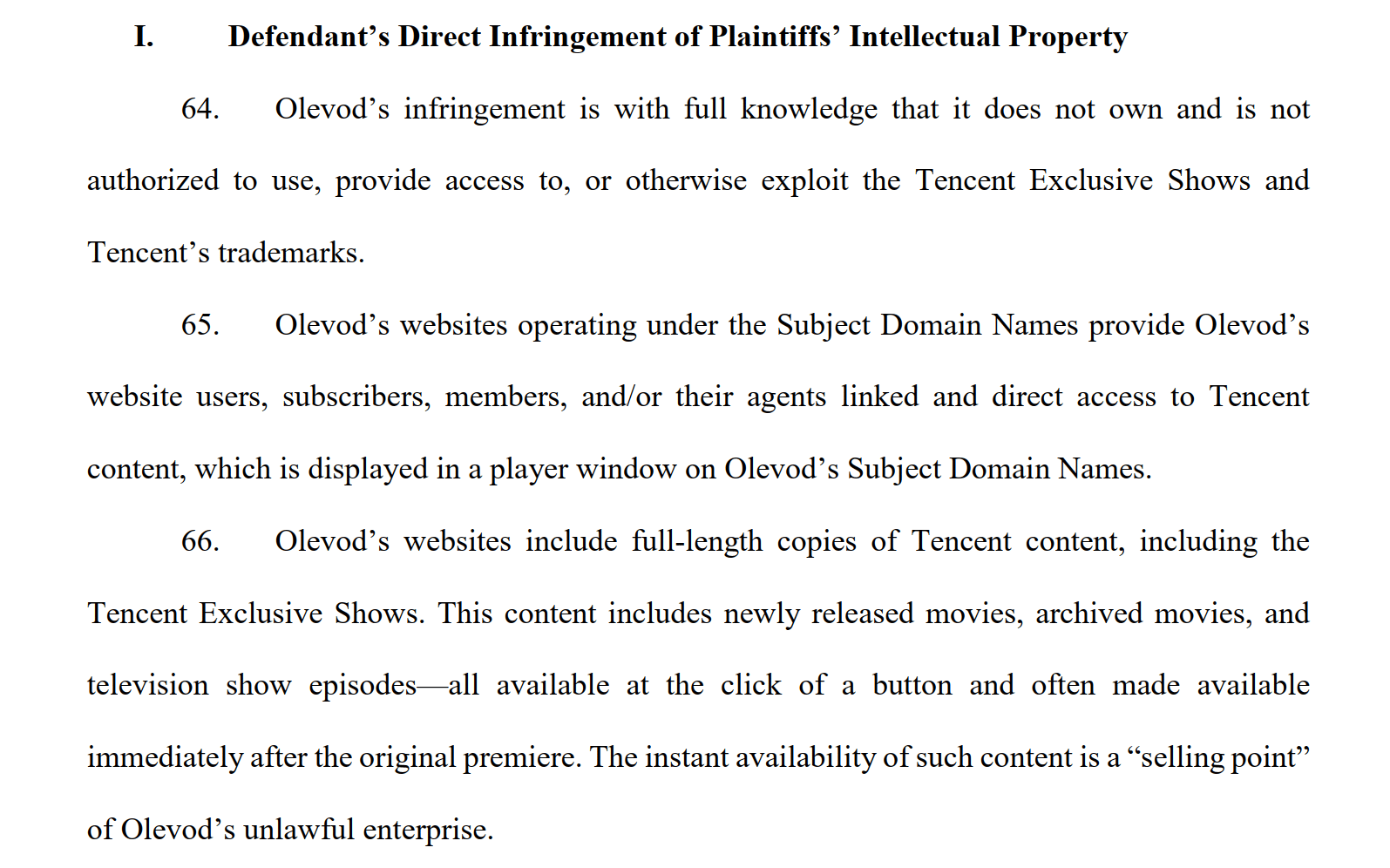
The legal conflict materialized in October of last year when Tencent Video formally lodged a comprehensive copyright and trademark infringement complaint against Olevod in a Florida federal court. Tencent, recognized globally as one of mainland China’s premier streaming and entertainment ecosystems, detailed in its filing that Olevod operates dual domains—Olevod.com and Olevod.tv—to systematically distribute unauthorized, full-length copies of its premier catalog.
According to court documents, Olevod’s operational model relies on a dual-stream monetization strategy. Visitors can access copyrighted content free of charge, albeit interspersed with advertisements, or pay for an upgraded "VIP membership" tier designed to strip away commercials and provide unhindered access. Tencent pointed out that Olevod routinely makes high-value intellectual property—ranging from newly debuted theatrical films to archived television series and exclusive platform-only premieres—available to consumers at the click of a button, often within hours of their original domestic release.

Jurisdiction and the Spanish Defense: January 2024
Rather than defaulting—a common strategy among offshore pirate operators who choose to ignore U.S. litigation entirely—Olevod retained Florida-based legal counsel to mount an aggressive defense. In January, the platform filed a motion to dismiss the lawsuit in its entirety, contending that the U.S. federal court lacked personal jurisdiction over the entities operating the site.
The defense identified the corporate vehicle behind the platform as Jiayi Network Technology SL, a limited company officially registered in Spain with zero physical offices, employees, or contractual obligations inside the United States. To further bolster its jurisdictional defense, Olevod noted that its server infrastructure is physically located in Germany and France, its pricing structures are denominated in foreign currencies (primarily Chinese Yuan and Euros), and its transactional revenue flows almost exclusively through Asian digital payment ecosystems such as Alipay and WeChat Pay.
Tencent fired back with compelling digital evidence, demonstrating that despite the platform’s European corporate facade, Olevod actively solicits U.S. dollars via PayPal, sells commercial advertising space tailored to Western markets, and routes infrastructural and administrative touchpoints through digital mail drops located within the jurisdiction of the Florida court—specifically in Destin, Florida.
The Magistrate’s Report and Recommendation: June 2024
The jurisdictional tug-of-war appeared to lean in the defense’s favor when U.S. Magistrate Judge Panayotta Augustin-Birch issued a formal report and recommendation in June. Judge Augustin-Birch sided with Olevod, concluding that while Tencent successfully proved that residents within Florida possessed the technical ability to access the pirate domains, the streaming giant failed to produce definitive evidence demonstrating that a single Floridian had actually streamed a Tencent-owned property on the site.
In her stinging critique of expansive jurisdictional claims, the Magistrate warned that accepting mere global accessibility as a baseline for personal jurisdiction would inadvertently "subject every company or individual that has a website anywhere in the world, and whose website can be accessed in Florida, to suit in Florida." For a brief moment, it appeared Olevod had successfully fended off U.S. litigation through traditional extraterritorial defenses.
The District Judge’s Reversal: September 2024
The momentum of the case shifted dramatically when U.S. District Judge David Leibowitz rejected the Magistrate’s recommendations, keeping Tencent’s multi-million-dollar lawsuit fiercely alive. Judge Leibowitz’s decision was heavily influenced by fresh, granular traffic analytics supplied by Tencent via Semrush.

The data revealed that Olevod.com pulled in an astounding 123,400 distinct visits originating from the state of Florida during the single month of June, cementing the state as the platform’s fourth-largest source of U.S. traffic. Combined with the platform’s active monetization tactics—namely, selling targeted advertising space viewable by Floridians and processing premium subscriptions for U.S.-based users—the judge determined that Olevod was purposefully availing itself of the Florida consumer base.
Drawing a direct parallel to historic counterfeit goods litigation—specifically referencing a precedent where online vendors of fake Louis Vuitton merchandise lost similar jurisdictional challenges—Judge Leibowitz dismissed the distinction between digital and physical commerce. Olevod, the judge underscored, was not a casual, isolated blogger operating out of a residential basement, but a sophisticated, profit-driven enterprise running an interactive commercial platform.
Supporting Context & Metrics: The Scale of Olevod and the Global Chinese Pirate Ecosystem
To fully comprehend the gravity of the Tencent v. Olevod litigation, one must examine the massive economic footprint of the Chinese-language streaming market and the unique vulnerabilities of overseas audiences.
+-------------------------------------------------------------------+
|                   Olevod Operational Overview                     |
+-------------------------------------------------------------------+
| • Corporate Entity: Jiayi Network Technology SL (Spain)           |
| • Server Infrastructure: Germany & France                         |
| • Primary Target Audience: Overseas Chinese Diaspora (U.S., etc.) |
| • Monetization Model: Ad-Supported Free Tier + Paid VIP Tier      |
| • Payment Gateways: PayPal (USD), Alipay, WeChat Pay (Yuan/Euros) |
| • Florida Traffic Metrics: 123,400+ visits in June alone          |
| • Copyright Scope: 150+ shows, 670+ registered infringing episodes|
| • Potential Financial Exposure: Up to $100 Million in Damages     |
+-------------------------------------------------------------------+
Navigating the Great Firewall Loophole
Olevod’s structural strategy relies heavily on geographic filtering. By deliberately blocking IP addresses originating from mainland China, the site insulates itself from domestic Chinese regulatory bodies and local rightsholders who might otherwise trigger aggressive enforcement actions within China’s judicial system. Instead, the platform focuses its marketing apparatus outward, aggressively positioning itself in Google search results as the premier "online video media platform for overseas Chinese."
This positioning appeals to millions of Mandarin-speaking expatriates, international students, and U.S. residents who find themselves geographically separated from domestic Chinese streaming ecosystems or frustrated by regional licensing restrictions imposed by platforms like Tencent Video, iQIYI, and Youku.
The Anatomy of the Infringement and Financial Stakes
Tencent’s legal complaint is built upon a monumental catalog of intellectual property. The filing explicitly itemizes more than 150 premier television series and cinematic works, many of which have achieved staggering cultural penetration, pulling in cumulative global view counts exceeding 30 billion.
Within the court filings, Tencent isolates 670 specifically registered episodes. Under U.S. copyright law, statutory damages can range up to $150,000 per willful infringement. Multiplying this statutory maximum across the 670 identified episodes pushes Olevod’s theoretical maximum financial exposure past the $100 million threshold.
Furthermore, Tencent’s complaint moves beyond standard copyright infringement, introducing claims of trademark infringement. The streaming giant highlighted the deeply damaging commercial optics of its proprietary branding appearing adjacent to unsolicited, highly controversial advertisements populating Olevod’s interface—including promotions for unregulated online gambling operations, adult entertainment portals, and illegal counterfeit diploma mills.
Official Statements and Industry Implications
While formal public commentary from Olevod’s corporate leadership in Spain has remained minimal outside of their legal filings, the strategic posture adopted by Chinese streaming giants highlights a unified shift toward aggressive extraterritorial litigation.
Tencent’s legal strategy is not an isolated experiment; it represents a coordinated industry-wide playbook. Just prior to Tencent’s action, rival Chinese streaming behemoth iQIYI initiated a strikingly similar lawsuit in the exact same Florida federal court targeting another major Chinese-language pirate portal, Aiyifan TV, utilizing the very same legal counsel.
While the anonymous operators of Aiyifan TV chose the path of least resistance by failing to appear in court—resulting in a swift default judgment—iQIYI’s subsequent pursuit of $196.55 million in damages hit a procedural roadblock. The presiding judge slammed the brakes on the sweeping damages request, criticizing the platform for pulling per-work financial figures "out of thin air" and demanding robust evidentiary support before issuing final financial penalties.
The contrast between Aiyifan TV’s default and Olevod’s active defense highlights a critical fork in the road for offshore piracy operations. By choosing to fight in a U.S. court, Olevod has subjected itself to rigorous discovery and jurisdictional tests, signaling that some modern pirate networks command the financial capital required to mount protracted international legal defenses.

Future Outlook: A New Legal Precedent for Rightsholders
As the litigation marches toward its next critical milestone—with Olevod facing an October 2 separate deadline to file its formal answer to Tencent’s comprehensive complaint—legal analysts and digital rights experts are closely monitoring the fallout.
It is crucial to note that Judge Leibowitz’s recent ruling did not address the ultimate merits of the copyright infringement claims. The court merely established that it possesses the constitutional and statutory authority to hear the case. Whether Olevod is ultimately found liable for willful copyright infringement, and what financial restitution or injunctive remedies will be levied against it, remains to be determined during subsequent phases of the trial. Both Olevod primary domains remain operational as of this writing.
Nevertheless, the immediate precedential impact of the ruling cannot be overstated. For Chinese rightsholders and international entertainment conglomerates alike, the decision confirms a vital legal reality: an overseas pirate platform utilizing ad-supported distribution and cross-border digital subscriptions can be successfully hauled into a U.S. federal court, even in the complete absence of a domestic U.S. plaintiff, physical U.S. server infrastructure, or corporate brick-and-mortar offices within the country.
If Tencent ultimately succeeds in securing its requested multi-million-dollar damages and forcing global ISPs and financial institutions to systematically de-platform Olevod, the case will serve as an absolute blueprint. It will likely unleash a tidal wave of aggressive, cross-border litigation from Asian media giants targeting the sprawling, multi-billion-dollar global underworld of language-specific pirate streaming empires.